
Specialized .NET companies have deeper knowledge of the framework’s nuances, best practices, and ecosystem. This expertise leads to better architecture, performance optimization, and security tailored specifically to .NET applications, reducing risks and increasing project success.
TOP 10 .NET development companies

 39 minutes read
Content
Microsoft’s .NET is one of the most robust, versatile, and widely adopted platforms for building enterprise-grade applications. Whether you want to develop a web application, mobile app, desktop software, or cloud solution, .NET offers the tools and ecosystem to deliver scalable, secure, and high-performance products.
However, the success of your project doesn’t depend solely on the technology. Whether you make or break your software project depends on your chosen development partner – the expertise and reliability of the development company. But, with hundreds of .NET software development companies worldwide, selecting the right one can be overwhelming.
This article helps you understand why .NET development services is an excellent choice for your project, what companies use .NET, what to look for when choosing one, and finally, presents a curated list of the top 10 .NET development firms recognized for their expertise and client satisfaction.
.NET development companies compared: size, location, rates and reviews
Ten .NET development companies compared on the facts a shortlist actually turns on: where they are, how big they are, what independent review platforms say, and what they charge. Solid underlines mark figures confirmed by an independent source. Dotted underlines mark figures the company reports about itself.
| Company | Founded | Headquarters | Team size | Clutch reviews value for cost |
Hourly rate | Strongest fit |
|---|---|---|---|---|---|---|
| 01Blackthorn Vision | 2009 | Lviv, Ukraine | 130+ | 24 reviews4.8 value for cost | $25 to $49 | Regulated healthcare and biotech; Azure and legacy modernization |
| 02Inoxoft | 2014 | Lviv, Ukraine; Philadelphia office | 50 to 250 | 74 reviews4.9 value for cost | $25 to $49 | SMB and mid-market web apps; legacy migration to .NET |
| 03Softeq | 1997 | Houston, Texas | About 400 | 27 reviews4.7 value for cost | $50 to $99 | Connected products where firmware, cloud and app ship together |
| 04Avanade | 2000 | Seattle, Washington | About 60,000 | No reviews yet | Not published | Enterprise Microsoft transformation programs at multi-country scale |
| 05N-iX | 2002 | Valletta, Malta; engineering in Lviv | 2,400+ | 35 reviews4.3 value for cost | $50 to $99 | Long-running enterprise platforms with team size that flexes |
| 06Binariks | 2014 | Lviv, Ukraine | 200+ | 66 reviews4.9 value for cost | $50 to $99 | Audit-ready compliance work; ISO 27001 and ISO 9001 certified |
| 07Cleveroad | 2011 | Tallinn, Estonia; R&D in Dnipro and Kharkiv | 250 to 999 | 81 reviews4.7 value for cost | $25 to $49 | Budget-conscious builds and rescue of stalled projects |
| 08DataArt | 1997 | New York, New York | 5,000 to 6,000 | 26 reviews4.5 value for cost | $50 to $99 | Enterprise finance, travel and hospitality, media |
| 09ScienceSoft | 1989 | McKinney, Texas | 750+ | 42 reviews4.5 value for cost | $50 to $99 | Healthcare and financial services; ISO 13485 certified |
| 10Sigma Software | 2002 | Kharkiv, Ukraine; part of Sigma Group, Sweden | About 2,100 | 37 reviews4.3 value for cost | $50 to $99 | .NET on Azure with an IoT or data-collection layer |
- Confirmed by an independent source
- Reported by the company
List of the top 10 .NET software development companies
1. Blackthorn Vision
Blackthorn Vision is a .NET software development company and Microsoft Solutions Partner, working since 2009 with about 130 engineers in Lviv and offices in Warsaw and Wroclaw. Its Clutch profile shows 4.8 out of 5 across 24 client reviews, including 4.8 for value for cost, and the company reports more than 70 long-term engagements. The work concentrates on the Microsoft stack: custom .NET development, Azure, and application modernization for healthcare, fintech, and B2B SaaS clients.
Three records give a sense of the range. The team built diagnostic software that cleared FDA 510(k) review, a compliance bar most .NET development companies never go near. It scaled a SaaS platform past 250,000 users. And on a legacy logistics platform, it migrated a Silverlight application to Azure and then lifted release frequency fifteenfold through DevOps work on the same account.
The event management platform described earlier in this article follows the same pattern: C#, .NET Core, ASP.NET, and Azure SQL, with Stripe and PayPal payment processing, Salesforce and Marketo integration, and virtual event modules for Zoom and WebEx.
Where Blackthorn Vision fits best:
- Custom .NET development and ASP.NET Core platforms built on Azure
- Regulated healthcare and biotech software, including software as a medical device
- Legacy modernization, particularly Silverlight, WinForms, and WCF migrations
- Azure migration paired with DevOps pipeline work
- Dedicated teams for product engagements that run for years rather than months
Worth knowing before you call us: this is a Microsoft-stack specialist by design. If your project centers on Java, Ruby, or a non-Azure cloud, another vendor on this list will fit better.
Real-world case
How Blackthorn Vision built a Fortune-500-grade event platform on .NET
A US-based event technology company trusted by Fortune 500 brands needed a scalable, fully customizable event management platform.
The challenge
The client required a centralized hub for event management that could handle large data volumes, support fully branded registration pages with no-code customization, process payments, and integrate with Salesforce, Marketo, Zoom, and multiple membership databases — all without sacrificing performance or security.
What we built
Blackthorn Vision architected a cloud-native platform using C#, .NET Core, and ASP.NET with Azure SQL — designed to handle enterprise-scale event data reliably. The team built a drag-and-drop registration flow editor, a full payment processing layer with Stripe, PayPal, and Authorize.net support, and a virtual events module integrating with Zoom, GoToMeeting, and WebEx.
C#
.NET Core
ASP.NET
Azure SQL
Entity Framework
Razor
JavaScript
ADO.NET
.NET Core
ASP.NET
Azure SQL
Entity Framework
Razor
JavaScript
ADO.NET
Customizable event landing pages (no-code)
Bulk email invitations + RSVP tracking
In-built payments + Stripe / PayPal / Authorize.net
Salesforce & Marketo integration
Virtual events: Zoom, GoToMeeting, WebEx
Attendee feedback & live polls
Badge printing with scannable barcodes
Google Analytics site traffic tracking
Outcome: The platform gained recognition from thousands of users worldwide and is now used across conferences, fundraisers, trade shows, trainings, and workshops — including events for Fortune 500 companies and industry-leading brands.


Looking for a .NET team that’s shipped at scale?
We’ve built enterprise-grade platforms for Fortune 500 clients. No fluff — just a direct conversation about your project.
2. Inoxoft
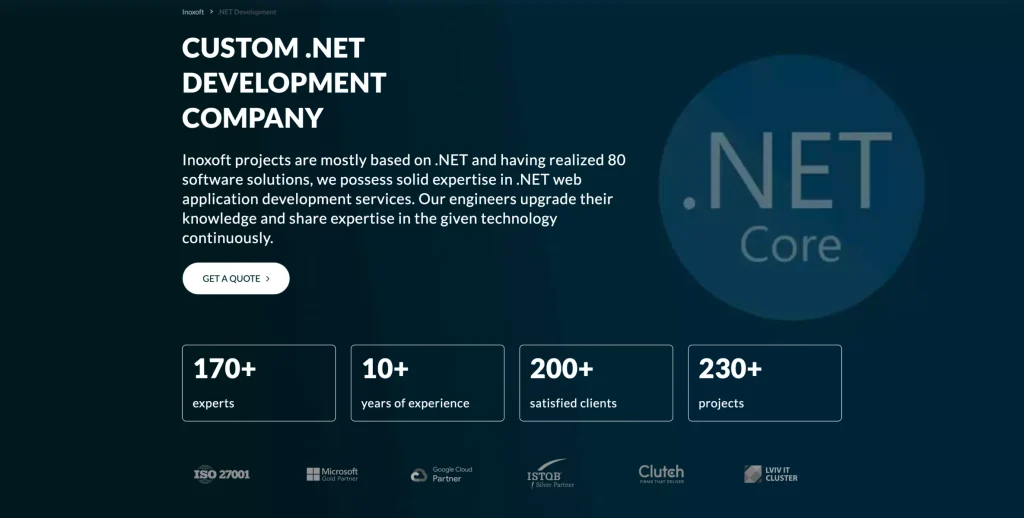
Inoxoft has been building software since 2014, with engineering in Lviv and a registered office in Philadelphia. Its Clutch profile carries 73 client reviews, the deepest review record of any company on this list, and one documented engagement runs to roughly $620,000 in client spend. Review volume matters more here than the score itself: it means the delivery record has been sampled by a lot of different buyers over nearly a decade rather than by a handful of friendly accounts.
The .NET picture needs one honest caveat. Inoxoft is a generalist, not a dedicated .NET development company. Its published technology stack leads with Python and JavaScript, and .NET sits alongside them rather than at the center. The company reports roughly 80 .NET projects out of more than 200 delivered overall, and Clutch has listed it among top .NET and web developers in Ukraine and Israel. The .NET capability is real; it is one practice among several rather than the house specialty.
Where Inoxoft fits best:
- ASP.NET Core web applications and API development for SMB and mid-market clients
- Legacy system migration to .NET
- Healthcare, education, fintech, logistics, and real estate platforms
- Dedicated team and extended team models, with Jira and Slack reporting
- Cloud services and DevOps automation
Worth knowing before you call them: reported headcount varies between 50 and 250 depending on which source you read, so confirm how many engineers would actually be free for your project. And if you need deep .NET architecture rather than delivery capacity, a Microsoft-focused shop will bring more to the table.
3. Softeq
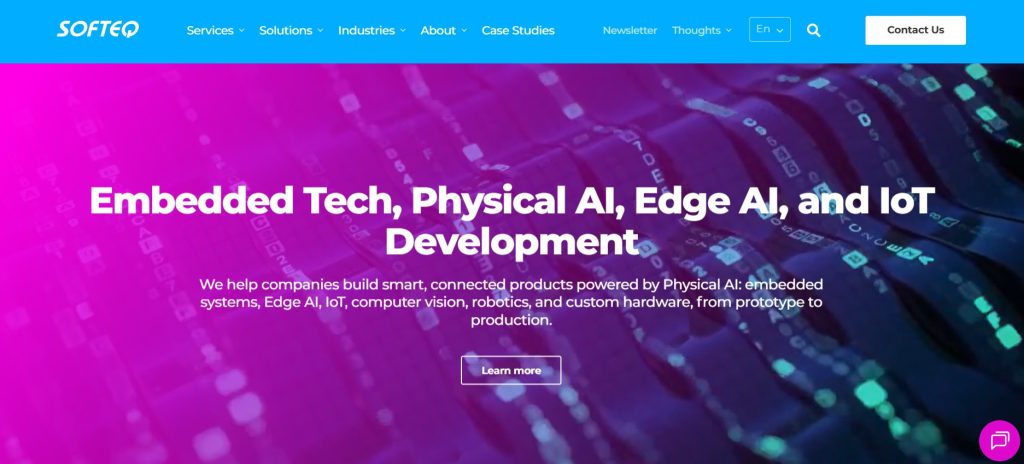
Softeq opened in Houston in 1997, and its first client was Compaq, for whom it built the Compaq PC Theater back when computers and television were first converging. That origin still shows in the work. Most .NET development companies grew up through business applications; Softeq grew up through devices, and its strongest .NET projects are the ones where software has to talk to hardware.
The company now runs around 400 engineers, with headquarters in Houston, sales offices in Los Angeles, London, and Munich, and development centers in Vilnius and Monterrey. Its custom .NET development work spans web systems, desktop software, BI and ERP platforms, enterprise portals, and IoT backends. One verified Clutch review walks through a .NET Core backend hosted on Azure, integrated with Office 365 and SharePoint, shipped alongside a cross-platform mobile client. As a .NET development company Softeq holds Microsoft partner status, and it has placed on the Inc. 5000 list.
Where Softeq fits best:
- Custom .NET development for connected products, where firmware, cloud, and application layers have to ship together
- ASP.NET Core web systems and APIs running on Azure
- Industrial and IoT platforms with data-heavy backends
- Enterprise portals, BI, and ERP on the Microsoft stack
- US-based account management paired with nearshore delivery from Mexico and Lithuania
Worth knowing before you call them: hardware and embedded engineering are still a large share of the business, and the pricing reflects a US headquarters. For a straightforward line-of-business .NET application with no device layer, you are likely buying capability you will never use.
4. Avanade
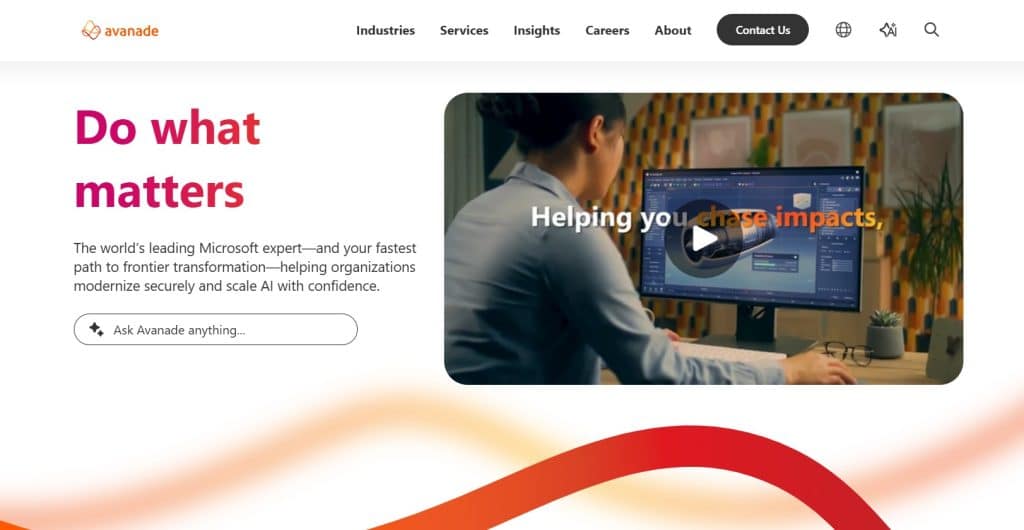
Avanade exists because Accenture and Microsoft built it to exist. The two founded it in April 2000 as a joint venture aimed squarely at Fortune 1000 companies running on Microsoft technology, with Accenture holding 51 percent and Microsoft 49. Accenture became majority owner in 2001. No other company on this list has that parentage.
The credential worth weighing here is repetition rather than any single award. Avanade and Accenture have been named Microsoft Global SI Partner of the Year twenty times, more than any other company, most recently in 2025. In 2022 the company reported more than 60,000 individual Microsoft certifications and all eighteen Gold-level Microsoft competencies then available. It now runs roughly 60,000 people across more than 90 offices in 26 countries, and reported revenue of $2 billion as far back as 2021.
Where Avanade fits best:
- Enterprise .NET and Azure programs where the application is one piece of a wider Microsoft transformation
- Dynamics 365 and Power Platform work running alongside custom .NET development
- Regulated industries that need governance, security, and audit trails at scale
- Multi-country rollouts requiring delivery across several time zones at once
- Organizations already committed to Microsoft as a strategic platform rather than a toolset
Worth knowing before you call them: this is a consulting firm, not a development shop, and pricing follows accordingly. Independent reviewers flag the engagement model as too expensive for small businesses. If you want a focused custom .NET development company rather than a transformation program, look further down this list.
5. N-iX
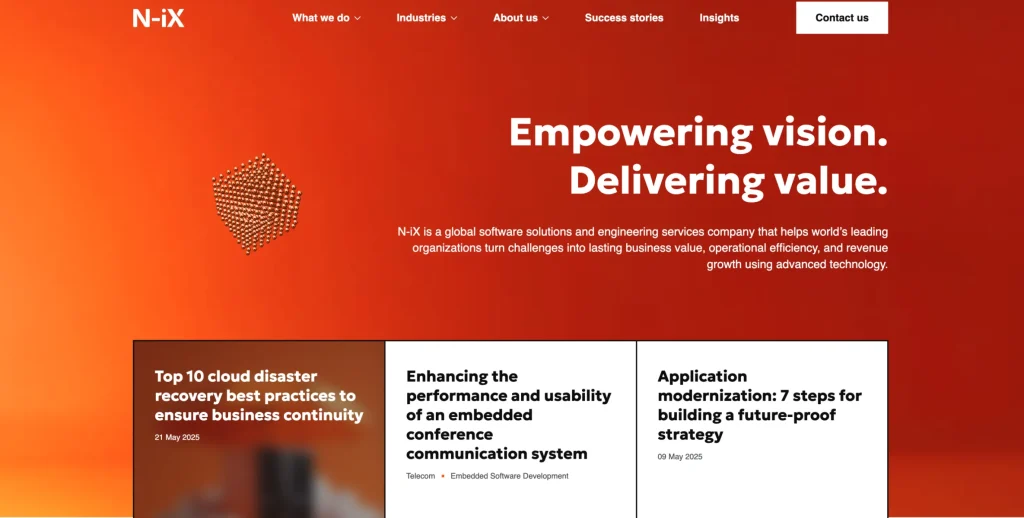
N-iX has been building software since 2002. Its legal headquarters sits in Valletta, Malta, while its primary engineering hub has historically been Lviv, and it now fields more than 2,400 engineers working across Europe, the Americas, and APAC. Gartner lists annual revenue in the $50 million to $250 million range. Clients named publicly include Bosch, Siemens, Inditex, OpenText, and Lebara.
For anyone evaluating N-iX as a .NET development company, the most useful evidence is a documented engagement rather than a headline number. A lending company describes N-iX building its back-office solution in .NET, starting in January 2019 and still running at the time of the review, with three to nine people on the account and six developers plus three QA engineers at peak. Spend fell between $200,000 and $500,000. That is a realistic picture of what a long .NET engagement with this company looks like.
Where N-iX fits best:
- Long-running .NET back-office and enterprise platforms where team size flexes over time
- Application modernization and cloud migration programs
- Financial services, manufacturing, supply chain, retail, and healthcare
- Fortune 500 and ISV clients that need multi-phase staffing
- Data platform engineering and AI work running alongside application development
Worth knowing before you call them: N-iX holds AWS Premier Tier Services Partner status, its strongest publicly documented cloud credential, so a Microsoft-first project sits among several stacks rather than at the house default, and a dedicated .NET development agency will bring more focus. Independent reviewers also note that its public Clutch review count, 35, is modest for a company of this size.
6. Binariks
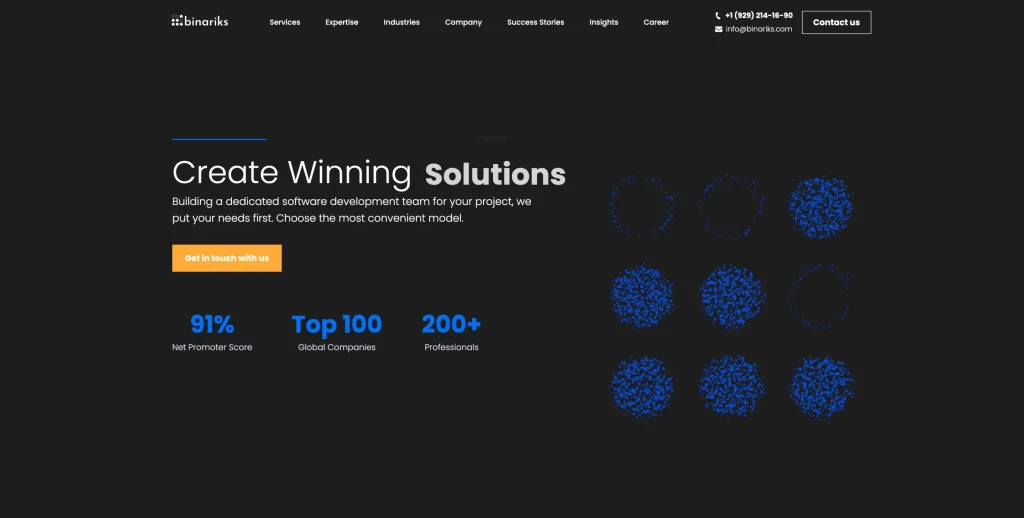
Binariks was founded in 2014 in Lviv, with branches in the United States and Canada and a team of over 200. Its Clutch profile carries 66 reviews, a minimum project size of $10,000, and a published rate band of $50 to $99 per hour. That is the clearest pricing signal any company on this list makes public, and it saves you a discovery call to find out whether you are in their range.
The real specialization here is regulated work. Binariks holds ISO 9001:2015 and ISO 27001:2013 certifications and builds around HIPAA, FDA, GxP, PCI DSS, and GDPR requirements in healthcare, pharma and life sciences, and insurance. One Clutch client, the CEO of a healthcare SaaS company, describes Binariks taking over a struggling project and bringing the platform to signing readiness within months.
Where Binariks fits best:
- Audit-ready platforms in healthcare, pharma, life sciences, and insurance
- Legacy modernization into cloud-native architecture that has to survive a compliance review
- Dedicated teams and staff augmentation, with rates published up front
- Smaller starting engagements, given the $10,000 minimum project size
- Work where certification and compliance discipline matter more than raw scale
Worth knowing before you call them: this is not primarily a .NET development company, and .NET is not their headline stack. Binariks is an AWS Select Consulting Partner, and the engagements documented publicly on Clutch run on AWS, Node.js, and React Native. he Microsoft partnership is real but far less evidenced than the AWS and compliance credentials, so weigh them against a .NET software development company with deeper Microsoft proof.
7. Cleveroad
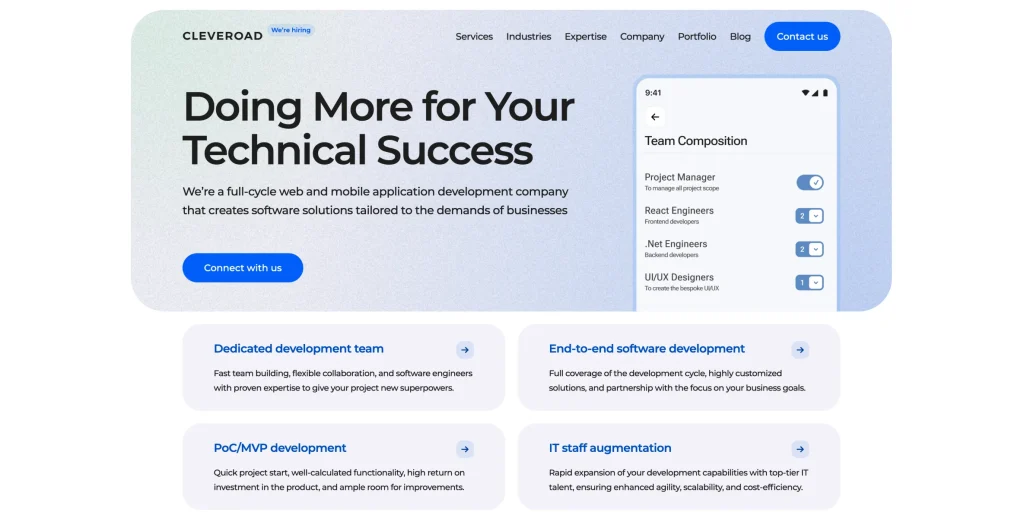
Cleveroad has been running since 2011, with headquarters in Tallinn, R&D operations in Dnipro and Kharkiv, and staff across five countries. Its Clutch profile carries 80 reviews, and the company made the Clutch 1000 for 2025, placing among the top 30 highest rated B2B providers out of more than 350,000 on the platform. No other mid-sized .NET development agency on this list holds a stronger independent ranking signal.
Pricing is the other thing Cleveroad publishes openly. Minimum project size is $10,000 and the stated band is $25 to $49 per hour, the lowest here, with most engagements landing between $50,000 and $200,000. Client size skews small, with the majority between one and 200 employees.
Documented delivery includes a HIPAA-compliant teledermatology platform that Cleveroad took over after a previous vendor failed to ship it, staff expansion for the fintech company Mangopay, and the replacement of manual workflows with automated processes for an education provider.
Where Cleveroad fits best:
- Budget-conscious custom .NET development company work for startups and SMBs
- Rescue projects that stalled with a previous vendor
- HIPAA-aware healthcare products
- Fintech, logistics, education, and eCommerce platforms
- Teams that need mobile and web shipped alongside the backend
Worth knowing before you call them: Cleveroad’s public case studies lean toward mobile and web rather than .NET specifically, so ask to see .NET Core work directly. The rate band also signals a different seniority mix than a Microsoft-focused .NET software development company charging twice as much.
8. DataArt
DataArt was founded in New York City in 1997 by Eugene Goland, who still runs it, and the firm remains headquartered at 475 Park Avenue South. It now spans 5,000 to 6,000 professionals across more than 40 locations in the US, the UK, Europe, Latin America, India, and the Middle East. Clients named publicly include Priceline, Ocado Technology, Legal & General, and Flutter Entertainment.
Its .NET credibility comes from client feedback rather than a services page. Clutch’s own summary of DataArt’s 26 reviews names .NET among the technologies clients single out for technical proficiency, alongside Java, Angular, and Elasticsearch. Reviewers return repeatedly to project management: organized processes, Jira and Confluence discipline, deadlines met. The company has made the Inc. 5000 list thirteen times.
Where DataArt fits best:
- Enterprise .NET platforms in finance, travel and hospitality, and media
- Healthcare and life sciences work that needs genuine domain depth
- Long-horizon engagements blending nearshore and offshore delivery across time zones
- Data, analytics, and AI platforms built alongside application development
- Buyers who want a US-headquartered .NET software development company with global reach
Worth knowing before you call them: reviewers flag pricing as less competitive than alternatives, particularly for Latin American delivery. DataArt is a generalist at scale rather than a Microsoft specialist, so .NET sits among several equally strong practices. If you want a .NET development company where Microsoft is the entire business, Avanade or Blackthorn Vision sit closer to that description.
9. ScienceSoft
ScienceSoft traces back to 1989, when the scientist Val Tsurikov founded the NILIM research cooperative that became the company. That makes it one of the longest continuously operating firms in this market. It is now headquartered in McKinney, Texas, with around 750 engineers, architects, and QA specialists working across the US, the EU, and the Gulf states.
The independent record is deep. Its Clutch rating sits at 4.8, it has appeared in the IAOP Global Outsourcing 100 every year from 2022 through 2025, and it has made the Financial Times list of the Americas’ fastest growing companies four years running, placing 200th of 300 in 2025. It holds ISO 9001, ISO 27001, and ISO 13485, the last of which covers medical device quality management and is rare among software vendors. Named clients include Walmart, IBM, NASA, Nestle, eBay, and Ford.
Where ScienceSoft fits best:
- Enterprise .NET software development company work in healthcare and financial services
- HIPAA-compliant systems: EHR integration, telemedicine, medical imaging, connected device software
- Banking, payments, lending automation, fraud detection, and regulatory reporting
- Buyers who need documented quality management more than a startup’s speed
- Long-lived systems where vendor stability outweighs novelty
Worth knowing before you call them: breadth is the trade-off. Across 30-plus industries and nearly every major platform, .NET is one practice among many rather than the defining one. Cost-saving percentages that circulate in vendor marketing are self-reported, so ask for the baseline and the methodology behind any figure quoted to you.
10. Sigma Software Group
Sigma Software began in 2002 in Kharkiv, founded by five friends: four developers and a lawyer. In 2006 the Scandinavian Sigma Group bought a stake, and the company still operates inside that group while keeping its Ukrainian engineering base. It now runs roughly 2,100 professionals across 40 offices in 19 countries, with more than 2,100 projects delivered. Clients named publicly include Volvo, Scania, Knorr-Bremse, AstraZeneca, Scandinavian Airlines, and Verizon Media.
The .NET evidence here is unusually specific. One Clutch client describes a cloud platform that collects data from the client’s own hardware, stores it, and analyzes it for their customers, built as a .NET application on Microsoft Azure with AI and IoT functionality. The engagement began in October 2021 and was still running at the time of review, with three developers and a project manager as the core team and close to $400,000 in spend.
Where Sigma Software fits best:
- Custom .NET development on Azure with an IoT or data-collection layer
- Automotive, aviation, AdTech, gaming, telecom, and fintech domains
- Buyers who want a European corporate structure behind a Ukrainian delivery team
- Engagements from $50,000 upward, which is the published minimum
- Work that needs ISO 9001:2015 and ISO 27001 certified processes
Worth knowing before you call them: reviewers name time zone friction as the recurring difficulty, so a US buyer should agree overlap hours before signing rather than after. Rates run $50 to $99 per hour, mid-range for a .NET development company of this size.
Why choose .NET for your project?
.NET is a free, open-source, cross-platform framework developed by Microsoft and designed to build scalable, modern applications. It has evolved significantly over the years and now supports multiple programming languages, including C#, F#, and Visual Basic. Below are the key reasons why .NET is a preferred choice for many businesses and developers.
Scalability and performance
.NET is built for throughput. Just-In-Time (JIT) compilation, native optimization, and asynchronous programming let applications use system resources efficiently and stay responsive under load. Kestrel, its cross-platform web server, is optimized for speed and outperforms traditional IIS in many configurations, and ASP.NET Core ranks among the top frameworks for raw performance in TechEmpower benchmarks.
Scaling out is equally well supported. .NET runs microservices architectures, so you can build modular, independently deployable services, and built-in support for containerization and horizontal scaling on Kubernetes or Azure App Services means your application can absorb traffic spikes and user growth without a rewrite.
Security features
Security matters most when you are handling sensitive user data or mission-critical business processes. .NET ships with security built into the framework rather than bolted on:
- Identity and access: claims-based identity, role-based security, and integration with OAuth, OpenID Connect, Active Directory, and Microsoft Entra ID.
- Data protection: the Data Protection API plus built-in encryption libraries for data at rest and in transit.
- Web attack surface: anti-forgery tokens, secure cookie handling, and X.509 certificate authentication.
- Standards alignment: coverage of the OWASP Top 10 and the controls most audits ask about.
- Patching: Microsoft continuously monitors and patches vulnerabilities, publishing detailed security advisories and Common Vulnerabilities and Exposures (CVEs).
Large and active community support
.NET is backed by Microsoft and supported by millions of developers worldwide. That ecosystem gives you extensive documentation, tutorials, open-source projects, and forums for troubleshooting: Microsoft Learn, Stack Overflow, Pluralsight, and conference talks from Microsoft Build and .NET Conf. The official .NET GitHub repository receives active contributions and issue tracking, the NuGet package manager hosts over 300,000 libraries, and the .NET Foundation fosters open-source development across the ecosystem. For your project, this means fewer problems you have to solve from scratch and a deeper hiring pool.
Versatility for various application types
.NET is not limited to a single type of application. One technology stack covers multiple platforms, which simplifies development, hiring, and long-term maintenance. With .NET you can build:
- Web applications and APIs: ASP.NET Core with MVC, Razor Pages, Minimal APIs, and gRPC.
- Interactive web UIs and SaaS platforms: Blazor Server and Blazor WebAssembly for native-like experiences in the browser.
- Mobile applications: .NET MAUI for cross-platform iOS and Android, plus cross-platform mobile backends.
- Desktop applications: Windows Presentation Foundation (WPF) and Windows Forms for rich Windows desktop applications.
- Cloud-native applications: serverless computing on Azure Functions, containerization, and microservices through integration with Microsoft Azure.
- Real-time, IoT, and AI/ML applications: SignalR for real-time communication, plus support for IoT devices and edge computing scenarios.
Integration capabilities within the Microsoft ecosystem
.NET is natively designed to integrate with Microsoft’s cloud and software stack, which cuts costs and integration work in Microsoft-centric environments. It works with Azure App Services, Azure SQL, Azure Functions, and Cosmos DB for hosting and scaling; with Microsoft Entra ID for SSO and access management; and with Microsoft 365 APIs for connecting to Outlook, Teams, and SharePoint. Power BI handles embedded analytics, SQL Server and Entity Framework Core handle data persistence, and Visual Studio covers development, debugging, and DevOps pipelines.
Key factors to evaluate when choosing a .NET development company
Selecting the right .NET development partner impacts your project’s budget, timeline, and long-term maintainability. Below are the essential factors to consider and detailed explanations to help you make an informed choice.
Technical expertise
A company’s technical proficiency is the foundation of quality .NET development. Look for depth across the ecosystem:
- .NET frameworks: ASP.NET Core, current .NET versions, Entity Framework Core for data access, Blazor for web UIs, and MAUI for mobile.
- Programming languages: strong skills in C#, F#, and VB.NET.
- Architecture: RESTful API development, microservices, asynchronous programming, and dependency injection for modular, maintainable systems.
- Cloud platforms: proven experience with Azure services (App Services, Functions, Cosmos DB, Azure DevOps) or AWS for cloud-native applications.
- DevOps and delivery: containerization with Docker, orchestration via Kubernetes, infrastructure-as-code, and CI/CD pipelines using Azure DevOps, Jenkins, or GitHub Actions.
- Security practices: secure coding standards, authentication and authorization protocols, and data encryption.
Ask about the certifications their developers hold and the ones the company holds. Microsoft Certified: Azure Developer Associate at the individual level and Microsoft Solutions Partner for Digital and App Innovation at the company level are both verifiable, unlike a claim of expertise on a website. Request technical case studies and ask how they keep pace with new .NET releases.
Industry experience
Domain expertise means the partner already understands your industry’s regulations, constraints, and user expectations, so you are not paying them to learn on your project. In practice this shows up as:
- Healthcare: knowledge of HIPAA compliance, patient data security, and interoperability standards.
- Finance: familiarity with PCI DSS, SOC 2, data privacy laws, and transaction security.
- Government and public sector: FedRAMP and GDPR requirements.
- Retail and e-commerce: payment gateways, inventory management, and customer engagement features.
- Manufacturing: IoT integration and supply chain workflows.
A company with relevant industry experience can anticipate pitfalls, reuse proven components, and keep you compliant, which reduces legal risk and audit costs. Examine their case studies and whitepapers for projects in your vertical specifically, not just adjacent ones.
Portfolio and case studies
Reviewing a company’s portfolio and case studies helps you evaluate:
- Project complexity: have they handled projects of similar size and technical demands?
- Technology stack: do they use current .NET versions and complementary technologies?
- Business impact: what measurable results did their solutions deliver, such as reduced page load time, improved user retention, or backend scalability gains?
- Problem-solving ability: how did they overcome technical or business challenges?
- Architecture and design quality: do system architecture decisions and UI/UX standards match your expectations?
Well-documented case studies include project goals, challenges, solutions, technologies used, timeline, and client outcomes. Portfolios that span multiple industries demonstrate adaptability, while depth in one vertical signals domain expertise. Firms typically publish these on their own site and on their Clutch profile, and the two should tell the same story.
Client testimonials and reviews
Verified client feedback is how you check a vendor’s claims against their delivery record. Review platforms such as Clutch, GoodFirms, G2, and LinkedIn let clients rate providers across categories that matter:
- Project management: do they manage scope, resources, and deadlines effectively?
- Communication: do they keep clients informed and engaged?
- Code quality: are deliverables bug-free, performant, and maintainable?
- Post-launch support: do they stay responsive after go-live?
Consistent high ratings, repeat clients, and long-term partnerships indicate a reliable vendor. Red flags include poor responsiveness, missed deadlines, and reviews that stay vague about what was actually built.
Communication and collaboration
Effective communication is vital for project success, especially with remote or offshore teams. Evaluate:
- Agile maturity: do they follow Scrum or Kanban, and do they provide sprint reports, burndown charts, demos, and stakeholder retrospectives?
- Transparency: do they provide clear project updates, and will you have direct access to developers as well as project managers?
- Responsiveness: how quickly do they reply to queries or issues?
- Tooling: Jira, Confluence, Microsoft Teams, or Slack for task tracking and communication.
- Cultural fit: do their working hours, English proficiency, and business culture align with yours?
Ask these as specific questions rather than general ones. “Do you use Jira?” gets a yes from everyone; “can you show me a sprint report from a comparable project?” does not.
Pricing and contract terms
Understanding pricing models and contract conditions helps you avoid surprises and manage your budget. Discuss:
- Pricing models: fixed price for well-defined projects with a clear scope, time and materials for evolving scope, and a dedicated team you hire exclusively for long-term engagements.
- Contract flexibility: the ability to scale team size, adjust timelines, or pivot scope, plus termination clauses and billing cycles.
- Change management: how change requests are priced and approved once the scope moves, which it will.
- Service levels and disputes: SLAs for response and uptime where relevant, plus a defined dispute resolution path before you need one.
- Intellectual property rights: confirm you fully own the code and deliverables.
- Confidentiality: non-disclosure agreements and data protection commitments. Scope inclusions: whether testing, documentation, code warranty, and post-launch support are part of the base package or billed separately.
Rates vary more by geography than by seniority, so the region you shortlist in sets your budget before any negotiation does:
| Region | Typical hourly rate |
|---|---|
| US and Western Europe | $100 to $150+ |
| Latin America | $35 to $70 |
| Eastern Europe (Ukraine, Poland) | $30 to $60 |
| India and Southeast Asia | $25 to $45 |
Treat these as market ranges, not quotes. Rates move with demand, and a figure at the bottom of a range usually means a junior-weighted team rather than a discount on the same team.
Location and time zone
Vendor geography affects cost, collaboration, and project velocity, so weigh it against how much real-time interaction your project needs:
- Onshore: same country, easiest communication, highest cost.
- Nearshore: nearby countries with overlapping working hours, balancing cost and collaboration. Eastern Europe suits EU clients, Latin America suits US clients.
- Offshore: distant countries with significant time differences, cost-effective but requiring more coordination.
Many vendors bridge the gap with overlapping working hours or a dedicated project manager. Factor in public holidays, cultural fit, and preferred communication styles as part of the decision, not after it.
Company’s development process
A mature software development life cycle (SDLC) ensures consistent delivery. Confirm the company’s stages: requirement gathering, UI/UX prototyping, architecture design, development (including code reviews and version control), QA (both manual and automated), CI/CD setup, and post-launch maintenance. Ask about tools used for each phase (GitHub, Jenkins, Selenium, Azure DevOps), frequency of deployments, and how they ensure compliance with security and performance standards.
Looking to power up your digital presence with .NET?
Let us elevate your project with reliable, scalable, and secure development.
The .NET company selection process: Key steps to take
Choosing the right .NET development company is a multi-step process that requires careful planning, research, and evaluation. Follow these steps to identify and select the best partner for your project’s needs.
Define your requirements
Start with a requirements document that gives you and every vendor the same shared understanding of the project. It should cover:
- Project goals: What business problem are you solving? What are the key objectives?
- Features and functionality: Define the core features, integrations, and user roles.
- Budget: Establish a realistic budget range considering development, testing, deployment, and maintenance.
- Timeline: Set expected milestones and final delivery dates.
This clarity is what lets vendors give you precise estimates instead of padded ones. If your team lacks the technical depth to define scope, consult an independent technical advisor before approaching companies.
Research providers
Use multiple sources to build a shortlist of .NET development companies:
- Directories and review sites: Platforms like Clutch and GoodFirms provide ratings, client reviews, and portfolios.
- Recommendations: Ask your professional network or industry contacts for referrals.
- Company websites: Explore service offerings, case studies, and technology stacks.
Prioritize vendors with recent ASP.NET projects of similar size and complexity to yours. A firm whose .NET work is five years old is selling you a different company than the one in the case study.
Evaluate expertise
Assess each shortlisted company’s technical skills and experience. Request technical documentation or conduct technical interviews to validate expertise.
- Technology stack: Confirm proficiency in C#, ASP.NET Core, Entity Framework, Azure, DevOps, and security best practices.
- Certifications: Look for Microsoft certifications such as Microsoft Certified: Azure Developer Associate or .NET Developer certifications.
- Industry experience: Prefer companies with experience in your domain to benefit from domain knowledge and compliance expertise.
- Development methodologies: Agile, Scrum, or Kanban adoption indicates flexibility and iterative delivery.
Contact and interview
Engage with the shortlisted companies to discuss your project in detail. Behavioral questions reveal how they handle challenges, conflicts, and scope changes mid-project.
- Technical questions: Inquire about their approach to architecture, scalability, security, and testing.
- Process questions: Understand their project management style, communication frequency, and tools used (e.g., Jira, Trello).
- Team composition: Ask about the experience and roles of the developers assigned to your project.
- Cultural fit: Evaluate language skills, time zone compatibility, and responsiveness.
Go beyond the conversation where you can. Ask for anonymized code repositories, public GitHub contributions, or documentation from past projects, then evaluate code structure, naming conventions, documentation quality, and security practices.
Request proposals
Send a request for proposal (RFP) to your top candidates, including your project brief, timelines, goals, and evaluation criteria. Ask each proposal to cover:
- Scope and deliverables: A clear description of what will be built.
- Timeline and milestones: Project phases and expected completion dates.
- Pricing models: Fixed price, time and materials, or dedicated team options.
- Support and maintenance: Post-launch services and warranties.
- Contract terms: IP ownership, confidentiality, and termination clauses.
Compare proposals on alignment with your goals, clarity, risk mitigation strategy, and evidence of success in similar engagements, not on headline price alone.
Pilot project
If possible, start with a small pilot or prototype, typically one to two sprints. A pilot lowers long-term risk by validating competence in real conditions before you commit to a full engagement:
- Validate technical skills: Observe coding standards, problem-solving, and testing rigour.
- Evaluate project management: Check adherence to timelines and transparency.
- Test collaboration: Assess communication, responsiveness, and quality of deliverables.
Make your choice
Weigh the shortlist against the four criteria groups above: business fit, technical fit, communication fit, and commercial terms. Rank them in that order rather than scoring them equally, because a vendor who understands your domain can learn your stack faster than a stack expert can learn your domain.
Then formalize. Put the pricing model, delivery scope, milestones, IP ownership, NDA, warranty, and support terms from pricing and contract terms into the contract itself, not into the proposal that the contract references.
After you sign: the first two weeks
Selection does not end at signature. Use the first two weeks to set up the things that are hard to add later.
- KPIs: velocity, defect rate, and UAT sign-off, agreed in writing so the first status report is not the first negotiation about what counts as done.
- Cadence: sprint reviews, demo schedule, and a project dashboard both sides can see.
- Escalation: a named contact on each side and an agreed path when a decision stalls.
Types of .NET development companies
.NET development agencies
These are mid-sized firms, typically 30 to 200 employees, that specialize in the Microsoft stack: ASP.NET Core, Azure, Blazor, and SQL Server. They offer end-to-end software development services from consulting and architecture through UI/UX, development, testing, deployment, and maintenance, with dedicated .NET developers, architects, QA engineers, and project managers on staff.
Key characteristics:
- Specialization: Agencies focus solely or primarily on .NET development, ensuring deep expertise in C#, ASP.NET Core, Entity Framework, Azure cloud services, microservices, and security standards.
- End-to-end services: From initial consulting, architecture design, UI/UX, development, testing, deployment, to post-launch support and maintenance.
- Agile and collaborative: Most agencies adopt Agile methodologies, providing iterative delivery, continuous feedback, and close client collaboration.
- Flexible team sizes: Agencies can scale teams up or down based on project needs, offering dedicated developers or full teams.
- Industry focus: Many agencies develop domain expertise in fintech, healthcare, e-commerce, or manufacturing, allowing them to deliver tailored solutions.
Advantages:
- High technical competence in .NET ecosystem.
- Strong project management and communication processes.
- Access to a pool of specialized developers and tools.
Ideal for:
- Companies seeking specialized .NET expertise.
- Projects requiring full lifecycle management.
- Startups and SMEs needing flexible, scalable teams.
These are mid-sized firms, typically 30–200 employees, that specialize in the Microsoft tech stack, including ASP.NET Core, Azure, Blazor, and SQL Server. They often operate in Agile or Scrum environments and offer flexible engagement models, and quick ramp-up times. Their lean structure allows personalized attention, efficient communication, and cost-effective delivery, making them ideal for startups, SMBs, and mid-market clients looking for full-cycle development.
Large-scale outsourcing companies
These companies employ hundreds to thousands of engineers across delivery centers in multiple countries. Alongside .NET, they offer Java, Python, mobile, cloud, AI, enterprise integration, DevOps, and IT consulting, which lets them solve problems that span several stacks at once.
Key characteristics:
- Multi-technology expertise: Besides .NET, they offer services in Java, Python, mobile, cloud, AI, and more, enabling cross-technology solutions.
- Large teams: Ability to allocate large teams quickly for fast ramp-up and parallel development streams.
- Global delivery models: Offices and development centers across various countries allow round-the-clock development and support.
- Robust processes: Mature project management, quality assurance, security compliance, and risk management frameworks.
- Industry verticals: Deep experience in regulated industries such as finance, healthcare, telecom, and government sectors.
Advantages:
- Capacity to handle complex, multi-year enterprise projects.
- Comprehensive service portfolio beyond just .NET.
- Strong governance and compliance capabilities.
Ideal for:
- Large corporations with extensive IT needs.
- Projects requiring integration across multiple platforms and technologies.
- Organizations needing stringent security and compliance adherence.
These companies employ hundreds to thousands of engineers across delivery centers in different countries They offer multi-stack capabilities, enterprise integration, DevOps, and IT consulting alongside ASP.NET. Their infrastructure supports multilingual capabilities, 24/7 delivery, and compliance with ISO 27001, SOC 2, and HIPAA standards. Although less agile, they are well-suited for high-budget, multi-year enterprise projects that require risk mitigation and scalability.
We have solutions for your business transformation
Want the best in .NET development? Hire our skilled developers!
Product development companies with .NET development services expertise
These companies build and maintain their own SaaS platforms or internal products on .NET and also sell custom development services. That dual role gives them embedded knowledge of long-term product evolution, DevOps, CI/CD, and user analytics.
Key characteristics:
- Product mindset: Focus on usability, scalability, and maintainability, learned from their own product development.
- Innovation-oriented: Often invest in R&D and emerging technologies like AI, machine learning, and IoT within .NET projects.
- Consultative approach: Provide strategic guidance on product roadmaps, feature prioritization, and go-to-market strategies.
- Full-cycle development: Expertise in continuous integration, delivery, and post-launch support.
Advantages:
- Deep understanding of product-market fit and user experience.
- Ability to foresee long-term technical challenges and scalability needs.
- Experience with rapid prototyping and iterative development.
Ideal for:
- Startups and businesses launching new software products.
- Companies wanting strategic partnership beyond coding.
- Projects requiring innovation and continuous evolution.
These companies build and maintain their own SaaS platforms or internal products using ASP.NET. They have embedded knowledge of long-term product evolution, DevOps, CI/CD, and user analytics, and are ideal for startups seeking a partner that shares ownership, provides technical strategy, and scales the product over time. The pitfall in working with such companies that use ASP.NET is that they might prioritize internal projects over service contracts.
Freelance .NET development teams/individuals
Freelancers and small freelance teams offer flexible, short-term engagements at lower hourly rates than agencies. They work directly with you, which speeds up decision-making but removes the layer of process an agency provides.
Key characteristics:
- Flexibility: Can be hired on-demand for specific tasks or short-term projects.
- Lower cost: Typically charge lower hourly rates than agencies or outsourcing firms.
- Direct communication: Clients work directly with the developers, allowing faster decision-making.
- Limited resources: May lack access to broader infrastructure, QA teams, or project management support.
- Variable reliability: Quality and availability can vary widely; risk of delays or lack of continuity if freelancers move on.
Advantages:
- Cost-efficient for small or well-defined projects.
- Agile and fast onboarding for short-term needs.
- Access to niche skills for specific tasks.
Limitations:
- Limited scalability for larger or complex projects.
- Potential lack of formal processes and quality assurance.
- There is a risk of knowledge loss if a freelancer leaves mid-project.
Ideal for:
- Early-stage startups testing ideas or building MVPs.
- Projects with limited scope and budget.
- Supplementing existing teams with specialized skills.
Freelancers offer flexible, short-term engagements for clients with constrained budgets or quick delivery needs. They are cost-efficient for MVPs, minor integrations, bug fixes, or UI refinements. Quality varies significantly, therefore consider conducting a technical interview, GitHub review, and trial task. Look at platforms like Upwork and Toptal to find freelance professionals.
Offshore and nearshore .NET development companies
This category includes companies in Ukraine, Poland, Argentina, Colombia, India, and Vietnam. What they cost: see the rate table above. Eastern Europe and Latin America sit in the $30 to $70 band depending on region and seniority. Many maintain ISO and Microsoft certifications and follow Agile methodologies.
Advantages:
- Cost-effective access to top .NET developers.
- Ability to scale teams quickly based on project demands.
- Access to specialized skills not readily available locally.
- Potential for 24/7 development cycles with distributed teams.
Limitations:
- Communication barriers due to language, culture, and time zone differences.
- Need for robust project management and collaboration tools.
- Risk of quality variation; requires careful vendor selection and oversight.
Ideal for:
- Companies looking to reduce development costs without sacrificing quality.
- Projects with flexible timelines and clear specifications.
- Organizations with experience managing distributed teams.
Bottom line
.NET is a powerful, secure, and versatile framework ideal for developing a wide range of applications. Choosing the right .NET development company is essential to fully leveraging these benefits. By considering technical expertise, industry experience, portfolio, communication, and pricing, you can select a partner who will deliver a high-quality product aligned with your business goals.
The companies listed above represent some of the best in the industry, each with proven track records and satisfied clients. Whether you need a specialized agency, a large .NET outsourcing partner, or a flexible freelance team, there is a .NET development company that fits your needs.
FAQ
Why should I choose a specialized .NET development company over a general software development firm?
What are the key skills and expertise I should look for in a .NET development team?
Look for proficiency in C#, ASP.NET Core, Entity Framework, Azure cloud services, microservices, DevOps, and security standards. Experience with Agile methodologies and industry-specific knowledge is also valuable.
How much does it typically cost to hire a .NET development company?
Costs vary widely based on project scope, complexity, company location, and engagement model. Hourly rates can range from $25 (offshore) to $150+ (onshore/US-based). Fixed-price projects depend on detailed requirements.
What are the different pricing models offered by .NET software development companies?
Fixed price — best for well-defined projects with a clear scope. Time and materials — flexible, suitable for evolving projects. Dedicated team, when you hire a team that works exclusively on your project. It is ideal for long-term engagements.
How do I know if a .NET development company has a good track record?
Check their portfolio, client testimonials, industry awards, and reviews on platforms like Clutch and GoodFirms. Also, ask for references and conduct interviews.
What is the importance of a portfolio when evaluating .NET companies?
A portfolio showcases the company’s experience, technical capabilities, and ability to deliver projects similar to yours. It helps you assess quality, innovation, and problem-solving skills, reducing the risk of project failure.
Why should I choose a specialized ASP.NET development company over a general software development firm?
Specialized ASP.NET firms possess domain-specific knowledge in Microsoft technologies, such as C#, .NET Core, Blazor, and Azure, that generalist companies may not posess. Their engineers are often certified by Microsoft, stay updated with the latest framework releases, and excel in optimizing performance, scalability, and security of .NET-based solutions. This specialization is particularly crucial for enterprise projects that require architectural precision and long-term maintainability.
What are the key skills and expertise to look for in a .NET development team?
Look for core expertise in ASP.NET Core, C#, Entity Framework Core, and API development. Teams should be proficient in containerization (Docker, Kubernetes), cloud infrastructure (Azure, AWS), asynchronous programming, and CI/CD pipelines. Knowledge of frontend technologies (Blazor and React) and testing frameworks (xUnit, NUnit, Selenium) also matters. Enterprise companies should also look for experience in DevOps, monitoring, and secure coding practices.
Is portfolio important when evaluating ASP.NET software development companies?
A detailed portfolio reveals a company’s technical breadth, problem-solving approach, and ability to deliver measurable outcomes. It should include system architecture overviews, user interfaces, integrations, and scalability solutions. Portfolios that span multiple industries demonstrate adaptability, while industry-specific experience may speak about domain expertise. It also helps evaluate if a vendor’s design and coding standards align with your expectations.
How can I determine if a company has a strong track record?
Look for independent reviews on platforms such as Clutch, GoodFirms, or The Manifest. Verify claims through client case studies, testimonials, and direct references. Certifications, such as ISO 27001 or Microsoft Solutions Partner status, validate quality and compliance. A mature portfolio, long-term client retention, and transparent communication processes are strong indicators of reliability.
How much does it cost to hire an ASP.NET developer?
Rates depend mostly on region: roughly $25 to $45 per hour in India and Southeast Asia, $30 to $60 in Eastern Europe, $35 to $70 in Latin America, and $100 to $150 or more in the US and Western Europe. Project complexity and team seniority move you within a band, rarely between bands.
You may also like
-
 October 14, 2026Read in 25 min.
Retail software development companies: 12 vetted partners for store, omnichannel, and supply chain tech
Compare 12 vetted retail software development companies for POS, omnichannel, and inventory builds. Independent review with costs and selection tips. -
 September 28, 2026Read in 19 min.
AI in supply chain: Use cases and implementation guide
What is AI in supply chain management? -
 September 21, 2026Read in 19 min.
AI in banking: Use cases, explainable AI, and how to deploy it in regulated environments
AI in banking: use cases, explainable AI and governance, generative AI, ROI, and how to deploy it in a regulated environment -
 September 8, 2026Read in 16 min.
The AI-Native SDLC: From Writing Software to Orchestrating It
An AI-native SDLC cuts delivery time by about half without loosening a single quality gate. See the three eras, the toolchain and the guardrails. -
 September 4, 2026Read in 36 min.
Custom software development cost: Real ranges, rate cards, and how to budget
How much custom software development costs. Explore real pricing ranges, hourly rates, key cost factors, hidden expenses, and budgeting tips. -
 September 2, 2026Read in 36 min.
Fitness app development companies: An independent shortlist
10 fitness app development companies compared on verified data, published pricing, and real client work. Only three have documented fitness delivery. -
 August 27, 2026Read in 36 min.
Top software development companies in the USA
Find the best US-based software developers. From AI to enterprise web apps, here are the top 30 software development companies in the USA you should hire in 2026. -
 August 19, 2026Read in 22 min.
Robotic Process Automation in healthcare: Definition, benefits, and real cases
From patient scheduling to claims processing: explore proven RPA use cases in healthcare, backed by real data, ROI benchmarks, and compliance guidance. -
 July 22, 2026Read in 21 min.
AI Use Cases: 25+ Real Enterprise Examples Across Industries
Most impactful AI use cases in business - from generative AI and agentic AI to predictive analytics. Real examples by industry with ROI data and implementation priorities. -
July 22, 2026Read in 17 min.
AI in manufacturing: How to implement, use cases and benefits
How artificial intelligence is transforming manufacturing - from predictive maintenance and quality control to supply chain optimization and digital twins. Real ROI data and implementation roadmap.