
A fitness app development company designs, builds, and maintains mobile and web products for workout tracking, nutrition management, wearable integration, live coaching, and gym or studio management. Some firms sell configurable white-label platforms, while others provide custom fitness app development services built around a specific brand and user base.
Fitness app development companies: An independent shortlist
 36 minutes read
Content
Ten fitness app development companies are compared below on data you can check yourself: Clutch review volume, published minimum project size, hourly rate bands, founding records, and named client work. No company paid to appear here. One of the ten is us, and that is disclosed openly rather than buried. Where a firm’s public record is thin or contradictory, we say so instead of filling the gap.
Most fitness apps do not fail on the idea. They fail on the things nobody scoped: the wearable that syncs cleanly in the demo and drops readings in production, the workout video that buffers mid-set on gym Wi-Fi, the HIPAA question legal raises in month four when the architecture is already frozen.
Choosing a fitness app development company is mostly an exercise in filtering out noise. Search results for this category are dominated by listicles published by development agencies that place themselves at position one. Those pages are marketing, not research, and the numbers in them tend to travel: one agency invents a performance metric for a competitor, three more copy it, and within a year the figure reads as established fact.
This guide takes the opposite approach. Every claim below is traced to a source you can open and check. Where a company’s own marketing makes a claim we could not verify independently, it is marked as self-reported. Where the public record is genuinely unclear, we say that too.
What fitness app development actually covers
Fitness app development is the design, engineering, and maintenance of mobile and web products that help people plan workouts, track activity, manage nutrition, and connect with coaches or communities. The category is wider than it looks from outside. A fitness app development company will typically work across some or all of the following:
| Product type | What it involves | Typical technical bottleneck |
|---|---|---|
| Workout and training apps | Exercise libraries, adaptive plans, progress logging | Data modelling for exercise variation and progression |
| Wearable and IoT integration | Apple HealthKit, Google Fit, Garmin, Fitbit, BLE devices | Delta sync, conflict resolution, background refresh limits |
| Gym and studio management | Booking, membership billing, class scheduling | Multi-tenant architecture and payment reconciliation |
| Nutrition and habit tracking | Food logging, macro tracking, streaks | Food database licensing and search performance |
| Live and on-demand video | Streaming for classes and virtual coaching | CDN cost, adaptive bitrate, concurrency |
| Corporate wellness and insurance-linked | Employer benefits and incentive programs | Integration with benefits or claims systems |
What separates fitness software development from general mobile work is that three constraints have to be solved together rather than in sequence. Real-time performance matters, because a heart-rate stream or a live leaderboard that lags reads as a broken product. Motivation-first UX matters, because the entire business case rests on daily return visits. And health-data compliance matters the moment the app touches anything that could be linked to a medical condition.
A generalist agency can ship a working app. Whether it holds up past month one usually comes down to decisions a generalist makes wrong the first time.
How we built this list
Transparency about method is the only thing that makes a list like this worth reading, so here is ours in full.
What we counted as evidence:
| Signal | Source | Why it matters |
|---|---|---|
| Review volume and rating | Clutch profile | Independently collected, some reviews verified by analyst phone interview |
| Minimum project size and hourly band | Clutch profile | Published by the firm, filters out budget mismatches early |
| Founding date and legal registration | BBB records, SEC filings, Wikipedia | Confirms longevity claims that are otherwise self-reported |
| Named client work | Company case studies, SEC filings, press coverage | Shows what the firm actually ships, not what it sells |
| Fitness-specific delivery | Clutch reviews, published case studies, industry reports | The difference between a fitness specialist and a generalist |
What we deliberately excluded. We did not repeat performance figures that appear only inside other agencies’ listicles. Several widely copied claims about firms on this list, including specific latency numbers, retention uplift percentages, and platform specialisations, trace back to a single competitor-published article with no source. Those claims are absent here.
We also excluded firms that publish competing listicles for this keyword, because ranking a direct publisher competitor in our own list would be a conflict we cannot resolve honestly.
One firm was cut late for a different reason. It maintains a dedicated fitness service line and a healthy Clutch review base, but public sources disagree on its founding year, its headquarters, and its team size by an order of magnitude, and we could not locate a registration record to settle it. A buyer cannot run due diligence on a company whose basic corporate facts are unstable, so we left it out rather than reprint figures we could not stand behind. Ten entries we can defend is more useful than eleven with a soft one at the end.
A note on our position, stated plainly. This article is published by Blackthorn Vision, and we appear in it at number three. You should factor that in when you read our entry.
Two things make that defensible rather than the usual self-promotion. First, the list is unordered. Nobody here is ranked first, and position three is a sequence number, not a score. Second, we applied the same evidence test to ourselves that we applied to everyone else, including the fitness delivery column in the table below, and we wrote a critical assessment of our own limitations in the same format as every other profile.
What we did not do is place ourselves at number one under a ranked heading, which is the pattern that dominates this category and the one buyers have learned to discount. If you would rather discount us anyway, the other nine entries stand on their own and the framework in the second half of this article works regardless of who wrote it.
A note on ratings drift. Clutch review counts and scores change weekly. Every figure below reflects the public record at the time of writing. Re-check any number before it influences a shortlist decision.
Comparison: fitness app development companies at a glance
| Company | HQ | Founded | Min. project | Hourly band | Documented fitness work |
|---|---|---|---|---|---|
| Coherent Solutions | Minneapolis, MN | 1995 | $50,000+ | $50-99 | Yes, Clutch-verified |
| Stormotion | Tallinn, Estonia | 2017 | $10,000+ | $50-99 | Yes, named clients |
| Blackthorn Vision Publisher of this article | Lviv, Ukraine | 2009 | $10,000+ | $50-99 | Yes, published case study |
| Appinventiv | Noida, India | 2015 | $50,000+ | $25-49 | Not independently confirmed |
| Yalantis | Warsaw, Poland | 2008 | $50,000+ | $50-99 | Fitness unconfirmed |
| Fueled | New York, NY | 2007 | $75,000+ | $150-199 | Not independently confirmed |
| WillowTree TELUS Digital | Charlottesville, VA | 2008 | Enterprise | Not published | Not independently confirmed |
| Cheesecake Labs | San Francisco and Florianópolis | 2013 | $50,000+ | $50-99 | Not independently confirmed |
| Zco Corporation | Nashua, NH | 1989 | $10,000+ | $25-49 | Not independently confirmed |
| Dom & Tom | New York, NY | 2009 | $75,000+ | $150-199 | Not independently confirmed |
Every figure in the review, minimum project, and hourly columns is taken from the company’s own published Clutch profile and changes over time. The companies are not ranked, and the numbering below is sequence only. The right fitness app development company for an enterprise wellness platform is rarely the right one for a boutique studio’s branded app, and a single ordering would hide that. Row three is the publisher of this article, flagged as such in the table so it is visible at a glance rather than discovered halfway down the page.
The 10 fitness app development companies
1. Coherent Solutions
Snapshot. Minneapolis, Minnesota. Founded 1995. Roughly 2,200 employees and US$127 million revenue as of the most recent public figures. Clutch: 30 reviews, minimum project $50,000, $50-99 per hour.
Coherent Solutions is the firm on this list with the clearest independent fitness credential, and it is worth explaining what that means in practice. Its Clutch profile carries a review from a VP of digital at a fitness franchise, conducted by a Clutch analyst over the phone, describing an engagement in which Coherent augmented the client’s in-house team on an iOS and Android build. That is not a case study written by the vendor. It is a third party describing the work, with an intermediary verifying the call happened.
The firm also publishes an annual Future of Fitness report, the 2026 edition of which was released in December 2025. Publishing sector research is a soft signal, but a firm that maintains a standing research artifact for one vertical is usually doing continuous work in it rather than treating it as an opportunistic case study.
Structurally, Coherent is an enterprise services organisation rather than a product boutique. Development runs from centres in Bulgaria, Lithuania, Romania, Moldova, Poland, and Mexico, with Minneapolis handling account management and consulting. It has been in business for thirty years, which means it has modernised platforms through more than one technology cycle. For a fitness franchise carrying years of technical debt, that is the relevant experience.
Best for: fitness franchises, multi-location gym operators, and connected fitness brands modernising an existing platform at scale.
Watch for: this is a large, process-driven organisation built for long engagements. A single MVP will get more focused attention from a leaner shop, and you should confirm which delivery centre and time zone your team will sit in.
2. Stormotion
Snapshot. Tallinn, Estonia. Founded 2017. Clutch: 17 reviews, minimum project $10,000, $50-99 per hour.
Stormotion has the most specific fitness portfolio here, and it is concentrated in one place: apps that talk to physical equipment. Its published client work includes Force USA, an Australian-American maker of all-in-one trainers, for which the firm states it built a cross-platform training app from scratch in four and a half months; STEPR, a stair-climbing machine for which it develops both an Android console app and a companion tracking app; and SportPlus. Adjacent wellness work includes Mindance, a German corporate mental health platform, and Caspar Health, a digital rehabilitation platform.
The technical centre of gravity is connectivity: Bluetooth Low Energy, telemetry from equipment, and sync with Apple Health and Google Fit. That is a genuinely different skill set from building a workout-tracking interface, and it is the deciding factor if your product includes hardware.
The published minimum project size of $10,000 is the lowest on this list by a wide margin, which makes Stormotion unusually accessible for a scoped first build or a companion app. The team is correspondingly small.
Best for: companion apps for connected fitness equipment, and any product where BLE or telemetry integration with a physical device is central.
Watch for: a small team suits a focused, well-scoped build. A programme with several parallel workstreams will stretch it. Review volume, at seventeen, is also the thinnest here, so ask for reference calls rather than relying on the aggregate score.

3. Blackthorn Vision
Snapshot. Lviv, Ukraine. Microsoft Solutions Partner. Clutch: 4.8 out of 5 from 24 verified reviews. Self-reported: 70-plus long-term engagements and 150-plus delivered projects. Minimum project size and hourly band not published.
Disclosure: we publish this article. Read the rest of this profile with that in mind.
Our fitness delivery is a home workout app with automatic progress adjustment, built cross-platform for a US startup founded by two fitness enthusiasts. The product runs an endurance assessment, generates a workout of the requested duration from the result, and then adapts the routine as the user’s fitness level changes. It logs progress across every exercise with complexity charts and tracks personal records. A discovery phase preceded development to test commercial viability before engineering started.
The wider engineering profile is Microsoft-stack and compliance-oriented: .NET back ends, Azure-native architecture, and applied machine learning for personalisation and analytics. The credential that matters most for a health-adjacent fitness build is that we have delivered FDA 510(k)-cleared diagnostic software for a healthcare client. That is a client project clearance rather than a certification we hold, but it means our team has shipped software through a regulatory review process rather than reading about one.
Best for: fitness and wellness products with a serious data or compliance dimension, particularly on the Microsoft stack, and adaptive or personalisation logic that needs real engineering rather than a rules table.
Watch for: three things, honestly. We publish this list, so weight our entry accordingly. We do not publish a minimum project size or hourly rate, which means you cannot filter us on budget the way you can filter most firms in the table above, and you should ask for both in the first call.
4. Appinventiv
Snapshot. Noida, India, with offices in New York, London, and Dubai. Founded 2015. Clutch: 90 reviews, minimum project $50,000, $25-49 per hour.
Appinventiv has the largest review base on this list and one of the lowest hourly bands, which is the trade most buyers are actually weighing when they consider an offshore fitness app development company. Its public client work spans consumer brands including IKEA, KFC, Adidas, Domino’s, and Pizza Hut, which tells you the firm is comfortable at consumer scale even if none of those engagements are fitness.
Team size is one of the places where the record does not settle. The company’s own recent profile puts it at 650-plus specialists, while third-party directories list it in the 1,001 to 2,000 band. Either way it is a large delivery organisation, and the practical implication is the same: the squad you get matters more than the headcount you are quoted.
We could not independently confirm a fitness-specific delivery. Ask for a live fitness or wellness app you can download and test.
Best for: consumer-scale mobile builds where cost efficiency is a primary constraint and you have the internal capacity to manage an offshore delivery relationship.
Watch for: Clutch’s own summary of the review base notes recurring mentions of delivery delays, project manager changes, and occasional miscommunication. Most were resolved, but it is a consistent enough pattern to raise in a discovery call rather than discover in month three.
5. Yalantis
Snapshot. Warsaw, Poland, with offices in the US and Cyprus. Founded 2008. Clutch: 76-79 reviews, minimum project $50,000, $50-99 per hour. Glassdoor: 4.3 out of 5 from around 49 employee reviews.
Yalantis positions itself as an engineering partner for complex digital products with a stated depth in IoT, and its verifiable health-adjacent work supports that. A Clutch-verified review from Duo Health, a risk-bearing medical group focused on kidney care, describes Yalantis building and deploying infrastructure to manage patient data and integrate with other vendors, with the client reporting several thousand patients processed through the system.
That is health-tech, not fitness, and the distinction matters. What it demonstrates is that the firm can handle sensitive personal health data inside a regulated context, which is the harder half of a connected-fitness build. The consumer engagement layer is a separate question you should probe directly.
The employee-side signal is worth noting for a different reason. Team continuity is the single most common failure mode in long outsourcing engagements, and a Glassdoor rating in the low fours with a high recommendation rate is a reasonable, if imperfect, proxy for whether the engineers assigned to you will still be there in year two.
Best for: fitness or wellness products that sit close to clinical data, and IoT-connected builds where the data pipeline is the hard part.
Watch for: clients note that initial estimates can drift. Push for a paid discovery phase with a fixed deliverable rather than accepting a headline number.
6. Fueled
Snapshot. New York, New York. Founded 2007. Reports 300-plus specialists. Clutch: 37 reviews, minimum project $75,000, $150-199 per hour.
Fueled is the most expensive firm here by published rate, and the client list explains why buyers pay it. Its public roster includes work for Apple, Microsoft, Disney, The New York Times, JetBlue, and Harvard, along with public-sector platforms for the White House and the Mayo Clinic, and early product work for Warby Parker. Reported project values on its Clutch profile run from roughly $36,000 to over $2 million.
The relevant question for a fitness buyer is whether design leadership is your primary constraint. If your product competes on brand experience, and the app is the brand rather than a utility attached to it, a firm operating at this tier is defensible. If your differentiator is wearable accuracy or backend throughput, you are paying a design premium for capability you could source cheaper.
We found no fitness-specific engagement in the public record. The Mayo Clinic work indicates comfort with health-sector requirements, but that is a different engagement type than a consumer fitness product.
Best for: design-led consumer brands with budget at the top of this range, where user experience is the competitive edge.
Watch for: at $150-199 per hour with a $75,000 floor, the total cost of an equivalent scope will run several times what an offshore firm on this list would quote. That is a positioning choice, not a flaw, but it should be a deliberate one.

7. WillowTree (TELUS Digital)
Snapshot. Charlottesville, Virginia. Founded 2008. More than 1,000 staff across 13 global studios. Acquired by TELUS International in a deal valued at US$1.225 billion, closed January 2023.
WillowTree is the one firm on this list whose numbers come from securities filings rather than a directory profile, which makes it the most rigorously documented entry here. TELUS International’s SEC filings describe a company with more than a thousand strategists, designers, engineers, and project managers across studios in the United States, Canada, Brazil, Portugal, Spain, Poland, and Romania, having shipped over 700 native applications and other digital products. Reported 2021 revenue was approximately US$140 million. Named clients include FOX, CBC, PepsiCo, Anheuser-Busch InBev, Synchrony, Manulife, and Marriott.
For a fitness brand already operating at scale, this is the profile of a partner that can run formal design research, multiple parallel workstreams, and enterprise security review without those becoming the bottleneck.
The acquisition is the thing to raise directly. A firm absorbed into a business of TELUS International’s size operates under a different commercial structure than it did as an independent studio, and account continuity through an integration of that scale is a fair question to ask rather than assume.
Best for: established consumer fitness or wellness brands that need enterprise-grade product strategy and design research, with procurement processes to match.
Watch for: confirm how the TELUS Digital structure affects your specific account team, escalation path, and pricing model before signing a multi-year engagement.
8. Cheesecake Labs
Snapshot. San Francisco, California and Florianópolis, Brazil. Founded 2013. Reports a 100-plus team and 300-plus products shipped. Clutch: 62-64 reviews, minimum project $50,000, $50-99 per hour. States SOC 2 and HIPAA compliance.
Cheesecake Labs’ distinguishing feature for a US buyer is structural rather than technical: it delivers from Brazil, which puts the engineering team within a few hours of US business hours rather than a full working day away. One client review on its Clutch profile cites exactly this as the deciding factor. For a fitness product in active iteration, where design and engineering need to talk daily rather than hand off overnight, that time-zone overlap is worth more than most feature checklists.
The firm was founded by engineers who worked on Uber’s early technology, and its published client list includes MoneyGram International, Mutual of Omaha, the Stellar Development Foundation, PepsiCo, Bemis, Tapcart, Singularity University, and Intelbras. Its stated SOC 2 and HIPAA compliance posture is directly relevant if your fitness app will handle data that crosses into health territory, though you should ask to see the current attestation rather than take the claim at face value.
No fitness engagement appears in the public record.
Best for: US-based fitness companies that want daily overlap with their engineering team without US agency rates, particularly where compliance posture matters.
Watch for: the firm’s current positioning leans heavily toward AI, data engineering, and legacy modernisation. Confirm that consumer mobile product work, and fitness specifically, is a live practice rather than a legacy one.
9. Zco Corporation
Snapshot. Nashua, New Hampshire, with offices in Boston and New York. Incorporated 14 July 1989. 250-999 staff. Clutch: 4.8 out of 5 from 58 reviews, minimum project $10,000, $25-49 per hour.
Zco has been writing software longer than any other firm here, and the BBB registration record confirms the 1989 founding rather than leaving it as a marketing claim. It reports more than 1,000 delivered software products, and its named clients include Volkswagen, Microsoft, and Verizon.
The genuinely unusual combination is a US-headquartered firm with a large in-house team at a $25-49 hourly band and a $10,000 minimum. For a buyer who needs a domestic contracting entity, US contract law, and Eastern-time working hours, but cannot absorb New York agency rates, that combination is rare enough to be worth a conversation on its own.
The firm also maintains an AR and VR practice, which is relevant if immersive or 3D workout content is on your roadmap.
Fitness is not a documented specialism. Zco is a broad generalist, and the fitness credentials attributed to it in other listicles do not appear in any source we could verify.
Best for: buyers who need a US-based vendor with a large in-house team and mid-market pricing, especially for cross-platform work or projects with a 3D component.
Watch for: ask specifically which recent projects the assigned team has shipped. In a firm with thirty-seven years of history and a wide service range, institutional tenure and squad-level relevant experience are not the same thing.
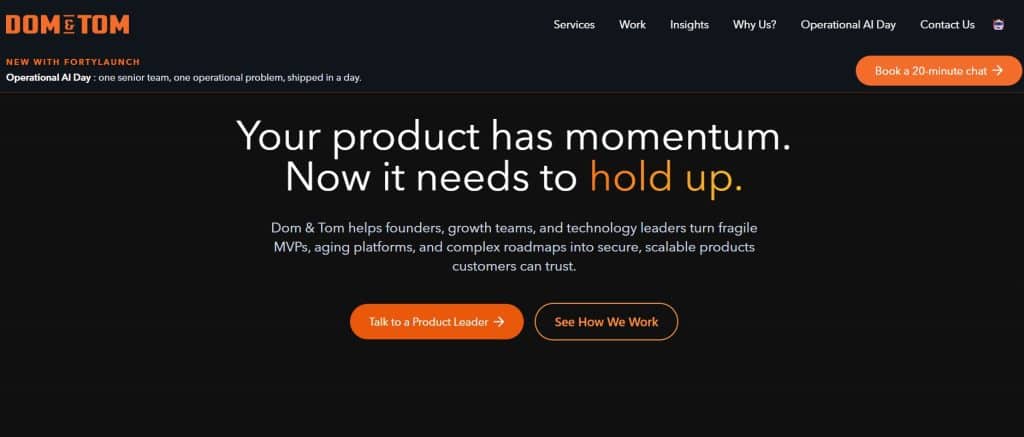
10. Dom & Tom
Snapshot. New York, New York, with a team in Chicago. Founded 2009. Approximately 80 employees. Clutch: 25 reviews, minimum project $75,000, $150-199 per hour. Clutch Global and Champion award winner, 2023.
Dom & Tom sits in an interesting position: US agency pricing with a team of around eighty people, which is small for that rate band. What you buy at that size is seniority and proximity to decision-makers rather than capacity. The firm reports more than 500 web projects and 120 native mobile applications delivered, and Clutch review data shows project values spanning roughly $10,000 to $1 million.
Reviews consistently describe responsiveness and flexibility on budget, with several turning into long-term engagements. For a fitness brand that wants a small senior team it can actually get on a call, rather than an account manager fronting an offshore squad, that profile fits.
We should correct something here. Several published listicles describe Dom & Tom as an Apple Watch and watchOS specialist. We could not find that claim in the firm’s own materials, its Clutch profile, or any independent source. Its public positioning is general digital product work across web, mobile, and AI. Treat the watchOS specialisation as unverified.
Best for: mid-sized fitness brands that want a small, senior, US-based team and are budgeting at agency rates.
Watch for: at roughly eighty people, capacity is finite. Confirm availability and team allocation before you build a roadmap around it.
Publisher disclosure and full credentials
This article is published by Blackthorn Vision, a custom software engineering company headquartered in Lviv, Ukraine. We are an AI-enabled product engineering partner built on deep Microsoft expertise, working primarily in regulated and data-intensive domains: healthcare, fintech, and B2B SaaS.
We appear in the list above at number three, and we have said so in the introduction, in the methodology, in the comparison table, and in our own profile. Nobody should reach this paragraph and be surprised.
Here is the full credential set, marked the same way we marked everyone else’s:
| Claim | Type |
|---|---|
| Microsoft Solutions Partner | Independently verifiable |
| 4.8 out of 5 on Clutch from 24 verified reviews | Independently verifiable |
| FDA 510(k)-cleared diagnostic software delivered for a healthcare client | Verifiable, client project clearance |
| 70-plus long-term engagements, 150-plus projects delivered | Self-reported |
| SaaS platform serving more than 250,000 users | Self-reported |
| DevOps rebuild that increased release frequency fifteenfold | Self-reported |
| Azure migration of a legacy Silverlight platform | Self-reported |
The same standard we apply to other firms applies here: the self-reported rows are our claims about our own work, and you are entitled to ask for a reference call before you accept any of them.
If you are evaluating fitness app development services and want a partner with a documented record in regulated, data-intensive software, we would be glad to talk. If you shortlist three of the other nine instead, this article has still done its job.
What full-scope fitness app development services include
If you are comparing proposals, it helps to know what a complete scope looks like so you can spot what has been quietly left out. Comprehensive fitness app development services usually cover:
- Discovery and product definition. Competitive review, feature prioritisation, and a technical architecture decision record. A fixed price quoted without this is a quote for a guess.
- UX and interaction design. Including the parts specific to fitness: one-handed operation mid-set, glanceable screens, and legibility under gym lighting.
- Mobile engineering. Native, cross-platform, or a hybrid split, depending on how much device-level access your feature set needs.
- Backend and data architecture. Time-series storage for workout and biometric data, which behaves differently from ordinary relational data.
- Wearable and third-party integration. HealthKit, Google Fit, and any device SDKs, plus the background sync and conflict-resolution logic behind them.
- Subscription and billing. Tiers, trials, family plans, and dunning. Churn management is often the largest single lever on revenue.
- Compliance engineering. Data classification, encryption, consent flows, retention policy, and audit logging.
- QA, including load testing. Fitness traffic is seasonal and spiky. Average-load testing tells you nothing about January.
- Post-launch support. Typically 15 to 20 percent of build cost per year, covering OS updates, SDK deprecations, and platform policy changes.
Any proposal missing items 4, 7, or 9 is either incomplete or has moved those costs somewhere you have not been shown yet.
Wearable and health data integration
This is where fitness mobile app development gets genuinely difficult, and where you should concentrate your technical due diligence.
| Integration | What it gives you | The part firms underestimate |
|---|---|---|
| Apple HealthKit | Read and write across the iOS health ecosystem | Granular permissions, background delivery limits, no server-side API |
| Google Fit and Health Connect | Android activity and body data | Platform migration and fragmentation across OEM implementations |
| Garmin, Fitbit, Polar | Device-specific metrics and training load | Separate developer agreements, rate limits, and per-vendor review |
| Bluetooth Low Energy | Direct connection to equipment and sensors | Reconnection logic, background execution, per-device protocol quirks |
| Aggregator APIs | One integration across many providers | Recurring cost, and a dependency you do not control |
Two questions separate firms with production wearable experience from firms with demo experience. First: how do you handle a device that reconnects after a dropout with conflicting readings? Second: what happens to background sync when the operating system suspends your app to save battery? Vague answers to either are a reliable signal.
Where fitness data becomes health data
Most fitness apps start outside healthcare regulation and drift into it without anyone noticing. The trigger is not the type of data but the context.
In the US, HIPAA applies when you are a covered entity or a business associate handling protected health information. A consumer workout tracker sold directly to users typically is not. The same app, sold through an employer wellness programme or integrated with an insurer, frequently is. In the EU, GDPR treats data concerning health as a special category requiring an explicit legal basis, and heart rate, sleep, and menstrual cycle data all qualify. Several US states now regulate consumer health data separately from HIPAA.
The practical implication for vendor selection is narrow and specific. Ask whether compliance is designed into the architecture or quoted as a phase after the contract is signed. Retrofitting encryption at rest, consent management, audit logging, and data retention into a shipped product costs several times what building it in would have, and the firms that quote it as a later phase are usually the ones who have never had to do it.
If your product sits closer to clinical use than consumer fitness, our guide to healthcare app development companies in the USA covers the firms working under those constraints.
What fitness app development costs
Treat these as planning ranges, not quotes. Cost is driven by feature depth, platform count, and whether health data brings compliance obligations into scope.
| Complexity | Typical timeline | Range | Fits |
|---|---|---|---|
| Basic tracker, calendar, step counting | 3-4 months | $30,000-$60,000 | Early-stage MVPs |
| Workout plans, video library, progress tracking | 5-7 months | $70,000-$120,000 | Boutique studios, single-brand launches |
| AI coaching, wearable sync, live classes, social | 8-12 months | $130,000-$250,000+ | Enterprise brands and scale-ups |
Three adjustments most estimates leave out. A second platform typically adds 30 to 50 percent rather than doubling the cost, since backend and design carry over. Annual maintenance runs 15 to 20 percent of build cost. And compliance engineering for a health-data product is usually a five-figure line item in its own right.
You can also sanity-check any quote against the published hourly bands in the comparison table above. A firm billing $25-49 per hour and a firm billing $150-199 per hour quoting the same total for the same scope are describing very different amounts of work.
How to evaluate a fitness app development company
Once you have a shortlist, the questions below separate firms quickly. Each is designed so a vague answer is itself informative.
Ask for live apps, not case studies. Request three fitness or health apps currently in the App Store or Google Play that the firm built. Download them. Read the recent reviews, which will tell you about sync reliability and crash frequency faster than any reference call.
Ask who is actually on your team. Request names, seniority, and current allocation. In a large delivery organisation, the difference between the pitch team and the delivery squad is the single most common source of disappointment.
Ask for retention numbers from past fitness work. Day 7, day 30, day 60. A firm that tracks these is building for engagement. A firm that cannot produce them built for launch day.
Ask about load testing. Fitness traffic spikes in January and around viral moments. Ask what load the app was tested against and what happened at the ceiling.
Ask about the offline path. Gyms have poor Wi-Fi and trails have no signal. A fitness app that cannot log a workout offline and reconcile it cleanly will generate its worst reviews on its busiest days.
Ask about compliance sequencing. Built in from sprint one, or quoted as a later phase. The answer tells you whether they have shipped a regulated product before.
For a broader view of mobile engineering partners beyond this vertical, our top mobile application development companies comparison covers generalist firms.
Red flags
- A fixed price with no discovery phase. It means the scope has been guessed at, and the gap will surface as a change request.
- Fitness listed among twenty industries with no named client. Breadth of industry claims is inversely correlated with depth in any one of them.
- Metrics with no attributable source. If a firm cites a performance figure, ask which engagement produced it and whether the client will confirm it.
- Reluctance to name the delivery entity. You should know which legal entity is signing, in which jurisdiction, before money moves.
- No named technical lead in the proposal. Someone senior has to own the architecture. If nobody is named, nobody owns it.
- Compliance quoted as a later phase. See above. This one is expensive.
FAQ
What does a fitness app development company do?
How do I verify a fitness app development company's credentials?
Check the Clutch profile for review volume and whether reviews were verified by analyst interview. Check business registration records for founding claims. For acquired or public companies, check securities filings. Then download three of the firm’s live apps and read the recent user reviews.
Why does the publisher of this list appear in it?
Because excluding ourselves would have removed one of only three entries with a publicly documented fitness delivery, and readers can weigh a disclosed conflict more easily than a hidden omission. The list is unordered, so position three is a sequence number rather than a score, and our profile carries the same critical assessment format as every other entry.
Can my fitness app integrate with Apple Watch, Fitbit, and Garmin?
Yes, through Apple HealthKit, Google Fit or Health Connect, vendor-specific developer programmes, or an aggregator API. Each route carries different costs and approval requirements. Ask any prospective partner for a live app you can install that demonstrates the specific integration you need.
What is the difference between fitness app developers and a general mobile agency?
Specialist fitness app developers have shipped production wearable integrations, handled background sync and conflict resolution, and worked under health-data constraints. A generalist agency can build a functioning app, but tends to discover those problems during your project rather than before it.
How long does it take to build a fitness app?
Three to twelve months in most cases. A basic tracker can reach the store in three to four months. A platform with wearable integration, live classes, and AI coaching typically needs eight to twelve.
Do I need HIPAA compliance for a fitness app?
Not always. HIPAA applies when you are a covered entity or a business associate handling protected health information. A consumer workout tracker sold directly to users usually is not, but the same app distributed through an employer wellness programme or integrated with an insurer often is. Confirm your specific position with legal counsel, and choose a health and fitness app development company that builds compliant infrastructure by default rather than as a later phase.
How much does it cost to build a fitness app?
Planning ranges run from roughly $30,000 for a basic tracker with scheduling to $250,000 and above for a platform with AI coaching, wearable sync, live classes, and social features. A second platform adds 30 to 50 percent, and annual maintenance runs 15 to 20 percent of build cost.
You may also like
-
 September 8, 2026Read in 16 min.
The AI-Native SDLC: From Writing Software to Orchestrating It
An AI-native SDLC cuts delivery time by about half without loosening a single quality gate. See the three eras, the toolchain and the guardrails. -
 September 4, 2026Read in 36 min.
Custom software development cost: Real ranges, rate cards, and how to budget
How much custom software development costs. Explore real pricing ranges, hourly rates, key cost factors, hidden expenses, and budgeting tips. -
 August 27, 2026Read in 36 min.
Top software development companies in the USA
Find the best US-based software developers. From AI to enterprise web apps, here are the top 30 software development companies in the USA you should hire in 2026. -
 August 19, 2026Read in 22 min.
Robotic Process Automation in healthcare: Definition, benefits, and real cases
From patient scheduling to claims processing: explore proven RPA use cases in healthcare, backed by real data, ROI benchmarks, and compliance guidance. -
July 16, 2026Read in 18 min.
Top 10 Banking Software Development Companies in the US
An independent, verified list of the top banking software development companies in the US, plus a practical guide to choosing the right partner -
 July 16, 2026Read in 17 min.
Custom ERP software for manufacturing – Built on Azure and .NET
Off-the-shelf ERP forcing workarounds? Blackthorn Vision, a manufacturing software company, builds ERP software for manufacturing on Azure and .NET. -
 June 30, 2026Read in 10 min.
Software development company in Boston: Custom solutions for a research-driven city
Boston software development company building HIPAA-aware healthcare, biotech, and enterprise software on .NET and Azure. Microsoft Solutions Partner, 4.8/5 on Clutch -
 June 18, 2026Read in 10 min.
Software Development Company in Washington State: Custom Solutions Across the Region
Software development company serving all of Washington State. Cloud-first custom software on .NET and Azure. Microsoft Solutions Partner since 2009. -
June 17, 2026Read in 12 min.
Software Development Company in Seattle: Cloud-First Custom Solutions
Seattle software development company building cloud-first custom software on .NET and Azure. Microsoft Solutions Partner trusted since 2009. Talk to us -
 June 11, 2026Read in 22 min.
Top 10 SEO Companies in the USA: An Honest, Research-Backed Guide
We compared 40+ professional SEO agencies on verified reviews, case studies, pricing, and AI search expertise — and ranked the top 10 with honest pros and cons.