













We use cookies to ensure we give you the best experience on our website. By clicking Agree you accept our Privacy and Cookies Policy.
Top 10 healthcare app development companies in the USA
 17 minutes read
Content
Choosing a healthcare app development company is not like hiring a vendor to build a food delivery app. If your developer ships a buggy checkout flow, you lose a sale. If they mishandle protected health information (PHI), you’re looking at HIPAA penalties of up to $2.1 million per violation category per year, an OCR investigation, and a breach notification letter going out to every affected patient.
That’s why this guide exists. Most top healthcare app developers lists are either pay-to-play directories or thinly disguised ads where the author ranks their own agency first. We took a different approach: we evaluated dozens of companies serving the US healthcare market against criteria that actually predict project success – verified healthcare portfolios, compliance engineering depth, interoperability experience (HL7/FHIR, EHR integrations), client retention, and pricing transparency.
Below you’ll find healthcare app development companies that came out on top, followed by everything else you need to make a confident decision: real cost benchmarks, a plain-English breakdown of US healthcare regulations, the questions that expose weak vendors, and answers to the questions founders and health system leaders ask us most often.
Quick comparison: Best healthcare app developers at a glance
| Company | Best for | Healthcare focus | Typical hourly rate | Team size | Engineering HQ |
|---|---|---|---|---|---|
| Blackthorn Vision | Custom healthcare software & AI-powered medical apps with senior engineering teams | High – dedicated healthcare practice | $40–70 | 100+ | Lviv, Ukraine (US/EU clients) |
| Topflight Apps | Regulated digital health products, FDA-adjacent apps | Very high – healthcare-first agency | $100–150 | 50–100 | Irvine, CA |
| Chop Dawg | Telemedicine MVPs and patient engagement apps | Medium-high | $100–150 | 50–100 | Philadelphia, PA |
| Designli | Non-technical founders building healthtech MVPs | Medium | $100–150 | 50–100 | Greenville, SC |
| Interexy | Fast-moving healthtech startups, AI + telehealth | High | $50–100 | 100+ | Miami, FL |
| MindSea | Patient-centered digital health & research apps | Very high – digital health only | $100–150 | 25–50 | Halifax, Canada (US clients) |
| Glorium Technologies | Healthcare startups needing end-to-end product teams | High | $50–100 | 100+ | Princeton, NJ |
| KMS Healthcare | Enterprise healthtech, EHR/interoperability projects | Very high – healthcare division | $50–100 | 500+ | Atlanta, GA |
| Orangesoft | Medical-grade and consumer health apps | High | $50–100 | 100+ | Distributed (US clients) |
| App Maisters | Enterprise health systems and device-connected apps | Medium | $50–100 | 100+ | Houston, TX |
How we evaluated these companies
Anyone can publish a list. Few explain how it was built. Here is the methodology behind ours, so you can judge whether our criteria match yours:
1. Verified healthcare portfolio. We only considered companies with multiple shipped healthcare products – telemedicine platforms, remote patient monitoring (RPM) systems, patient portals, clinical workflow tools, or medical device companion apps. A generic agency that built one fitness tracker didn’t qualify.
2. Compliance engineering, not compliance marketing. Every agency website says “HIPAA-compliant.” We looked for evidence of real compliance work: documented experience with HIPAA technical safeguards, SOC 2 practices, FDA Software as a Medical Device (SaMD) pathways, and accessibility standards (WCAG 2.1 AA, Section 508).
3. Interoperability experience. Healthcare apps rarely live in isolation. We prioritized teams with hands-on HL7 v2, FHIR R4, and EHR integration work (Epic, Cerner/Oracle Health, athenahealth), plus HealthKit and Google Health Connect for consumer-facing products.
4. Independent client feedback. We weighted verified reviews on Clutch, G2, and GoodFirms, looking specifically at long-term engagements and repeat clients – the strongest signal that a healthcare mobile app development company delivers beyond the sales pitch.
5. Engineering depth and stability. Company age, retention of senior engineers, and the ability to staff full product teams (product manager, UX, mobile, backend, QA, DevOps) rather than renting out individual freelancers.
6. Value for money. We didn’t rank by cheapest hourly rate. We ranked by what a dollar actually buys – senior engineering output, fewer rework cycles, and compliance done right the first time.
One note on transparency: this article is published by Blackthorn Vision, and we include ourselves in the list. We’ve kept our profile to the same format and the same standard of evidence as everyone else’s, and the other nine companies are here on merit – several of them compete with us directly.
The 10 best healthcare app development companies in the USA
1. Blackthorn Vision – Best for custom healthcare software with senior engineering teams
| Founded | 2009 |
| Headquarters | Lviv, Ukraine; offices in Warsaw and Wrocław, Poland |
| Team size | 100+ engineers |
| Hourly rate | $40–70 |
| Key clients/verticals | Healthcare, life sciences, fintech, energy, B2B SaaS |
| Recognition | Microsoft Solutions Partner |
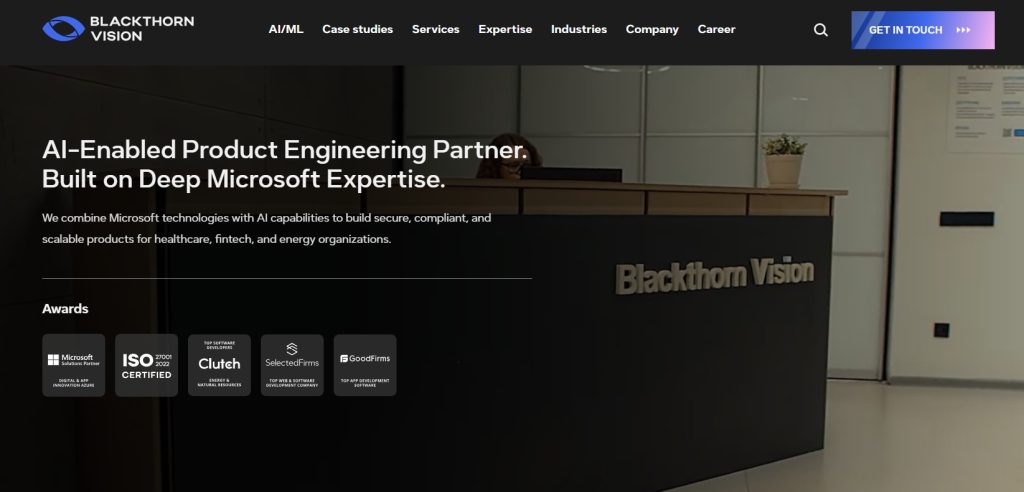
Blackthorn Vision is a custom software development company that has been building healthcare applications for US and European clients for over 15 years. While headquartered in Eastern Europe, the company operates on US time-zone overlap and serves a predominantly American client base – which is exactly why it earns a place on this list: it delivers US-grade healthcare engineering at roughly half the blended rate of a comparable onshore team.
The company’s healthcare practice covers the full spectrum of healthcare application development: telehealth and virtual care platforms, remote patient monitoring, medical imaging software, laboratory information systems, and AI-powered diagnostic tools. As a Microsoft Solutions Partner, Blackthorn Vision has deep expertise in the Azure ecosystem – a meaningful advantage for healthcare organizations already running on Microsoft infrastructure, since Azure offers a HIPAA Business Associate Agreement (BAA) and healthcare-specific services like Azure Health Data Services with native FHIR support.
Healthcare expertise:
- HIPAA-aligned architecture: encryption at rest and in transit, role-based access control, audit logging, and BAA-covered cloud infrastructure
- AI and machine learning for healthcare: medical image analysis, predictive analytics, clinical decision support, and LLM-powered features built with PHI safety in mind
- EHR/EMR integrations and healthcare data interoperability (HL7, FHIR)
- Medical device software and IoMT (Internet of Medical Things) connectivity
- Modernization of legacy healthcare systems without disrupting clinical workflows
Strengths: Senior-heavy teams with low rotation, strong .NET/Azure and AI engineering, transparent communication, and pricing that lets healthcare startups stretch their runway significantly further than with a US-based agency at $150+/hour.
What to consider: Blackthorn Vision is an engineering-led partner rather than a design-first boutique. If your project is primarily a branding and UX exploration with light development, a design studio may be a better first stop. For complex, regulated, long-running healthcare builds, this is precisely the profile you want.
2. Topflight Apps – Best for regulated digital health products
| Founded | 2016 |
| Headquarters | Irvine, California |
| Team size | 50–100 |
| Hourly rate | $100–150 |
| Key clients/verticals | Digital health startups, medical device companies, clinics |
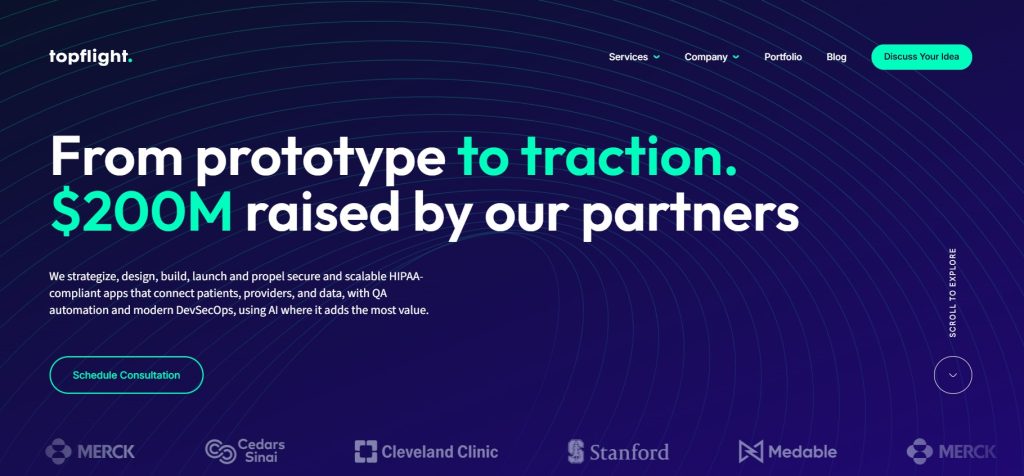
Topflight Apps is one of the few US agencies that can genuinely call itself healthcare-first: digital health makes up the majority of its portfolio, and the company has positioned itself around AI-powered healthcare development. The team has shipped telemedicine platforms, RPM solutions, and patient engagement apps, and publishes some of the most detailed healthcare app development content in the industry – a good signal that the expertise is real, not rented.
Healthcare expertise: Telehealth, remote patient monitoring, HIPAA compliance audits, AI integration into clinical workflows, and prototyping for digital health startups seeking FDA clearance pathways.
Strengths: Deep regulatory fluency, strong product strategy alongside development, and US-based communication for clients who want an onshore partner.
What to consider: Onshore rates mean a meaningfully higher total budget – a mid-complexity app that costs $120K–180K with a nearshore/offshore partner can run $250K+ here. For well-funded startups, the regulatory experience can justify it.
3. Chop Dawg – Best for telemedicine MVPs and patient engagement
| Founded | 2009 |
| Headquarters | Philadelphia, Pennsylvania |
| Team size | 50–100 |
| Hourly rate | $100–150 |
| Key clients/verticals | Health systems, universities, startups; partners include Jefferson Health and the University of Pennsylvania |
Chop Dawg has delivered over 500 apps and digital products since 2009, with a substantial healthcare segment: HIPAA-compliant telemedicine platforms, patient portals, medication management tools, and medical training software. Work with major health systems like Jefferson Health demonstrates the company can pass enterprise-grade security and procurement reviews – a bar many agencies never clear.
Healthcare expertise: Telehealth video visits, secure messaging, scheduling, Epic and other EHR integrations, wearables and health data connectivity, and role-based access architecture.
Strengths: Long operating history, fixed-budget proposals with free consultations, and proven enterprise healthcare references.
What to consider: Chop Dawg is a generalist agency with a strong healthcare wing rather than a pure healthcare shop. Ask specifically for the healthcare team’s case studies during evaluation.
4. Designli – Best for non-technical founders
| Founded | 2013 |
| Headquarters | Greenville, South Carolina |
| Team size | 50–100 |
| Hourly rate | $100–150 |
| Key clients/verticals | Healthtech founders, medical education, clinical operations |
Designli built its reputation helping non-technical founders get from idea to shipped product without losing their minds – or their budgets – along the way. Its signature “SolutionLab” process turns a vague concept into clickable prototypes and a detailed development plan before serious money is committed. In healthcare, that de-risking matters even more, because scope mistakes get expensive fast once compliance enters the picture.
A representative healthcare project is AskIris, a cross-platform app (Flutter, Angular, Node.js) that lets healthcare professionals find medical supplies by voice or text search, with low-stock alerts and inventory management – running on iOS, Android, Apple Watch, and Zebra enterprise devices used in hospitals.
Strengths: Exceptional discovery process, transparent fixed-scope phases, strong UX for clinical and operational users.
What to consider: Best suited to MVPs and mid-sized products. Very large, multi-year healthcare platform builds may need a partner with deeper bench strength.
5. Interexy – Best for fast-moving healthtech startups
| Founded | 2017 |
| Headquarters | Miami, Florida |
| Team size | 100+ |
| Hourly rate | $50–100 |
| Key clients/verticals | Telemedicine, patient engagement, mental health, AI healthtech |
Interexy is a Miami-based custom software company with healthcare as one of its strongest verticals. The team builds telemedicine platforms, patient engagement tools, and remote monitoring systems, and has leaned early into combining mobile development with AI, IoT, and blockchain where those technologies genuinely add value – not as buzzword decoration.
Healthcare expertise: HIPAA and HITECH compliance support, telemedicine and RPM platforms, EHR integrations, and healthcare IT consulting alongside delivery.
Strengths: Competitive blended rates for a US-headquartered firm, fast team assembly, and strong velocity for startups racing to market.
What to consider: Rapid growth since 2017 means project experience varies by team. Interview the actual engineers who will staff your project, not just the sales engineers.
6. MindSea – Best for patient-centered digital health and research apps
| Founded | 2007 |
| Headquarters | Halifax, Canada (serving US healthcare clients) |
| Team size | 25–50 |
| Hourly rate | $100–150 |
| Key clients/verticals | Hospitals, universities, healthtech startups, clinical research |
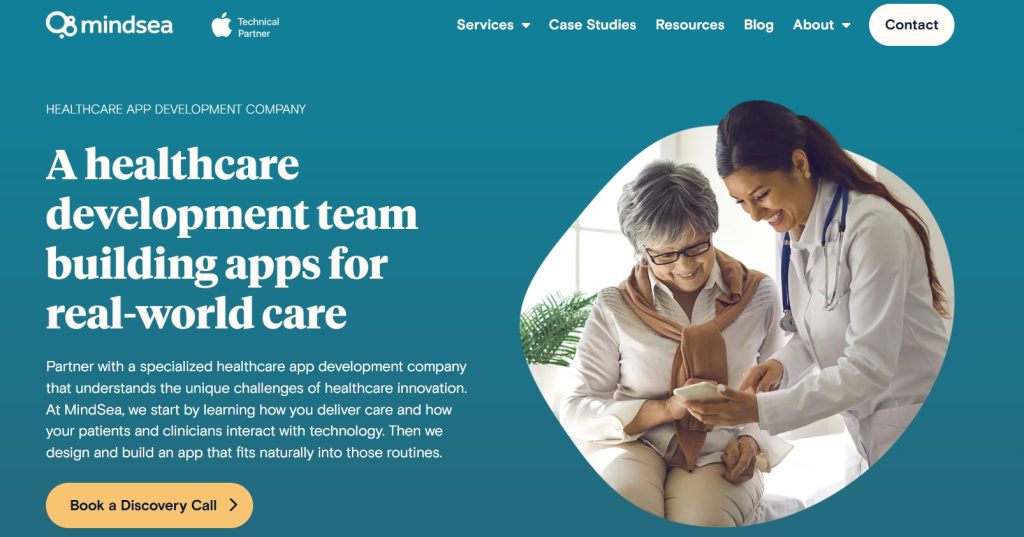
MindSea is a digital-health-only studio – a rarity in this market. The company works with hospitals, research universities, and healthtech teams on telemedicine platforms, remote patient monitoring, and research-grade applications, with a UX-first philosophy: healthcare apps fail not because the code is bad, but because patients and clinicians won’t use them.
Healthcare expertise: FHIR and HealthKit integrations, wearable and sensor connectivity, accessibility-focused design, and apps built for regulated clinical environments.
Strengths: Pure healthcare focus, exceptional patient-facing UX, and deep experience with research and academic stakeholders.
What to consider: A boutique team size means limited parallel capacity; book discovery early if your timeline is fixed. Canadian HQ is a non-issue for most US clients (same time zones, PHIPA/HIPAA fluency), but verify data residency requirements if your contracts demand US-only hosting.
7. Glorium Technologies – Best for end-to-end healthcare product teams
| Founded | 2010 |
| Headquarters | Princeton, New Jersey |
| Team size | 100+ |
| Hourly rate | $50–100 |
| Key clients/verticals | Healthcare startups, medtech, real estate tech |
Glorium Technologies is a New Jersey-headquartered company with delivery centers in Europe, and healthcare is one of its two flagship verticals. The company has helped launch dozens of healthcare products – from practice management and telehealth systems to medical device software – and is a consistent presence in independent rankings of healthcare software developers.
Healthcare expertise: HIPAA, FDA, and IEC 62304 (medical device software lifecycle) experience, EHR/EMR development, telehealth, and RPM solutions.
Strengths: A true end-to-end partner – discovery, regulatory consulting, development, and post-launch support – with hybrid US/EU pricing.
What to consider: As with any hybrid-delivery model, clarify which roles sit onshore versus offshore and how overlap hours are guaranteed.
8. KMS Healthcare – Best for enterprise healthtech and interoperability
| Founded | 2009 (KMS Technology; dedicated healthcare division) |
| Headquarters | Atlanta, Georgia |
| Team size | 500+ (group level) |
| Hourly rate | $50–100 |
| Key clients/verticals | Healthtech ISVs, payers, providers, health data companies |
KMS Healthcare is the healthcare-dedicated arm of KMS Technology, and it plays in a different weight class than most agencies on this list: large-scale product engineering for healthtech software vendors, payers, and providers. If your roadmap includes serious interoperability work – FHIR APIs, HL7 interface engines, TEFCA-era data exchange, EHR integration at scale – this is the kind of partner built for it.
Healthcare expertise: FHIR/HL7 interoperability, EHR integrations, healthcare data engineering, compliance-heavy enterprise development, and QA automation for clinical software.
Strengths: Enterprise scale, deep healthcare-specific engineering talent pool, and the process maturity that payer and provider procurement teams require.
What to consider: Enterprise focus cuts both ways – early-stage startups with a $75K budget will likely find better-fitting partners higher up this list.
9. Orangesoft – Best for medical-grade and consumer health apps
| Founded | 2011 |
| Headquarters | Distributed team serving US clients |
| Team size | 100+ |
| Hourly rate | $50–100 |
| Key clients/verticals | Digital health, femtech, virtual care; past clients include Philips and Flo |
Orangesoft has built 300+ custom projects, with healthcare as a signature vertical spanning both medical-grade and consumer-grade applications. A standout example: a HIPAA- and FDA-compliant MVP for a virtual hospital platform giving patients 24/7 access to specialists, with real-time access to medical history and connected device data.
Healthcare expertise: HIPAA, FDA, GDPR, and PCI DSS compliance; AI, IoMT, and AR/VR-powered health solutions; mobile-first product design.
Strengths: Strong consumer health UX pedigree (work with Flo speaks volumes), broad regulatory coverage, and competitive rates.
What to consider: A distributed-first team – make sure communication rhythms and overlap hours are contractually defined if your stakeholders expect frequent synchronous collaboration.
10. App Maisters – Best for enterprise health systems and device-connected apps
| Founded | 2012 |
| Headquarters | Houston, Texas |
| Team size | 100+ |
| Hourly rate | $50–100 |
| Key clients/verticals | Enterprise; brands include PepsiCo, ExxonMobil; healthcare device companies |
Houston-based App Maisters rounds out the list with a profile that’s especially relevant for medical device companies: among its healthcare work is a Windows tablet application that interfaces with a mechanical circulatory support system – an artificial heart pump – for patients with advanced heart failure. Software that talks to life-critical hardware demands a level of rigor most app shops never face.
Healthcare expertise: Medical device companion software, cross-platform health apps (Flutter, React Native, Xamarin), healthcare prototyping, and enterprise system integration.
Strengths: Enterprise client experience, device-integration depth, and Texas Medical Center proximity – useful for Houston’s enormous healthcare ecosystem.
What to consider: Healthcare is one vertical among several; vet the specific team’s clinical software experience during scoping.
How much does healthcare app development cost?
The honest answer: anywhere from $60,000 to $500,000+, and anyone who quotes you a number before discovery is guessing. But here are realistic benchmarks by product type, assuming a blended team and a market-rate partner:
| App type | Typical scope | Cost range | Timeline |
|---|---|---|---|
| Patient appointment & engagement app (MVP) | Booking, reminders, profiles, secure messaging | $60K–120K | 3–5 months |
| Telemedicine platform | Video visits, e-prescribing hooks, payments, provider dashboard | $120K–250K | 5–8 months |
| Remote patient monitoring (RPM) | Device/wearable integration, alerts, clinician dashboard, billing-code support | $150K–300K | 6–9 months |
| mHealth app with EHR integration | FHIR/HL7 interfaces, Epic/Cerner connectivity, audit logging | $180K–350K | 6–10 months |
| FDA-regulated SaMD product | Clinical-grade software, IEC 62304 documentation, validation | $300K–500K+ | 9–18 months |
What drives the price beyond features:
- Compliance engineering. HIPAA technical safeguards (encryption, access controls, audit trails, BAAs with every cloud vendor) typically add 15–25% to a build versus an unregulated app. Budget $10K–50K extra depending on depth.
- Interoperability. A single bidirectional Epic integration can cost more than the rest of your MVP. Scope EHR work as its own line item.
- Hourly rates by geography. US-based teams: $100–250/hour. Eastern European teams serving the US market: $40–90/hour. The 2–3x rate difference is why hybrid models (US-facing product leadership, European engineering) have become the default for cost-conscious healthcare startups.
- Post-launch reality. Plan 15–20% of the build cost annually for maintenance, OS updates, security patching, and compliance upkeep. A healthcare app is never “done” – regulations alone guarantee that.
US Healthcare compliance: What your development partner must know
This is where weak vendors get exposed. Use this section as a literacy test during sales calls.
HIPAA & HITECH. If your app creates, stores, or transmits PHI on behalf of a covered entity (provider, payer, clearinghouse), HIPAA applies. Your developer must implement the Security Rule’s technical safeguards – unique user authentication, automatic logoff, end-to-end encryption, tamper-evident audit logs – and your cloud provider must sign a Business Associate Agreement. AWS, Azure, and Google Cloud all offer BAAs, but only for specific services; an experienced healthcare application development company knows which ones.
FDA Software as a Medical Device (SaMD). If your app diagnoses, treats, or drives clinical decisions, it may be a medical device requiring FDA clearance (typically 510(k)) and development under IEC 62304. Wellness apps generally aren’t regulated – but the line is thinner than founders assume, especially with AI-driven features that interpret patient data.
21st Century Cures Act & information blocking. Modern US healthcare apps are expected to support patient data access via standardized FHIR APIs. If your product touches certified EHR data, your architecture must not “information block.” Practically, this means FHIR R4 fluency is now table stakes for any serious healthcare app developer.
Accessibility (WCAG 2.1 AA / Section 508). Healthcare users skew older, manage chronic conditions, and include people with visual, motor, and cognitive impairments. Accessibility lawsuits against healthcare organizations have climbed steadily, and federally funded entities have explicit obligations. Accessible design isn’t a nice-to-have; it’s risk management and basic decency in one.
SOC 2 and security posture. Enterprise healthcare buyers will send your product through vendor security review. A development partner who builds with SOC 2 Type II controls in mind from day one saves you a painful retrofit when your first hospital deal lands.
7 Questions that separate real healthcare developers from pretenders
- “Walk me through how you handle PHI in non-production environments.” (Right answer: de-identification or synthetic data – never raw PHI in staging.)
- “Which AWS/Azure services have you deployed under a BAA, and which did you avoid?” (Tests real cloud compliance experience.)
- “Show me a FHIR integration you’ve shipped. Which resources and which EHR?”
- “Has any product you built gone through a hospital’s vendor security review or an OCR audit? What broke?”
- “How do you decide whether a feature pushes an app into FDA SaMD territory?”
- “What’s your audit-logging architecture for a multi-tenant healthcare product?”
- “Who exactly will be on my team, and what healthcare products have they shipped?” (Agency-level case studies mean nothing if your team is new hires.)
Red flags: guaranteed app-store approval promises, “HIPAA-certified” claims (no such government certification exists – it’s a compliance posture, not a badge), refusal to sign a BAA themselves when they’ll handle PHI, fixed quotes delivered within 24 hours of first contact, and portfolios where every “healthcare” project is actually a fitness app.
Healthcare app development trends shaping
AI moves from chatbots to clinical workflow. Ambient clinical documentation (AI that drafts visit notes from conversation), intelligent triage, and LLM-powered patient communication are now mainstream feature requests. The differentiator is no longer “can you integrate an LLM” but “can you do it without leaking PHI into a model provider’s training data” – demand architecture answers, not demos.
Remote patient monitoring keeps compounding. With CMS reimbursement codes for RPM and chronic care management well established, providers have direct financial incentive to deploy monitoring apps. Device-integrated apps (continuous glucose monitors, blood pressure cuffs, cardiac wearables) are among the fastest-growing healthcare app development categories.
Interoperability is now a product feature, not plumbing. Patients increasingly expect their data to follow them. Apps built API-first on FHIR win enterprise deals that siloed competitors lose.
Hybrid care is the default model. Pure telehealth plays have consolidated; the winning products blend virtual visits, asynchronous messaging, in-person scheduling, and monitoring in one continuum – which raises the architectural bar for new entrants.
Cybersecurity scrutiny is intensifying. Healthcare remains the most-breached industry, with the average healthcare data breach costing more than in any other sector. Security review is moving earlier in every procurement cycle, rewarding development partners with mature DevSecOps practices.
Bottom line
The US healthcare app market rewards products that are clinically useful, genuinely secure, and ruthlessly easy to use – and punishes everything else with abandonment rates and audit findings. The companies on this list have earned their places by shipping healthcare software that survives contact with real patients, real clinicians, and real regulators.
If you’re weighing partners, start with two or three from this list whose “best for” profile matches your stage and budget, run them through the seven questions above, and insist on meeting the actual delivery team. The right healthcare app development company won’t just build what you ask for – it will tell you, early and honestly, where what you asked for would get you in trouble.
Ready to discuss your healthcare product? Blackthorn Vision offers a free technical consultation where our healthcare engineering team reviews your concept, flags compliance considerations, and gives you a realistic roadmap – no obligation, no sales theater.
You may also like
-
 September 2, 2026Read in 36 min.
Fitness app development companies: An independent shortlist
10 fitness app development companies compared on verified data, published pricing, and real client work. Only three have documented fitness delivery. -
 June 1, 2026Read in 21 min.
iOS App development companies: How to choose a partner that actually ships
Leading iOS app development companies serving the US market, with verified portfolios, real pricing ranges, and a framework to choose the right fit -
 May 28, 2026Read in 27 min.
Azure Consulting Services: Migrating and Optimizing on Microsoft’s Cloud
Azure consulting services explained: migration, data, AI, security, and cost optimization. Learn what they include, how engagements work, and how to choose the right partner -
 March 18, 2026Read in 11 min.
Choosing React Native app development company
Top 10 React Native App Development Companies reviewed — evaluation criteria, tech stack depth, delivery models, and how to choose the best partner for your cross-platform mobile project. -
 February 23, 2026Read in 12 min.
How to choose the best Android app development agency: Rankings & selection criteria
Compare the leading Android development companies. Our guide highlights the top 10 firms for enterprise architecture, security, and custom app engineering. -
 January 19, 2026Read in 18 min.
Top 10 desktop application development companies to watch
Compare the world’s best desktop development firms. From legacy modernization to high-performance C++ and cross-platform Electron apps, find your perfect vendor here. -
 September 19, 2025Read in 28 min.
Top 15 custom software development companies
Choosing a software development partner is a big decision. Read our expert guide to learn the right questions to ask and how to hire a firm that will bring your vision to life -
September 4, 2025Read in 14 min.
Top 10 leading application modernization companies
Top 10 application modernization companies that can transform your business with cloud, AI, and microservices for agility and growth -
June 23, 2025Read in 16 min.
.NET MAUI vs Flutter: Full comparison, performance, and use cases
Compare .NET MAUI vs Flutter on performance, UI rendering, community, AI integration, and enterprise fit. Expert guide by Blackthorn Vision’s mobile team. -
March 20, 2025Read in 7 min.
How to migrate Xamarin to MAUI: A step-by-step guide
How to migrate Xamarin to MAUI with our comprehensive guide. Simplify your transition and enhance your app development process.