
A focused MVP typically takes around three to four months from discovery to App Store launch, while a medium-complexity product often runs five to eight months. Enterprise apps with heavy integrations, compliance requirements, or AI features can extend well beyond that. Timelines depend less on the vendor’s promises and more on how clearly scope is defined before development starts – ambiguity, not engineering, is what usually slips schedules.
iOS App development companies: How to choose a partner that actually ships

 21 minutes read
Content
Search for an iOS app development company and you will be buried in directories, each listing hundreds of “top-rated” firms with near-identical promises. Award badges, five-star ratings, “award-winning” taglines – every profile reads the same. That uniformity is the real problem. The hard part of building an iPhone or iPad app was never finding a vendor; it is telling a genuine engineering partner apart from a polished sales page.
This guide is built to solve that. Instead of another ranked list you scroll past, it gives you the context a buyer actually needs: why Apple’s platform commands a premium audience, what modern iOS engineering involves under the hood, how to weigh native against cross-platform, what an honest budget looks like, and the exact questions that separate a capable studio from an expensive one. By the end, you should be able to read any shortlist – including the one further down this page – with a sharper, more skeptical eye.
The iOS app development companies worth a closer look
The shortlist below applies the same lens used throughout this guide: real shipped work over slogans, genuine iOS specialization over generalist claims, and an honest sense of who each partner actually fits. The companies span the full range a buyer in the United States might realistically consider – from boutique product studios to enterprise engineering firms, and from onshore agencies to cost-efficient nearshore and offshore teams. Use the table for a quick orientation, then read the profiles for the detail that matters when you are narrowing a decision.
| Company | Headquarters | Known for / best fit | Notable clients or work |
|---|---|---|---|
| Blackthorn Vision | Lviv, Ukraine (offices in Poland) | Engineering-led custom development and dedicated teams for regulated, product-heavy software | ANC, unTill, Selux, Recnice, CapTable, WysePower |
| WillowTree | Charlottesville, VA, USA | Enterprise-scale digital products for Fortune 500 brands | T-Mobile, Marriott, PepsiCo, FOX Sports, Domino’s |
| Appinventiv | Noida, India | High-volume consumer and enterprise apps for global brands | Adidas, IKEA, KFC, Domino’s |
| Fueled | New York, NY, USA | Premium, design-forward consumer apps | Verizon, MGM Resorts, 9GAG |
| Intellectsoft | Palo Alto, CA, USA | Enterprise digital transformation and integrations | Jaguar Land Rover, Universal Pictures, Harley-Davidson |
| ScienceSoft | McKinney, TX, USA | Compliance-heavy healthcare and fintech engineering | Award-winning mobile banking, healthcare platforms |
| Mercury Development | Florida, USA | Long-horizon multi-platform and wearable products | Dow, Kensington; Apple-featured iOS/watchOS apps |
| TechAhead | Los Angeles, CA, USA (+ India) | Blended onshore-offshore delivery for enterprises | American Express, Audi, Disney, AXA, ESPN |
| ArcTouch | San Francisco, CA, USA | Connected/IoT apps and accessibility | 3M, Audi, CBS, NBC, Tile |
| Cleveroad | Tallinn, Estonia (+ US) | Cost-efficient full-cycle development for SMBs and startups | Nordic video-streaming platform, fintech apps |
Blackthorn Vision
Blackthorn Vision is an engineering-led iOS app development company built around deep custom-software expertise rather than templated app production. With more than 15 years in the market, a team of over 100 engineers, and a Microsoft Solutions Partner pedigree, it is strongest where the hard part is the software itself – performance-critical systems, complex integrations, and products in regulated sectors. Its public portfolio reflects that depth: SciChart, a high-performance cross-platform charting library that renders millions of real-time data points, and engineering platforms for the energy and oil-and-gas industries.
On Apple’s platform, the team works in native Swift and Objective-C, complemented by cross-platform options and a mature AI/ML development practice. That combination suits fintech, healthcare, media, and industrial clients who need iPhone application development services tied into serious back-end engineering, not just a polished front end. Headquartered in Lviv with a presence in Poland, it offers nearshore cost efficiency for US and European clients, with explicit IP-ownership and NDA guarantees and both full-cycle delivery and dedicated-team models.
Best fit: product companies and enterprises that value engineering rigor, long-term partnership, and data-intensive or regulated software over high-volume consumer app churn.
WillowTree
WillowTree is one of the most recognized names in US app development and now operates as part of TELUS Digital. For over 15 years it has built a reputation as a premium digital product consultancy, and its client roster reads like a Fortune 500 directory: T-Mobile, Marriott, PepsiCo, FOX Sports, Synchrony, Domino’s, and National Geographic among them. This is an enterprise-grade iPhone app development company, not a budget option.
Its strength is end-to-end product work – strategy, design, full-stack engineering, and growth – delivered by large, multidisciplinary teams that can take a complex brand experience from concept to App Store and keep iterating after launch. The design pedigree is real, and the firm has the scale to staff demanding, long-running programs across iOS and Android simultaneously. That scale is also the trade-off: WillowTree is oriented toward substantial budgets and established organizations, so early-stage founders with a lean MVP will likely find it priced above their needs.
Best fit: large brands and enterprises that want a single, accountable partner for a high-visibility consumer or customer-facing app and have the budget to match the ambition.
Appinventiv
Appinventiv is a high-volume product company that has scaled rapidly into one of the better-known global names in mobile. Operating for over a decade with a large engineering organization, it has shipped well over a thousand apps and worked with blue-chip brands including Adidas, IKEA, KFC, and Domino’s. For buyers who want a partner that has clearly done this at scale, that track record is reassuring.
The firm provides full iOS application development services across consumer and enterprise contexts, pairing native iOS work with cross-platform delivery, plus strong design, QA, and increasingly AI-driven capabilities. Its sweet spot is feature-rich, market-facing apps that need to launch quickly and scale to large user bases. Because it is headquartered in India with a footprint in the US and beyond, it blends competitive rates with the capacity to handle ambitious scope – appealing to both funded startups and enterprises optimizing budget. The flip side of working with a large, fast-moving studio is that engagement quality can hinge on which team you are assigned, so it is worth confirming who will actually own your build.
Best fit: brands and scale-ups that need a proven, high-capacity partner for a consumer app with an aggressive timeline.
Fueled
Fueled is a New York studio that has built its name on premium, design-forward consumer apps. For more than 15 years it has produced polished products for the likes of Verizon, MGM Resorts, and 9GAG, and it has earned Apple recognition – including App of the Year honors – that genuinely signals craft on the platform. If the bar for your product is a flawless, delightful iOS experience, Fueled is the kind of iPhone app development company that clears it.
The team’s identity is rooted in product design and user experience, backed by native engineering and lifecycle support from concept through growth. That makes it especially strong for direct-to-consumer brands and venture-backed startups where the interface is the product and first impressions decide retention. As a boutique US agency with a heavy design emphasis, its pricing sits at the higher end, and it is a better match for products where experience quality is the priority than for commodity utility apps where cost is the deciding factor.
Best fit: consumer brands and funded startups that treat design excellence as a competitive advantage and want iPhone app developers with a demonstrable taste level.
Intellectsoft
Intellectsoft is an enterprise-focused iOS development company headquartered in Palo Alto, with a delivery footprint across several countries. Operating for over 15 years, it has delivered hundreds of enterprise projects for demanding clients including Jaguar Land Rover, Universal Pictures, Harley-Davidson, and EY. A representative example is JRL Talk, a multilingual iPad app it built for Jaguar Land Rover that enables real-time conference calls across more than a dozen languages – a useful signal of genuine iPad app development company experience, not just phone-screen work.
The firm’s positioning is digital transformation: integrating mobile app development service into existing enterprise systems, cloud infrastructure, and emerging technologies such as blockchain and AI. It combines native and hybrid mobile expertise with dedicated QA and Agile delivery, which fits organizations that need an app to plug into complex internal processes rather than stand alone. As with most enterprise consultancies, it is calibrated for mid-size and larger budgets and structured engagements.
Best fit: established enterprises that need a mobile product tightly integrated with back-office systems and a partner comfortable in regulated, process-heavy environments.
ScienceSoft
ScienceSoft is a Texas-headquartered IT consultancy with an unusually long track record – more than three decades in software and a workforce of over 750 – and a reputation built on engineering discipline in compliance-heavy domains. Its mobile portfolio includes award-winning banking apps and numerous healthcare solutions, and its case studies are refreshingly specific about stacks, naming Swift, RxSwift, and modern tooling rather than hiding behind marketing language.
This is a strong choice for iOS app development services where security, regulatory compliance, and reliability outrank flash – think HIPAA-aligned health apps, fintech, and insurance. ScienceSoft offers both full-cycle development and team augmentation, so it can either own a project end to end or slot senior iPhone app developers into an existing team, a flexibility that larger product agencies often lack. Its consulting-led, methodical style is a great match for risk-averse buyers and a less natural fit for those wanting a scrappy, design-first consumer launch.
Best fit: healthcare, fintech, and enterprise clients who prioritize compliance, documentation, and engineering rigor, and value a US headquarters with global delivery.
Mercury Development
Mercury Development is a Florida-based iOS mobile app development company that has been building for the Apple ecosystem since the earliest days of the App Store. Over more than two decades it has delivered thousands of projects, reportedly reaching tens of millions of users, for clients ranging from startups to Fortune 500s such as Dow and Kensington. Several of its iOS and watchOS apps have been featured by Apple, which is a meaningful third-party endorsement of platform quality.
The firm’s distinguishing trait is multi-platform and long-horizon engineering: native iOS and Android, cross-platform via .NET MAUI, Flutter and React Native, plus wearables, IoT, and connected-device work, all from full-time in-house teams rather than rotating contractors. That makes it well suited to products expected to live across phone, tablet, and watch, or to evolve over many years with a stable partner. With deep experience and a US base, it leans toward considered, durable builds rather than the cheapest possible MVP.
Best fit: companies planning a multi-device or wearable product, or a long-term roadmap that benefits from a partner with institutional memory and Apple ecosystem depth.
TechAhead
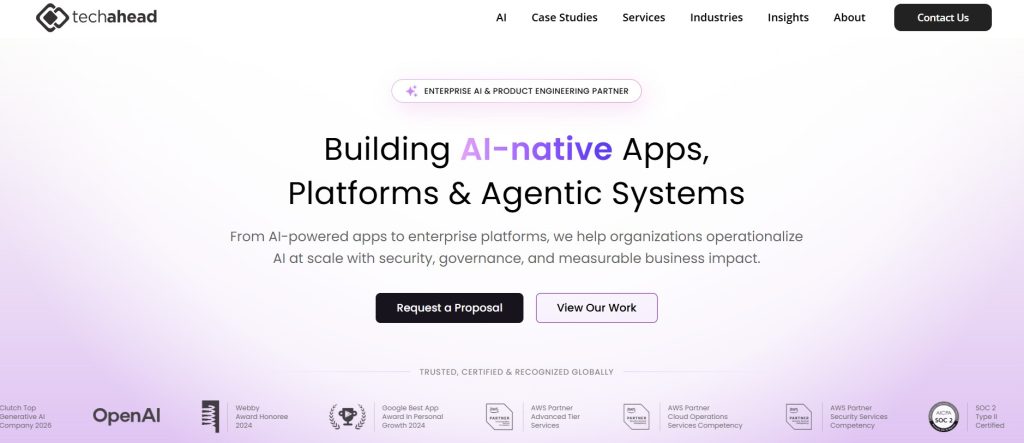
TechAhead runs a blended delivery model that many US buyers find appealing: creative and product leadership based in Los Angeles, paired with a larger engineering organization in India. Operating for over 15 years, it has shipped a couple of thousand apps for around 700 brands, with a client list that includes American Express, Audi, Disney, AXA, and ESPN. The model is built to combine onshore communication and market understanding with offshore cost efficiency.
As an iPhone app development services provider, TechAhead covers strategy, design, native and cross-platform engineering (including React Native and Flutter), and ongoing maintenance, with an increasingly AI-forward positioning. It explicitly emphasizes IP protection and NDAs, which matters to enterprise buyers. The structure works best for organizations that want recognizable-brand experience and a single partner spanning the full lifecycle while keeping budgets below pure-onshore rates. As with any distributed model, the value depends on disciplined project management bridging the two locations, so clarity of scope up front pays off.
Best fit: mid-market and enterprise clients who want US-facing product leadership with the economics of a larger offshore engineering bench.
ArcTouch
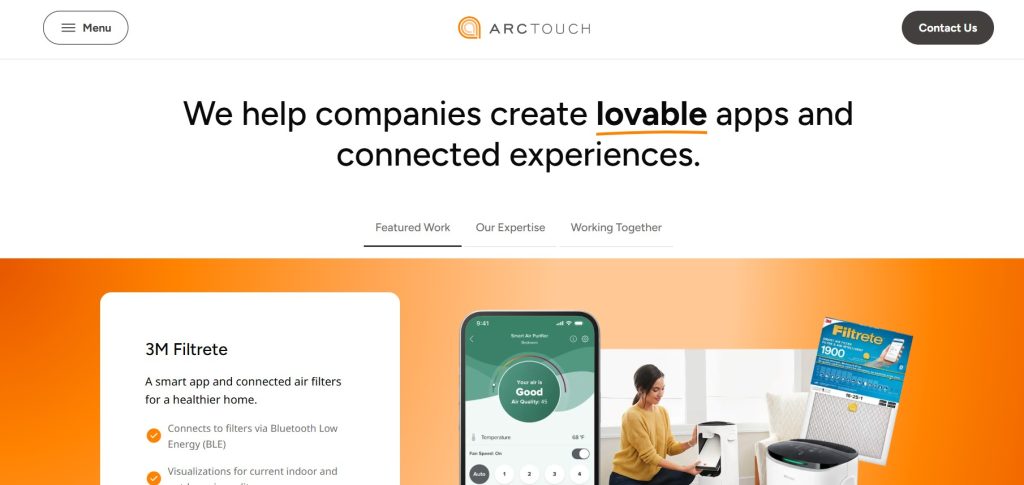
ArcTouch is a San Francisco studio that has carved out a clear niche: apps for the connected world. Now part of the AKQA network and operating for over 15 years across offices in the US, Canada, Europe, and Brazil, it has built more than 500 products for clients including 3M, Audi, CBS, NBC, and Tile. Its specialty is software that brings smart devices and connected hardware to life – a genuinely differentiated capability among iOS application development company options.
Beyond IoT, ArcTouch is notable for treating accessibility as a first-class discipline, with dedicated expertise and published best practices, which is increasingly important for both compliance and reach. It works in native Swift and Kotlin as well as cross-platform Flutter and React, and extends into AR and spatial computing for clients exploring newer Apple surfaces. With a US headquarters and a design-and-engineering reputation, it sits in the premium tier rather than the budget one.
Best fit: companies launching apps tied to physical or connected products, or those that need accessibility and connected-device expertise alongside polished iOS engineering.
Cleveroad
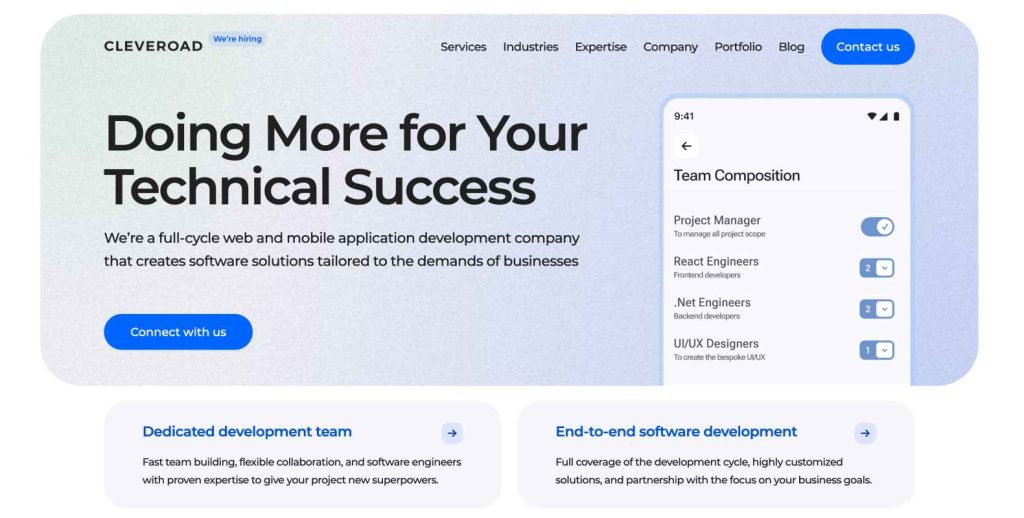
Cleveroad is a full-cycle ios app company that pairs Eastern European engineering economics with a US presence, headquartered in Estonia with an office in the United States and roots in Ukraine. Operating for over a decade, it focuses on custom software for SMBs and startups across healthcare, logistics, fintech, marketplaces, and retail, and its portfolio includes substantial products such as a Nordic video-streaming platform serving hundreds of thousands of subscribers.
On iOS it builds native apps in Swift and offers Flutter for cross-platform needs, backed by ISO 27001 certification and AWS partnership – signals that matter for security-conscious buyers. It provides discovery, design, development, QA, and staff augmentation, and is transparent about effort, publishing indicative build-hour ranges for common app types. The combination of competitive rates, solid process maturity, and verified review-platform standing makes it a sensible option for organizations that want professional ios application development services without onshore pricing. As a mid-size outsourcing firm, it is better matched to well-defined products and growth-stage companies than to those needing a large brand-name agency.
Best fit: startups and SMBs seeking dependable, cost-efficient full-cycle development with a real US point of contact and strong security credentials.
Why building for iOS is a atrategic decision, not a default
Globally, Android dwarfs Apple in raw device numbers – StatCounter consistently puts Android above 70% of the worldwide smartphone market against roughly 28–29% for iOS. If reach were the only metric, the choice would be obvious. But reach is rarely the metric that pays for an app.
The picture inverts in the markets where most app revenue is generated. In the United States, iOS holds roughly 58% of smartphones, and in other high-value economies such as Japan, Denmark, and Canada it sits above 60%. More importantly, that audience spends. Industry data from sources like Business of Apps and Statista shows the Apple App Store generating well over $85 billion in annual consumer spend and capturing close to two-thirds of all global app-store revenue, despite serving a minority of devices. iPhone owners also skew toward higher household income and notably higher monthly technology spending than the Android average – the kind of users who actually subscribe, upgrade, and complete in-app purchases.
There is a retention angle too. The average iPhone stays in active service for roughly 4.7 years versus about 3.1 for Android, which means a well-built iOS product enjoys a longer, more stable lifespan on each device. For most consumer and B2B products targeting the US and similar premium markets, this is why teams engage iPhone app development services first and treat Android as the follow-on, rather than the reverse. Choosing an iOS development company is, in effect, choosing to build where the spending users already are.
What modern iOS development actually involves
A lot of vendor copy still describes iOS work as if it were simply “writing Swift code.” The reality is broader, and the gap between studios that keep pace and those that do not is widening. When you evaluate any iOS app development company, you are really assessing whether its engineers are fluent in the current Apple stack – not the one from several release cycles ago.
The foundations have shifted decisively toward Swift and SwiftUI. Swift’s move to strict concurrency changed how robust apps are architected, and SwiftUI has matured from a risky bet into the default way most new interfaces are built, while UIKit remains essential for complex or legacy screens. A serious iOS development company should be able to explain when it reaches for each, rather than defaulting blindly to one.
Beyond the language, several capabilities now separate competent teams from genuinely strong ones:
- On-device intelligence. Core ML and Apple’s on-device AI frameworks let apps run personalization, vision, and language features locally, protecting privacy and reducing latency. This is fast becoming a baseline expectation rather than a differentiator.
- Multi-surface design. A capable studio thinks beyond the phone – iPad layouts, Apple Watch companions, widgets, and emerging spatial computing on Vision Pro. If you need tablet-first experiences, confirm the partner has real iPad app development company credentials, not just stretched iPhone screens.
- Privacy and compliance. App Tracking Transparency, privacy “nutrition” labels, and required-reason APIs are now gating factors for App Store approval. Mishandling them delays launches.
- Distribution shifts. Regulatory change in the European Union has opened alternative app marketplaces and new fee structures. US apps are largely unaffected today, but a forward-looking team understands the implications for any product with international ambitions.
The takeaway: depth in current Apple tooling is the single best predictor of whether your build will age gracefully or need a costly rewrite within a couple of release cycles.
Native vs. cross-platform: Choosing the right stack for an iOS-first product
One of the first real decisions you will make with any iOS application development services provider is how the app should be built. The honest answer is that it depends on your product, not on which framework the vendor happens to prefer. A studio that pushes the same stack onto every client regardless of context is showing you its limitations, not its expertise.
Native development with Swift and SwiftUI delivers the best performance, the earliest access to new Apple features, and the most “Apple-native” feel – at the cost of needing a separate codebase if you later add Android. Cross-platform frameworks share code across both platforms and can shorten time-to-market and lower combined cost, but they introduce a dependency layer between your app and the operating system, which can lag behind new iOS capabilities.
| Approach | Best for | Strengths | Trade-offs |
|---|---|---|---|
| Native (Swift / SwiftUI) | Performance-critical, design-led, or iOS-first products | Peak performance, day-one access to new APIs, tightest platform integration | Separate codebase needed for Android; higher combined cost for two platforms |
| React Native | Content- and form-driven apps needing both platforms fast | Large talent pool, fast iteration, web-team synergy | Native modules required for heavy device features; performance ceiling on complex UI |
| Flutter | Brand-heavy UIs identical across platforms | Consistent custom UI, strong rendering performance, single codebase | Larger app size; less “native” feel; reliance on Google’s roadmap |
| Kotlin Multiplatform | Teams sharing business logic but keeping native UIs | Native UI per platform with shared logic, growing enterprise adoption | Younger ecosystem; still requires native iOS skill for the UI layer |
The practical rule for most US-market consumer products is straightforward: if the experience is performance-sensitive, design-forward, or expected to adopt new Apple features quickly, native is usually worth the premium. If you need both platforms on a tight timeline and the interface is relatively standard, a cross-platform stack can be the smarter economic call. A strong partner will reason through this with you on the merits – and put the reasoning in writing.
How to choose an iOS app development company
Because most marketing pages look alike, the work of choosing comes down to verification. A capable iOS mobile app development company will welcome scrutiny; a weak one will deflect it. Use the criteria below as a filter rather than taking any badge at face value.
Start with shipped evidence. Ask for named apps the team has launched on the App Store, then go look them up – check live ratings, review recency, and update cadence. A maintained app with healthy reviews tells you more than any case study. Genuinely experienced iPhone app developers will have a portfolio you can actually open and use, not just screenshots.
Probe the process, not just the price. How do they handle discovery, design, QA, and the App Store review cycle, including rejections and hotfixes? Studios that own end-to-end releases behave very differently from those that only write code and hand it off.
Match the engagement model to your situation:
- Fixed-price suits well-defined, smaller scopes where requirements are unlikely to change.
- Time and materials fits evolving products where you want flexibility to adjust as you learn.
- Dedicated team works best for ongoing roadmaps that need a stable, long-running squad.
Get the commercial terms right early. Confirm in writing who owns the source code and intellectual property on delivery, what the NDA covers, and what post-launch support and maintenance look like. Reputable iPhone application development services spell this out before a contract is signed.
Finally, watch for red flags that recur across weak vendors: no named, openable portfolio; vague or evasive pricing; no clear QA or testing story; no in-house design capability; and reluctance to discuss code ownership. Any single one of these is a reason to slow down. Together, they are a reason to walk away – no matter how strong the iPhone app development company looks on a directory ranking.
How much iOS app development costs
Cost is where expectations and reality most often collide, so it helps to separate the two main drivers: the complexity of what you are building and the location of the team building it. Across recent industry cost surveys, a few consistent ranges emerge for full-cycle iOS app development services.
| App type | Typical scope | Indicative cost range |
|---|---|---|
| Simple / MVP | One core flow, basic backend, limited integrations | ~$30,000 – $60,000 |
| Medium complexity | Multiple features, custom UI, API and payment integrations | ~$60,000 – $120,000 |
| Complex / Enterprise | Real-time features, heavy integrations, AI, compliance | ~$120,000 – $400,000+ |
Team location moves these numbers significantly. Reported hourly rates cluster roughly as follows: North America at about $100–$250 (with many US studios in the $80–$170 band), Western Europe around $70–$120, Eastern Europe near $40–$70, and South Asia around $20–$40. The skill gap is often smaller than the price gap – several rate studies note that senior iOS engineers in Eastern Europe deliver comparable Swift and SwiftUI work at close to half the average US senior rate, which is why so many US companies blend onshore product leadership with nearshore or offshore engineering.
Two budget items are routinely forgotten. First, the Apple Developer Program costs $99 per year and is mandatory to publish. Second, maintenance is not optional: most teams should plan for an additional 15–25% of the original build cost annually to cover OS updates, security, hosting, and iterative improvement. One modest upside is that iOS typically requires fewer QA hours than Android – often 10–15% less for similar complexity – because Apple’s tightly controlled device range eliminates the fragmentation that inflates Android testing.
The regional question: Where should you hire?
Geography is one of the largest levers on both cost and working experience, and the right answer depends on how much you value overlap, oversight, and price. There is no universally “best” region – only the best fit for your priorities.
A US-based iOS application development company offers the tightest time-zone overlap, the easiest contracting, and deep familiarity with the American market – at the highest rates. It tends to suit funded startups and enterprises that prioritize speed of communication and on-shore accountability over budget.
Western Europe sits a notch below US rates with strong engineering culture and similar quality standards, though time-zone overlap with US teams is partial. Eastern Europe has become the default sweet spot for many US buyers: senior Swift and SwiftUI talent at meaningfully lower rates, strong English, and workable overlap with US mornings. Latin America offers near-shore advantages for US clients – close time zones and increasingly mature studios – while South Asia provides the lowest rates and the largest talent volume, best suited to well-specified scopes with disciplined project management on your side.
When comparing any iOS app company across regions, weigh four things honestly: hourly rate, depth of genuine iOS specialization, communication and English fluency, and the number of overlapping working hours you will actually get. A lower rate stops being a saving the moment it costs you weeks in miscommunication or rework. The strongest outcomes often come from a deliberate blend – product and design leadership close to your market, engineering where the talent-to-cost ratio is best.
Bottom line
The mobile market rewards iOS out of proportion to its device share: a premium, high-spending audience concentrated in markets like the United States, longer device lifespans, and the lion’s share of global app revenue. That makes the choice of an iOS app development company a genuine business decision, not a procurement formality.
The companies worth your shortlist share a recognizable pattern – an openable portfolio of shipped apps, fluency in the current Swift and SwiftUI stack, a clear process through the App Store review cycle, transparent pricing, and contracts that hand you the code and IP without a fight. Use the framework above to read the list that follows critically: verify the evidence, match the engagement model and region to your priorities, and treat any vendor that resists scrutiny as your answer. The right partner will make that scrutiny easy.
FAQ
How long does it take to build an iOS app?
How do I verify a companys iOS experience before signing?
Ask for specific apps they have shipped to the App Store, then open those apps yourself. Check live ratings, the recency of reviews, and how often the app is updated. A maintained product with healthy, recent reviews is far stronger evidence than any award badge or self-reported ranking.
Do I own the source code and IP when the project ends?
You should – but only if it is contractually explicit. Confirm in writing that all source code, design assets, and intellectual property transfer to you on final payment, and that the arrangement is covered by an NDA. This is standard practice for reputable ios app development services providers, and reluctance to commit to it is a serious warning sign.
Should I choose native Swift or a cross-platform framework?
If your product is performance-sensitive, design-led, or expected to adopt new Apple features quickly, native Swift and SwiftUI usually justify the premium. If you need iOS and Android on a tight timeline with a relatively standard interface, a cross-platform stack can lower combined cost and speed up delivery. Any competent provider of iphone app development services should reason through the trade-off with your specific product in mind.
You may also like
-
 September 8, 2026Read in 16 min.
The AI-Native SDLC: From Writing Software to Orchestrating It
An AI-native SDLC cuts delivery time by about half without loosening a single quality gate. See the three eras, the toolchain and the guardrails. -
 September 4, 2026Read in 36 min.
Custom software development cost: Real ranges, rate cards, and how to budget
How much custom software development costs. Explore real pricing ranges, hourly rates, key cost factors, hidden expenses, and budgeting tips. -
 September 2, 2026Read in 36 min.
Fitness app development companies: An independent shortlist
10 fitness app development companies compared on verified data, published pricing, and real client work. Only three have documented fitness delivery. -
 August 27, 2026Read in 36 min.
Top software development companies in the USA
Find the best US-based software developers. From AI to enterprise web apps, here are the top 30 software development companies in the USA you should hire in 2026. -
 August 19, 2026Read in 22 min.
Robotic Process Automation in healthcare: Definition, benefits, and real cases
From patient scheduling to claims processing: explore proven RPA use cases in healthcare, backed by real data, ROI benchmarks, and compliance guidance. -
July 16, 2026Read in 18 min.
Top 10 Banking Software Development Companies in the US
An independent, verified list of the top banking software development companies in the US, plus a practical guide to choosing the right partner -
 July 16, 2026Read in 17 min.
Custom ERP software for manufacturing – Built on Azure and .NET
Off-the-shelf ERP forcing workarounds? Blackthorn Vision, a manufacturing software company, builds ERP software for manufacturing on Azure and .NET. -
 June 30, 2026Read in 10 min.
Software development company in Boston: Custom solutions for a research-driven city
Boston software development company building HIPAA-aware healthcare, biotech, and enterprise software on .NET and Azure. Microsoft Solutions Partner, 4.8/5 on Clutch -
 June 18, 2026Read in 10 min.
Software Development Company in Washington State: Custom Solutions Across the Region
Software development company serving all of Washington State. Cloud-first custom software on .NET and Azure. Microsoft Solutions Partner since 2009. -
June 17, 2026Read in 12 min.
Software Development Company in Seattle: Cloud-First Custom Solutions
Seattle software development company building cloud-first custom software on .NET and Azure. Microsoft Solutions Partner trusted since 2009. Talk to us