

Scoped engagements typically run from 4 months for a modular MVP to 18 months for a full enterprise rollout. The spread depends on two variables more than any others: how many shop floor and third-party systems must be integrated, and how much legacy data needs cleansing and migration. Blackthorn Vision phases delivery so the first working module reaches your team early in the program, which shortens time-to-value even on the longest engagements and lets ROI start accruing before the final phase ships.
Custom ERP software for manufacturing – Built on Azure and .NET
 17 minutes read
Content
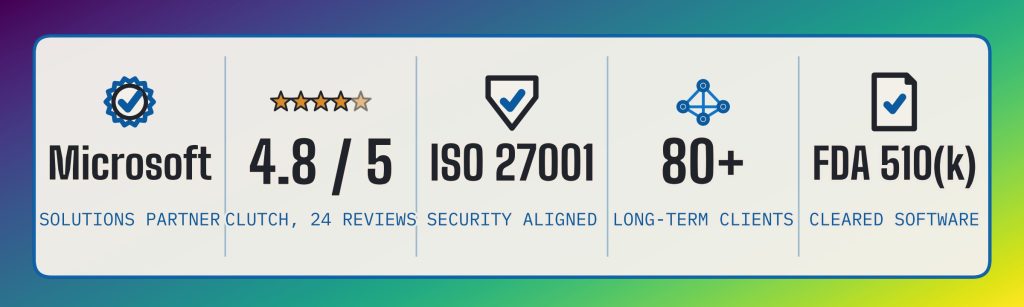
Your production schedule lives in a spreadsheet. Your inventory counts live in a fifteen-year-old on-premises system. Your quality records live in a filing cabinet. Every handoff between them costs hours, and every mismatch costs money. Off-the-shelf ERP promised to fix this, then forced your team to work around its assumptions instead. Blackthorn Vision builds custom ERP software for manufacturing on Azure and .NET, covering the full cycle from process mapping to post-launch support. As a Microsoft Solutions Partner and a manufacturing software company with 80+ long-term client engagements and a 4.8/5 rating on Clutch, Blackthorn Vision replaces disconnected tools with manufacturing management software shaped around how your plant actually runs, not around a vendor’s template.

Book a Free Discovery Call
find out if custom ERP is right for your operation
When your manufacturing operation outgrows a generic ERP
There is a predictable moment when generic manufacturing ERP systems stop paying for themselves. Production deadlines slip because planners cannot see real machine capacity. Auditors find gaps because records live in three different tools. Shop-floor supervisors keep paper logs because the system was never built for them. If any of this sounds familiar, the problem is not your team. It is the software.
Disconnected systems and manual data entry cost you daily
Siloed data is not an inconvenience, it is a recurring expense. When shop floor control systems, finance, and supply chain tools do not share data, someone re-keys the numbers by hand, and re-keyed numbers fail at a measurable rate. Research by Raymond Panko at the University of Hawaii found that roughly 88 percent of spreadsheets contain errors. Feed those numbers into material requirements planning and the damage multiplies downstream: wrong purchase quantities, phantom inventory, and production plans built on fiction. A plant processing thousands of transactions a day absorbs that cost on every single shift, quietly, in expedite fees and missed ship dates.
Off-the-Shelf ERP Forces Your Processes into Its Mold
Packaged ERP was designed for a statistical average of manufacturers, and your plant is not average. Discrete, process, and mixed-mode operations differ in how they define a batch, cost a job, and trace a lot, yet off-the-shelf manufacturing ERP software flattens those differences into a single configuration model. The result is familiar to anyone who has lived through it: workarounds in spreadsheets, “temporary” side systems that survive for a decade, and consultants billing by the hour to bend the package toward reality. When the workaround layer grows thicker than the system underneath it, you are already paying custom prices for packaged limitations.
Compliance and Audit Readiness Cannot Be an Afterthought
If you manufacture medical devices, food and beverage products, or aerospace components, audit readiness is a production requirement, the same as calibration or lot control. Generic systems bolt audit logging on top. Regulated manufacturers need audit trails, electronic signatures, and lot-level traceability baked into the data model itself, because retrofitted compliance rarely survives an inspection. Blackthorn Vision has shipped FDA 510(k)-cleared diagnostic software, the kind of delivery where validation documentation and regulated manufacturing compliance are acceptance criteria, not aspirations. That regulated-industry experience transfers directly to ERP builds where an auditor will one day sit across the table.
Manufacturing ERP Software Development Services
One vendor rarely fits every stage of an ERP journey, so Blackthorn Vision structures its services to meet you where you are: building new, modernizing old, integrating what already exists, or adding intelligence on top of all of it. Each service below stands alone. Together they form full-cycle manufacturing software solutions delivered by one accountable engineering team.
Custom ERP Design and Architecture
Greenfield ERP starts with domain modeling: capturing how your orders, routings, inventory, and costing actually relate before a line of code is written. Blackthorn Vision architects then make the structural decision most vendors skip debating: microservices where independent scaling and deployment justify the overhead, a modular monolith where they do not. Data architecture follows the same discipline, with Azure SQL for transactional integrity and Azure Cosmos DB where multi-site distribution or telemetry volume demands it. The result is ERP for manufacturing where production planning software, bill of materials management, and job costing are built around your domain instead of a vendor template.
Legacy ERP Modernization and Cloud Migration
If your ERP runs on an unsupported framework, every year adds risk: security exposure, a shrinking talent pool, and integration dead ends. Blackthorn Vision has executed exactly this move, migrating a Silverlight-era logistics platform to Azure-native architecture, and applies the same playbook to aging ERP systems for manufacturing. Cloud ERP migration follows zero-downtime patterns: strangler-fig decomposition, parallel runs, and staged cutovers onto Azure App Service. Azure DevOps CI/CD pipelines are built alongside the migration itself, so enterprise resource planning modernization leaves you with two assets at once: a modern platform and a modern delivery process.
ERP Integration with Shop Floor and Third-Party Systems
An ERP that cannot see the shop floor is an accounting system with ambitions. We connects ERP to the systems that actually run production: manufacturing execution system integration for live work order status, SCADA and IoT shop floor connectivity for machine-level data, WMS links for inventory movements, and CRM sync so sales promises reflect real capacity. The connective tissue is event-driven. Azure Service Bus carries the messages, and Azure API Management governs the interfaces. For software for manufacturing companies with decades of accumulated systems, integration architecture is usually the difference between a successful rollout and an expensive new silo.
AI-Enhanced Production Intelligence
Production data is only valuable at the moment a decision gets made. Blackthorn Vision builds the AI layer that closes that gap: demand forecasting on Azure AI Foundry models trained on your own order history, predictive maintenance AI that flags equipment degradation before unplanned downtime, and Azure OpenAI copilots that let a plant manager ask “why did line 3 miss target yesterday” in plain English. Azure AI Search makes BOMs, inventory, and work instructions semantically searchable. The goal is manufacturing management software that surfaces answers on its own, not another dashboard your team stops opening after week two.
ERP for Small and Mid-Size Manufacturers
Custom does not have to mean enterprise-scale budgets. For smaller operations, we scopes modular, phased rollouts: start with the module that hurts most, often production planning or inventory, ship it, prove the return, then extend. Azure consumption-based pricing keeps infrastructure costs proportional to actual usage, a meaningful lever when you are not running enterprise volumes. This is manufacturing software for small business done responsibly: ERP for manufacturing sized to a $5M-$50M operation, without over-engineering you into paying today for architecture you will not need for another five years.
Ongoing Support, DevOps, and Continuous Improvement
The riskiest day in an ERP’s life is the day the implementation team leaves. Managed support tiers run from business-hours response to SLA-backed 24/7 coverage, with Azure Monitor alerting wired to a support pod that already knows your codebase. DevOps continuous delivery keeps improvements flowing: the same pipeline discipline that produced a 15x release frequency gain for one client means fixes and features ship continuously instead of piling into a risky annual upgrade. Manufacturing business software should compound in value every quarter it runs, and continuous improvement is how that compounding happens.
Our ERP Development Process
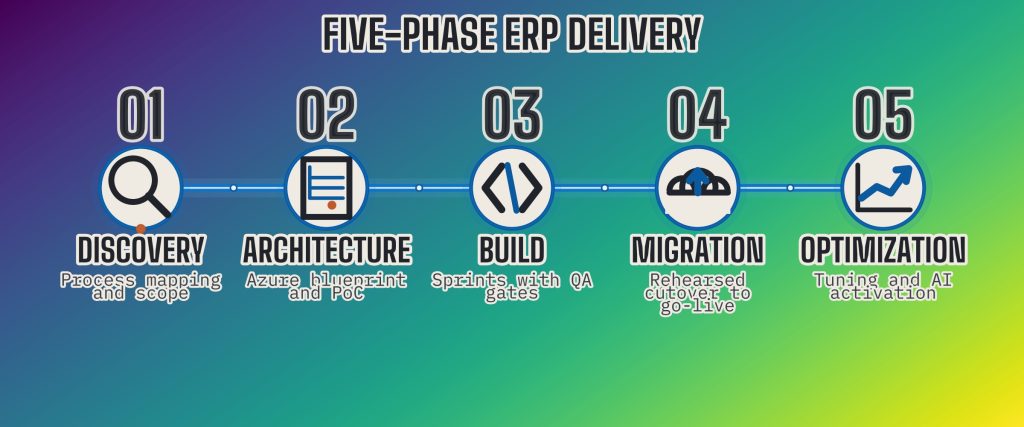
A predictable process is how custom development stops being a leap of faith. We delivers ERP software for manufacturing through a five-phase engagement model designed to surface risk early, keep spend proportional to validated progress, and hand your team a system they helped shape rather than one they were handed.
Phase 1: Discovery and Process Mapping
Every engagement starts on your floor, not in a slide deck. Blackthorn Vision analysts run requirements workshops with planners, operators, and finance leads, audit as-is processes, and map how data actually flows between machines, spreadsheets, and legacy systems. Regulatory constraints are identified here, not discovered during validation. The output is a documented process model and a prioritized scope that both sides sign before any architecture work begins.
Phase 2: Architecture Design and Proof of Concept
The team translates that process model into an Azure-native architecture blueprint: .NET 8 services, Azure Kubernetes Service or App Service hosting, Azure SQL for transactional data. Stack decisions are documented with trade-offs, not asserted. A time-boxed proof of concept then de-risks the scariest integration first, whether that is a thirty-year-old machine protocol or a fragile EDI link, before full development funding is committed.
Phase 3: Iterative Build and QA
Development runs in two-week sprints that end with working software your team can react to, not status reports. Automated QA gates cover regression, integration, and performance testing on every merge, so quality is enforced by the pipeline rather than by heroics. User acceptance cycles happen with production team leads on the shop floor, using real orders and real routings, which means friction surfaces while it is still cheap to fix.
Phase 4: Migration, Cutover, and Go-Live
Cutover is engineered, not improvised. Data migration scripts are rehearsed against production-scale copies until the numbers reconcile. A parallel-run period validates outputs against the legacy system, and a written cutover playbook assigns every task an owner, a time window, and a rollback path. A hypercare window follows go-live, with the build team on call while your planners and operators settle into daily use.
Phase 5: Optimization and AI Layer Activation
Go-live is the midpoint, not the finish line. The team tunes query performance against real production load, stands up Azure Monitor dashboards for your operations staff, and activates the AI layer: predictive maintenance alerts, copilot-style reporting, and demand forecasting trained on your own history. This is the phase where manufacturing software solutions stop being systems of record and start acting as systems of decision.
Why Manufacturers Choose Blackthorn Vision
Every vendor page claims expertise, so this section sticks to claims you can verify. Blackthorn Vision is a manufacturing software company whose credentials are auditable: partner status you can look up, ratings on an independent review platform, and shipped software in regulated industries. Here is what separates the company from the field, with sources listed at the end of this page.
Microsoft Solutions Partner with Deep Azure Expertise
Microsoft Solutions Partner status is not a logo. It is an audited validation of engineering bench strength on Azure, .NET, and Azure AI Foundry, backed by certified engineers and verified customer outcomes. It matters because ERP is a decade-long commitment to a platform. A manufacturing software company that builds exclusively on the Microsoft stack goes deeper than a generalist vendor spreading attention across three clouds: deeper into Azure service internals, deeper into .NET performance behavior, and deeper into the AI services your ERP will lean on next. Focus is a feature you inherit.
Regulated-Industry Experience You Can Verify
Any vendor can claim compliance experience. Point to it: FDA 510(k)-cleared diagnostic software shipped for a medical technology client, and an ISO 27001-aligned security posture across engagements. For regulated manufacturers, that history changes the conversation entirely. Audit trails, electronic records, validation documentation, and access controls become architectural decisions made on day one, not retrofits negotiated after a failed audit. If you are evaluating software for manufacturing companies in medical devices, food and beverage, or aerospace, verifiable regulated-industry delivery is the credential that separates partners from vendors.
Long-Term Engineering Partner, Not a Project Shop
Seventy-plus long-term engagements and a SaaS platform serving more than 250,000 users tell the same story: clients keep Blackthorn Vision around long after launch. That matters more for ERP than for almost any other software category, because manufacturing management software is never finished. Product lines change, regulations change, acquisitions add plants with entirely different processes. A project shop hands over a repository and disengages. A partner keeps the same engineers on your account, accumulating context that makes every subsequent change faster, cheaper, and safer than the one before it.
DevOps Maturity that Compresses Release Cycles
Release cadence is a leading indicator of how fast your ERP can adapt to the business. On one engagement, Blackthorn Vision rebuilt the delivery pipeline and increased release frequency 15x, moving from quarterly big-bang deployments to routine, low-risk releases. The mechanics are standard but rarely executed well: Azure DevOps boards for traceable work, CI/CD pipelines with automated test gates, and infrastructure-as-code so environments stop drifting apart. For your plant, DevOps maturity means the gap between “we need this field on the work order” and “it is live” gets measured in days, not quarters.
Clutch-Verified Client Satisfaction
Independent review platforms are where vendor marketing meets client reality. Blackthorn Vision holds a 4.8/5 rating on Clutch across 24 verified client reviews. The recurring theme in that feedback is partnership depth: engineers who integrate into client teams, communicate proactively, and stay through the hard phases rather than around them. For a buyer comparing ERP software for manufacturing partners, third-party verified reviews carry more weight than any case study a vendor writes about itself, which is exactly why they are cited here rather than paraphrased into marketing copy.
Book a Free Discovery Call
bring your current ERP pain points and leave with an honest read on whether custom is worth it
Manufacturing Sectors We Serve
ERP requirements diverge sharply by sector. A medical device plant and a make-to-order machine shop share almost no compliance or data model assumptions. We adapts the same Azure-native manufacturing management software architecture to each sector’s regulatory regime and workflow reality instead of forcing one template across all of them. Four sectors where that depth already exists:
Medical Device and Life Sciences Manufacturing
Medical device and life sciences manufacturers operate under FDA 21 CFR Part 11, which makes electronic records, electronic signatures, and audit trails legal requirements rather than nice-to-have features. Blackthorn Vision designs ERP data models around that reality: electronic batch records, device history file (DHF) traceability from raw material lot to shipped serial number, and validation documentation prepared for inspection from the start. The team’s FDA 510(k)-cleared software delivery means these constraints are familiar territory, not a learning project billed at your expense.
Industrial and Precision Machinery Manufacturing
Precision machinery production lives or dies on the link between office systems and the machines themselves. Blackthorn Vision built desktop control software for industrial wire-bending machines, including 3D wire path simulation, automated collision detection, and an event-driven architecture that parses proprietary machine program files. That is the level of shop-floor integration available to clients here: not just dashboards about machines, but software for manufacturing companies that talks to the equipment directly, safely, and in real time, because someone on the team has already done it.
Fintech-Adjacent and B2B SaaS Manufacturers
A growing class of manufacturers run subscription billing, usage metering, or embedded finance alongside physical production: equipment-as-a-service models, consumables on auto-replenishment, financed capital sales. Their ERP has to reconcile production costing with recurring revenue logic that traditional manufacturing ERP software simply ignores. Blackthorn Vision’s fintech and B2B SaaS portfolio covers exactly this intersection, so billing engines, payment integrations, usage metering, and revenue recognition are built by engineers who have shipped those systems before, not learned them on your invoice.
Small-Batch and Custom-Order Manufacturers
Engineer-to-order and make-to-order shops break most packaged ERP assumptions: every job carries its own bill of materials, its own routing, and its own margin story. Blackthorn Vision builds for that workflow directly, with BOM versioning that tracks engineering changes per order, job costing that captures actual versus quoted margin in real time, and dynamic scheduling that re-sequences work when a rush order lands. Make-to-order workflow automation turns custom-order chaos into a repeatable, measurable process your estimators can finally trust.
Technology Stack
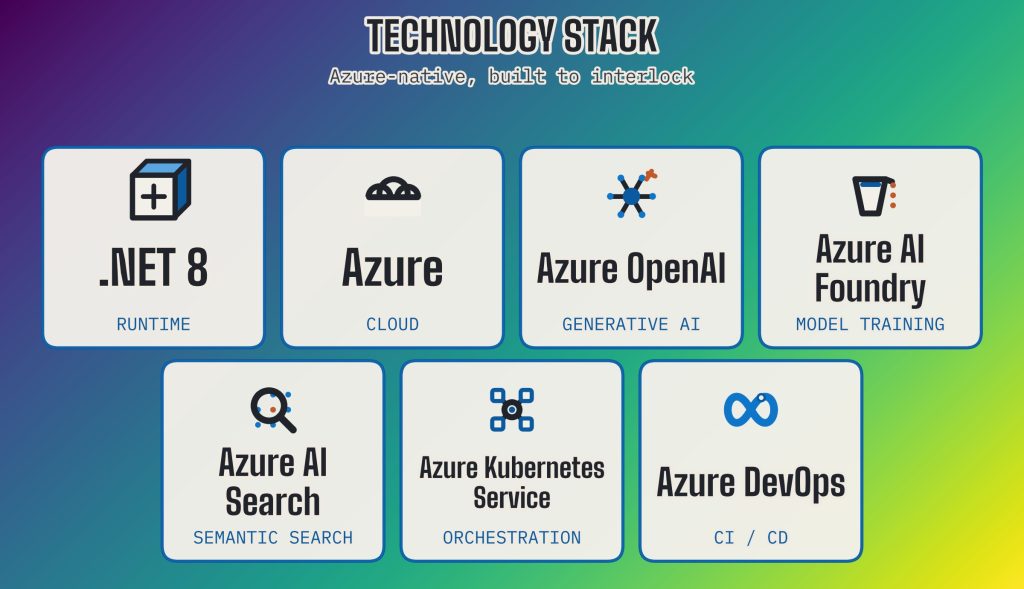
Technology choice is a risk decision before it is a technical one. Blackthorn Vision builds ERP for manufacturing on a single, coherent Microsoft stack, which reduces integration seams, keeps hiring and support predictable, and shortens time-to-value because the platform components were designed to work together rather than stitched across three vendors.
Core Platform: .NET 8 and Azure Cloud-Native Services
The core is .NET 8 with ASP.NET Core services written in C#, a stack with a two-decade enterprise track record and a modern performance profile. Hosting runs on Azure App Service for straightforward workloads or Azure Kubernetes Service where multi-site scale demands orchestration. Azure SQL Database handles transactional data with point-in-time recovery, Azure Cosmos DB serves globally distributed or high-ingest scenarios such as sensor telemetry, and Azure Service Bus provides the reliable messaging backbone that event-driven plant integrations depend on. Azure-native enterprise software, assembled from parts built to interlock.
AI and Intelligence Layer: Azure OpenAI, AI Foundry, AI Search
Azure OpenAI powers generative copilot features: planners ask questions in plain language and get answers grounded in live production data. Azure AI Foundry is the training ground for custom models, from scrap-rate prediction to maintenance scheduling. Azure AI Search adds semantic lookup across BOMs, inventory, and documentation, so “find every assembly using this bracket” works even when part descriptions are inconsistent. This is Blackthorn Vision’s canonical AI stack for ERP software for manufacturing, chosen because it inherits Azure’s identity, compliance, and data residency controls instead of bolting a third-party model onto regulated data.
DevOps, Security, and Compliance Tooling
Delivery tooling is part of the product, not an afterthought. Azure DevOps and GitHub Actions run the CI/CD pipelines, with automated test gates on every change. Azure Monitor provides production observability from day one, so incidents are diagnosed from telemetry rather than guesswork. Security follows an ISO 27001-aligned posture: Microsoft Defender for Cloud for threat detection across the environment, Azure Key Vault for secrets and certificate management, and role-based access enforced at the platform level. The result is regulated manufacturing compliance supported by tooling, not by policy documents nobody reads.
Case Studies
Credentials describe a manufacturing software company. Delivered projects define it. The three engagements below are representative of Blackthorn Vision’s manufacturing work, spanning machine-level control software, platform modernization, and applied AI. Each is summarized the same way: the problem the client faced, the engineering approach taken, and the outcome that followed.
Wire Bending Machine Control and 3D Simulation Software
An industrial machinery manufacturer needed desktop control software for CNC wire bending machines: real-time machine control, 3D simulation of the wire path, and automated collision detection before a single meter of stock was bent. Blackthorn Vision engineers reverse-engineered the proprietary .PRG program file format, built an event-driven control architecture, and rendered the full bending sequence in interactive 3D so operators could validate programs offline. The result: fewer crashed tools, faster program validation, and a control application the manufacturer now ships alongside its machines. The engagement shows the depth of shop floor control work Blackthorn Vision takes on well beyond back-office ERP modules.
Azure-Native ERP Modernization for a Legacy Industrial Platform
A manufacturer was running its core operations platform on a Silverlight-era codebase that no modern browser supported and no new hire wanted to maintain. Blackthorn Vision migrated the platform to .NET on Azure App Service, restructured deployment around Azure DevOps CI/CD pipelines, and executed the cutover without halting production reporting. Post-migration, the client gained a supported technology base, automated release pipelines, and room to add the integration and analytics features the legacy stack had blocked for years. For manufacturers weighing a similar move, this is what manufacturing ERP software modernization looks like when it is treated as an engineering project rather than a rewrite gamble.
AI-Driven Production Intelligence for a SaaS Manufacturer Platform
A B2B SaaS platform serving more than 250,000 users needed production intelligence its existing dashboards could not deliver. Blackthorn Vision integrated Azure OpenAI into the platform to add copilot-style capabilities: demand forecasting that planners query in plain language, anomaly detection that flags unusual consumption patterns before they become stockouts, and NLP reporting that turns raw production data into readable shift summaries. The AI layer runs on the same Azure backbone as the rest of the platform, so security, identity, and monitoring stayed unified. It is a working example of manufacturing management software gaining real decision support without a rip-and-replace project or a second vendor stack.
FAQ
What is the typical timeline for custom ERP software for manufacturing?
What ongoing support do you provide after go-live?
Post-go-live support runs on SLA-backed monitoring through Azure Monitor, with dedicated support pods that know your codebase rather than a rotating ticket queue. Quarterly roadmap reviews keep the system evolving alongside your operation instead of freezing at launch. Because CI/CD pipelines are in place from day one, patches and new features ship in days rather than release seasons, the same DevOps discipline that produced a 15x release frequency improvement for another Blackthorn Vision client, applied to keeping your ERP current.
How do you handle compliance requirements in regulated manufacturing sectors?
Compliance is designed in from the discovery phase, not audited in afterward. Depending on your sector, that means electronic records and signatures aligned to FDA 21 CFR Part 11, full audit trails on every transaction, role-based access control, and documentation packages structured for ISO 9001 or sector-specific audits. Blackthorn Vision has shipped FDA 510(k)-cleared diagnostic software, so the team knows from first-hand delivery what regulated validation actually requires in practice, and prices that work into the plan instead of surprising you with it later.
Can you build ERP for a small manufacturing business without enterprise-level costs?
Yes. Modular, phased delivery keeps the initial investment proportional to the problem being solved: start with production planning or inventory, prove the return, then extend module by module. Azure consumption-based pricing means infrastructure costs scale with actual usage instead of a fixed enterprise license. For a smaller manufacturer, that combination delivers purpose-built software at a total cost closer to a high-end off-the-shelf subscription over its lifetime than to a classic enterprise implementation, and without the shelfware.
How does custom manufacturing ERP software differ from SAP or Microsoft Dynamics?
Packaged manufacturing ERP systems ask your processes to conform to the software. Custom ERP conforms the software to your processes: your routings, your costing logic, your compliance model. That difference compounds over years of workarounds never needed and consultants never hired. It is not an either-or decision, though. When Dynamics 365 is genuinely the right fit for part of your landscape, Blackthorn Vision extends and integrates it rather than replacing it, so you get Microsoft platform economics with custom-fit workflows where they matter.
You may also like
-
 September 8, 2026Read in 16 min.
The AI-Native SDLC: From Writing Software to Orchestrating It
An AI-native SDLC cuts delivery time by about half without loosening a single quality gate. See the three eras, the toolchain and the guardrails. -
 September 4, 2026Read in 36 min.
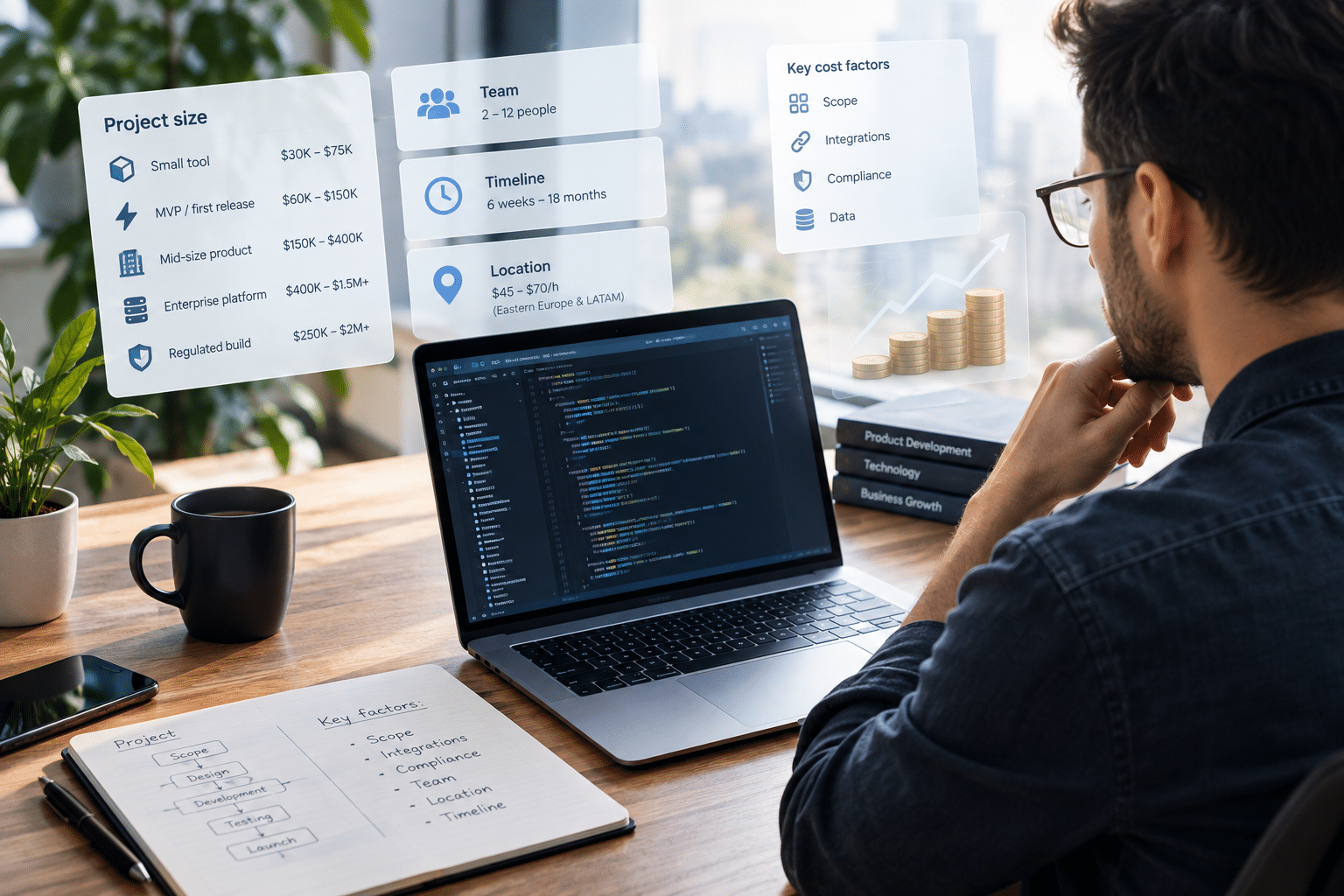
Custom software development cost: Real ranges, rate cards, and how to budget
How much custom software development costs. Explore real pricing ranges, hourly rates, key cost factors, hidden expenses, and budgeting tips. -
 September 2, 2026Read in 36 min.
Fitness app development companies: An independent shortlist
10 fitness app development companies compared on verified data, published pricing, and real client work. Only three have documented fitness delivery. -
 August 27, 2026Read in 36 min.
Top software development companies in the USA
Find the best US-based software developers. From AI to enterprise web apps, here are the top 30 software development companies in the USA you should hire in 2026. -
 August 19, 2026Read in 22 min.
Robotic Process Automation in healthcare: Definition, benefits, and real cases
From patient scheduling to claims processing: explore proven RPA use cases in healthcare, backed by real data, ROI benchmarks, and compliance guidance. -
July 16, 2026Read in 18 min.
Top 10 Banking Software Development Companies in the US
An independent, verified list of the top banking software development companies in the US, plus a practical guide to choosing the right partner -
 June 30, 2026Read in 10 min.
Software development company in Boston: Custom solutions for a research-driven city
Boston software development company building HIPAA-aware healthcare, biotech, and enterprise software on .NET and Azure. Microsoft Solutions Partner, 4.8/5 on Clutch -
 June 18, 2026Read in 10 min.
Software Development Company in Washington State: Custom Solutions Across the Region
Software development company serving all of Washington State. Cloud-first custom software on .NET and Azure. Microsoft Solutions Partner since 2009. -
June 17, 2026Read in 12 min.
Software Development Company in Seattle: Cloud-First Custom Solutions
Seattle software development company building cloud-first custom software on .NET and Azure. Microsoft Solutions Partner trusted since 2009. Talk to us -
 June 11, 2026Read in 22 min.
Top 10 SEO Companies in the USA: An Honest, Research-Backed Guide
We compared 40+ professional SEO agencies on verified reviews, case studies, pricing, and AI search expertise — and ranked the top 10 with honest pros and cons.