
Telecom software development companies build the systems operators use to run their business and their networks. That covers billing, CRM, network management, network software, and customer apps. Some sell ready-made platforms, and others provide engineering teams that build custom software.
The best telecom software development companies

 20 minutes read
Content
Search for telecom software development companies, and you’ll find list after list. All claim expertise, but do they actually offer what you’re looking for? Do they have real experience? Can they commit to a multi-year partnership?
We checked many companies offering telecom software development and picked 12 with the most solid profiles. They have proven expertise in the field and are known for reliability and a client-oriented approach. The list splits into two groups: platform vendors, which sell you software, and engineering partners that sell you teams to build it.


Looking for an engineering partner for your telecom software?
Blackthorn Vision builds custom AI-powered software and extends the telecom platform you run.
What telecom software development companies do
Telecom operators vs telecom software companies
Operators such as AT&T, Vodafone, or Telefónica own networks and sell connectivity. Telecom software companies build the systems those operators run on: billing, order handling, network monitoring, and customer apps. Search results often blur the two. If a company’s main revenue comes from phone and broadband subscriptions, it’s an operator. You’d buy from it as a customer, and it’s not a candidate for your software project.
Platform vendors vs engineering partners
A platform vendor sells packaged telecom software solutions that you license and configure. You share a roadmap with the vendor’s other operator clients and get upgrades under a support contract. Customization happens inside the product’s limits.
An engineering partner sells skilled people’s time through telecom software development services. The partner builds what you specify, connects the platform to your other systems, or runs a dedicated team. You own the code and the roadmap, and also carry more of the delivery risk.
The telecom software stack: BSS, OSS, network and digital layers
Most telecom software fits into one of five layers, and each one usually has a different owner inside the operator. Billing sits with finance, network software sits with engineering, and customer apps often sit with marketing. Vendors usually lead in one layer and touch two or three others. So when a vendor says it covers “the full stack,” ask which layer its biggest customers bought it for.
| Layer | What it does | Common parts |
| BSS (business support systems) | Runs the money and customer side | Product catalog, ordering, billing, charging, CRM |
| OSS (operations support systems) | Runs the network as a service | Inventory, service orchestration, fault and performance monitoring |
| Network software | Software that is the network | Mobile core, IMS (voice over 4G and 5G), radio access software |
| Digital layer | What customers and partners touch | Apps, self-care portals, websites, partner APIs |
| Data and AI | Spans every layer | Analytics, churn models, AI agents for care and operations |
Understanding BSS and OSS
Picture a customer buying a 5G plan. The BSS takes the order, checks credit, sets the price, and sends the monthly bill. The OSS finds network capacity, activates the SIM and the service, and watches for faults.
The trouble sits at the handoff. If an order in the BSS doesn’t match the inventory in the OSS, customers pay for service they don’t get, or get service they don’t pay for. TM Forum, the industry body for operator software, publishes Open APIs that standardize this handoff. Ask a vendor how its product uses them.
The best telecom-native platform vendors
These seven are telecom software companies you buy from. They sell licensed software built for operators. You pay for the product, and most of these vendors also charge to set it up and support it. Some, like Amdocs, will run the whole system for you under a managed services contract. You’ll still need integration work to connect the platform to your other systems, either from the vendor’s own services arm or from a partner.
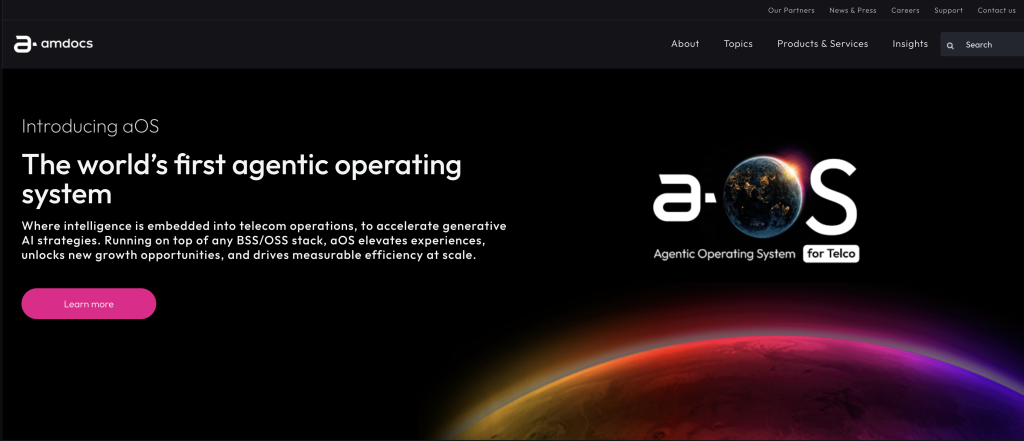
1. Amdocs: for large-scale BSS, managed services and customer experience
Amdocs is the largest specialist on the list. It reported revenue of $4.53 billion for fiscal 2025, which ended September 30, 2025. Managed services brought in a record $2.996 billion of that, about two-thirds. Put simply, most operators that buy from Amdocs also pay it to run the systems day to day.
Its annual 20-F filing names its biggest customers. AT&T accounted for 25.9% of revenue and T-Mobile for 19.9%, and the ten largest customers made up about 70%.
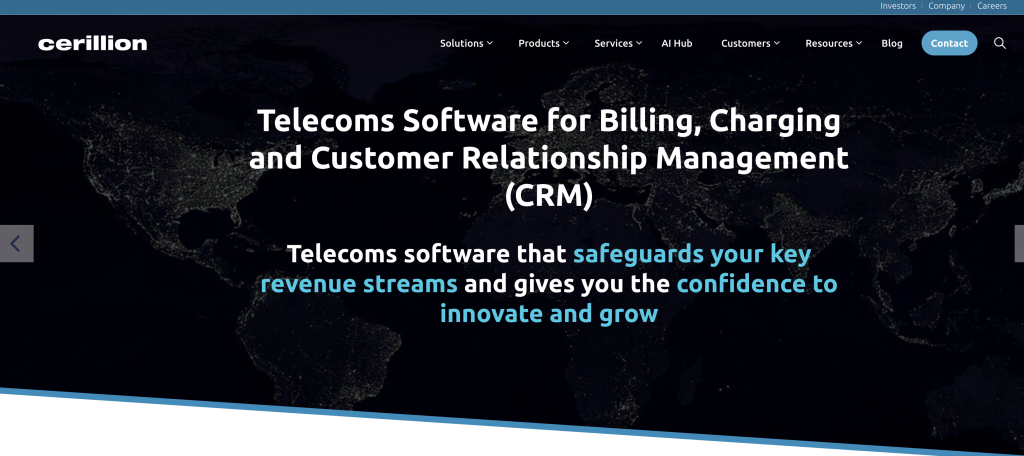
2. Cerillion: for converged billing, charging and CRM
Cerillion is a London-based vendor listed on AIM. It reported revenue of £45.4 million for the year to September 30, 2025, from about 70 customer installations across about 45 countries. Its suite bundles billing, charging, and CRM into one pre-integrated BSS/OSS product, and the 25.2 release added AI agents.
The same results name a new customer, Ucom in Armenia, on an $11.4 million contract over five years. They also report completed rollouts for Virgin Media Ireland and Paratus.
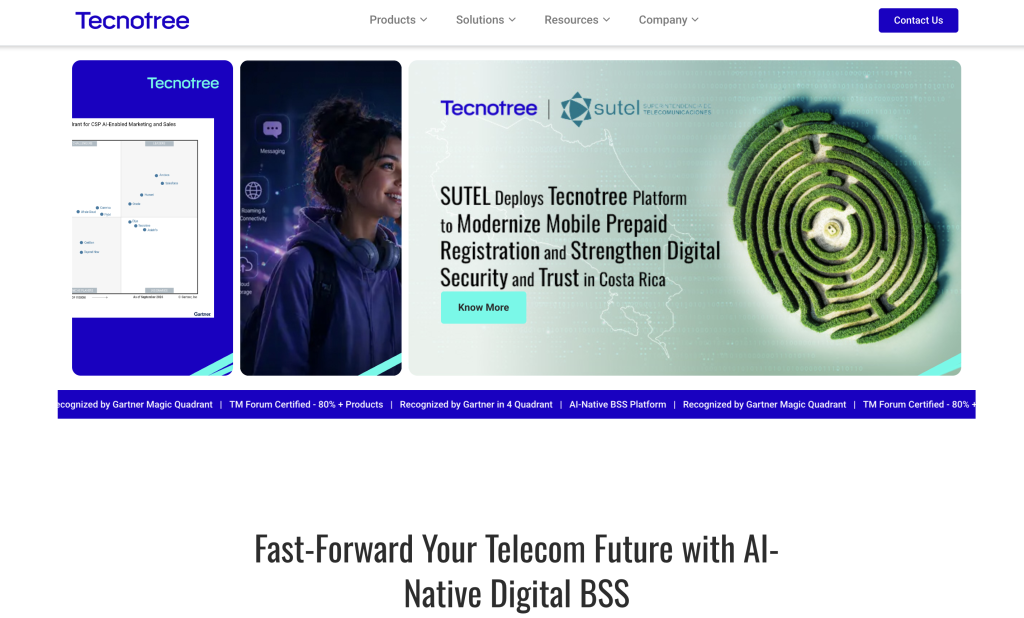
3. Tecnotree: for AI-native BSS and digital B2B2X platforms
Tecnotree is a Finnish vendor listed on Nasdaq Helsinki. It reported net sales of €72.4 million for 2025 and 704 staff at year-end. Its products cover digital BSS, AI for operator operations, and B2B2X, a model in which an operator resells partners’ digital services to its own subscribers.
Named public work includes Emtel in Mauritius, which picked Tecnotree in 2023 to replace its legacy BSS. In June 2025, Tecnotree signed a five-year BSS deal worth about $19.6 million with a global MVNO for the UK and Europe, though it didn’t name the customer.
| N | Company | Ownership | Latest scale | Named telecom work |
| 1 | Amdocs | Listed on NASDAQ | $4.53B revenue, fiscal 2025 | AT&T 25.9% and T-Mobile 19.9% of revenue |
| 2 | Cerillion | Listed on London’s AIM | £45.4M revenue, year to September 30, 2025 | Ucom (Armenia) five-year deal; Virgin Media Ireland |
| 3 | Tecnotree | Listed on Nasdaq Helsinki | €72.4M net sales, 2025 | Emtel (Mauritius), 2023 |
| 4 | Ciena Blue Planet | Unit of NYSE-listed Ciena | $115.5M segment revenue, fiscal 2025 | Telefónica Germany, 2025 |
| 5 | Comarch | Private, CVC Capital Partners and founding family | 50+ operators use its BSS/OSS | TDC (Denmark), 2020 |
| 6 | Netcracker | Owned by NEC since 2008 | Not reported separately | Cox Communications, extended October 2025 |
| 7 | Mavenir | Private, controlled by Siris Capital | Not reported | Vodafone Portugal, 2022 |
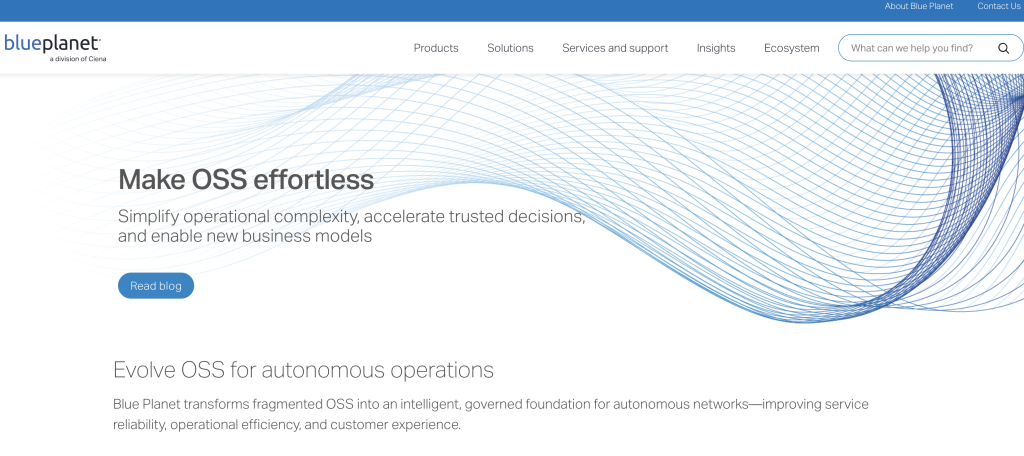
4. Ciena Blue Planet: for network automation and service orchestration
Blue Planet is the software unit of Ciena, a US optical networking company. Its segment revenue reached $115.5 million in fiscal 2025 (ended November 1, 2025), up from $77.6 million a year earlier, or roughly 49% growth. The products handle network inventory, service orchestration across several equipment vendors, and assurance.
In 2025, Telefónica Germany chose Blue Planet inventory, multi-domain orchestration, and 5G network slicing to automate services across its radio, transport, and core networks. Good fit for operators modernizing OSS on a network built from several vendors’ equipment.
5. Comarch: for BSS and billing from a broad IT group
Comarch is a Polish software group founded in 1993 in Kraków. Telecom is one of several lines, alongside banking, retail, and public sector software. More than 50 operators use its BSS/OSS systems, including Orange, Telefónica, T-Mobile and Vodafone.
A clear dated example is TDC in Denmark, which picked Comarch in 2020 for wholesale CRM, ordering and convergent billing built on TM Forum Open APIs. In 2024, CVC Capital Partners and the founding Filipiak family launched a tender offer to take Comarch off the Warsaw Stock Exchange, and the Polish regulator approved the delisting in 2025.
6. Netcracker: for full-stack BSS and OSS transformation
Netcracker covers both business and network systems, plus professional services. NEC completed its purchase of Netcracker in October 2008, and it runs as a wholly owned subsidiary.
In October 2025, Cox Communications extended its BSS and services deal with Netcracker, a relationship that runs back more than 30 years. In May 2026, NEC closed its acquisition of CSG Systems, and Netcracker now leads CSG’s operations and integration.
7. Mavenir: for cloud-native network software and Open RAN
Mavenir sells network software: mobile packet core, IMS for voice calls over 4G and 5G, and Open RAN radio software that runs on standard servers. Vodafone Portugal picked its 5G packet core in 2022 for its standalone 5G buildout. Other named operators include Virgin Media O2 for Open RAN and AT&T for Open RAN radios.
In July 2025, Mavenir completed a recapitalization that removed more than $1.3 billion of debt and added $300 million of new financing, with Siris Capital as the controlling shareholder. It’s shifting Open RAN investment from hardware to software and putting more weight on its core network business.
Engineering and services partners
An engineering partner provides telecom software development services. You hire its engineers to build custom software for your business or to connect a vendor platform to the systems you already run. A partner can also modernize old code or run a long-term team on your product. You keep more control over what gets built, and you take on more of the project management.
Blackthorn Vision works as a partner of this kind. We’re a Microsoft-partnered .NET and AI development company that helps enterprise teams build and modernize complex software products. In telecom projects, our engineers connect vendor platforms to existing systems and build AI tools for customer care and network operations.
Below are five more engineering partners operating in the telecom field that deserve your attention.
1. Tech Mahindra
Tech Mahindra is an Indian IT services group with revenue of $6.39 billion in fiscal 2026, which ran from April 2025 to March 2026. Communications is its largest business line, accounting for about a third of revenue, and it had 147,623 employees at year-end.
Its best-known telecom contract is a multi-year agreement with AT&T signed in 2019 and reported at about $1 billion. Under it, Tech Mahindra took over many of the applications that run AT&T’s network and set out to modernize them.
2. N-iX
N-iX is a software engineering company with about 2,400 experts. More than 300 of them have telecom experience, and the team has delivered over 50 telecom projects.
Its telecom clients include Lebara, a mobile operator that rents network capacity. The work includes a mobile top-up app, a post-paid service built from scratch, a CRM upgrade, and omnichannel team-building features for Lebara’s sales channels. Gogo, an in-flight connectivity provider, is named for data warehouse work.
Planning a platform with an independent partner?
Blackthorn Vision can take the partner role, connecting the platform to your billing and CRM systems and building the custom apps on top.
3. Software Mind
Software Mind is a Polish software engineering company. Its telecom case studies cover network-side work: a steering-of-roaming platform that decides which partner network a roaming phone joins, a network management system for alarms, and a platform that exposes CAMARA-certified network APIs.
Its telecom clients include Alianza, a cloud communications provider, as well as CSL and Andorra Telecom.
4. EPAM: best for enterprise-scale digital engineering where telecom is one of several verticals
EPAM is a NYSE-listed engineering company with about 62,850 employees at the end of 2025. In its annual 10-K filing, telecom sits inside a group called “Emerging Verticals,” with no separate revenue figure.
Its telecom work includes Liberty Global’s Connect app, BT Enterprise’s web platform, and Fastweb’s FASTGate modem. Its staff holds more than 550 TM Forum certifications. Good fit for large operators that need digital product engineering across apps, web, and data, with the backing of a big public company.
5. Intellias: best for BSS and OSS engineering with connected-services work
Intellias is a software engineering company with more than 3,000 experts. Its telecom services cover BSS integration, billing and CRM customization, network planning, 5G core virtualization, and VoIP apps. The same company does connected-car and IoT work, which helps if your project mixes telecom with automotive or smart devices.
Its telecom clients include Amdocs, lifecell, and HERE, with case studies on back-office optimization and network capital planning. Great fit for BSS and OSS engineering that overlaps with connected services.
Well-known companies that didn’t make the list
Ericsson, Nokia, and Huawei sell a lot of telecom software, mostly as part of their network equipment, so buying from them is an equipment decision that deserves its own comparison. Huawei gear has also been on the FCC Covered List since March 12, 2021, and the FCC no longer approves new equipment from it. CSG Systems and Openet are missing because they’re now part of Netcracker and Amdocs. Blackthorn Vision isn’t here either, since we build .NET, cloud, and AI software and don’t yet have a named telecom operator to point you to.
Platform or partner: which telecom software company you need
The choice comes down to one question: is the software you need the same for every operator, or is it what sets you apart? Billing, charging, and network inventory work much the same way at most operators. For those, a tested platform is usually cheaper and safer than building from scratch. A new B2B product or a customer app your rivals can’t copy quickly is different, because nobody sells it off the shelf. That’s where an engineering partner earns its fee. Most projects mix both kinds of work, and the matrix below shows which side each common situation tends to fall on.
Decision matrix
| Your situation | Usually buy (platform) | Usually hire (partner) |
| Billing system near end of life | Yes, a BSS platform | Yes, for data migration and testing |
| Need a custom customer app or partner portal | – | Yes |
| Automating services across several network vendors | Yes, an OSS or orchestration platform | Sometimes, for integration |
| Launching a product competitors can’t copy quickly, such as B2B IoT bundles | Use your platform’s APIs | Yes, to build it |
| Security code deadline on existing systems | – | Yes |
| Little in-house engineering | Yes, with managed services | Sometimes, to keep a second opinion |
Common combinations
The simplest setup is a platform plus the vendor’s own services. One supplier answers for everything, though you get less room to negotiate on price. Another option pairs the platform with an independent engineering partner. The vendor owns the core billing or OSS product. The partner provides telecom software development services for integration and the custom digital layer.
Large operators can also split the work between a big integrator and a specialist team. The integrator runs day-to-day operations, while the smaller team builds new products where speed counts. On the network side, you can mix software from different suppliers. For example, a cloud-based mobile core from one vendor can be managed by an orchestration layer from another.
Need a team to build around your platform?
We provide dedicated development teams that build the integrations and custom apps your telecom platform doesn’t offer.
How to choose a telecom software development company
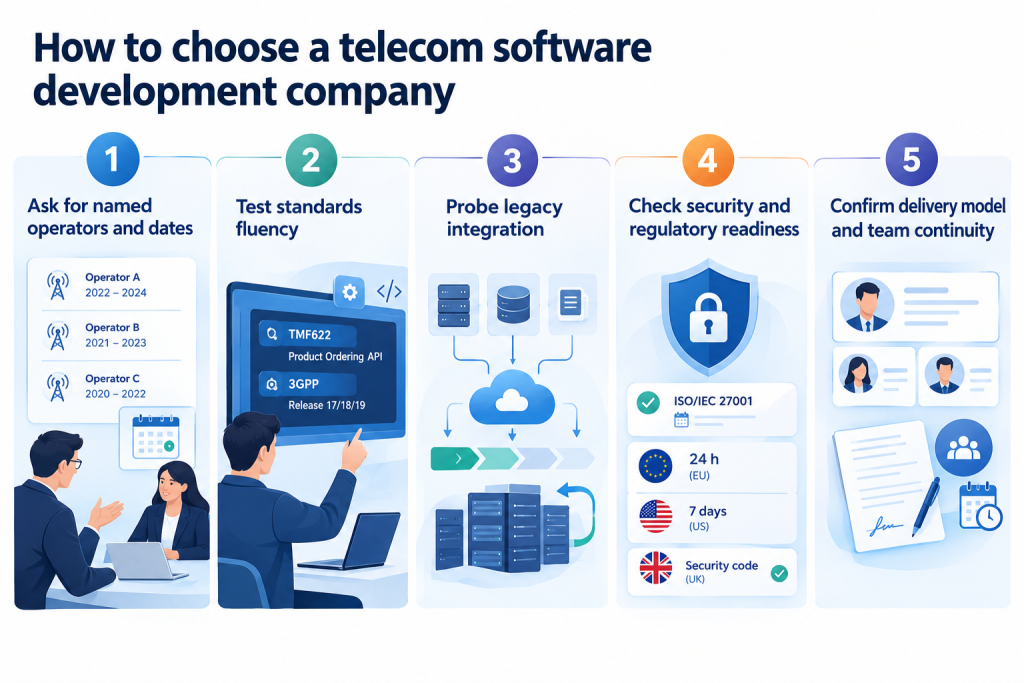
Step 1: Ask for named operators and dates
Ask for three operators the vendor has worked with in the last three years, with the scope and the go-live date. Then ask for one reference call. A vendor that can’t name a single operator, even under NDA, goes to the bottom of the pile.
Step 2: Test standards fluency
Pick a real process, such as a customer changing plans mid-month, and ask the vendor to walk through it. Listen for TM Forum Open API names such as TMF622, the product ordering API, and for 3GPP release numbers on anything network-side. Vague answers here usually mean expensive custom integration later.
Step 3: Probe legacy integration
Ask about the hardest migration the team has run: how many subscribers, how many old systems, and how the cutover worked. Did they move everyone in one weekend or in waves? What was the rollback plan, and did they use it?
Step 4: Check security and regulatory readiness
Ask for current security certifications with dates, such as ISO/IEC 27001. Then ask how the vendor would support your breach-reporting deadlines: seven business days for US federal agencies and 24 hours for an EU early warning. If you operate in the UK, ask how the product maps to the telecoms security code of practice.
Step 5: Confirm delivery model and team continuity
Ask for the names and CVs of the people who’d lead your project. Ask about staff turnover on telecom accounts over the last year. Put key people in the contract, with a notice period and an approved replacement process if anyone leaves.
Telecom regulations and standards your software has to handle
Many telecom rules apply directly to software. They affect how your systems store customer data and how they report security incidents. Some even control what your network has to do for law enforcement. Your operator license makes you responsible for meeting these rules, even if a third party built the software. That’s why compliance belongs in vendor selection, not just in your legal review.
When you compare vendors, ask which regulations their product already supports in your markets. Also ask how they handle updates. Your contract should state who is responsible for each requirement, so nothing falls between your team and the vendor’s. The main rules for the US, the EU, and the UK are below.
United States
- Customer data and breach reporting. Carriers must protect customer proprietary network information (CPNI), the data about who customers call and what they use. Under FCC rules released December 21, 2023, carriers and interconnected VoIP providers must report breaches to the FCC, the Secret Service, and the FBI within seven business days. Customer notice follows within 30 days in most cases, and the rules now cover personal data beyond CPNI.
- Lawful intercept. CALEA requires networks to support authorized law enforcement surveillance. Any software that touches call or session handling has to keep that capability working.
- Supply chain limits. The FCC Covered List names equipment and services, including Huawei and ZTE gear, that the FCC treats as a national security risk. New equipment from listed makers can’t get FCC approval.
- Caller ID authentication. Voice providers must sign and verify calls under the STIR/SHAKEN framework to fight robocalls.
European Union and United Kingdom
- Network security. The NIS2 Directive covers electronic communications providers. It requires an early warning within 24 hours of a significant incident, a fuller notification within 72 hours and a final report within a month. Fines for the largest providers can reach €10 million or 2% of worldwide turnover, whichever is higher.
- Consumer rules. The European Electronic Communications Code sets rules on contract summaries and switching providers. Those land in your BSS as order flows and customer documents.
- Personal data. GDPR applies to every subscriber record, including call and location data.
- UK telecoms security. The Telecommunications (Security) Act 2021 and the 2022 security measures regulations set binding duties, and Ofcom checks providers against a code of practice. The revised code issued July 14, 2026 adds measures on network automation, signaling and APIs, with deadlines in March 2028, December 2028 and December 2029. The government puts the cost at £1.9 million to £3.2 million one-off per provider, plus £285,000 to £445,000 a year.
Technical standards you as a buyer should know:
| Standard | What it covers | What to ask |
| 3GPP releases | Mobile network specs, from 4G through 5G | Which release does your network software support today? |
| TM Forum Open APIs and ODA | Standard interfaces and architecture for operator IT | Which APIs are certified, and at which version? |
| O-RAN Alliance specs | Open interfaces between radio parts from different vendors | Which interfaces have you tested with other vendors? |
| CAMARA and GSMA Open Gateway | Network APIs that developers can call, such as SIM swap checks | Which APIs have you shipped to production? |
| ETSI NFV | Running network functions as software on standard servers | Which cloud platforms are certified? |
| ISO/IEC 27001 | Information security management | When does your certificate expire, and what’s in scope? |
Telecom software development cost and engagement models
No honest vendor can price a telecom program from a single call, whether it sells a platform or telecom software development services. However, you can control how you pay and what you ask them to estimate.
Pricing models
| Model | How you pay | Works best when | Main risk |
| Licence plus implementation | Upfront or yearly licence, plus project fees | You’re buying a platform | Change requests inflate the project fees |
| Subscription (SaaS) | Monthly or yearly per subscriber or usage | You want fast setup and fewer servers to run | Costs grow with your subscriber base |
| Fixed price | One agreed price for a defined scope | Scope is small and clear | Vendor pads the price or fights every change |
| Time and materials | Hourly or daily rates for actual work | Scope will change as you learn | Budget drifts without strong tracking |
| Dedicated team | Monthly fee for a stable team | Long-running product work | You manage priorities yourself |
| Managed services | Multi-year fee to run systems for you | You’d rather not staff operations | Hard to switch suppliers later |
The biggest cost driver is how many systems the new software has to talk to. Each integration needs its own design, testing, and ongoing upkeep. Data migration comes next. Old billing systems carry years of special offers, legacy price plans, and messy records, and each has to land correctly in the new system.
Regulation adds a fixed layer of work. The UK government’s estimate of £1.9 million to £3.2 million one-off per provider for the revised security code shows the scale. Team location changes the rate card. In the US, the median software developer earned $135,980 in May 2025 before benefits, which is a useful baseline for comparing in-house hiring with telecom software outsourcing.
How to get a defensible estimate
- Pay for a short discovery phase before the main contract. You’ll get an estimate built on your data, and you can walk away if it doesn’t fit.
- Ask for estimates by component, each with written assumptions.
- Ask for a range with a contingency line. Large IT projects run over budget by 45% on average, according to the McKinsey and Oxford study cited above.
- Compare proposals line by line, using the same scope for every vendor.
- Tie payments to milestones you can test, such as a migrated customer segment billing correctly.
Telecom software trends that change vendor choice in 2026
The telecom software market has changed a lot in two years, and those changes affect which supplier you can count on for a multi-year program. Ownership keeps shifting. NEC closed its CSG deal in May 2026 and put Netcracker in charge. Comarch went private under CVC, while Mavenir cut more than $1.3 billion of debt in a 2025 recapitalization.
Networks are also running with less manual work. A March 2026 TM Forum report found that 21% of respondents run their networks at Level 3 or above on its five-level autonomy scale, and AI agents are pushing some network domains to Level 4. China Mobile reported 30% shorter repair times after reaching that level in its network operations centers.
Open RAN now lets operators mix radio parts from different suppliers, a shift AT&T backed with about $14 billion over five years in 2023. Operators also sell network functions, such as SIM swap checks, as APIs that banks and app makers can call. By early 2026, 81 operator groups had joined GSMA Open Gateway, and the CAMARA project listed 73 live APIs in December 2025.
For buyers, this comes down to one planning question: which parts of your stack you license as a platform and which parts you build. Platforms will keep running billing and network operations. New products, such as network APIs and AI tools for operations, need engineering teams that can build fast, and that’s where an engineering partner’s telecom software development services fit best.
Building a custom layer around your telecom platform?
Blackthorn Vision is a Microsoft-partnered .NET and AI development company with ISO 27001 certification.
FAQ
What are telecom software development companies?
Are telecom companies and telecom software companies the same thing?
No. Telecom companies, or operators, own networks and sell connectivity to customers. Software vendors build and sell the systems that operators run on. Some large operators also build software in-house, but that’s not their main business.
How can I verify a company's telecom experience?
Ask for named operators with dates and scope, then ask for a reference call. Check the company’s annual filings if it’s listed, and search for dated press releases that name the operator. A telecom software development company with real telecom work can usually pass all three checks within a week.
Should telecom operators outsource software development?
Many do, for work that a vendor or partner can deliver faster than an in-house hire. Telecom software outsourcing suits integration, custom apps, modernization, and extra capacity. Keep product decisions and architecture ownership in-house, and put key people and code ownership in the contract.
Which companies provide telecom billing software?
On this list, Amdocs, Cerillion, Tecnotree, Comarch and Netcracker all sell billing as part of their telecom software solutions for BSS. Cerillion focuses on converged billing, charging and CRM for mid-size operators. Amdocs and Netcracker serve the largest operators.
What is the difference between OSS and BSS?
BSS runs the customer and money side: orders, pricing, billing, and CRM. OSS runs the network side: inventory, activation, and fault monitoring. The two must stay in sync, or customers get billed for services they don’t receive.
How long does telecom software development take?
A self-contained app or portal can go live in a few months. A billing or OSS replacement at a large operator usually takes years, because migration, testing, and regulatory checks run in phases. Ask vendors for go-live dates from past projects of a similar size.
How much does telecom software development cost?
It depends on scope, the number of systems involved, and how much data moves. A small custom app might take a few months with a small team, while a full BSS replacement at a large operator is a multi-year program. Get a component-by-component estimate after a short paid discovery phase.
What is the difference between a telecom software vendor and a software development partner?
A vendor sells a licensed product that many operators share, along with upgrades and support. A partner provides telecom software development services: engineers who build, integrate or modernize software to your specification. Many operators use both at once.
Who are the biggest telecom software companies?
Among specialists, Amdocs is the largest on this list, with $4.53 billion in fiscal 2025 revenue. Netcracker, now combined with CSG under NEC, is another major BSS and OSS supplier. Network equipment makers such as Ericsson and Nokia also sell a lot of telecom software, mostly bundled with their hardware.
You may also like
-
 September 8, 2026Read in 16 min.
The AI-Native SDLC: From Writing Software to Orchestrating It
An AI-native SDLC cuts delivery time by about half without loosening a single quality gate. See the three eras, the toolchain and the guardrails. -
 September 4, 2026Read in 36 min.
Custom software development cost: Real ranges, rate cards, and how to budget
How much custom software development costs. Explore real pricing ranges, hourly rates, key cost factors, hidden expenses, and budgeting tips. -
 September 2, 2026Read in 36 min.
Fitness app development companies: An independent shortlist
10 fitness app development companies compared on verified data, published pricing, and real client work. Only three have documented fitness delivery. -
 August 27, 2026Read in 36 min.
Top software development companies in the USA
Find the best US-based software developers. From AI to enterprise web apps, here are the top 30 software development companies in the USA you should hire in 2026. -
 August 19, 2026Read in 22 min.
Robotic Process Automation in healthcare: Definition, benefits, and real cases
From patient scheduling to claims processing: explore proven RPA use cases in healthcare, backed by real data, ROI benchmarks, and compliance guidance. -
July 16, 2026Read in 18 min.
Top 10 Banking Software Development Companies in the US
An independent, verified list of the top banking software development companies in the US, plus a practical guide to choosing the right partner -
 July 16, 2026Read in 17 min.
Custom ERP software for manufacturing – Built on Azure and .NET
Off-the-shelf ERP forcing workarounds? Blackthorn Vision, a manufacturing software company, builds ERP software for manufacturing on Azure and .NET. -
 June 30, 2026Read in 10 min.
Software development company in Boston: Custom solutions for a research-driven city
Boston software development company building HIPAA-aware healthcare, biotech, and enterprise software on .NET and Azure. Microsoft Solutions Partner, 4.8/5 on Clutch -
 June 18, 2026Read in 10 min.
Software Development Company in Washington State: Custom Solutions Across the Region
Software development company serving all of Washington State. Cloud-first custom software on .NET and Azure. Microsoft Solutions Partner since 2009. -
June 17, 2026Read in 12 min.
Software Development Company in Seattle: Cloud-First Custom Solutions
Seattle software development company building cloud-first custom software on .NET and Azure. Microsoft Solutions Partner trusted since 2009. Talk to us