

The cost to develop an app can vary significantly based on complexity, features, and the mobile app development agency’s location. Generally, a simple MVP (Minimum Viable Product) can range from $30,000 to $60,000, while a medium-complexity app with custom backends and integrations might cost between $80,000 and $150,000. Large-scale enterprise solutions with advanced AI or real-time data processing can exceed $250,000. A reputable custom app development company will provide a detailed “Time and Materials” or “Fixed Price” quote after a thorough discovery phase.
Top 10 mobile application development companies: Selection & industry leaders

 22 minutes read
Content
A mobile presence is no longer a luxury but a fundamental necessity for business survival and growth. As consumer behavior shifts almost entirely toward handheld devices, the demand for a sophisticated mobile application development company has skyrocketed. These organizations do not just write code; they act as strategic partners that translate complex business goals into functional, user-centric digital products. For a business to remain competitive, it must move beyond simple web interfaces and embrace the “Product Engineering” mindset, where every swipe and tap is optimized for engagement and conversion.
The global market is saturated with various app development companies, making the selection process daunting for many executives. However, the most successful projects are those that prioritize high-level architecture and a deep understanding of the end-user. Whether you are a startup looking to disrupt a niche or an enterprise aiming to streamline internal operations, the right mobile application development company will bridge the gap between your vision and technical reality. They provide the necessary expertise to navigate app store algorithms, security protocols, and the ever-changing habits of global mobile users.

Ready to turn your mobile vision into a reality?
Book a free 30-minute consultation with our expert mobile app developers today and receive a preliminary roadmap for your project. No strings attached.
Taxonomy of mobile development services
When engaging with a mobile application development services company, it is vital to understand the technological paths available. Native development remains the gold standard for high-performance requirements. By using platform-specific languages such as Swift for iOS or Kotlin for Android, mobile app developers can access the full suite of hardware capabilities, from biometric sensors to advanced camera processing. This path is ideal for apps that require maximum speed and a “seamless” feel, aligning perfectly with the operating system’s native UI patterns.
Conversely, many businesses now turn to an app development agency for cross-platform solutions. Using frameworks like Flutter or React Native, a single codebase can power applications on both major platforms. This approach significantly reduces “Time-to-Market” and lowers maintenance costs, making it a favorite for companies that need to test ideas quickly without compromising on quality. A versatile mobile development company will help you weigh the pros and cons of these technologies, ensuring that the chosen stack aligns with your long-term business objectives and user experience goals.
Beyond consumer-facing apps, a specialized mobile software development services provider often focuses on Enterprise Mobility and Progressive Web Apps (PWAs). Enterprise solutions focus on secure, internal tools that integrate with existing legacy systems. At the same time, PWAs offer a web-based experience that mimics a native app without requiring an app store download. By understanding these distinctions, you can better communicate your needs to a mobile development services provider and ensure that your project’s architectural foundation is built for both performance and growth.
The “Elite vendor” selection framework
Selecting the right mobile app development agency requires a rigorous vetting process that goes far beyond a simple portfolio review. The first pillar of evaluation is “Domain Expertise.” A firm might have a stunning design portfolio but lack the deep technical knowledge required for specialized sectors like FinTech or Healthcare, where data privacy and regulatory compliance are non-negotiable. When interviewing app development companies, ask for case studies that demonstrate their ability to solve complex logic problems and handle large-scale data integrations within your specific industry vertical.
The second pillar is the “Full-Cycle Development” methodology. A premier custom app development company does not simply take a list of features and start coding. They should offer a robust discovery phase involving market research, user persona creation, and technical feasibility studies. This ensures that the final product is not only technically sound but also market-ready. Furthermore, transparency in communication is non-negotiable. Top-tier mobile app developers utilize agile ceremonies, regular sprint demos, and transparent project management tools to keep stakeholders informed at every stage of the lifecycle.
Legal and operational security are critical when partnering with a mobile app development firm. It is essential to verify that the contract includes full transfer of intellectual property (IP) rights and comprehensive documentation. A reliable mobile application development company will have established protocols for code ownership, post-launch support, and bug-fixing guarantees. Without these safeguards, a business risks becoming “locked in” to a single vendor or, worse, losing control over its own digital assets. Always look for a partner who views the relationship as a long-term technical co-foundership.
Don’t build a product without a plan
Start with our high-impact Product Discovery Phase to validate your idea and define a technical blueprint that wins.
Top 10 mobile application development companies: at a glance
| Company | Headquarters | Clutch | Hourly rate | Best for |
|---|---|---|---|---|
| Blackthorn Vision | Lviv, Ukraine · est. 2009 | 4.8 / 24 reviews | $25 to $49 | Mobile front ends on .NET and Azure backends in regulated sectors |
| WillowTree | Charlottesville, Virginia · part of TELUS | 4.9 / 25 reviews | $150-$199 | High-traffic consumer apps for enterprise brands |
| Vention | New York · 20+ years | 4.9 / 100+ reviews | $50-$99 | Scaling an engineering team fast without loosening compliance |
| Mercury Development | Miami, Florida · est. 1999 | 5.0 / 33 reviews | $50-$99 | Long-lifecycle and hardware-adjacent products with clean IP handover |
| Fueled | New York and London | 37 reviews | $150-$199 | Brand-led launches where the app is the product’s public face |
| ELEKS | Tallinn, Estonia · est. 1991 | 31 reviews | $50-$99 | Apps that are one surface of a larger data or security platform |
| ScienceSoft | McKinney, Texas · est. 1989 | 42 reviews | $50-$99 | Regulated healthcare and finance builds needing certification evidence |
| Intellectsoft | New York · est. 2007 | 45 reviews | $50-$99 | Multi-year enterprise programs needing a full SDLC bench |
| Miquido | Kraków, Poland · est. 2011 | 51 reviews | $50-$99 | Mid-market products where AI and retention engineering are central |
| Cheesecake Labs | San Francisco and Florianópolis · est. 2013 | 64 reviews | $50-$99 | Extending an in-house team with nearshore engineers in overlapping hours |
Top 10 mobile application development companies
Below is the expanded list of the top 10 players in the industry. Each profile is crafted to reflect their current market standing, technical depth, and unique approach to digital product engineering.
1. Blackthorn Vision
Blackthorn Vision is a Microsoft Solutions Partner founded in Lviv, Ukraine in 2009, with delivery offices in Khmelnytskyi, Warsaw, and Wroclaw. The company is ISO 27001 certified and holds a 4.8 rating across 24 verified Clutch reviews.
Its mobile practice is built on the .NET stack rather than beside it. The team ships mobile clients in Xamarin and .NET MAUI that share a language, domain models, and engineers with the ASP.NET Core services behind them. For a company already running .NET on the server, that removes the handoff between backend and mobile which most agencies treat as unavoidable.
Three delivered products show the pattern. A herd genetics and breeding suite for a Canadian livestock genetics company combines four desktop applications with a mobile app that lets farmers organise and submit genetic samples in the field and read results without returning to a workstation. The software is in use in almost 90 countries and the engagement has run for more than eleven years. An Australian coaching platform pairs a web console for trainers with a Xamarin and MAUI client for athletes, driven by a configurable formula engine that generates individual weight prescriptions. A women’s strength and nutrition product, also Australian, feeds smartphone health data such as steps and sleep into a dynamic questionnaire that reshapes each user’s programme as the answers change.
The common thread is offline tolerance and long product lifecycles rather than consumer polish. These are applications used in barns, gyms, and field conditions, and maintained across three to eleven years of continuous engagement.
2. WillowTree
WillowTree is a Charlottesville, Virginia-based enterprise mobile app development company that has operated inside TELUS since January 2023, when TELUS International closed a $1.225 billion acquisition and rebranded it as WillowTree, a TELUS International Company. The studio kept its delivery brand and its Charlottesville base, but the entity you contract with now sits inside an organisation of more than 70,000 people running 69 delivery centres across 30 countries. Buyers evaluating WillowTree against independent app development agencies should price that in on both sides: deeper bench and global support, less of the founder-level attention a boutique offers.
The mobile portfolio is concentrated in high-traffic consumer applications where stability under load matters more than feature count. As experienced mobile app developers, WillowTree built the ESPN app, the Regal Cinemas loyalty app that won multiple customer experience awards, the Wyndham Hotels app, and the companion app for the PepsiCo Super Bowl Halftime Show. Other named clients include Verizon, Brightline, Fox News, and Johnson & Johnson.
Providing end-to-end custom mobile app development services, delivery pairs native iOS and Android engineering with in-house product strategy and UX research, which is why the studio is typically engaged at the concept stage rather than handed a finished specification. Clutch lists an average rate of $150 to $199 per hour with project sizes running from roughly $50,000 to just under $1 million, and a rating close to 4.9 across 25 verified reviews. That places WillowTree at the premium end of the US mobile app development market, appropriate when brand risk on a consumer launch outweighs the rate card.
3. Vention
Vention is a software development company with over 20 years of experience and more than 400 mobile applications delivered across fintech, healthcare, education, foodtech, and enterprise SaaS. The company covers native iOS, Android, and cross-platform development as part of broader product engineering engagements that include backend, cloud, and API layers, as well as wearable and connected device apps. For publicly traded StoneX, Vention built native iOS and Android trading apps for the Forex.com brand, now serving 330,000+ retail accounts across 180 countries. For ClassPass, 35+ engineers were onboarded within two months to build feature-rich mobile apps and a venue portal as the platform scaled from startup to IPO.
Vention’s mobile practice extends across regulated industries where compliance and data security are embedded at the architecture level. The company brings strong AI and ML capabilities to mobile apps, including computer vision, conversational AI, and predictive analytics, backed by 150+ AI projects delivered across its portfolio and dedicated AI Center of Excellence. Vention holds a 4.9 rating on Clutch across 100+ reviews and is a recognized AWS, Google Cloud, and Microsoft partner.
4. Mercury Development
Mercury Development has built mobile software from its Miami base since 1999, establishing itself as a seasoned custom mobile app development company with a track record almost a decade ahead of the App Store itself. Offering end-to-end mobile application development services, the team works across native iOS and Android alongside cross-platform delivery, and extends into machine learning, IoT, DevOps, and data engineering when an application needs more than a client layer.
As a long-standing app development company, its published figures need reading with care. Its Clutch profile cites more than 2,500 delivered projects, over 50 million active users, and 450 full-time employees. Its own website says 1,500 projects and 40 million users, and the Clutch employee bracket for the same firm reads 50 to 249. Both sets are self-reported and they do not agree. Named clients, also self-reported, include Google, HSBC, FitBit, Monster Energy, and Burger King.
What is independently verifiable is stronger than any of those numbers. Mercury holds a 5.0 rating on Clutch across 33 verified reviews, and one reviewed engagement has run since 2018 with cumulative client spend above $5 million. Rates sit in the $50 to $99 per hour band with a $25,000 project minimum, and documented projects range from $6,000 for a discovery phase to over $5 million.
The company states that all work is performed work-for-hire, with the client owning the source code and underlying IP. For a US-headquartered mobile development agency at half the rate of the premium tier, that combination of price, IP protection, and proven track record makes them a strong option among top app development companies.
5. Fueled
Fueled is a New York-based app development agency with a second office in London, built during the first wave of App Store development and now covering strategy, design, engineering, AI, and cloud infrastructure under one roof.
Its client list spans both ends of the market. On the enterprise side: Apple, Microsoft, Disney, The New York Times, JetBlue, and Harvard. On the public-sector side: platforms for the White House and the Mayo Clinic. Among startups, Fueled worked with Warby Parker and Compass before either became a household name. As a prominent mobile application development company, Fueled reports a team of more than 300 specialists, a figure that includes its 10up practice focused on enterprise WordPress.
Core mobile app development services are where the agency built its reputation, and the work remains design-led. As a sought-after app development agency, Fueled is engaged most often by companies that treat interface quality as a competitive asset rather than a cost line, and its pricing follows from that positioning. Clutch records 37 verified reviews with an average rate of $150 to $199 per hour and a $75,000 project minimum, with completed engagements ranging from roughly $36,000 to over $2 million.
That $75,000 floor is the highest on this list and functions as the clearest filter in either direction. If a discovery phase or a single-module build is what you need, Fueled is not structured for it. If the application is the public face of the brand and a mediocre interface would cost more than the rate card, the floor is doing its job.
6. ELEKS
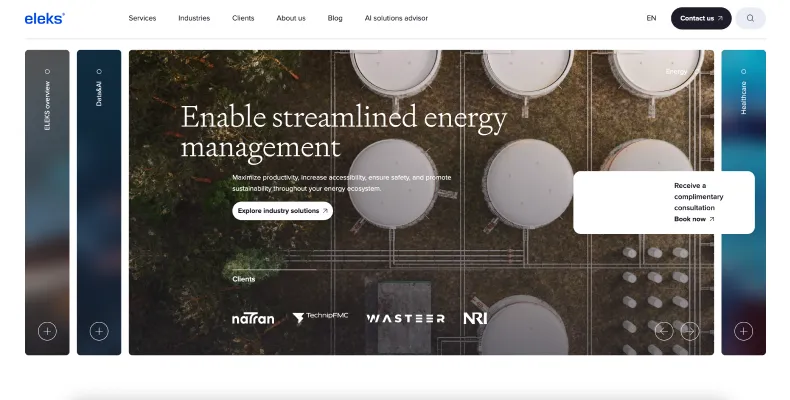
Operating globally, ELEKS maintains offices in Chicago, Las Vegas, London, Toronto, Berlin, Zürich, Amsterdam, and Tokyo. Three decades of continuous operation is this mobile development company’s central credential, and it shows in engagement length rather than in headline numbers: one Clutch-reviewed client has worked with ELEKS since March 2003, with cumulative spend above $1 million.
As an established mobile app development agency, the firm offers comprehensive app development services, reporting more than 2,000 engineers and over 1,000 completed end-to-end projects; LinkedIn places the headcount in a 1,001 to 5,000 bracket. Named clients include Vodafone, Gartner, AutoTrader UK, and Ring.
Mobile work sits inside a broader custom software development and consulting practice rather than standing alone. The firm’s depth is in data engineering, cybersecurity, and financial services, and mobile deliverables tend to arrive as one surface of a larger platform: a field client on top of an analytics system, an operator app against an industrial data layer. Teams that need a standalone consumer application with no backend problem to solve are buying capability they will not use.
Clutch lists 31 verified reviews, a rate band of $50 to $99 per hour, and a $25,000 project minimum, with engagements documented from €10,000 to over $4 million. Among global app developer companies, its recruiting runs largely through Lviv Polytechnic National University, which is where the long tenure of individual engineers on multi-year accounts originates.
7. ScienceSoft
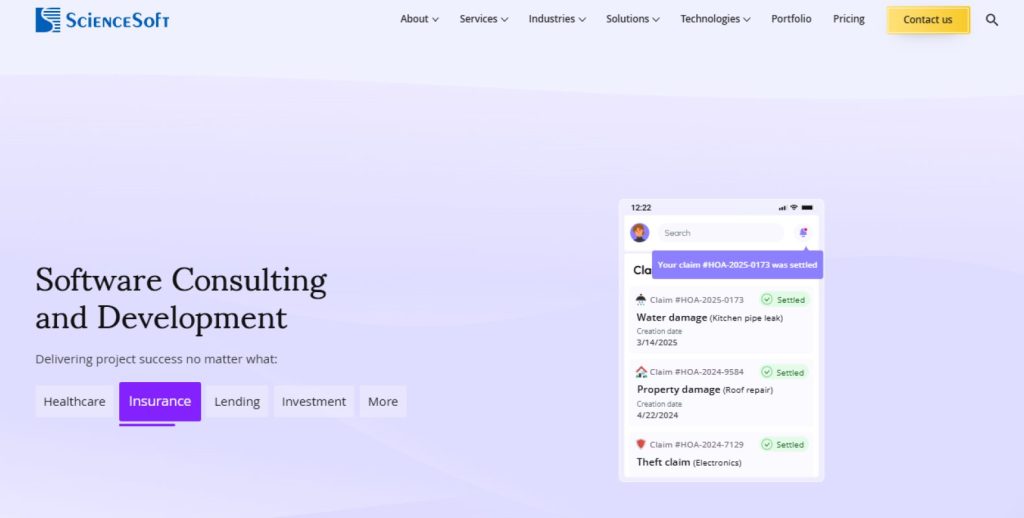
ScienceSoft is an IT consulting and mobile app development company founded in 1989 and headquartered in McKinney, Texas, with additional offices in Fujairah, Riga, Vilnius, and Warsaw. Thirty-seven years of continuous operation makes it the oldest company on this list.
Its certification set is the most complete here: ISO 9001, ISO/IEC 27001, ISO/IEC 27701, and ISO 13485, the last of which covers medical device quality management and is rare among software vendors. That matters for anyone seeking custom mobile app development services in healthcare or banking, where a buyer often has to evidence a supplier’s quality system rather than simply trust it. The company reports 750+ experts, 4,200+ delivered projects, and 1,400 clients; the Clutch employee bracket reads 250 to 999. Named clients include IBM, eBay, Viber, PerkinElmer, Ford, and Royal Bank of Canada.
One caveat belongs on the record regarding their mobile application development services. Mobile accounts for roughly a quarter of the service mix published on the company’s own Clutch profile, behind custom software development and IT managed services. Depth in regulated engineering is real; a mobile-first partner this is not.
Clutch lists 42 verified reviews and a $50 to $99 per hour rate band. The $5,000 project minimum makes them one of the most accessible app development companies for complex, regulated builds.
8. Intellectsoft
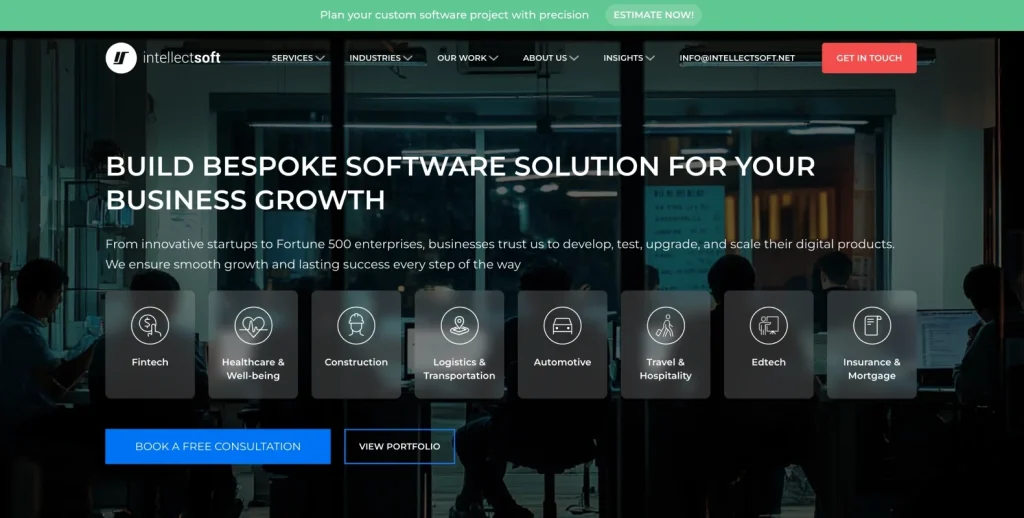
Intellectsoft was founded in 2007 as an enterprise mobile app development company and runs delivery across the US, UK, Norway, Ukraine, and Latin America. Its current Clutch profile lists New York as headquarters, while older directory entries still show Coral Gables, Florida. Confirm which legal entity appears on the contract before signing, since it determines governing law and data residency by default.
While offering specialized mobile application development services, the firm positions around broader enterprise digital transformation rather than standalone application builds, and its client list reflects that scale: Ernst & Young, Harley-Davidson, Jaguar, Universal Pictures, the London Stock Exchange, Qualcomm, and Bombardier. Mobile arrives as one component of a programme that usually also touches cloud infrastructure and ERP integration.
Engagements skew large and long. One reviewed project ran with roughly 80 Intellectsoft mobile app developers and specialists covering engineering, design, business analysis, QA, architecture, and project management, delivering a loyalty club application alongside its web platform. That staffing profile is the clearest available signal of fit: mid-market and enterprise programmes that need a full SDLC bench, not a six-person product squad.
Clutch records 45 verified reviews. Intellectsoft publishes neither an hourly rate band nor a headcount on that profile, which is the one gap in an otherwise well-documented vendor. Both are worth requesting in writing during evaluation, alongside the entity question above, because a firm that discloses commercial terms only under NDA is harder to benchmark.
9. Miquido
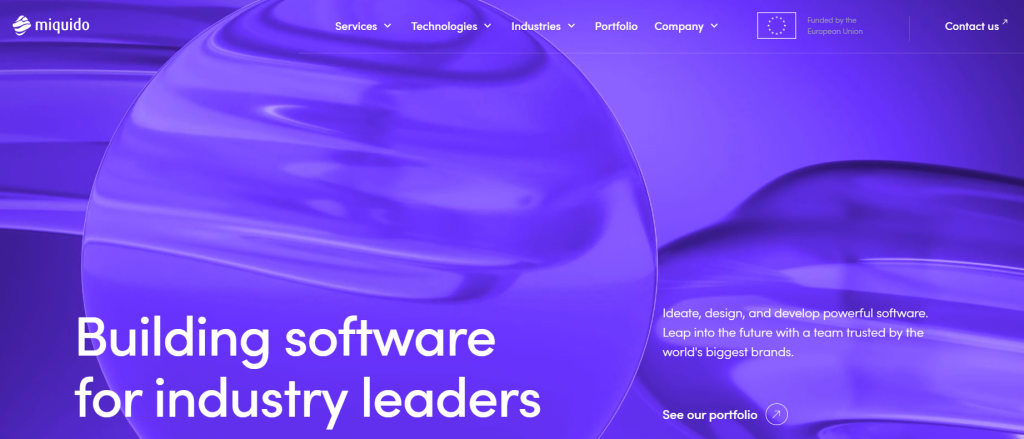
Miquido was founded in 2011 in Kraków, Poland, with additional offices in London, Berlin, and Zürich, and a team in the 50 to 249 bracket. It is the smallest company on this list by headcount and one of the most heavily reviewed, with 51 verified entries on Clutch.
The mobile stack centres on Flutter and React Native alongside native iOS and Android. A representative delivery is the Flutter application built for Diagnostyka, a Polish diagnostics network operating over 1,200 collection facilities and more than 50 automated testing laboratories, where the team handled UX design, new functionality, and custom integrations. Other named clients include Dolby Laboratories, Warner Music Group, BNP Paribas, and Skyscanner, a range that runs from early-stage startups to organisations above 10,000 employees.
Where Miquido differs from the larger firms here is the emphasis on what happens after launch. Product strategy, UX workshops, and behavioural analysis are sold as part of the engagement rather than as a discovery upsell, and the company’s AI work feeds personalisation and retention rather than sitting in a separate practice. For a product whose commercial problem is week-four churn rather than shipping at all, that ordering is the right one.
The published project minimum starts at $25,000. Miquido does not publish an hourly rate band. For mid-market European products, particularly in fintech, ecommerce, and healthtech, it occupies the space between a boutique and a delivery house.
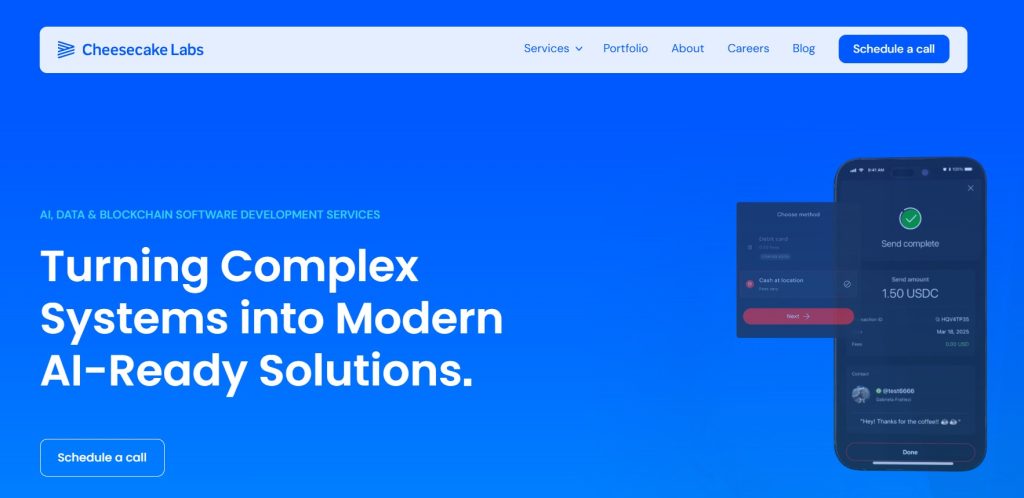
10. Cheesecake Labs
Cheesecake Labs was founded in 2013 and pairs a San Francisco headquarters with its main engineering centre in Florianópolis, Brazil. The practical consequence is a four-hour time offset rather than a full overnight handoff, which means a US product owner and a Brazilian engineer share most of a working day. For teams extending an in-house squad rather than outsourcing a project wholesale, that overlap is the entire proposition.
Clutch ranked the firm the number seven global mobile and web app development company in 2025 and the number one mobile app developer in San Francisco. Named clients include MoneyGram International, Mutual of Omaha, the Stellar Development Foundation, Bemis, and Tapcart. Delivery volume depends on which source you read: the Clutch profile cites more than 300 applications, the company website says 200 products built. Both are self-reported.
The mobile stack runs React Native and Flutter alongside native iOS and Android, with Python and Node.js behind them and cloud work across AWS, Azure, and GCP. Engagement models range from individual staff augmentation to fully dedicated squads.
Clutch lists 64 verified reviews, the largest sample of any company here apart from Vention, with a $50 to $99 per hour rate band and a $50,000 project minimum. Documented projects run from $10,000 to over $1 million. The combination of nearshore rates, US contracting, and a working-hours overlap is what separates this option from offshore delivery at a similar price.
Economics of app development: Understanding cost drivers
Understanding the financial landscape of a mobile app development company is crucial for realistic budgeting. The cost is rarely a flat fee; instead, it is driven by scope, complexity, and the level of innovation required. For instance, an app requiring a custom backend, real-time synchronization, and third-party API integrations will naturally command a higher price than a simple content-driven application. A reputable app development company will provide a transparent breakdown of costs, distinguishing between design, frontend development, backend architecture, and quality assurance.
The geographic location and team composition of a mobile app development services provider also play a significant role in pricing. While it may be tempting to choose the lowest bidder, savvy businesses understand that “cheap code is expensive to fix.” A high-quality app development agency invests in senior-level talent, including dedicated Project Managers, UI/UX Specialists, and Lead Architects. This ensures that the code is scalable and maintainable. Investing in a mobile application development services company that prioritizes high-quality architecture will ultimately save money by reducing “technical debt” and minimizing the need for extensive post-launch rewrites.
Beyond the initial build, a professional mobile software development services provider will emphasize the importance of maintenance and post-launch evolution. Apps are not static products; they require constant updates to remain compatible with new OS versions and hardware. A strategic mobile development company will help you plan for these ongoing expenses, ensuring your budget covers not just the “Launch” but the first year of optimization. By viewing app development as a continuous investment rather than a one-time purchase, you ensure the longevity and success of your digital product in a competitive market.
Emerging technologies integration
To remain at the forefront of the digital economy, a leading mobile application development company must do more than follow current trends; it must anticipate the next wave of innovation. Today, the integration of Artificial Intelligence (AI) and Machine Learning (ML) has transitioned from a niche feature to a core requirement for many app development companies. Whether through predictive analytics, natural language processing for chatbots, or personalized recommendation engines, these technologies enable mobile app developers to create experiences that feel intuitive and hyper-relevant to each user.
Furthermore, the rise of the Internet of Things (IoT) and Edge Computing has expanded the horizon for any mobile app development agency. A sophisticated mobile application development services company is now tasked with connecting handheld devices to a vast ecosystem of smart hardware, ranging from wearable health monitors to industrial sensors. This requires a deep understanding of low-latency communication protocols and robust data synchronization. By partnering with a mobile development company that stays ahead of these curves, businesses can ensure their products remain functional and competitive as the hardware landscape evolves.
The security implications of decentralized technologies, such as Blockchain, are becoming a focal point for mobile software development services. Beyond cryptocurrency, these technologies offer high-integrity data logging and secure identity management, which are vital for sectors like logistics and legal tech. A forward-thinking mobile development services provider will help you navigate these complex integrations, ensuring your application is not just a standalone tool but a secure node in a modern, larger digital infrastructure.
Risk mitigation: Red flags to watch out for
Navigating the sea of app development companies requires a keen eye for “red flags” that could signal future project failure. One of the most significant warnings is a lack of a dedicated “Discovery Phase.” If a mobile app development firm is willing to give you a hard quote and a timeline without first conducting a deep dive into your business logic, user personas, and technical requirements, they are likely overpromising. This often leads to “scope creep” and budget overruns later in the process, as the mobile app development agency realizes the complexity was greater than initially estimated.
Another critical warning sign is a lack of transparency regarding the quality assurance (QA) process. A professional mobile apps development company should have a rigorous testing protocol that includes automated testing, manual regression tests, and user acceptance testing (UXT) across various devices and OS versions. If an app development agency treats QA as an afterthought or an “extra” service, the risk of a buggy launch increases exponentially. Always ask a potential custom app development company about their bug-tracking systems and how they handle post-release stability.
Lastly, be wary of companies that develop apps but offer no clear path for code ownership or documentation. A “black box” development style – where you have little insight into the codebase or the architecture – is a major risk to your business continuity. A reputable mobile application development company will provide regular code commits to a repository you control and deliver comprehensive technical documentation. Without this, you may find yourself tethered to a single mobile app development services provider, unable to scale or transition to an internal team in the future.
Conclusion
Choosing a mobile application development company is one of the most consequential decisions a modern business leader can make. As we have explored, the process is about finding more than just a vendor; it is about securing a technical partner who understands the nuances of user behavior, architectural scalability, and market trends. The best app development companies are those that challenge your assumptions, refine your vision, and deliver a product that provides genuine value to the end-user. By focusing on quality over the lowest bid, you protect your brand’s reputation and ensure a high return on your digital investment.
In summary, whether you are engaging a boutique mobile app development agency or a global mobile application development services company, the principles of success remain the same: clear communication, technical rigor, and a commitment to long-term growth. Use the frameworks provided in this guide to vet your potential mobile app developers and hold them to the highest standards of transparency and performance. Remember that a great mobile app is never truly “finished” – it is an evolving asset that grows alongside your business and your customers’ needs.
FAQ
How much does it cost to build a custom mobile app?
Do you provide post-launch support and maintenance?
Yes, most companies that develop apps offer ongoing maintenance packages. These typically cover bug fixes, security patches, and updates for new iOS and Android OS releases. Ongoing maintenance is vital; without it, apps can become unstable as mobile operating systems evolve. A reliable mobile app development services provider usually charges between 15% and 25% of the initial development cost annually for comprehensive support and performance optimization.
Who owns the intellectual property (IP) and source code?
A professional mobile application development services company will state clearly in the contract that the client owns 100% of the intellectual property and source code upon final payment. This includes design assets, backend code, and documentation. Ensure your agreement with any app development company includes a clause for the transfer of all rights to prevent “vendor lock-in” and ensure you have full control over your digital product’s future.
Native vs. Cross-Platform: Which should I choose?
The choice depends on your performance needs and budget. Native development (Swift for iOS, Kotlin for Android) offers the best performance and deepest access to device hardware, making it ideal for high-end gaming or graphics-heavy apps. Cross-platform development (Flutter, React Native) allows mobile app developers to use a single codebase for both platforms, often reducing costs by 30-40% and shortening the time-to-market. A specialized mobile development services provider will help you choose the stack that aligns with your specific user experience goals.
How long does the mobile app development process take?
On average, the timeline for a professional mobile application development company to bring an app from concept to launch is 4 to 9 months. The discovery and design phases typically take 4-6 weeks, followed by 3-6 months of development and testing. Highly complex projects involving multi-platform synchronization or extensive third-party API integrations may take a year or more. Your mobile app development firm should provide a clear roadmap with defined sprint milestones to keep the project on track.
You may also like
-
 September 8, 2026Read in 16 min.
The AI-Native SDLC: From Writing Software to Orchestrating It
An AI-native SDLC cuts delivery time by about half without loosening a single quality gate. See the three eras, the toolchain and the guardrails. -
 September 4, 2026Read in 36 min.
Custom software development cost: Real ranges, rate cards, and how to budget
How much custom software development costs. Explore real pricing ranges, hourly rates, key cost factors, hidden expenses, and budgeting tips. -
 September 2, 2026Read in 36 min.
Fitness app development companies: An independent shortlist
10 fitness app development companies compared on verified data, published pricing, and real client work. Only three have documented fitness delivery. -
 August 27, 2026Read in 36 min.
Top software development companies in the USA
Find the best US-based software developers. From AI to enterprise web apps, here are the top 30 software development companies in the USA you should hire in 2026. -
 August 19, 2026Read in 22 min.
Robotic Process Automation in healthcare: Definition, benefits, and real cases
From patient scheduling to claims processing: explore proven RPA use cases in healthcare, backed by real data, ROI benchmarks, and compliance guidance. -
July 16, 2026Read in 18 min.
Top 10 Banking Software Development Companies in the US
An independent, verified list of the top banking software development companies in the US, plus a practical guide to choosing the right partner -
 July 16, 2026Read in 17 min.
Custom ERP software for manufacturing – Built on Azure and .NET
Off-the-shelf ERP forcing workarounds? Blackthorn Vision, a manufacturing software company, builds ERP software for manufacturing on Azure and .NET. -
 June 30, 2026Read in 10 min.
Software development company in Boston: Custom solutions for a research-driven city
Boston software development company building HIPAA-aware healthcare, biotech, and enterprise software on .NET and Azure. Microsoft Solutions Partner, 4.8/5 on Clutch -
 June 18, 2026Read in 10 min.
Software Development Company in Washington State: Custom Solutions Across the Region
Software development company serving all of Washington State. Cloud-first custom software on .NET and Azure. Microsoft Solutions Partner since 2009. -
June 17, 2026Read in 12 min.
Software Development Company in Seattle: Cloud-First Custom Solutions
Seattle software development company building cloud-first custom software on .NET and Azure. Microsoft Solutions Partner trusted since 2009. Talk to us