
AI in banking uses machine learning, language models, and automated decision systems to do work banks previously handled with static rules and manual review, including fraud detection, credit scoring, customer service, document processing, and risk management.
AI in banking: Use cases, explainable AI, and how to deploy it in regulated environments

 19 minutes read
Content
AI programs in banking can struggle to pass control reviews when they cannot explain how they reached a particular decision or which factors influenced it. That can delay deployment, and every delay adds to the cost of manual fraud reviews, underwriting, and other processes AI was meant to improve. While those issues are being resolved, competitors may already be putting similar systems into production.
This blog explains how to avoid those bottlenecks when adopting AI in banking and finance. It covers the key considerations for implementing AI in banking, explores practical use cases, and takes a closer look at where generative AI fits into the financial services landscape.
What is AI in banking?
AI in banking means using machine learning, language models, and automated decision systems to do work that banks used to handle with static rules and people: scoring credit, spotting fraud, answering customers, pricing risk, and reading large volumes of documents.
That definition covers a wide spread of maturity.
A gradient-boosted fraud model retrained weekly and a retrieval-based assistant that answers policy questions are both artificial intelligence banking systems, but they sit under completely different control regimes. Where the system lands depends on who it affects and how reversible the decision is. In general, the use of AI and ML in banking splits into two jobs: systems that rank and flag, and systems that decide.
AI in retail banking
Retail is a very specific area because of high transaction volumes.
A bank running tens of millions of payments a day can’t review them manually, so models do the first pass on fraud, scams, and card disputes. The same applies to service: an AI assistant handles balance questions and card freezes, and a human takes the complaint that needs judgment.
Another important nuance is consumer protection. Decisions about credit limits, overdraft treatment, collections, and account closures touch people directly, and each one has to be explainable to the customer and to a supervisor.
The use of artificial intelligence in banking at the retail end works best when the model ranks and flags, and then a documented policy or a person makes the call that affects people’s money.
AI in corporate banking
Corporate banking has fewer customers but far more paperwork per each of them.
The work that responds well to automation is document-heavy and repetitive, such as spreading financials, reading loan agreements, checking covenants, reconciling trade finance documents, and preparing annual credit reviews that take a specialist most of a day to complete.
Contrary to retail, you’re not saving a cent per transaction across millions of transactions. You’re cutting hours off a process that a senior, expensive person performs a few hundred times a year. Commonwealth Bank of Australia has said its AI work cut small business annual reviews from about 14 hours to two.
AI in investment banking
On the markets side, machine learning has been in production for years in execution algorithms, transaction cost analysis, and risk. What’s newer is language work: summarising filings, drafting pitch material, extracting terms from documentation, and answering research questions across an internal corpus.
The only constraint is information control. A model that can read across deal data touches material non-public information, and the surveillance and barrier obligations don’t relax because a language model is doing the reading. Most banks solve this with tenancy and retrieval boundaries before they solve it with a better model.
In this case, AI and banking regulations intersect very early.
AI in financial services beyond the bank
Insurers, asset managers, payment firms, and lenders without a banking license run the same playbook but with different regulators. The Bank of England and the FCA found in their third joint survey that 75% of UK financial services firms were already using AI in 2024, with another 10% planning to do so within the following three years, across banking, insurance, investments, and market infrastructure.
A third of AI use cases in that research were third-party implementations, and 46% of firms reported only partial understanding of the AI they were using. If your board is asked to sign off on a model your team can’t fully describe, that’s the first gap to close.
AI use cases in banking
The use of artificial intelligence in banking is broad, and not all of them are widely in production. The AI examples in banking below are the ones that show up most often in live systems, ordered roughly by how quickly they bring measurable improvements.
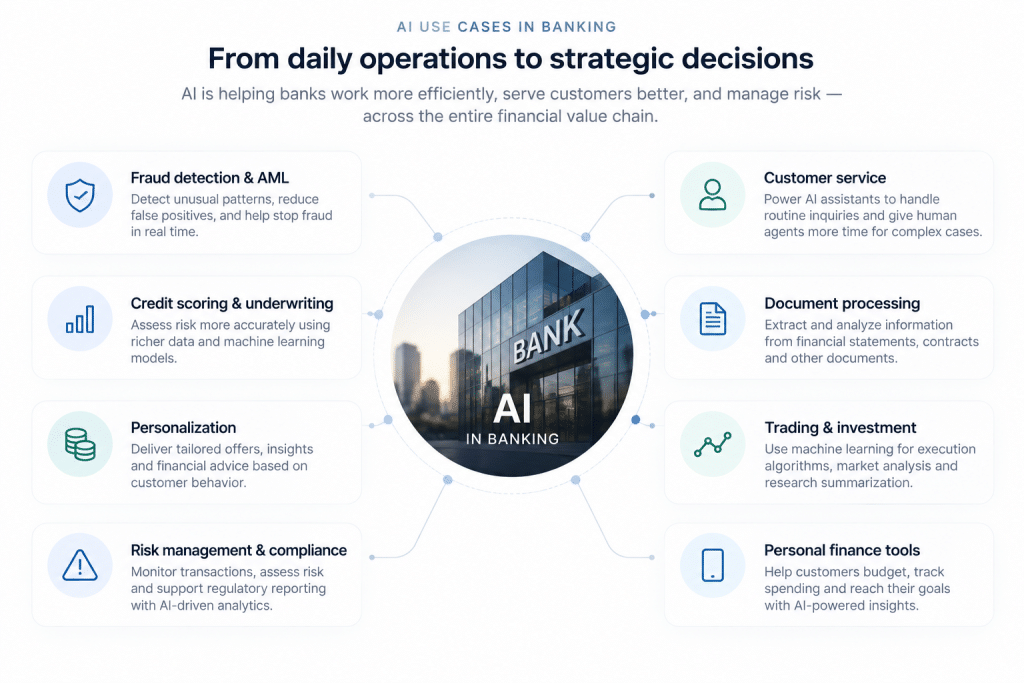
Fraud detection and AML
This is the strongest case in banking and AI. Rules-based fraud engines miss novel patterns and drown analysts in false positives. Models trained on transaction sequences, device signals, and behavior catch more with fewer alerts.
The same Commonwealth Bank report mentions a 50% drop in customer scam losses and a 30% drop in customer-reported frauds after rolling out AI-based checks, and a 20% fall in scam losses in the first half of 2026 from a system monitoring more than 80 million signals a day.
On the AML side, the win is usually alert triage. Most transaction monitoring alerts close as false positives. A model that ranks them, and a language model that drafts the narrative for the ones that stay open, gives investigators back the hours they currently spend on clearing noise.
Credit scoring and underwriting
Machine learning models pick up interactions that a scorecard flattens, which improves separation, especially for thin-file applicants. That’s the upside. The catch is that credit decisions are regulated, and the model must produce reasons as well as scores.
Under the Equal Credit Opportunity Act and Regulation B, a declined applicant receives the specific principal reasons for the decline. Model complexity doesn’t excuse a vague notice. In the EU, credit scoring sits in Annex III of the AI Act as a high-risk use, which brings documentation, data governance, human oversight, and logging obligations.
Conversational AI and customer service
Chatbots earned a bad name because scripted trees were often unclear and annoying, and couldn’t solve real problems. Retrieval-based assistants are different because they answer from your documented product terms and policies. When they can’t find the answer, they say so and connect you to a human, instead of hallucinating.
To reach this, it’s vital to design against a failure mode: confidently wrong answers on a regulated topic. It requires hard boundaries around questions involving advice, complaints, hardship, or account closure. This is a must to keep the assistant useful and your service out of trouble.
Personalization and customer segmentation
Most banks already have next-best-action engines. Models improve the targeting, the timing, and the channel: a savings nudge when a balance pattern shifts, a repayment option before a missed payment instead of after it.
At the same time, there are two limits. Personalization built on inferred financial distress can quickly cross into unfair treatment, and the same segmentation that lifts conversion can produce a disparate outcome nobody intended. Test the outputs by protected class even when the use case isn’t credit.
Risk management and regulatory compliance
Credit risk, market risk, liquidity, capital planning, and stress testing all run on models already, which means AI here lands inside an existing governance regime. Newer work includes early warning signals on portfolio deterioration, collateral valuation, and scenario generation.
Compliance is another, quieter area where AI can deliver value. Language models can monitor regulatory change feeds, map new obligations to internal controls, and prepare first-pass gap analyses. A compliance officer still reviews the findings and makes the final call.
Back-office and document processing
This is an unglamorous, but often the fastest payback. KYC document checks, mortgage file assembly, payment investigations, reconciliation breaks, and client onboarding packs all involve extracting structured facts from unstructured files.
Accuracy targets matter most here. A 92% extraction rate may sound acceptable until you calculate the cost of the 8% of errors that reach customers without correction. Successful teams set a confidence threshold, route anything below it to a human reviewer, and track straight-through processing as the metric they want to increase. The goal is not simply higher model accuracy, but more cases that can move through the process without manual intervention.
Algorithmic trading and investment banking
Execution algorithms, smart order routing, and market-making models have been used in financial markets for years. Machine learning adds another layer, allowing these systems to adapt parameters to changing conditions and improve short-horizon predictions. It also introduces a sharper systemic risk: if many firms use similar models and signals, they can end up making the same trade at the same time, amplifying market movements.
For most banks, however, the more immediate value of AI in markets lies in the work around trading itself. Research synthesis, client coverage notes, post-trade exception handling, and market surveillance are all areas where AI can reduce manual work and speed up existing processes.
Fully automated, alpha-generating models remain a much narrower use case.
Personal finance
Budgeting insights, cash-flow forecasting, savings goals, and subscription detection can turn transaction data into valuable and usable information for customers. When done well, these features can increase engagement and encourage customers to keep more of their money with the bank.
A thing to remember is that once an AI-generated suggestion becomes specific enough to be interpreted as a personal recommendation, it may fall within a regulated advice perimeter, bringing additional disclosure and suitability requirements. Product and compliance teams need to agree on that line before the feature reaches users.
Explainable AI and model governance in finance
Explainable AI means you can say, in terms acceptable for a customer, an auditor, and a supervisor, why a system produced particular output. In banking, that breaks into three questions:
- what drives the model overall,
- why this particular decision came out this way,
- what the applicant would have to change to get a different answer.
The governance ground for this subject has changed this year. On 17 April 2026, the OCC, the Federal Reserve, and the FDIC issued revised interagency guidance on model risk management and rescinded the 2011 guidance, SR 11-7, along with the 2021 BSA/AML model risk statement and the Comptroller’s Handbook booklet. This replacement is principles-based and scaled to a bank’s size and model use. It doesn’t set enforceable standards, and it mainly targets institutions above $30 billion in assets.
The most important part for anyone building AI right now is a specific sentence in the OCC’s announcement: generative AI and agentic AI models are novel and rapidly evolving, so they aren’t within the scope of the guidance. The agencies said they plan to issue a request for information covering model risk management generally and banks’ use of AI specifically.
It doesn’t mean deregulation. Fair lending law, consumer protection law, safety and soundness expectations, and your own board’s risk appetite all still apply to a generative AI system. What changed is that the map you used to design controls no longer covers the territory, and the replacement map hasn’t been drawn yet. AI and banking supervision are moving at different speeds now.
A workable governance baseline, whatever the guidance says next:
- An inventory that covers AI systems as well as models. If a language model drafts an adverse action narrative, it belongs on the list.
- Tiering by impact and reversibility. A marketing segmentation model and a credit decision model don’t need the same validation depth.
- Independent challenge. Someone who didn’t build it tests it, including for fair lending outcomes.
- Logging that reconstructs a decision. Inputs, model version, prompt and retrieval context, output, human override, timestamp. If you can’t replay it, you can’t defend it.
- Monitoring for drift and degradation, with a defined trigger for retraining or rollback.
The Financial Stability Board’s June 2026 consultation report sets out 12 sound practices along similar lines, covering board oversight, lifecycle management, data governance, explainability, human oversight, and third-party risk. It works well as a checklist to test your framework against.
Generative AI in banking
Most considerations about banking and AI now start with generative models. Generative AI arrived in banks through the back office, and it earns most of its keep there. The reliable pattern is retrieval plus generation over your own content: policies, product terms, credit files, regulatory text, client correspondence. The model doesn’t recall facts; it reads the documents you give it and cites them.
JPMorgan Chase built an internal platform, LLM Suite, as a controlled gateway to external models instead of training its own, after blocking staff from consumer chatbots. Most banks now copy that architecture choice: a single tenanted entry point with logging, redaction, and policy controls.
It helps with:
- Drafting first versions of credit memos, SAR narratives, and client correspondence, with a named human editor and approver.
- Answering internal policy and procedure questions, which cuts the load on operations and compliance help desks.
- Extracting terms and obligations from contracts, then routing anything low-confidence to a person.
- Summarising long case files so an investigator starts with context instead of building it.
At the same time, it fails in anything that needs a guaranteed answer. Generative systems produce plausible text, and plausible doesn’t equal correct. If the output goes to a customer or into a regulatory filing without a human in the loop, it becomes a control problem.
Another problem may be related to money. While the marginal cost per request is small, the volume is not, so a useful assistant gets used constantly. Model spend, retrieval infrastructure, and evaluation tooling all scale with adoption, which should be constantly monitored and budgeted.
AI agents and agentic AI in banking
An agent plans a sequence of steps and acts, instead of returning an answer and stopping. In banking, that reflects in pulling account history, cross-referencing records, checking a policy, drafting a finding, and proposing the next step, with a human reviewing the result instead of assembling it.
The Financial Stability Board’s June 2026 report uses a bank running a fraud system across more than 80 million signals a day as one of its case studies. They treat agentic AI as a category its existing frameworks weren’t built for. The concerns include agents taking unauthorised actions, goal misalignment, reward hacking, and the difficulty of reversing what an agent has already done.
Three design rules keep agentic projects out of trouble:
- Separate proposing from executing. An agent that drafts a detection rule and hands it to a human for approval is a different risk object from one that deploys it.
- Scope permissions like you would for a new employee. Which systems, which data, which actions, and what spending or exposure limit.
- Make every action reversible, or gate it. If an action can’t be undone, a person approves it. That single rule removes most of the tail risk.
How does AI help banks? The benefits and ROI of AI in banking and finance
AI helps banks in four ways: fewer losses, lower unit cost, faster cycle times, and better decisions at the margin. Everything else is a story about one of those four.
Let’s get back to the Commonwealth Bank of Australia to see the example.
The bank now handles more than 20 million payments a day. It reported a 50% reduction in customer scam losses and a 30% drop in customer-reported frauds after deploying AI-based safety checks, alongside a 40% cut in call centre wait times from AI-powered in-app messaging.
It later told the market that scam losses fell a further 20% in the first half of 2026, with its fraud systems monitoring more than 80 million signals a day. Mortgage conditional approvals dropped to as little as 10 minutes, and small business annual reviews went from about 14 hours to two.
Building something similar? See how our AI and ML development services work for regulated teams.
How the four benefit categories of AI in banking & finance typically behave:
| Value type | Where it shows up | How fast you see it |
| Loss avoidance | Fraud, scams, AML, collections | 3 to 9 months |
| Cost per unit | Document processing, service, onboarding | 6 to 12 months |
| Cycle time | Underwriting, credit review, onboarding | 3 to 12 months |
| Decision quality | Credit, pricing, risk | 12 to 24 months |
When it comes to ROI, it’s worth remembering two things. First, many of the published gains come from banks that spent years building the data platforms, integrations, and processes that made AI possible in the first place. In those cases, the model may be only the final part of a much larger investment.
Second, productivity gains rarely reflect in direct headcount reductions. More often, they allow existing teams to absorb higher volumes without adding staff. That is real economic value, even if it does not appear neatly as a reduction in the cost line.
The most useful thing you can do before starting an AI project is to establish a clear baseline. Record the current false-positive rate, average handling time, hours spent on each credit review, or whatever metric the new system is expected to improve. Without that baseline, teams can achieve meaningful improvement and still struggle to demonstrate it.
How to deploy AI in a bank
Deploying AI in banking and finance is mostly a sequencing problem. This is what makes AI for banking harder than AI in most other industries: the model is finished long before the bank can use it. Here’s the sequence that works, and the trap in each step.
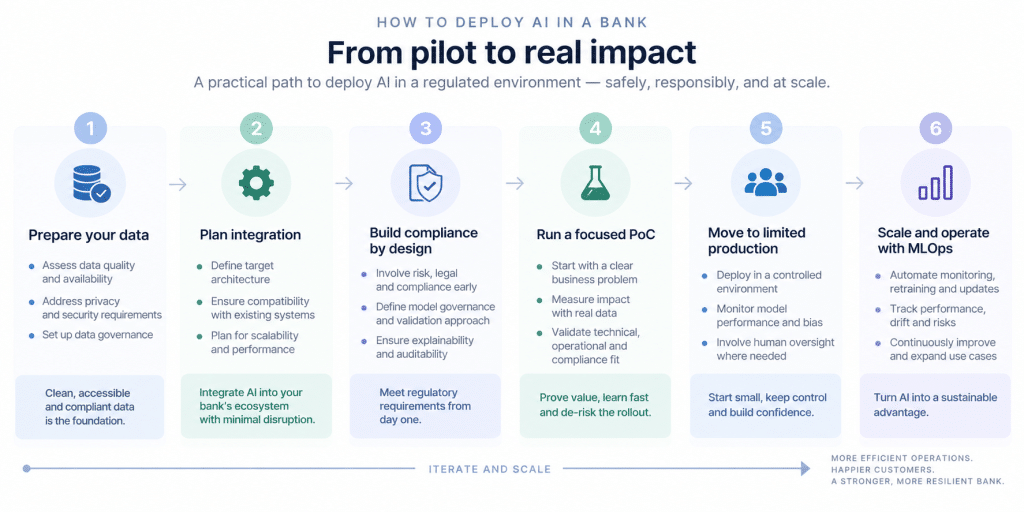
Start with data readiness, not model selection
Pick one use case and analyze its data. Can you get it, with permission, in the form the model needs? Can you trace where each field came from? Can you reproduce last month’s version?
Most banks fail at least one of these three questions, and that’s what needs to be fixed first. It might slow you down for a quarter but then speed you up for the next two years. If you skip this step, you build a model that works in the notebook but can’t be fed into production.
Pre-plan the core banking integration
Choosing the model is usually the easy part. Getting its output into the decision path of a core system built decades ago is much harder. Batch windows, message formats, latency requirements, and change freezes all constrain how the model can be deployed and, ultimately, what the finished system looks like.
Two patterns tend to work well. First, keep the model outside the core system and connect it through an integration layer with a clearly defined interface and a fallback path. Second, make that fallback a real part of the design. If the model is unavailable, times out, or returns a low-confidence result, the system should fall back to established rules instead of stopping the process.
Build in compliance
Compliance by design means building controls into the system from the start, rather than treating compliance as a review gate at the end. Decide upfront who signs off on outputs, what needs to be logged, how decisions can be reconstructed, when a human can override the system, and what evidence you will need to demonstrate fair outcomes.
Adding these controls later is more expensive and can create major delays. It is also a common reason a technically successful pilot never makes it into production or reaches customers.
Get from POC to production on purpose
A proof of concept answers whether the signal exists. It is not a smaller version of the production system. Set exit criteria before you start, including required accuracy, control requirements, and the integration path, and give the POC a firm deadline.
If the POC clears the bar, move to a limited production release with a holdout group so you can measure the real-world effect. If it does not, stop. Pilot graveyards are expensive because projects often linger long after the evidence says to close them.
Decide build versus buy per use case
The popular mix here would be: buy the commodity layers, build the decision logic and the controls around them, and keep the ability to swap a model provider without rewriting the application. While popular, this solution is not universal.
| Buy | Build | |
| Best for | Commodity capability: OCR, speech, standard fraud scoring | Anything tied to your data, your risk appetite, or your differentiation |
| Time to value | Weeks | Months |
| Control over explainability | Limited to what the vendor exposes | Full, and it’s your evidence to produce |
| Third-party risk | Concentration, version changes, supply chain | Your own operational risk |
| Long-run cost | Per-seat or per-call, rises with volume | Higher upfront, cheaper at scale |
Fund MLOps before you need it
A model in production is a service with an owner, a runbook, version control, monitoring, and a rollback plan. Without that, you get models that can’t be retrained or turned off. Budget for it in the first project. Our MLOps consulting breakdown covers what that stack looks like.
A short readiness checklist before you commit budget:
- One named use case with a measured baseline
- Data available, traceable, and reproducible
- Decision owner and approver named
- Integration path into the deciding system agreed
- Logging standard defined before the build starts
- Exit criteria and a deadline for the POC
- Monitoring, retraining trigger, and rollback plan funded
How Blackthorn Vision builds AI for banking and fintech
AI projects in banking and finance require two kinds of engineering at once: building the model and integrating it into systems that can’t simply be replaced or taken offline. We’re a Microsoft Solutions Partner, and have been building on the .NET and Azure stack since 2009. That combination is very important in regulated environments, where a new AI capability usually has to work within an existing technology ecosystem.
Our track record in finance sector is significant.Recently, we’ve built a cloud trading platform with AI capabilities for stock and currency automation, and developed a client management system for a UK financial advisory group. We’re ISO 27001 certified.
On AI projects, we start with discovery to establish whether your data can support the use case before building a model. We design architectures that keep data within your tenancy, agree on logging and reason-code requirements with compliance teams upfront, and provide an application modernization path for legacy components that need to support the new workload.
FAQ
What is AI in banking?
Where should a bank start with AI?
Most AI in banking & finance programs that work start with one use case where the baseline is manual and the volume is high, with an outcome you can count. That usually means fraud triage or document processing. Measure the baseline before you build, confirm the data is available and reproducible, and agree the logging and sign-off model with compliance before the beginning of the work.
Is AI in banking safe and regulatory-compliant?
It can be, with the right controls. AI does not suspend fair lending law, consumer protection, or safety and soundness expectations. In April 2026 US banking agencies replaced the 2011 model risk guidance and placed generative and agentic AI outside the scope of the new version, with a request for information still to come, so banks are currently designing controls against principles instead of a specific rulebook.
What is the ROI of AI in banking?
It arrives in four forms: loss avoidance, lower unit cost, shorter cycle times, and better decisions. Loss avoidance is fastest and easiest to prove. There are examples of 50% reduction in customer scam losses and a 30% fall in customer-reported fraud after deploying AI-based checks, along with 20% drop in scam losses. Your own return depends heavily on how ready your data is before you start implementing AI.
What is explainable AI in finance, and why does it matter?
Explainable AI means being able to state why a system produced a given output, in terms a customer, an auditor, and a supervisor can accept. It matters because credit decisions carry legal obligations: under Regulation B, a declined applicant receives the specific principal reasons, and in the EU, credit scoring is classified as high-risk under the AI Act, with documentation and human oversight obligations attached.
How is AI used in banking?
The use of artificial intelligence in banking is wide-ranging. The most common applications of AI in banking are fraud and scam detection, AML alert triage, credit scoring and underwriting, customer service assistants, personalization, regulatory compliance support, back-office document processing, trading and execution, and personal finance features. Fraud and document processing usually return measurable value first.
You may also like
-
 September 28, 2026Read in 19 min.
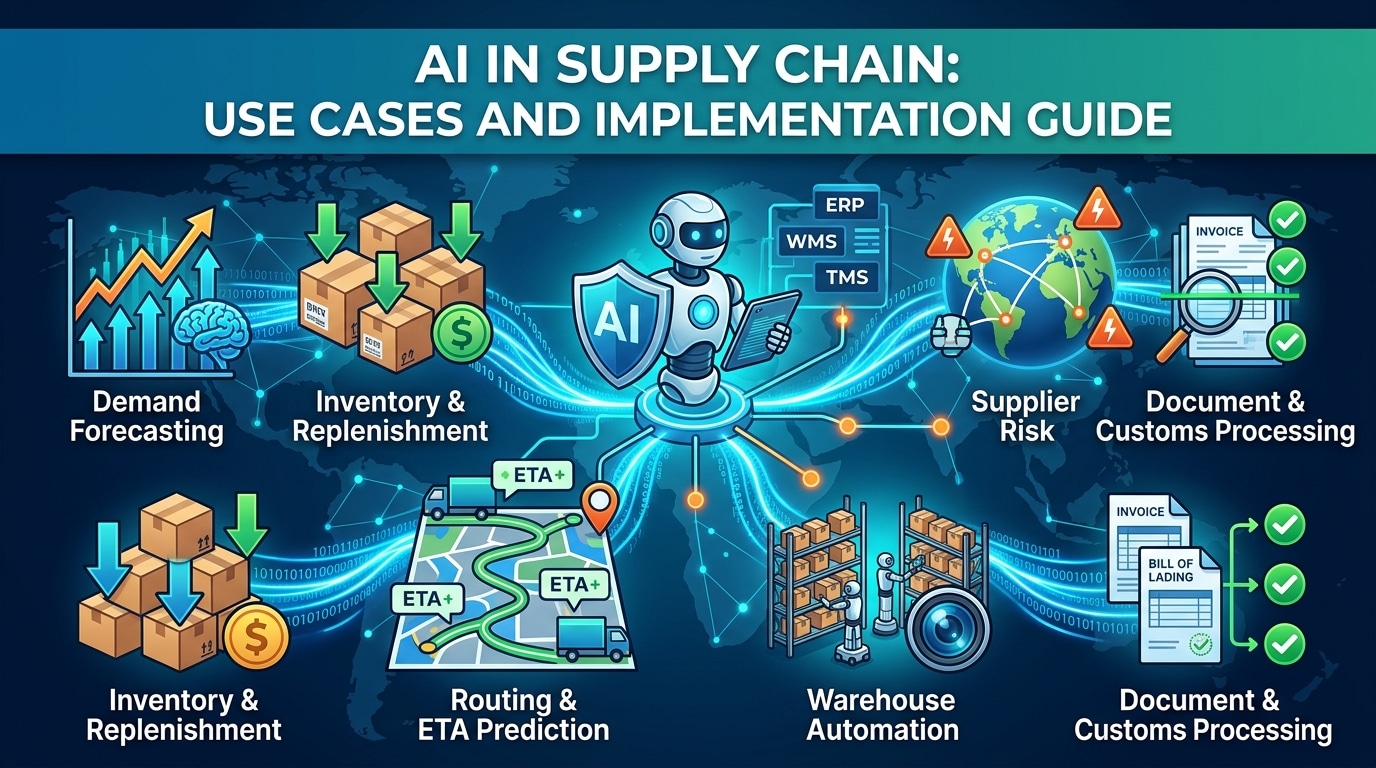
AI in supply chain: Use cases and implementation guide
What is AI in supply chain management? -
 September 8, 2026Read in 16 min.
The AI-Native SDLC: From Writing Software to Orchestrating It
An AI-native SDLC cuts delivery time by about half without loosening a single quality gate. See the three eras, the toolchain and the guardrails. -
 August 19, 2026Read in 22 min.
Robotic Process Automation in healthcare: Definition, benefits, and real cases
From patient scheduling to claims processing: explore proven RPA use cases in healthcare, backed by real data, ROI benchmarks, and compliance guidance. -
 July 22, 2026Read in 21 min.
AI Use Cases: 25+ Real Enterprise Examples Across Industries
Most impactful AI use cases in business - from generative AI and agentic AI to predictive analytics. Real examples by industry with ROI data and implementation priorities. -
July 22, 2026Read in 17 min.
AI in manufacturing: How to implement, use cases and benefits
How artificial intelligence is transforming manufacturing - from predictive maintenance and quality control to supply chain optimization and digital twins. Real ROI data and implementation roadmap. -
July 21, 2026Read in 18 min.
AI in Education: How Artificial Intelligence Is Transforming Learning
How AI is used in education - from personalized learning and automated grading to AI tutors and corporate L&D. Real examples, benefits, challenges, and what's next. -
 July 16, 2026Read in 17 min.
Custom ERP software for manufacturing – Built on Azure and .NET
Off-the-shelf ERP forcing workarounds? Blackthorn Vision, a manufacturing software company, builds ERP software for manufacturing on Azure and .NET. -
 June 10, 2026Read in 22 min.
Selecting elite Vue.js development company
Top Vue.js development companies vetted for Vue 3 architecture, high-performance rendering, and secure AI integration. Read our definitive guide for tech leaders. -
May 15, 2026Read in 24 min.
Claude vs. ChatGPT: Which one is right for your work?
Should you switch to Claude for its Artifacts or stay with ChatGPT for its Omni-Agent capabilities? A hands-on comparison of reasoning, coding, and privacy. -
 May 12, 2026Read in 16 min.
Machine Learning Consulting Services: The Executive Guide to Strategy, ROI, and Scaling Intelligence
Navigate of machine learning consulting. Learn how top firms deliver ROI through MLOps, custom model development, and strategic AI advisory.