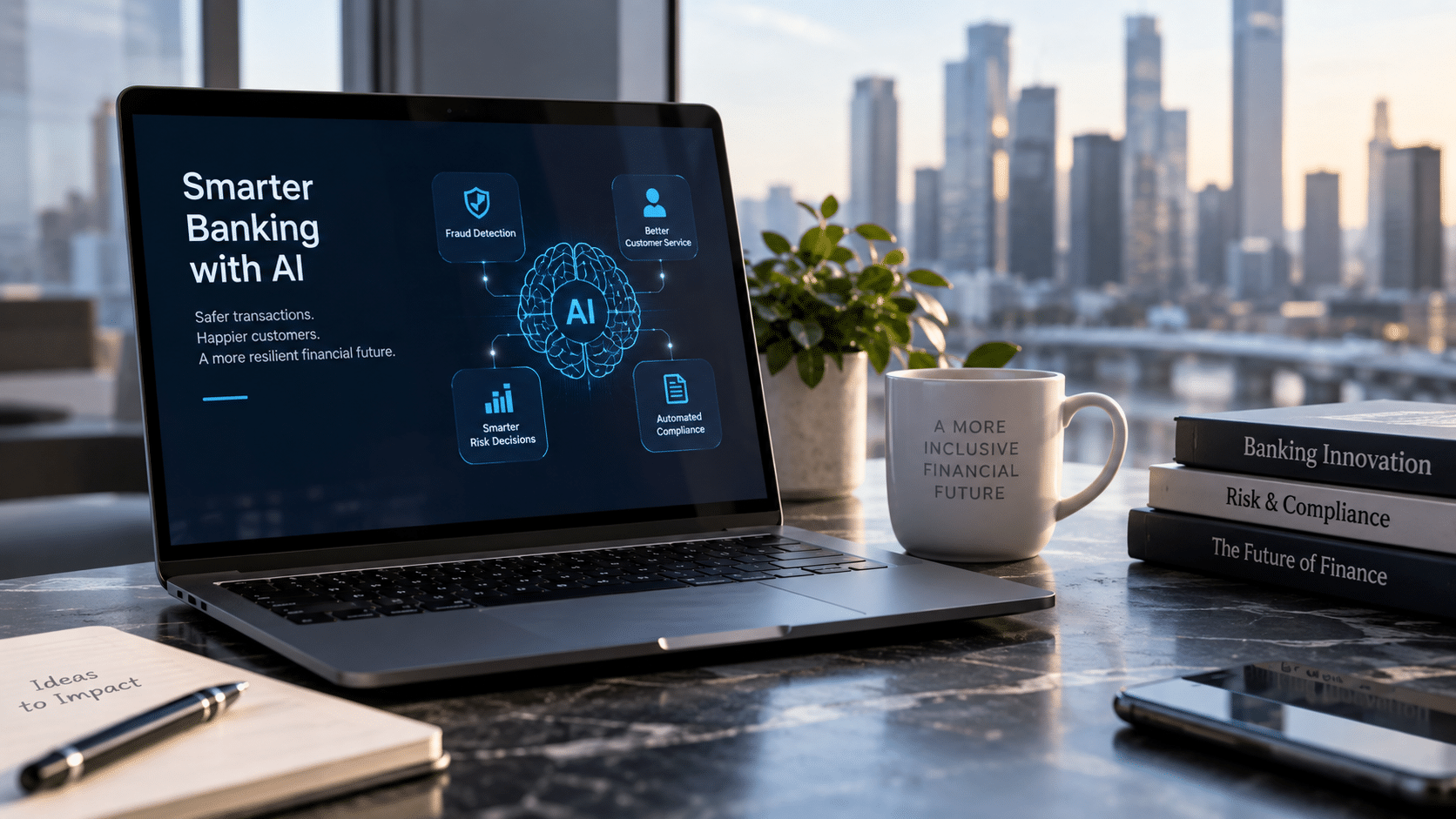

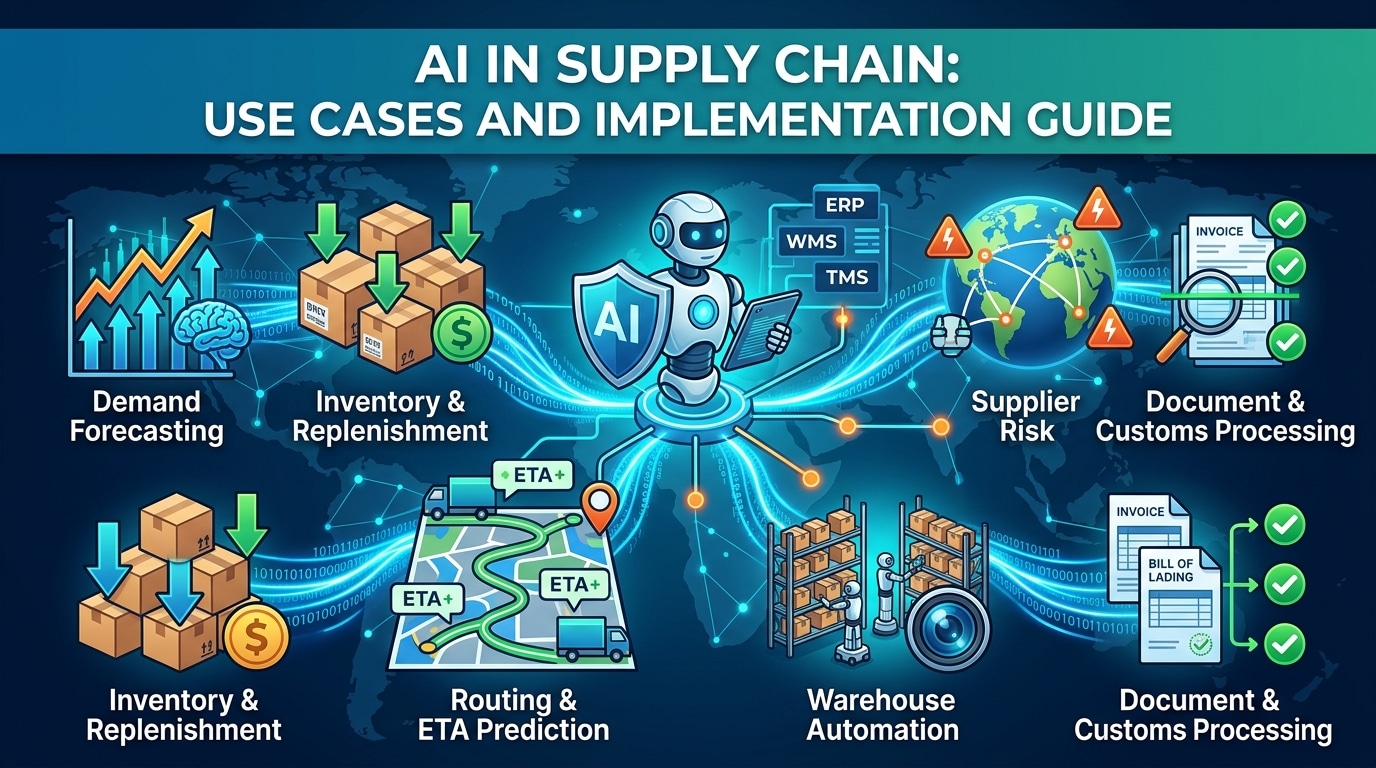
It’s the use of models that learn from operational data to predict demand, set inventory, plan routes, flag supplier risk, and process documents. The models connect to your ERP, WMS, and TMS, and either recommend decisions to people or act within set limits.
AI in supply chain: Use cases and implementation guide
 19 minutes read
Content
AI in supply chain management is the use of models that learn from operational data to predict, recommend, or carry out planning and execution decisions: what to buy, how much to stock, where to ship from, and which route to take. Those models sit inside or next to the systems that already run the supply chain, such as ERP, warehouse management (WMS), and transportation management (TMS) software.
Gartner forecasts that 60% of enterprises using supply chain management software will have adopted agentic AI features by 2030, up from 5% in 2025. This only shows how quickly the market is moving.
This guide covers where AI for supply chain management pays off, where agentic AI fits, and how to connect models to your ERP, WMS, and TMS software.
What does AI changes supply chain?
A classic planning tool follows rules and formulas written and tuned by hand. A model learns patterns from history, such as how a promotion in one region shifts demand in another, or how one carrier’s delays cluster before public holidays. That makes it better at messy problems with many variables. It also makes it wrong in new ways when conditions change, which is why the workflow around the model is just as important as the model itself.
There are six technologies that do most of the work in artificial intelligence in supply chain management today:
- Machine learning (ML) finds patterns in structured data such as orders, shipments, and lead times. It powers most forecasting and inventory models.
- Predictive analytics turns those patterns into forward-looking numbers: expected demand, expected delay, the probability that a supplier misses a date.
- Natural language processing (NLP) reads unstructured text in emails, contracts, supplier notices, and customs documents.
- Generative AI drafts and summarizes. Think supplier emails, exception reports, and plain-language answers when a planner asks why the plan changed.
- Computer vision reads labels and barcodes, counts stock, and checks packing quality and damage in warehouses and yards.
- Autonomous agents combine the above with permission to act. An agent watches for an event, picks a response within set limits, and updates the systems of record.
Where AI in supply chain and logistics works today
In the table below you will see the summaries of the seven use cases that gain the most traction in AI in logistics and supply chain work. The result column only includes verified figures; where no reliable industry average exists, it names the metric you should baseline instead. “Maturity” reflects how widely the approach runs in production, based on published deployments. It’s not about your own data readiness.
Use cases at a glance
| Use case | What it does | Typical result | Maturity |
| Demand forecasting | Predicts demand by product, location, and week from sales, price, promotion, and calendar data | ML beat the best statistical benchmark by 22.4% overall, and by 3.4% at single-product, single-store level (M5 competition, Walmart data) | Mature |
| Inventory and replenishment | Sets safety stock and reorder points per item from forecast error and lead-time variability | Early adopters of AI-enabled supply chain management cut inventory 35% versus slower peers, across several levers (McKinsey, 2021) | Mature |
| Routing and ETA prediction | Builds daily routes, re-sequences stops, predicts arrival times | About 100 million fewer miles a year and $300-400 million in expected annual savings at UPS (INFORMS) | Mature |
| Warehouse picking, packing, and slotting | Places products, plans pick paths and labor, checks packing with cameras | No reliable independent average. Baseline picks per labor hour and mis-pick rate | Maturing |
| Supplier risk | Flags suppliers and lanes likely to slip, using delivery history and outside signals | No reliable independent average. Baseline time from first signal to a changed plan | Early to maturing |
| Procurement | Classifies spend, matches equivalent parts, drafts RFQs, checks contract terms | No reliable independent average. Baseline cycle time and touches per purchase order | Maturing |
| Document and customs processing | Extracts data from invoices, bills of lading, and certificates, then checks it against rules | No reliable independent average. Baseline touches per document and error rate | Mature for extraction, early for autonomous filing |
Demand forecasting
Forecasting has the clearest public evidence of any use case.
In the M5 competition, teams forecast 42,840 Walmart sales series. The winning machine-learning method beat the best statistical benchmark, exponential smoothing, by 22.4% on the competition’s accuracy measure. At the most granular level (one product in one store), the gain fell to 3.4%, because daily sales at that level are sparse and noisy.
For planners, that means the biggest gains show up at the aggregation levels where you actually make buying and allocation decisions. Keep a planner override for new products and one-off events.
Inventory and replenishment
Once demand is forecast, inventory models decide how much safety stock each item needs at each location. They work from forecast error, supplier lead-time variability, and the service level you’re targeting. AI helps most with large, uneven catalogs, where a single rule of thumb overstocks slow movers and starves fast ones.
McKinsey reported that early adopters of AI-enabled supply chain management cut inventory levels by 35% and logistics costs by 15% compared with slower competitors. Treat that as a ceiling reached by leaders using several levers at once. No single model will get you there.
Logistics, routing, and ETA prediction
Logistics is the oldest success story on this list.
UPS’s ORION system plans delivery routes from telematics and address data, cutting roughly 100 million miles driven per year. Most of ORION is operations research, the math behind route planning, with machine learning around it. The same shipment data then feeds ETA prediction, which tells customers and receiving docks when a truck will really arrive. Good ETAs let a warehouse plan labor by the hour.
Warehouse automation: picking, packing, and allocation
Inside the warehouse, models decide where each product should sit (slotting), which path a picker should walk, and how to split work across shifts. Computer vision confirms that the right item went into the right box and reads labels that are damaged or badly placed. Results depend heavily on layout and order profile, so there’s no honest industry-wide number to quote. Baseline picks per labor hour, mis-pick rate, and dock-to-stock time before the pilot.
Supplier risk and resilience
Supplier-risk models, one of the newer uses of artificial intelligence in supply chain planning, combine your own delivery history (which suppliers slip, on which items, in which months) with outside signals such as weather, port congestion, and financial news. The output helps you spot potential problems, for example, that a particular purchase order has a high chance of arriving late.
Its value depends on how early the warning comes and whether anyone can act on it. Use the time from the first signal to a changed plan as a metric.
Procurement automation
In procurement, AI classifies spend, matches equivalent parts across suppliers, drafts RFQs, and flags contract terms that drift from policy. Much of the real work is cleaning up data.
Blackthorn Vision built a cross-reference tool for SiTime that maps competitor part numbers to SiTime equivalents across more than ten attributes, and the client expects it to save hundreds of hours of manual lookups a year. That tool is rules-based, and that’s the useful part of the story. A clean attribute model underpins any later AI matching step.
Document and customs processing
Invoices, bills of lading, packing lists, certificates of origin, and customs declarations still arrive as PDFs, scans, and email attachments. Document AI extracts the fields, checks them against the purchase order or tariff rules, and routes mismatches to a person. Guardrails are most important here. Extraction can run automatically above a confidence threshold. Filing a customs declaration carries legal liability, though, so a person should sign off on anything the model is unsure about.
Running cost is the other trap. In Blackthorn Vision’s document-recognition project for a Dutch legal organization, a managed cloud extraction service performed well in the proof of concept, then proved too expensive at full volume. The team rebuilt the core pipeline to run on-premises with OpenCV, so the client could balance cost and quality.
Agentic AI in supply chain
Most AI for supply chain work so far has produced recommendations: a forecast, a suggested order, a risk score. A person is still responsible for reading it and acting on it. Agentic AI adds the acting part. An AI agent watches for an event, works out a response, and carries it out in your systems within limits you set. The best early fit is exception handling, the steady stream of small problems that eats a planner’s day.
Supplier delay management. The agent sees an advance shipping notice slip by, say, six days. It checks which customer orders depend on those parts and looks for stock at other sites or an alternate supplier. Then it drafts a revised plan. A planner approves it with one click, and the agent updates the ERP and alerts the account managers whose customers are affected.
Invoice reconciliation. Three-way matching compares the purchase order, the goods receipt, and the supplier invoice. The agent clears matches within tolerance on its own. For each mismatch (a short delivery, a price change, a duplicate invoice), it writes a plain-language explanation and queues the case for accounts payable with a proposed fix.
Autonomous replenishment. For stable, low-value items, the agent places replenishment orders when stock crosses a reorder point, within spending and quantity limits. Anything outside those limits, or any item with unusual demand, goes to a buyer.
Guardrails decide whether an agent is an asset or a liability:
- Autonomy by risk. The agent acts alone on low-value, reversible decisions. Anything above a spending threshold, or anything customers will see, waits for approval.
- Narrow permissions. The agent gets its own service identity with access to specific ERP transactions, never a planner’s full login.
- An audit trail. Every action records the data the agent saw, the model output or rule it used, and who approved it.
- A pause button and rollback. Operations can stop the agent and reverse its recent actions without calling IT.
Benefits and ROI of AI for supply chain management
Benefits may differ, but some show up consistently when supply chain management AI projects succeed. Those are:
- Lower cost. Better forecasts mean less expediting, fewer split shipments, and fewer empty miles.
- Resilience. Earlier warning of supplier and lane problems buys days to react. With month-long disruptions arriving every 3.7 years on average, those days matter.
- Forecast accuracy. Better accuracy at the planning level means less safety stock for the same service level.
- Sustainability. Fewer miles, less spoilage, and less overproduction cut emissions and waste together. ORION alone was expected to save about 10 million gallons of fuel and 100,000 metric tons of CO2 a year.
A simple ROI framework with a break-even date
Build the business case around your own numbers. Start with the annual cost of the problem, such as expediting costs, inventory carrying costs, or the time employees spend handling invoice exceptions. Then estimate a conservative improvement you can test during the pilot. From there, account for the one-time cost of data work, integration, development, and user training, as well as the ongoing costs of cloud services, licenses, monitoring, and retraining.
The annual net benefit is the savings from the expected improvement minus the annual running costs. You can then use the upfront project cost and monthly net benefit to estimate the break-even period.
For example, imagine a distributor with $30 million in average inventory and a 20% annual carrying cost. If a replenishment model reduces inventory by 5%, it frees up $1.5 million in stock and saves $300,000 a year in carrying costs. With a $350,000 upfront project cost and $60,000 in annual running costs, the net benefit would be $240,000 a year, or $20,000 a month. The project would break even in roughly 18 months.
This is only an illustration, not a benchmark. Results will depend on your costs, expected improvement, and implementation budget.
Proof point: automated replenishment across 500+ stores
ECCO, a well-known Danish shoe company, had a costly problem: store replenishment orders were placed by hand and varied from one market to the next. Its in-house Data & AI team built an automated replenishment system that planned orders for 536 stores in 27 countries in 2025. According to INFORMS, which named the project a 2026 Franz Edelman Award finalist, the system now generates close to 300,000 replenishment orders a month and has cut key operational costs by 1.09%.
While a one-percent gain sounds small, that works out to several million euros a year. Across a global store network, it adds up to a seven-figure saving from automating one repeated decision.
Want similar results? See how our AI integration services connect forecasting and agent workflows to the ERP you already have.
How AI for supply chain differs by industry
- Retail
Retail forecasting juggles thousands of products, promotions, and weather effects, and the above-mentioned M5 results came from exactly this kind of data. The usual first project is store-level replenishment for fast movers, with markdown planning close behind.
- E-commerce
Online sellers promise a delivery date at checkout, so ETA accuracy directly affects conversion and returns. Common projects are slotting for fast-changing assortments, carrier selection per order, and returns forecasting.
- Manufacturing
Manufacturers need material availability to match the production schedule. AI links demand forecasts to purchasing and flags component shortages weeks ahead. Our guide to AI in manufacturing covers the plant-floor side.
- Automotive
Automotive supply chains run deep, with tier-2 and tier-3 suppliers that carmakers often can’t see. McKinsey Global Institute research places electronics- and semiconductor-heavy value chains among the most exposed to shocks. Supplier-risk models that map sub-tier dependencies are the usual starting point.
- Food supply chain
Around 13% of the world’s food is lost between harvest and retail, according to FAO estimates cited in the UNEP Food Waste Index Report 2024. Shelf-life-aware forecasting and temperature monitoring target that loss directly, since perishables leave little room for forecast error.
- Healthcare and pharma (cold chain)
Biologics and vaccines must stay within narrow temperature ranges from plant to patient. Models combine sensor readings with lane and weather history to predict temperature excursions and reroute shipments before product is lost. Audit rules in this sector make explainable decisions and complete audit trails part of the job from day one.
- Transportation and logistics
For carriers and 3PLs, AI prices loads, matches freight to capacity, plans routes, and predicts dock appointments. Margins are thin, so small gains in empty miles or asset use go straight to profit.
How to implement AI in your supply chain
Projects that combine AI and supply chain management often run into problems with integration and adoption. About 35% of organizations say results fall short of expectations, 45% report projects were delivered late, and 26% experienced budget overruns. So it makes sense to start small and expand once the results are clear.
Start with one supply chain decision where you can measure the cost of getting it wrong, and assign a clear business owner. Before building anything, check whether you have enough reliable data to support that decision. Look at how much history you have, whether records use consistent IDs, and whether you record stockouts properly. Otherwise, products that were unavailable may look like unwanted ones.
Next, before training a model, work out how the AI will connect to the systems that hold your operational data. Once the integration is ready, run a pilot on real volumes with people still approving the AI’s recommendations. Make sure the pilot includes difficult periods, not just normal operating weeks.
If the results are consistent, gradually give the system more autonomy. The level of automation should follow what the data shows the model can handle reliably.
Integration architecture: how AI connects to ERP, WMS, and TMS
AI for supply chain needs to work with the systems your business already uses. It needs to get information from them and, when needed, send updates back. A practical setup usually has five parts:
- The systems that hold your data. Your ERP, warehouse and transport systems, supplier portals, and IoT devices contain the information AI needs. The AI uses this data but does not replace these systems as the main source of record.
- The connection between systems. APIs and other integration tools move data between your business systems and the AI without disrupting day-to-day operations.
- The data AI learns from. Before it reaches the model, the data needs cleaning and organization. Products, locations, and suppliers should use consistent IDs, and the data should show when things happened.
- The AI itself. This includes forecasting and risk models, document processing, and AI agents. These services need monitoring and versioning so they can be updated or rolled back when needed.
- Getting results back into the business. AI recommendations should appear in the tools planners already use, such as the ERP. A person can review and approve them, or an AI agent can take action within clearly defined limits.
Older ERP systems can be the most difficult part. If there is no reliable way to connect to the system, you may first need a small integration service or some application modernization to make the connection possible.
Build, buy, or extend your platform?
| Option | Best when | Watch out for |
| Buy a SaaS application with AI built in (a forecasting or TMS product, say) | Your process is standard and the vendor’s data model fits yours | Per-transaction pricing at volume, little control over the models, lock-in |
| Extend your current platform (AI features in your ERP or SCM suite, or cloud AI services such as Azure AI) | You already run that platform and the use case matches what it offers | Features that demo well but miss your exceptions, and usage-based costs that grow with volume |
| Build custom models and agents connected to your systems | The decision gives you a competitive edge, or your process is unusual | You need an owner for monitoring, retraining, and support after launch |
Most supply chain management artificial intelligence projects mix all three. Whichever route you choose, test cost at production volume before you commit.
Our document-recognition project described above is a good example of a proof of concept that looked affordable until volume arrived. Align incentives too: only 1 in 4 of respondents working with a system integrator say its incentives match their objectives. Tie payment milestones to the metric you’re trying to move.
Challenges and risks of using AI in supply chain
The main technical risks in AI supply chain management are fairly straightforward:
- Poor data. Product and supplier IDs may not match across systems. Missing stockout records can also make it look like demand was low when products were simply unavailable.
- Models can go out of date. A model trained on stable years may struggle after a major disruption, such as a port closure or tariff change. Check its accuracy regularly and give planners a way to override its recommendations.
- People may not trust it. If planners cannot see why the AI made a recommendation, they may go back to their spreadsheets. Showing the main factors behind each recommendation makes the system easier to understand and use.
- Security matters. An AI agent that can change data in your ERP creates another access point to protect. Give it only the permissions it needs and keep a record of every action.
- Vendor claims need testing. Ask vendors to show how their AI performs on your own data, rather than relying on general claims or benchmark results.
Company size does not have to determine AI project size. A mid-sized distributor may not need a large routing system. A smaller project, such as improving replenishment for the top 500 products or handling routine invoice mismatches, may be enough to make the numbers work. The key is to start with one problem and keep the pilot focused on it.
To keep the system under control and make it clear which decisions the AI can handle on its own, AI agents should work within clear limits, with spending thresholds, approval steps for customer-facing actions, and a full record of what they do. People should also be able to pause or stop an agent when needed.
Where AI in supply chain is heading
AI for supply chain is steadily moving from experiments to everyday operations. The next step is not replacing planners with autonomous systems, but giving them tools that can act on reliable data, work across existing systems, and handle routine decisions within clear limits.
As supply chain and AI technology matures, AI agents will take on more tasks, while digital twins will make it easier to test changes before committing resources. Planners will spend less time pulling data together and rebuilding plans, and more time dealing with exceptions and setting the rules for AI.
The companies that get value from artificial intelligence in supply chain operations will be the ones that connect it to the systems, data, and processes their supply chain depends on, and start with problems where they can measure results.
How Blackthorn Vision builds supply chain AI
Blackthorn Vision is a Microsoft Solutions Partner and ISO 27001-certified engineering company that has built .NET, Azure, and AI software since 2009. Our work on artificial intelligence and supply chain management sits where models meet the systems a business already runs:
- We rebuilt a US company’s inventory-balancing platform, software that helps its customers avoid stockouts and overstock, moving it from Silverlight to Azure and letting each customer choose a shared or dedicated database. We built SiTime’s part cross-reference tool, which replaced manual spreadsheet lookups for its sales channel.
- We built document-recognition pipelines on Azure AI services and on-premises OpenCV, with summarization on top.
- We develop machine-vision quality control software with high-resolution barcode reading for industrial lines.
Our approach is to pick one expensive decision, review its data and integration path in a short discovery, and pilot with human approval. An agent only gets more room once the numbers support it. If you’re weighing agents specifically, our AI agent development team covers guardrails, permissions, and ERP integration.


Discuss your supply chain AI use case
Send us one recurring exception, such as late suppliers, invoice mismatches, or stockouts on a product group, and we’ll tell you whether AI fits, what data it needs, and roughly what it would take to connect it to your ERP.
FAQ
What is AI in supply chain management?
How long does AI for supply chain take to pay back?
It depends on the size of the problem and the integration work. Calculate break-even as one-time cost divided by monthly net benefit. In the illustrative example above, a focused replenishment project breaks even in about 18 months. Broad programs take longer because the data foundation comes first.
Is it safe to connect AI agents to our ERP?
It can be, with the right setup: a dedicated service identity with narrow permissions, spending limits, approval steps for anything customers will see, a full audit log, and the ability to pause the agent and roll back its actions.
Should we build or buy supply chain AI?
Buy when your process is standard and a product’s data model fits. Extend your current ERP or cloud platform when its AI features match the use case. Build custom when the decision is a competitive edge or your process is unusual. Most supply chain management artificial intelligence projects mix all three.
Where should a company start with AI for supply chain?
Start with one recurring, measurable loss with a clear owner: stockouts in a product group, expediting for late suppliers, or an invoice exception queue. Check the data for that decision, pilot with human approval, and expand only after the pilot beats your baseline.
You may also like
-
 September 21, 2026Read in 19 min.
AI in banking: Use cases, explainable AI, and how to deploy it in regulated environments
AI in banking: use cases, explainable AI and governance, generative AI, ROI, and how to deploy it in a regulated environment -
 September 8, 2026Read in 16 min.
The AI-Native SDLC: From Writing Software to Orchestrating It
An AI-native SDLC cuts delivery time by about half without loosening a single quality gate. See the three eras, the toolchain and the guardrails. -
 August 19, 2026Read in 22 min.
Robotic Process Automation in healthcare: Definition, benefits, and real cases
From patient scheduling to claims processing: explore proven RPA use cases in healthcare, backed by real data, ROI benchmarks, and compliance guidance. -
 July 22, 2026Read in 21 min.
AI Use Cases: 25+ Real Enterprise Examples Across Industries
Most impactful AI use cases in business - from generative AI and agentic AI to predictive analytics. Real examples by industry with ROI data and implementation priorities. -
July 22, 2026Read in 17 min.
AI in manufacturing: How to implement, use cases and benefits
How artificial intelligence is transforming manufacturing - from predictive maintenance and quality control to supply chain optimization and digital twins. Real ROI data and implementation roadmap. -
July 21, 2026Read in 18 min.
AI in Education: How Artificial Intelligence Is Transforming Learning
How AI is used in education - from personalized learning and automated grading to AI tutors and corporate L&D. Real examples, benefits, challenges, and what's next. -
 July 16, 2026Read in 17 min.
Custom ERP software for manufacturing – Built on Azure and .NET
Off-the-shelf ERP forcing workarounds? Blackthorn Vision, a manufacturing software company, builds ERP software for manufacturing on Azure and .NET. -
June 10, 2026Read in 22 min.
Selecting elite Vue.js development company
Top Vue.js development companies vetted for Vue 3 architecture, high-performance rendering, and secure AI integration. Read our definitive guide for tech leaders. -
 May 15, 2026Read in 24 min.
Claude vs. ChatGPT: Which one is right for your work?
Should you switch to Claude for its Artifacts or stay with ChatGPT for its Omni-Agent capabilities? A hands-on comparison of reasoning, coding, and privacy. -
 May 12, 2026Read in 16 min.
Machine Learning Consulting Services: The Executive Guide to Strategy, ROI, and Scaling Intelligence
Navigate of machine learning consulting. Learn how top firms deliver ROI through MLOps, custom model development, and strategic AI advisory.