

The main role of AI in education is to support defined learning and administrative decisions. It can adapt practice, provide timely feedback, help teachers identify recurring problems, and reduce repetitive work. It is most useful when the task, data boundaries, and human owner are clear.
AI in Education: How Artificial Intelligence Is Transforming Learning
 18 minutes read
Content
AI in education means using adaptive learning software, AI tutors, automated grading, administrative automation, and generative AI tools to support teaching and learning. As of 2026, 95% of UK undergraduates and 86% of education organizations use some form of AI, but only 20-26% of institutions have a formal AI policy. The technology can speed up feedback and personalize practice, but research from the OECD shows that better task performance with AI does not automatically translate into durable learning once the tool is removed.
Generative AI arrived in classrooms in an awkward order: students tried it, teachers worked out what it meant for assignments, and policy teams came later. The numbers make the speed visible, and they keep moving even between survey rounds.
The Higher Education Policy Institute’s Student Generative AI Survey 2026 found that 95% of UK undergraduates now use AI in some form, and 94% use generative AI specifically to help with assessed work. A year earlier, in the 2025 edition of the same survey, that overall usage figure was 92%, itself up from 66% in 2024. Whichever year you quote, the trajectory is the same: a near-total swing from occasional use to default behavior in about 24 months.
Microsoft’s 2025 AI in Education Report, drawing on IDC research, put generative AI use among education organizations at 86%, the highest adoption rate of any industry it measured. RAND Corporation data cited across multiple 2026 industry reports shows a similar pattern lower down the system: the share of K-12 teachers using generative AI for their own work roughly doubled between the 2023-24 and 2024-25 school years.
The market numbers tell a parallel story. Precedence Research values the global AI in education market at $7.05 billion in 2025, projecting growth to roughly $136.79 billion by 2035, a compound annual growth rate above 34%. Policy has not kept pace with any of this. A Coursera survey of more than 4,200 university students and educators across five countries found that only 20% of U.S. respondents said their institution had a formal AI policy (26% globally), even though 95% of respondents were already using AI in an academic context.
Faculty concern is just as concrete, and worth stating precisely. A January 2026 survey of 1,057 faculty by the American Association of Colleges and Universities and Elon University found that 95% believe generative AI will increase students’ overreliance on it, and 90% believe it will diminish students’ critical thinking skills. Those are two related but distinct findings, and both point the same direction.
Corporate learning and development has a differently shaped version of the same mismatch. The Josh Bersin Company’s February 2026 research put the global corporate training market at over $400 billion a year, yet found that 74% of senior leaders say their organizations cannot keep up with the skills the business now needs. Spending has not been the constraint; the delivery model has.
None of these numbers are evidence that learning improved. They confirm that AI is now a fixed part of the environment students and staff work in. The job left for an institution is to decide where AI helps, where it gets in the way, and what has to stay under human control. Blackthorn Vision approaches that as a software and systems-integration problem, but also as a learning-design problem. The model is only one component of a much larger service.
What Is AI in Education?
The term covers more than chatbots. Artificial intelligence in education includes adaptive practice, recommendation engines, speech recognition, translation, document processing, predictive models, computer vision, and generative tools. Some of these systems help a person make a decision. Others adapt a sequence or complete a bounded administrative task on their own.
That difference is worth keeping in view. An AI-assisted grading tool might group common mistakes so a teacher can respond to the pattern. An AI-driven workflow might route a transcript, check required fields, and open a case without anyone touching it. The acceptable level of autonomy changes with the cost of being wrong.
The role of AI in education is, in other words, contextual. A low-risk course-search assistant and a predictive model that flags a student as “at risk” should never sit in the same approval process.
Key Applications of AI in Education
Personalized Learning Paths
Most classes contain several levels of prior knowledge, pace, and confidence at once. An adaptive product can look at recent answers and adjust the next exercise, aiming for work that is neither trivial nor hopelessly difficult, and surfacing exactly where a learner got stuck.
The real design argument starts with the optimization target. Completion rates rise if the work simply gets easier; that says little about mastery. A credible design ties each activity to a specific skill, checks retention later rather than only at the point of practice, and leaves the sequence open to a teacher’s override when the data misses context the model can’t see. For institutions building this around their own curriculum and student data, custom machine learning and AI development gives more control than a generic, off-the-shelf recommendation layer.
AI Tutors and Conversational Learning
An always-available tutor is attractive, especially when office hours and family budgets are limited. Khan Academy’s Khanmigo illustrates the more useful pattern: ask questions, prompt a next step, and resist the temptation to just finish the work for the student.
That behavior doesn’t appear by accident. General-purpose chatbots are built to answer promptly. A learning tool should instead pause, ask for an attempt, simplify one idea at a time, or send the learner back to a prerequisite. Good AI for education often needs to feel slower than a search engine; productive struggle is part of how learning actually happens. A purpose-built AI chatbot development approach can enforce those pedagogical boundaries in code, rather than relying on a general answer engine to behave itself.
Automated Assessment and Grading
Objective checks, a first rubric pass, and recurring-error clustering are reasonable machine tasks. Draft comments can reach the teacher sooner, but the teacher still decides which ones are accurate and worth keeping. Preparation time is what gets saved. Responsibility stays exactly where it was.
High-stakes grading needs a different rule. An essay may contain an unusual argument, multilingual phrasing, or an accessibility-related writing pattern the model hasn’t learned to read fairly. AI-writing detectors can also return false positives on legitimate student work. A misconduct finding should never rest on a single percentage displayed by a tool.
AI for Administrative Automation
Some of the clearest uses of AI in education sit outside the classroom entirely. Admissions teams classify documents. Advisers answer the same repeated questions. Registrars compare transcripts. Staff maintain course catalogs and schedule rooms. These workflows have queues, owners, and measurable turnaround times, which makes them far easier to pilot honestly than anything touching grades or instruction.
Blackthorn Vision starts by mapping the current process and its exceptions. If the admissions rule is deterministic, it gets coded as a rule. If the work involves varied documents or open-ended questions, a model may help. The point is to use the simplest reliable component for each step, not the most impressive one.
AI in Corporate Training and L&D
Corporate learning has a freshness problem. Product details, security procedures, and regulations change faster than a traditional course can be rebuilt. A grounded assistant can search approved material, while generative tools help subject experts turn a new policy into scenarios and practice questions much faster than a manual course-build cycle allows.
Blackthorn Vision builds custom AI-powered training platforms that integrate with existing .NET systems. Integration matters because completion records, roles, permissions, and source content already live somewhere; a standalone chatbot just creates another place for information to drift out of sync. In knowledge-heavy environments, custom generative AI development can keep responses grounded in approved material while preserving permissions and source traceability.
Gallup and the Walton Family Foundation provide a useful adjacent signal for the K-12 side of this same problem: teachers who use AI at least weekly report saving an average of 5.9 hours a week, roughly six school weeks across a year. The figure is self-reported and doesn’t measure student learning directly, but it explains a good share of the continued demand from time-poor staff.
Accessibility and Inclusion
Captioning, speech interfaces, translation, text simplification, and alternative image descriptions can remove real barriers. They can also introduce errors that are hard for a user to catch. A translated safety instruction or an image description used in an exam needs more scrutiny than a draft meeting transcript ever would.
Accessibility should be tested with the people who actually rely on it. A feature isn’t inclusive just because it’s filed under an accessibility heading.
Benefits of AI in Education
The strongest benefit isn’t “personalization” as a slogan. It’s the ability to respond sooner. A learner can get another explanation at 10 p.m. A teacher can see that half the class made the same conceptual error before the next lesson starts. An adviser can spend less time copying policy text and more time on the genuinely unusual cases.
AI in schools can carry specialist support beyond the limits of one timetable or one postcode. That promise depends on devices, connectivity, language coverage, and teacher preparation. Leave any one of those out, and the same product can widen the gap it was meant to close.
For the AI in education sector as a whole, the scorecard has to mix educational and operational measures: learning gain, retention, teacher time, answer accuracy, completion, accessibility, and the cost of correcting mistakes. Message volume by itself is not an outcome.
Challenges and Risks
Student records are unusually revealing. Age, disability status, attainment, behavior, family circumstances, and private communications may all sit inside one workflow. FERPA, COPPA, GDPR, local law, contracts, and institutional rules can overlap and sometimes conflict. Blackthorn Vision makes access, retention, and audit decisions before launch, using a privacy-first architecture aligned with FERPA obligations from the start rather than retrofitted later.
Bias isn’t confined to a training dataset. It can enter through missing devices, uneven language quality, historical intervention records, or simply the choice of what the system counts as success. Results need to be checked across the groups affected, and people need a real route to challenge them.
There’s also a durable-learning risk, and it’s the central finding of the OECD’s Digital Education Outlook 2026: better performance on a task completed with generative AI does not automatically become durable learning once the tool is taken away. Purpose-built tools designed with pedagogical intent show more promise than unrestricted, general-purpose answer engines. That finding belongs on every product roadmap in the AI in education sector, not just in a risk-register footnote.
Real Examples: Schools, Universities, and Companies
Khanmigo favors guided tutoring over immediate answer delivery, while Duolingo Max uses role-play and explanations inside language practice. At Georgia Tech, the “Jill Watson” virtual teaching assistant handled routine forum questions without taking course responsibility away from instructors. Arizona State University’s partnership with OpenAI spans tutoring, research, and administration.
These applications aren’t interchangeable. Their users, data, stakes, and success measures all differ. What they share is a defined place inside a larger service. A generic chatbot dropped onto a homepage has no curriculum, no escalation path, and no reason to know when it should stop.
Blackthorn Vision helps EdTech and L&D teams connect custom LLM functions to the platforms, permissions, and source material they already run on. That integration work is less visible than a conversational demo, and it matters far more once the pilot is over. Our case studies cover comparable integration work in adjacent regulated industries, including an FDA 510(k)-cleared diagnostic software platform and a SaaS product serving more than 250,000 users, where the same access-control and audit-trail discipline applies.
What Institutions Need to Start
Choose one delay, error, or learning problem. Record the baseline before touching any tooling. Audit data and privacy before comparing models, not after. Give teachers and subject experts real control over content and evaluation, not just a feedback form. Write a policy with a review date, rather than pretending today’s tool landscape will hold still.
Then test the whole service, including what happens with unavailable sources, wrong answers, low-confidence output, accessibility gaps, and the escalation path. The use of AI in education becomes real the moment the exception path actually works, not before.
Planning an education AI pilot? Blackthorn Vision can help define the use case, connect it to existing systems, and establish the controls a production deployment needs.
The Future of AI and Education
Agentic tutors may coordinate practice, schedule revision, and alert an instructor when a learner is repeatedly stuck on the same concept. AR and VR can add rehearsal time for clinical, technical, and operational training. Competency-based programs can lean on richer evidence than seat time alone.
None of that changes the core design principle. AI and education have to be built together. The technology can scaffold thinking, widen access, and cut routine work. It should not replace teacher judgment, or the relationships that keep learners engaged in the first place.
What a Credible Education AI Pilot Looks Like
A useful pilot begins with a sentence a teacher or program owner would actually say out loud. “Students wait four days for feedback on the first draft” is workable. “We need artificial intelligence in education” is not. The first sentence tells the team what to measure, who feels the problem, and where the new tool enters an existing routine. The second sentence mostly tells vendors that a budget might exist somewhere.
Take writing feedback as an example. The pilot might let a model flag missing evidence, confusing transitions, or a mismatch with the rubric. It should not rewrite the paper. Teachers review a sample of the comments, students can challenge feedback, and the system records whether a suggestion was accepted. After six weeks, the institution can compare turnaround time, revision quality, teacher workload, and differences between student groups. That’s a genuine test of an application of AI in education, not a product demo dressed up as one.
The same discipline applies to an AI tutor. Pick one course and one specific point of friction, perhaps algebra students getting stuck after office hours end. Ground the tutor in the approved curriculum. Make it show its source, ask the learner to attempt a step first, and stop it from completing graded work outright. Put an obvious “ask a teacher” route directly in the interface. If the model can’t find support in the course material, “I don’t know” is the correct answer, not a confident guess.
There’s a procurement lesson buried in all of this. AI for education cannot be assessed from a feature list alone. Leaders need to know where prompts and responses are stored, whether the vendor trains on them, how records get deleted, which subprocessors receive data, and how the service behaves when its underlying model changes without warning. They also need an exit plan. A school should be able to export its content and logs without rebuilding an entire course around one supplier.
Policy Has to Match the Classroom
Most policies fail in one of two directions. A blanket ban is hard to enforce once widely available tools are already built into browsers and office software by default. A vague “use AI responsibly” statement gives students and teachers no usable boundary at all. The use of AI in education needs task-level guidance: brainstorming may be allowed, generated citations may not; language feedback may be acceptable, submitting generated analysis may not.
The gap between adoption and governance shows up clearly in the newest data. The 2026 Stanford AI Index found that only around half of U.S. middle and high schools have any AI policy in place, and just 6% of teachers describe that policy as clear. Among institutions the Index tracked, roughly 48% reported having a formal policy at all. Coursera’s global data lands in a similar range, at 26% of educators reporting a formal institutional policy. Whichever survey you use, adoption is running well ahead of governance, in K-12 and higher education alike.
Assessment design should follow from this, not wait for a policy to catch up. If an assignment can be completed by pasting its wording into a chatbot, surveillance is a weak fix. Ask students to work with local evidence, explain their choices, keep process notes, defend an argument orally, or critique an AI response directly. These changes make thinking visible again. They also reduce the pressure to treat an unreliable detector as a disciplinary judge.
AI in schools raises age-specific questions that corporate software teams rarely have to face. Younger learners may not understand that a fluent answer can still be wrong. Emotional attachment to a conversational product is a separate concern entirely. Interfaces should avoid manipulative personas, persistent emotional profiling, and unnecessary long-term memory. Parents and teachers need plain-language information about what the system records, and why.
For universities, the problem is less about access than consistency. One faculty member may encourage experimentation while another treats the same behavior as misconduct. A time-boxed policy for the current academic year is more honest than pretending the rules will stay fixed. Review it with student representatives, accessibility staff, librarians, instructors, legal counsel, and IT, all in the same room.
Measure Learning, Not Convenience
Artificial intelligence in education can make an assignment easier without making a learner more capable. That’s the central warning in the OECD’s 2026 review, and it deserves to be taken literally. An institution should measure what happens after assistance is removed. Can the learner solve a related problem unaided? Can they explain the reasoning behind it? Do the gains persist several weeks later, or evaporate?
This changes how teams should interpret engagement data. More messages exchanged with a tutor might mean productive practice, confusion, or dependency; the number alone can’t tell you which. Faster completion might mean mastery, or it might mean cognitive offloading. The real importance of AI in education lies in the opportunity to provide timely support at scale, but the metric that matters still has to describe learning, not just activity.
The same caution belongs in corporate training. A sales employee who can query a product assistant mid-call may perform well even without memorizing every specification. A safety technician, by contrast, still needs the knowledge in their head when a device is offline and the assistant isn’t available. The acceptable balance between retrieval and recall depends entirely on the job. AI and education teams should write that balance into the learning objective before choosing a product, not after.
A Practical Readiness Checklist
Before expanding artificial intelligence in education, an institution should be able to answer a few unglamorous questions:
- Which learner or staff problem are we solving, and what is today’s baseline?
- Who approves content and reviews harmful or incorrect output?
- Which student data is actually necessary, and what can be left out entirely?
- How will learners without reliable devices or broadband get equivalent support?
- What is the fallback when the model, integration, or vendor is unavailable?
- Which outcomes will be checked across language, disability, income, age, and other relevant groups?
These questions matter to the whole AI in education sector, not just to any single pilot. Useful applications of AI in education tend to look modest at first: a shorter feedback queue, better practice at the exact moment of confusion, or less time spent searching policy documents for an answer that should be one click away. Those small changes compound once they’re connected to real teaching, not left running in parallel to it.
The broader role of artificial intelligence in education is not to turn a school into a software company. It’s to give teachers, learners, and administrators better tools while preserving the actual purpose of the institution. AI and education have to be designed together. Buying one and hoping it will transform the other is exactly how pilots become shelfware.
That’s also why the use of AI in education needs classroom evidence, not only vendor benchmarks. A second application of AI in education may only be justified once the first one has a stable owner. The practical role of AI in education is to support a defined learning or service decision, nothing more sweeping than that. In AI in schools specifically, that boundary should be understandable to families without a glossary. The importance of AI in education is, in the end, measured by what learners and educators can do better because of it, not by how much of it gets deployed.
Build Learning Systems That Earn Trust
Blackthorn Vision is a Microsoft Solutions Partner specializing in .NET and AI development. We help enterprises and EdTech companies build scalable learning software, integrate LLM functions, and move pilots into governed production. The goal is not to add another AI interface. It’s to build a learning system that stays useful, explainable, and controlled long after the pilot ends.
FAQ
What is the main role of AI in education?
How should an institution start an AI education project?
Start with one measurable problem rather than a broad AI initiative. Record the baseline, identify the owner, audit the required data, define what the system must not do, and test the exception path. A pilot should prove that learning or service quality improved, not merely that people used the tool.
What are the biggest risks of AI in schools and universities?
The main risks include privacy exposure, biased decisions, inaccurate answers, overreliance, unequal access, and weaker assessment integrity. Institutions need clear policies, limited data collection, human review, outcome testing across groups, and a route for learners to challenge decisions.
What are the most common applications of AI in education?
Common applications include personalized learning paths, AI tutors, assessment support, admissions and document processing, accessibility tools, predictive analytics, and corporate training assistants. The right application depends on the risk of an incorrect output and its consequence for the learner.
Can AI replace teachers?
AI can extend a teacher’s reach, but it cannot replace professional judgment, classroom context, or the relationships that keep learners engaged. A model may explain a concept or prepare draft feedback. The teacher still decides what is appropriate, fair, and educationally useful.
What is AI in education?
AI in education refers to the use of artificial intelligence, including adaptive learning platforms, AI tutors, automated grading, administrative automation, and generative AI tools, to support teaching, learning, and institutional operations. It spans low-stakes tools like course-search assistants and high-stakes systems like predictive risk models, which need very different levels of oversight.
How do I start an AI pilot at my institution without wasting the budget?
Pick one specific, measurable problem (a feedback delay, an admin bottleneck) rather than a generic “we need AI” goal. Audit data and privacy before comparing vendors, ground any AI tutor in your own curriculum, and test the exception path (wrong answers, low confidence, unavailable sources) before scaling. Blackthorn Vision can help scope and build this kind of pilot.
What's the biggest risk of using AI in the classroom?
Faculty’s top concern is overreliance: a January 2026 AAC&U/Elon University survey of 1,057 faculty found 95% expect AI to increase student overreliance and 90% expect it to diminish critical thinking. Student data privacy under FERPA, COPPA, and GDPR is the other major risk, particularly for predictive or administrative AI systems.
How much time can AI actually save teachers?
Teachers who use AI at least weekly save an average of 5.9 hours per week, roughly six school weeks a year, according to a Gallup and Walton Family Foundation survey. The time savings come mainly from lesson planning, worksheet creation, and administrative tasks, not from grading or one-on-one instruction.
Do schools and universities have formal AI policies?
Mostly not yet. Coursera’s 2026 survey found only 20% of U.S. universities (26% globally) report a formal AI policy. The 2026 Stanford AI Index found roughly half of U.S. middle and high schools have any policy, and just 6% of teachers describe it as clear.
How many students and teachers actually use AI?
According to HEPI’s 2026 survey, 95% of UK undergraduates use AI in some form. Microsoft’s 2025 AI in Education Report puts adoption among education organizations at 86%, the highest of any industry it tracked.
Is AI good or bad for education?
Neither, on its own. Research from the OECD’s Digital Education Outlook 2026 shows AI can improve immediate task performance without improving durable learning, especially when used without pedagogical guidance. Purpose-built tools designed with clear teaching intent perform better than general-purpose chatbots used unsupervised.
You may also like
-
 September 28, 2026Read in 19 min.
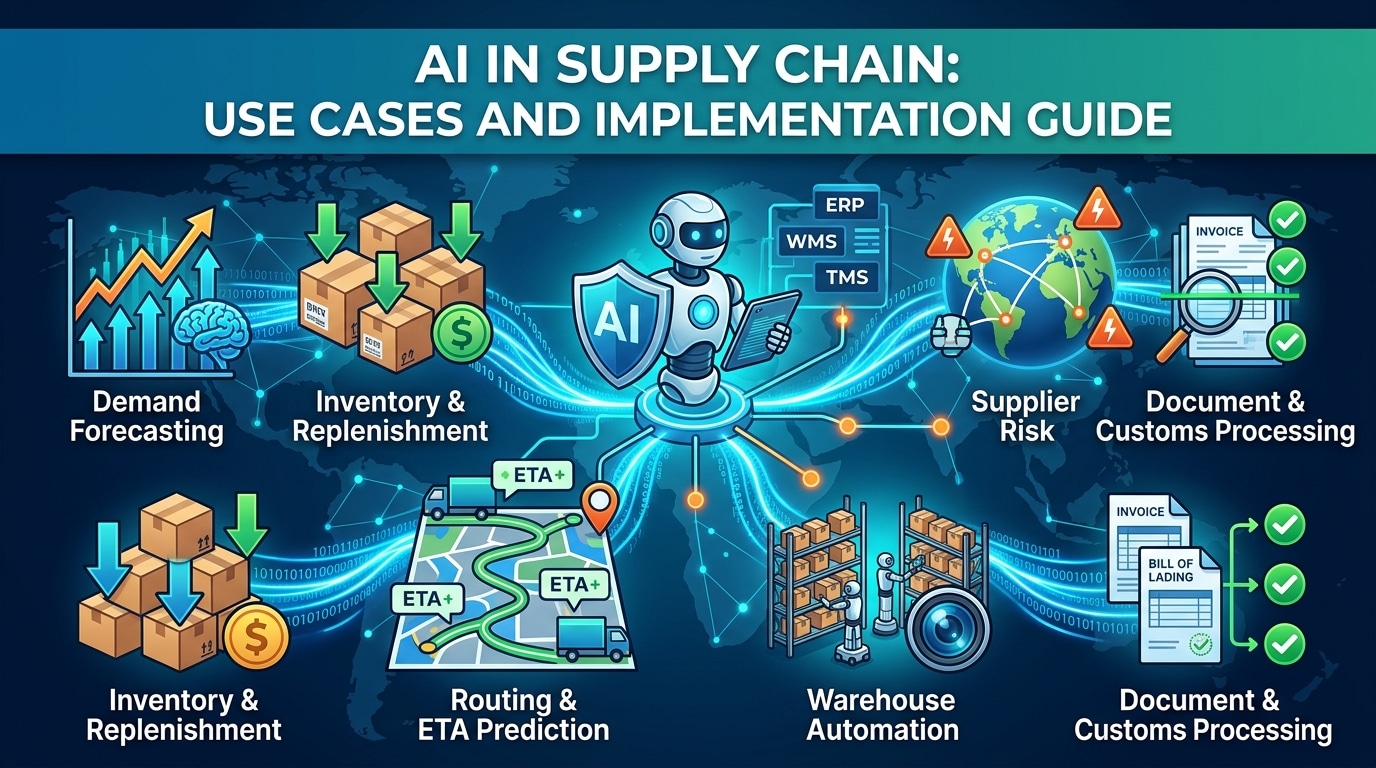
AI in supply chain: Use cases and implementation guide
What is AI in supply chain management? -
 September 21, 2026Read in 19 min.
AI in banking: Use cases, explainable AI, and how to deploy it in regulated environments
AI in banking: use cases, explainable AI and governance, generative AI, ROI, and how to deploy it in a regulated environment -
 September 8, 2026Read in 16 min.
The AI-Native SDLC: From Writing Software to Orchestrating It
An AI-native SDLC cuts delivery time by about half without loosening a single quality gate. See the three eras, the toolchain and the guardrails. -
 August 19, 2026Read in 22 min.
Robotic Process Automation in healthcare: Definition, benefits, and real cases
From patient scheduling to claims processing: explore proven RPA use cases in healthcare, backed by real data, ROI benchmarks, and compliance guidance. -
 July 22, 2026Read in 21 min.
AI Use Cases: 25+ Real Enterprise Examples Across Industries
Most impactful AI use cases in business - from generative AI and agentic AI to predictive analytics. Real examples by industry with ROI data and implementation priorities. -
July 22, 2026Read in 17 min.
AI in manufacturing: How to implement, use cases and benefits
How artificial intelligence is transforming manufacturing - from predictive maintenance and quality control to supply chain optimization and digital twins. Real ROI data and implementation roadmap. -
 July 16, 2026Read in 17 min.
Custom ERP software for manufacturing – Built on Azure and .NET
Off-the-shelf ERP forcing workarounds? Blackthorn Vision, a manufacturing software company, builds ERP software for manufacturing on Azure and .NET. -
June 10, 2026Read in 22 min.
Selecting elite Vue.js development company
Top Vue.js development companies vetted for Vue 3 architecture, high-performance rendering, and secure AI integration. Read our definitive guide for tech leaders. -
May 15, 2026Read in 24 min.
Claude vs. ChatGPT: Which one is right for your work?
Should you switch to Claude for its Artifacts or stay with ChatGPT for its Omni-Agent capabilities? A hands-on comparison of reasoning, coding, and privacy. -
 May 12, 2026Read in 16 min.
Machine Learning Consulting Services: The Executive Guide to Strategy, ROI, and Scaling Intelligence
Navigate of machine learning consulting. Learn how top firms deliver ROI through MLOps, custom model development, and strategic AI advisory.