

The cost of custom retail software development solutions depends on team size and time. Multiply team size by months, hours per month, and the blended hourly rate. A five-person team working six months at a $50 blended rate costs about $240,000 before hardware and licenses. Ask each retail software development company for a written team plan so you can compare like with like.
Retail software development companies: 12 vetted partners for store, omnichannel, and supply chain tech

 25 minutes read
Content
On Black Friday 2025, U.S. shoppers spent $11.8 billion online. Three days later, Adobe expected Cyber Monday spending to peak at about $16 million per minute. If your checkout goes down on a day like that, shoppers move to another store in a few seconds and those sales are hard to win back.
Peak-day outages are only the most visible failure. A register that freezes when the store’s internet drops loses sales every week of the year. So do stock counts that drift between the website and the shelf. Payment pages also carry new risk. Since March 31, 2025, PCI DSS 4.0.1 rules require retailers to approve and monitor every script running on them.
These are software problems, and they get expensive to fix once a system is live. How often you face them depends on the team you hire to build and maintain your retail systems.
This guide compares 12 retail software development companies with public retail work that you can check. For each one, you’ll see what they build, one of their published cases, who they partner with, and where they fit. Besides the profiles, we cover cost, integrations, compliance, and the questions to ask before signing.
How we selected these companies
Every company on this list markets retail software development services and meets the specific criteria we listed below (checked in October 2026). With this list, we aimed to create a shortlist that can be verified and used as a starting point.
Evaluation criteria
Each company clears four bars:
- Published retail work. At least one retail or consumer case study that names the client or describes the project in enough detail to discuss on a reference call.
- Breadth across store and digital. Retail software development that goes past an online storefront into POS, inventory, order management, data, or store operations.
- Platform or integration experience. Named partners or published integration work with the systems retailers run on, such as SAP Commerce, Microsoft Dynamics 365, Salesforce, Shopify, commercetools, or the major clouds.
- A track record of more than seven years in custom software, so you’re not their first long-term client.

What we excluded and why
The list leaves out marketplaces and agencies that resell other firms’ engineers, because you can’t judge delivery quality through a middleman. It also leaves out firms whose retail pages list services with no project behind them. Blackthorn Vision, as the publisher of this review, isn’t on the list, even though we provide the same services and have extensive experience doing so.


Want to hear about our expertise in retail or discuss your case?
Data sources and verification
For every company, we read its current retail pages, case studies, and partner listings. For the two public companies, EPAM Systems and Grid Dynamics, we used their latest annual results filed with the U.S. Securities and Exchange Commission.
Case study figures come from the vendors themselves. We haven’t audited these numbers, so treat them as a reason to ask questions on a reference call. Headcounts for private companies are the figures each company publishes.
Top retail software development companies at a glance
The table gives you a quick read before the full profiles. The order is editorial; we didn’t score the companies.
| Company | Base and history | Size (as published) | Retail strength | Best for |
| EPAM Systems | Newtown, Pennsylvania; public company | About 62,850 employees | Composable commerce, retail media, supply chain | Global retailers with multi-country replatforming |
| Grid Dynamics | San Ramon, California; public company | 4,961 employees | AI search, personalization, digital commerce | Large catalogs and personalization projects |
| SoftServe | Austin, Texas, and Lviv; since 1993 | 10,000+ (public profiles) | Data, cloud, order management migrations | Data-heavy omnichannel programs |
| Itransition | Offices in Decatur, Georgia, and London; since 1998 | 3,000+ professionals | POS, ERP, platform-based builds | Mid-market retailers on SAP, Adobe, or Dynamics |
| N-iX | Malta headquarters; since 2002 | 2,400+ engineers | Pricing, forecasting, cloud migration | Data and AWS-centered retail work |
| Intellias | 23 offices in 17 countries | Not published | Composable commerce, order management | Retailers moving off a monolithic platform |
| MobiDev | Since 2009; 50+ retail and hospitality clients | Not published | POS, ERP, inventory products | POS vendors and growing chains |
| DOOR3 | New York; since 2002 | Not published | UX-led apps, project rescue | U.S. retailers with customer-facing app needs |
| Geniusee | Offices in Austin, Warsaw, Stockholm, Kyiv; since 2017 | 300+ specialists | Marketplaces, inventory, mobile | Retail tech startups and scale-ups |
| Appinventiv | Offices in the U.S., UAE, India, UK, Australia, Canada | 1,600+ specialists (retail page) | Consumer apps, POS modernization | High-traffic shopping apps |
| ELEKS | Tallinn headquarters; since 1991 | 21 offices and delivery centers | POS with ERP, pricing tools | Long-term retail R&D programs |
| Oxagile | New York; since 2005 | 350+ clients served | Commerce platforms, payment migrations | Commerce with heavy QA and video needs |
Top 12 retail software development companies
Each of these retail software development companies gets the same profile order: overview, retail services, a notable case, technology partnerships, who it suits, and what to check before you sign.
EPAM Systems
EPAM is the largest company on this list. It reported $5.46 billion in revenue for 2025 and about 62,850 employees at year-end, per its fourth-quarter 2025 results filed with the SEC. Retail sits inside its Consumer business, next to consumer packaged goods and travel.
Retail services: EPAM groups its retail work into commercial transformation, omnichannel acceleration, supply chain digitization, and cost optimization. It also builds retail media platforms (the ad business retailers run on their own sites) and composable commerce, where a store’s checkout and search run as separate services that can be swapped one at a time.
Notable case: EPAM features its work with Primark on the retailer’s move to a composable architecture, presented at a MACH Alliance event. The page gives no performance figures, so ask for them directly.
Tech and platform partnerships: Commerce partners listed on EPAM’s retail page include commercetools, Fluent Commerce, Salesforce, SAP, Adobe, and Sitecore. Data and cloud partners include Snowflake, Databricks, Google Cloud, and Microsoft.
It’s best for global retailers replatforming across several countries at once, where you need hundreds of engineers and deep bench strength.For a single-store-format POS project, a firm this size may be more than you need.
Grid Dynamics
Grid Dynamics is a Nasdaq-listed engineering firm based in San Ramon, California. Retail is its biggest business. It made up 29.3% of 2025 revenue, or $120.5 million out of $411.8 million, according to the company’s annual results filing. It ended 2025 with 4,961 employees.
Retail services: The company’s retail work centers on AI for inventory forecasting, product recommendations, dynamic pricing, and store operations. It also builds product search and data platforms for retail analytics.
Notable case: In April 2026, Grid Dynamics announced a personalization system for French department store Galeries Lafayette. It replaced the retailer’s old search and recommendation engines across a catalog of 600,000 products. The company reports a 7% revenue increase, an 8% rise in average basket value, and 20% year-over-year online sales growth.
Tech and platform partnerships: Listed partners include commercetools, Fluent Commerce, Lucidworks, Sitecore, Mirakl, Algolia, Adyen, and SAP, plus AWS, Google Cloud, and Microsoft.
Best for retailers with large catalogs who want better search and recommendations on digital channels.
Store hardware and POS work are less visible in its retail material. If your project is mostly in-store, ask for examples from the store floor.
SoftServe
SoftServe was founded in Lviv, Ukraine, in 1993. It has headquarters in Austin, Texas, and Lviv. Public profiles of the company put its headcount above 10,000.
Retail services: SoftServe’s retail offer leans on data and cloud: centralizing retail data, cloud migration, connecting systems, and building the base for analytics and AI. Named solutions include demand forecasting, an AI shopping assistant, personalized in-store mobile promotions, robotic order fulfillment, and customer lifetime value analytics.
Notable case: SoftServe helped U.S. menswear retailer Tailored Brands unify online and in-store order data during its move to the Manhattan Active Omni order management system on Google Cloud. The team migrated the retailer’s data pipelines and connected on-premise systems to the cloud.
Tech and platform partnerships: Google Cloud, AWS, Salesforce, and Microsoft. NVIDIA named SoftServe its 2025 Americas service delivery partner of the year.
Best for retailers whose main problem is scattered data across stores and ecommerce, especially during an order management migration. The published retail cases describe the work but give few numbers. Ask for measured outcomes from a comparable project.
Itransition
Itransition has built software since 1998 and says it has 25+ years of retail and ecommerce work. It lists offices in Decatur, Georgia, and London, and reports more than 3,000 professionals.
Retail services: Its retail software development services form one of the broadest catalogs on the list: online stores, mobile apps, portals, POS, ERP, CRM, inventory, order management, logistics, and warehouse management. Work covers consulting, new builds, integration, modernization, and support.
Notable case: For an unnamed fashion retailer, Itransition built a business intelligence platform. The company reports a 50% cut in monthly infrastructure costs and an 8% rise in conversion. A separate SAP Commerce project for a trading company reportedly lifted marketplace sales by 25% and made product feed generation twice as fast. Provenance: Itransition retail page, reviewed October 2026; figures are self-reported.
Tech and platform partnerships: Itransition names Microsoft, AWS, and Salesforce as partner programs. On its retail page, it lists certified experts in Adobe Commerce, Salesforce, SAP Commerce, and Odoo, and works with Shopify and Dynamics 365.
Best for mid-market retailers who want a platform-based build with custom modules, plus help connecting it to POS and supply chain systems. Most retail case studies are anonymized. Ask for a reference you can call.
N-iX
N-iX traces its work back to 2002 and lists its headquarters in Malta, with delivery in 10 countries. It reports 2,400+ engineers, with 300+ of them on retail and ecommerce projects. N-iX also holds AWS Premier Tier partner status.
Retail services: N-iX’s retail software development services focus on data-driven retail: competitive pricing intelligence, demand planning, personalized search, logistics and supply chain, in-store operations, and customer analytics.
Notable case: N-iX reports that Boohoo Group cut operational costs tenfold through an AWS migration and tech modernization. A separate global retailer moved to twice-as-fast pricing across 20+ countries on a unified cloud platform.
Tech and platform partnerships: AWS (Premier Tier), Microsoft, Google, SAP, Snowflake, and Palantir.
Best for retailers moving pricing or forecasting work to AWS. Store-level POS work is less prominent than data and pricing. Check fit if your project is mostly about the checkout counter.
Intellias
Intellias runs 23 offices in 17 countries, according to its website, and has a dedicated retail practice.
Retail services: Intellias focuses on modern commerce stacks: headless and composable commerce, marketplace platforms, order management, click-and-collect (also called BOPIS: buy online, pick up in store), endless aisle, product information management, and Microsoft Dynamics 365 for retail.
Notable case: Intellias moved UK builders’ merchant Travis Perkins from a legacy monolithic platform to a composable architecture.
Tech and platform partnerships: A long list of commerce partners: commercetools, Shopify, VTEX, BigCommerce, Fluent Commerce, Mirakl, Akeneo, Contentful, Algolia, Avalara for tax, and Blue Yonder for supply chain. Cloud partners are AWS, Microsoft Azure, and Google Cloud.
Best for retailers stuck on an aging all-in-one platform who want to replace it piece by piece. Case summaries on the retail page don’t include results, so ask for before-and-after numbers.
MobiDev
MobiDev has built software since 2009 and has done retail work since 2013. It reports 400+ clients, 50+ of them in retail and hospitality. It also says 91% of its engineers are mid-level or senior.
Retail services: MobiDev’s retail software development services cover the store operations stack: ERP, POS, inventory, workforce scheduling, self-checkout, electronic shelf labels, and warehouse robots. It also builds loyalty and demand forecasting tools.
Notable case: Since 2013, MobiDev has worked on ComCash, a cloud-based ERP with a built-in POS. The system now serves more than 3,000 retail locations, according to MobiDev’s retail software development page.
Tech and platform partnerships: MobiDev doesn’t list formal partner tiers. It names integrations with Stripe, PayPal, Shopify, Salesforce, and major carriers such as FedEx and UPS.
Best for companies that sell POS or retail management software to other retailers, and chains that need a custom POS that keeps working offline. Without formal platform partnerships, check its experience with your specific ERP or commerce platform.
Read also: AI and machine learning in retail: What’s working, what’s next, and how to implement it
DOOR3
DOOR3 is a New York firm founded in 2002, with offices in Europe. Its work starts with user research and design, then moves into software and AI.
Retail services: DOOR3 lists consumer and retail as one of its industries, with a focus on customer-facing apps and portals. It also runs a Project Rescue service for software projects that have stalled with another vendor.
Notable case: DOOR3 designed and launched a bilingual mobile app for Leon Market to support hyper-local delivery. For PepsiCo, it built a dashboard that pulls together sales and product data from thousands of stores.
One of the best U.S. development companies for. U.S. retailers who need a retail app development company for a polished customer app, or a rescue plan for a stalled project. Their retail portfolio is smaller than others here, and it has no published retail metrics. Ask for a retail reference.
Geniusee
Geniusee was founded in 2017 and lists offices in Austin, Warsaw, Stockholm, and Kyiv. It reports 300+ specialists and 200+ active clients. Geniusee is also a certified AWS partner.
Retail services: Geniusee’s retail software development services include online stores, marketplaces, dropshipping platforms, inventory and order management, supply chain dashboards, and loyalty features.
Notable case: Geniusee worked as the long-term Android and QA team for Crave Retail, bringing its iOS fitting-room experience to Android. Shoppers can preview items and request sizes from the fitting room. The case headline claims fitting-room sales rose by more than 20%.
Tech and platform partnerships: AWS (certified partner).
Best for retail technology startups and scale-ups that need retail app development and cloud work without enterprise overhead. It’s the youngest firm on the list, with one retail case that includes a number. Ask about their work on long engagements.
Appinventiv
Appinventiv’s registered company is in Noida, India, and it lists offices in the U.S., UAE, UK, Australia, and Canada. Its retail page cites 1,600+ specialists. Another section of the same page says 1,700+.
Retail services: Retail app development services sit at the center, alongside retail consulting, ecommerce storefronts, system integration, POS modernization, and inventory management across stores and warehouses.
Notable case: Appinventiv reports that the Adidas app it worked on for the Middle East reached 2 million downloads and 500,000+ new users. It also built an ERP-based kiosk now used in 7+ IKEA outlets. Provenance: Appinventiv retail page, reviewed October 2026; figures are self-reported.
Tech and platform partnerships: Shopify, Odoo, SAP Commerce, Salesforce, and Adobe Commerce. It displays compliance logos for PCI DSS, ISO 27001, SOC 2, and EMVCo.
Best for brands looking for a retail app development company to launch high-traffic shopping apps, especially in the Middle East and South Asia. Check which office and time zone your team would sit in, and confirm the specific people assigned.
ELEKS
ELEKS was founded in 1991 and is headquartered in Tallinn, Estonia. It runs 21 offices and delivery centers.
Retail services: ELEKS lists retail software development services that include POS for card and mobile payments; multi-store inventory; pricing and promotion tools; logistics management; ecommerce; and AR or VR features such as virtual fitting rooms.
Notable case: For B2B marketplace SAVSERVICE, ELEKS reports a 15% rise in order frequency and an estimated 13% increase in added sales. For a Middle Eastern construction leader, it delivered an integrated POS and retail ERP as a market-ready MVP in 16 months, according to their retail software development page.
Best for retailers that want a long-term R&D partner for a POS and ERP combination built around their own processes. With no named platform partners on the retail page, ask about certified experience with your ERP.

Oxagile
Oxagile was founded in 2005 and lists a New York address. It runs eight offices across Europe and North America and reports 350+ clients served.
Retail services: Storefronts, mobile shopping apps, customer portals, POS, inventory and order management, warehouse management, ERP modules, and retail analytics. It works with Magento, Shopify, Salesforce, SAP Commerce, Odoo, and Dynamics 365.
Notable case: For one retail client, Oxagile automated regression testing (rechecking existing features after each change) and cut the run from eight hours to one minute. In a separate project, it moved payment infrastructure and added PayPal with zero downtime.
Tech and platform partnerships: Oxagile shows a Microsoft partner badge. Payment integrations include Stripe, PayPal, Apple Pay, and Checkout.com.
Best for commerce platforms where release speed and test automation are the bottleneck, and businesses that sell video or media content. Retail cases are anonymized. Ask for a named reference in your segment.
Types of retail software these companies build
Retail software development covers far more than the website. Here’s what each category does, in plain terms. Most of the retail software development companies above build several of them.
Point of sale (POS) and mobile POS systems
The POS is the checkout: scanning, payments, receipts, returns. Mobile POS puts that checkout on a phone or tablet so staff can ring up sales anywhere on the floor. A custom POS pays for itself when you have unusual workflows, such as made-to-order items or rentals, or need the register to keep selling when the internet drops.
Order management systems (OMS) and unified commerce
An OMS decides where each order ships from and tracks it to the customer. Unified commerce means one shared view of orders and stock across every channel. It lets a store ship a web order or accept a return for an online purchase.
Inventory management, RFID, and warehouse software
Inventory software tracks what you have and where it is. RFID tags let staff count a whole rack with a handheld reader in minutes. Warehouse management software (WMS) directs picking and shipping. Accurate stock data is what makes “in stock at your store” promises true.
Retail ERP customization and integration
ERP is the back-office system for finance, purchasing, and stock. Most retailers already own one, such as SAP or Microsoft Dynamics 365. Much of the software development for retail back offices happens around it: connectors and store-specific screens that the standard product doesn’t offer.
Loyalty programs and customer data platforms (CDP)
Loyalty software runs points and rewards. A CDP pulls customer data from the POS, website, app, and email into one profile per person. Together, they let you recognize a customer at the till and send offers that match what they buy.
Pricing, promotion, and markdown optimization
These tools suggest prices and plan promotions, including when to mark down slow stock. They work from sales history and competitor prices. Several firms above, including Grid Dynamics and N-iX, list pricing work among their retail cases.
Demand forecasting and replenishment
Forecasting software predicts how much of each product will sell, by store and by week. Replenishment then turns that forecast into purchase and transfer orders. Good forecasts mean fewer empty shelves and less cash tied up in stock that won’t move.
Workforce management and store operations apps
These apps handle staff scheduling, time tracking, task lists, and store audits. Managers see who is on shift and what still needs doing. Head office sees which stores completed a planogram change or a price update.
Retail app development: customer-facing mobile apps (mobile app development for retail, BOPIS, scan-and-go)
Retail app development covers the apps shoppers carry in their pockets. Retail app development services usually cover BOPIS (buy online, pick up in store), scan-and-go (scan items with your phone and skip the checkout line), loyalty wallets, and store maps. Mobile app development for retail only pays off when the app connects to live stock and order data, so check that any retail app development company you hire can do the backend work too. Custom retail app development without a live data connection can show shoppers items that are out of stock.
Read also: AI in supply chain: Use cases and implementation guide
Custom vs off-the-shelf vs extending retail platforms
Most retailers end up mixing packaged products with extensions and some custom code. The choice for each piece depends on how far your process differs from the standard one.
When SaaS POS and retail suites are enough
If your stores sell standard products in standard ways, start with a SaaS product. Shopify, for example, lists POS Pro at $89 per location per month, billed yearly, on its pricing page. That’s hard to beat for a small chain. You get updates and support without building anything. The trade-off is that you live with its workflows and its roadmap.
When to extend SAP, Dynamics 365 Commerce, or Salesforce Commerce Cloud
If you already run one of these suites, extending it is often cheaper than replacing it. For custom software development for retail industry work on these suites, ask for developers certified on your platform. Extensions add custom screens, pricing rules, or connectors while keeping the vendor’s core updates. The risk is heavy customization that breaks at every upgrade. Ask any retail software development company how its extensions survive a version change.
When custom retail software development pays off
Custom retail software development makes sense when the process is your edge: a unique service model or a store format nobody else runs. It also makes sense when license fees across hundreds of stores outgrow the cost of owning the code. A good partner for custom software development for retail industry projects will tell you which parts not to build. Custom retail software development solutions should still sit on standard parts for payments and tax. Build only what sets you apart.
Leaning towards custom development?
Let’s discuss your case!
Integrations, Scalability, and Compliance in Retail Software
Use this section as a checklist when you talk to retail software development companies.
Core integrations
Expect your new system to connect to your ERP, WMS, OMS, payment processors, and marketplaces such as Amazon. Ask each vendor for a list of integrations they’ve built before, and who maintains them after launch.
Peak-season scalability
The 2025 Thanksgiving weekend drew a record 202.9 million shoppers in stores and online. On Cyber Monday, Adobe Analytics expected online spending to peak at about $16 million per minute.
Your retail software development company should load-test (simulate peak traffic) months ahead of Black Friday or Christmas. Systems should add server capacity automatically when traffic jumps. Ask for results from a past peak.
Payment security
PCI DSS is the card industry’s security standard. Since March 31, 2025, two PCI DSS 4.0.1 rules for online payment pages are mandatory. Scripts on payment pages must be approved and monitored, and unauthorized page changes must be caught. Both target e-skimming, where attackers slip code onto a checkout page to steal card numbers.
Two methods cut your exposure. Tokenization swaps the card number for a meaningless code. Point-to-point encryption (P2PE) scrambles card data from the moment it’s read at the terminal. Retail logged 997 security incidents in 2025, 806 with confirmed data disclosure, according to Verizon’s 2026 Data Breach Investigations Report.
Customer data privacy
California’s CCPA, as updated by the CPRA, gives shoppers the right to access and delete their data. They can also opt out of its sale. Twenty states had broad consumer privacy laws in effect in 2026. Your loyalty program, CDP, and apps need consent management: a record of what each customer agreed to and a way to honor their requests.
Sales tax automation and nexus rules (Avalara, Vertex)
Since the 2018 Supreme Court ruling in South Dakota v. Wayfair, states can require online sellers to collect sales tax even without a store there. This obligation is called nexus. Forty-five states levy a statewide sales tax, and 38 allow local sales taxes on top, per the Tax Foundation. Rates change often. Tax engines such as Avalara and Vertex calculate the right rate per address, and your vendor should connect your POS and checkout to one.
Accessibility
Websites and in-store kiosks must be usable by people with disabilities under the ADA. Plaintiffs filed 3,117 federal website accessibility lawsuits in 2025, up 27% from 2024. The working standard is WCAG 2.2, published by the W3C. Ask vendors how they test for it and whether people who use screen readers are part of testing.
How much does retail software development cost?
Retail software development companies can’t quote a fair price without seeing your scope. Yet, you can still build a sensible budget range before talking to vendors, using the method below.
Cost by software type
Cost follows team size and time. The formula is team size × months × hours per month × blended hourly rate. Here’s what pushes custom retail software development costs up for each software type.
| Software type | Main cost drivers |
| POS and mobile POS | Payment certification, offline mode, hardware support, store rollout |
| OMS and unified commerce | Number of channels and fulfillment rules, ERP and WMS integrations |
| Inventory, RFID, WMS | Device integration, data accuracy work, warehouse process mapping |
| ERP customization | Depth of customization, upgrade testing, data migration |
| Loyalty and CDP | Data sources, consent management, privacy compliance |
| Pricing and forecasting | Data cleanup, model training, links to purchasing systems |
| Customer mobile apps | Number of platforms, live stock and order links, peak load testing |
A worked example: a team of five working for six months, at about 160 hours a month and a blended rate of $50 an hour, comes to 5 × 6 × 160 × $50 = $240,000. Change any input and the total moves in a straight line. That’s why a vendor’s team plan is as important as its rate.
Hourly rates by region
There is no neutral public price list for outsourced developers, so treat any single “average rate” you will find online cautiously. Here’s a public anchor for the U.S.
For U.S. in-house staff, the median wage for software developers, QA analysts, and testers was $64.44 an hour. Benefits make up 30% of private employers’ compensation costs. That puts the loaded cost of a median in-house developer at roughly $92 an hour, before office space, tools, or recruiting.
Hidden costs
These items often sit outside the first quote:
- PCI DSS assessments and payment terminal certification with your processor.
- Store hardware: terminals, scanners, printers, and RFID readers.
- Data migration from the old system, including cleanup of product and customer records.
- Third-party licenses for tax engines, search, or cloud hosting.
- Staff training and a pilot in a few stores before full rollout.
- Ongoing maintenance and support after launch, which runs for as long as you use the software.
Read also: Custom software development cost: Real ranges, rate cards, and how to budget
Engagement models for retail projects
Dedicated team
You get a stable team that works only on your product, billed monthly. You set priorities, and the vendor handles hiring and payroll. It fits long programs where scope keeps changing, such as a multi-year omnichannel rollout. Blackthorn Vision’s dedicated team model page explains how this setup works in practice.
Fixed price
You agree on scope and price up front. It fits small, well-defined jobs, such as one integration or a kiosk app with a clear spec. Every change after signing means a new estimate, and vendors price their risk into the quote.
Time & materials
You pay for hours worked against a rolling backlog. You keep flexibility, and you carry the budget risk. It suits discovery phases and projects where requirements will shift as you learn.
How to choose a retail software development company
Use these 10 questions to ask a retail software development companies during calls.
- Which retail projects similar to ours has your company shipped in the last two years, and can we speak to those clients?
- Who exactly will be on our team, and how many of them have worked on retail systems before?
- How will you handle PCI DSS 4.0.1 requirements for our payment pages and terminals?
- What did your last peak-season load test show, and what broke?
- Which ERP, OMS, and payment integrations have you built before?
- How do your customizations survive upgrades to the platforms we use?
- What’s your staff turnover rate, and what happens if a key engineer leaves?
- How do you test for accessibility under WCAG 2.2?
- Who owns the code and the intellectual property at the end of the contract?
- What will support and maintenance cost after launch?
Red flags in retail vendor proposals
- A fixed price on a vague scope. Someone will pay for the gaps, and it’s usually you.
- No mention of payment security or accessibility in a proposal for a checkout or POS.
- Case studies with big percentages but no client name or time frame.
- A team plan of senior names in the pitch that turns into “to be assigned” in the contract.
- No plan for data migration or store rollout.
Check metrics. Look for numbers that tie to money or time: conversion rate, average basket value, stock accuracy, checkout speed, uptime during peak, or cost per order. Then check the context. A “50% cost cut” means little without the starting cost and the time frame. The best way to test any number is to ask the client directly on a reference call.
Evaluating retail software developers?
Let’s discuss your case!
FAQ
How much does custom retail software development cost?
How long does it take to build a custom POS system?
Timelines depend on store formats, payment certification, hardware, and integrations. Plan for a pilot in a small number of stores before a full rollout. For reference, ELEKS reports delivering an integrated POS and retail ERP as a market-ready MVP in 16 months. Ask each retail software development company for a phased plan with dates for pilot and rollout.
Should retailers build custom software or use Shopify POS / Lightspeed?
Start with Shopify POS, Lightspeed, or a similar SaaS product if your store workflows are standard. They’re cheaper to start and come with updates and support. Consider custom software development for retail processes that set you apart, or when per-location fees across many stores exceed the cost of owning the code.
How do retail software development companies handle Black Friday traffic?
Good teams load-test months ahead and set servers to scale up automatically. Many also freeze risky changes before peak season. Strong teams also plan for failure, so the POS keeps selling and the site keeps taking orders if one service slows down. Ask any retail software development company for results from its last peak-season test.
What tech stack is best for omnichannel retail platforms?
There’s no single best stack. Many retailers now use composable commerce: separate services for catalog, search, checkout, and orders, joined through APIs (standard connections between systems). They run on a major cloud such as AWS or Azure. Pick tools your team and your retail software development company can support for years, and make sure they connect to your ERP and payment providers.
What does PCI DSS 4.0 require from retail software?
PCI DSS sets rules for anyone who stores, processes, or sends card data. Under version 4.0.1, scripts on payment pages must be approved and monitored, and changes to those pages must be detected. Both rules have been mandatory since March 31, 2025. Software should also encrypt card data and log who accessed it.
What is the difference between retail software and ecommerce software?
Ecommerce software runs online sales through the storefront and checkout. Retail software covers the whole business, including stores, POS, inventory, warehouses, staff, and loyalty. Online sales were 17.1% of U.S. retail sales in the second quarter of 2026, per the U.S. Census Bureau, so most retailers need both working from the same data.
You may also like
-
 September 28, 2026Read in 19 min.
AI in supply chain: Use cases and implementation guide
What is AI in supply chain management? -
 September 21, 2026Read in 19 min.
AI in banking: Use cases, explainable AI, and how to deploy it in regulated environments
AI in banking: use cases, explainable AI and governance, generative AI, ROI, and how to deploy it in a regulated environment -
 September 8, 2026Read in 16 min.
The AI-Native SDLC: From Writing Software to Orchestrating It
An AI-native SDLC cuts delivery time by about half without loosening a single quality gate. See the three eras, the toolchain and the guardrails. -
 September 4, 2026Read in 36 min.
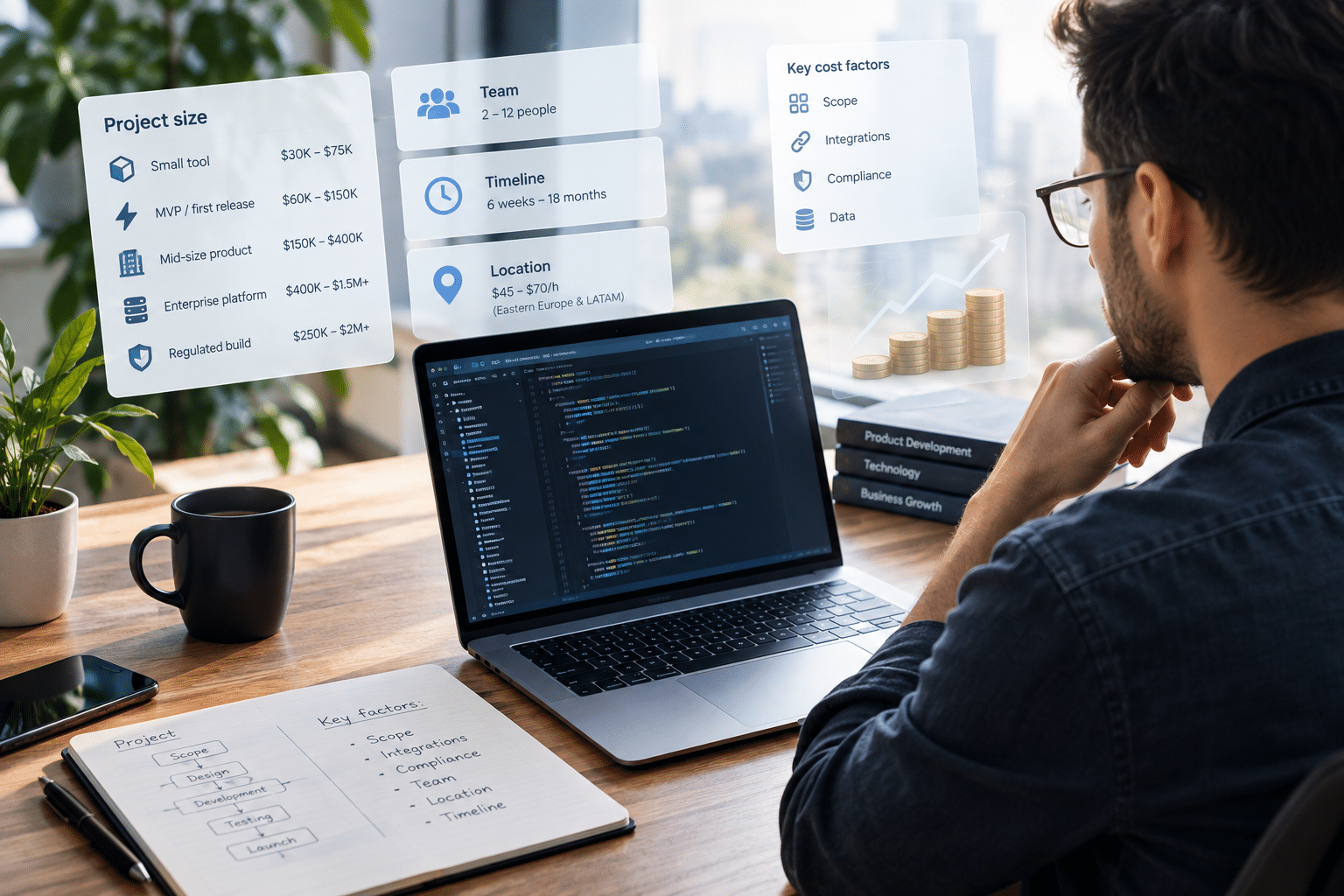
Custom software development cost: Real ranges, rate cards, and how to budget
How much custom software development costs. Explore real pricing ranges, hourly rates, key cost factors, hidden expenses, and budgeting tips. -
 September 2, 2026Read in 36 min.
Fitness app development companies: An independent shortlist
10 fitness app development companies compared on verified data, published pricing, and real client work. Only three have documented fitness delivery. -
 August 27, 2026Read in 36 min.
Top software development companies in the USA
Find the best US-based software developers. From AI to enterprise web apps, here are the top 30 software development companies in the USA you should hire in 2026. -
 August 19, 2026Read in 22 min.
Robotic Process Automation in healthcare: Definition, benefits, and real cases
From patient scheduling to claims processing: explore proven RPA use cases in healthcare, backed by real data, ROI benchmarks, and compliance guidance. -
 July 22, 2026Read in 21 min.
AI Use Cases: 25+ Real Enterprise Examples Across Industries
Most impactful AI use cases in business - from generative AI and agentic AI to predictive analytics. Real examples by industry with ROI data and implementation priorities. -
July 22, 2026Read in 17 min.
AI in manufacturing: How to implement, use cases and benefits
How artificial intelligence is transforming manufacturing - from predictive maintenance and quality control to supply chain optimization and digital twins. Real ROI data and implementation roadmap. -
July 21, 2026Read in 18 min.
AI in Education: How Artificial Intelligence Is Transforming Learning
How AI is used in education - from personalized learning and automated grading to AI tutors and corporate L&D. Real examples, benefits, challenges, and what's next.