



PyTorch in virtually all cases. The clear exceptions are a specific edge or mobile deployment requirement where TFLite is mandatory, a TPU-native infrastructure where JAX’s performance advantage is real and accessible, or an inherited TFX pipeline where the migration cost to PyTorch would be prohibitive. Outside these scenarios, choose PyTorch and do not second-guess it.
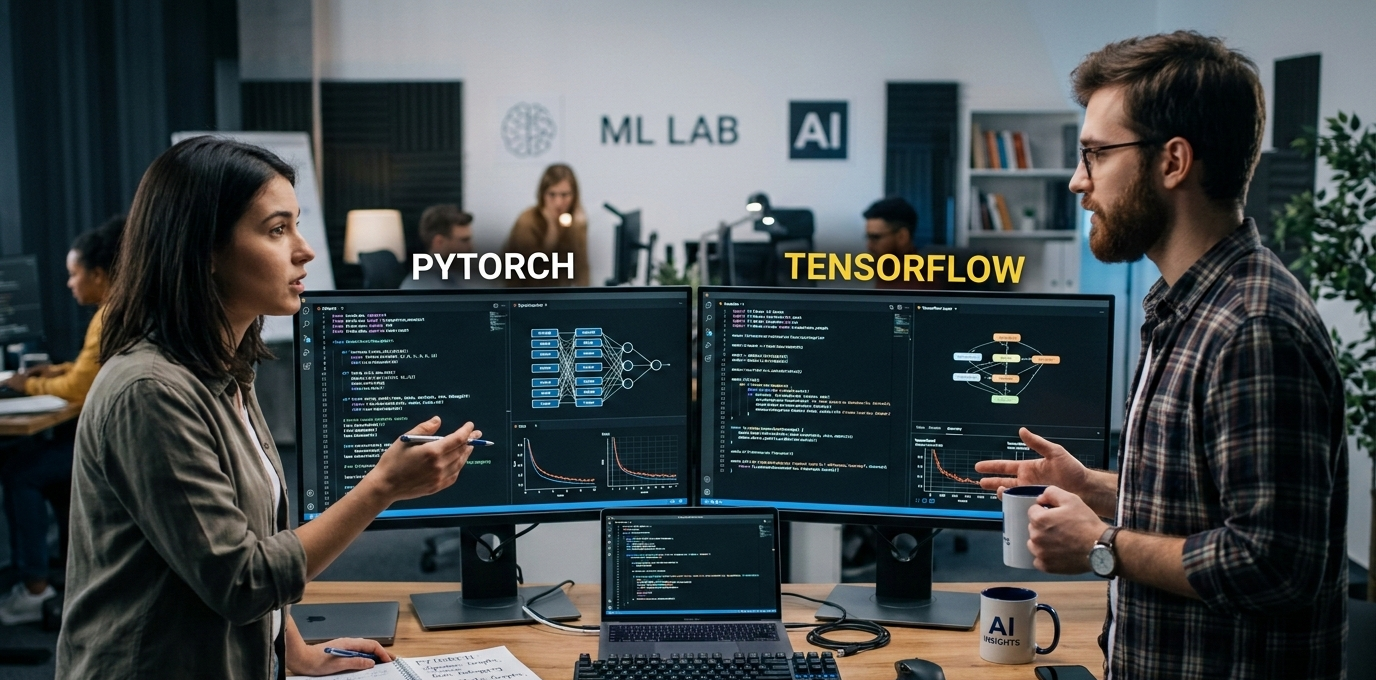
PyTorch vs TensorFlow vs JAX: Differences, performance, and how to choose
 18 minutes read
Content
For years, the AI community operated under a convenient fiction: PyTorch was the researcher’s tool, TensorFlow was the enterprise production workhorse, and never the twain shall meet. For anyone asking PyTorch vs TensorFlow for beginners, that binary was at least a useful starting point. It is now definitively dead.
The ecosystem has undergone a tectonic realignment. PyTorch has achieved near-hegemony in both research and production. TensorFlow and its Keras 3 successor have pivoted to a compelling multi-backend positioning. JAX has emerged as a high-performance challenger backed by Google’s own Gemini infrastructure. And for enterprise teams on Azure, the question of how to choose between TensorFlow and PyTorch now includes a third path entirely – Microsoft’s native AI stack.
This guide walks through each framework’s genuine strengths, financial implications, and a scenario-based decision framework you can actually use. It also covers adoption data, the emerging role of generative AI development pipelines in framework selection, and what the enterprise path looks like for teams that don’t start from Python at all.
PyTorch vs TensorFlow vs JAX: At a glance
| Parameter | PyTorch | TensorFlow | JAX |
| Created by | Meta AI (2016) | Google Brain (2015) | Google Research (2018) |
| Primary use | Research & production | Production & edge | High-performance research |
| Learning curve | Gentle | Moderate | Steep |
| Eager execution | Default | Default (TF 2.x) | JIT via @jit decorator |
| Hugging Face support | Native (PyTorch-first) | Supported | Limited |
| TPU support | Via PyTorch/XLA | Native | Native (best) |
| Edge / mobile | ExecuTorch (early) | TFLite / LiteRT | Not designed for it |
| Best for | New projects, NLP, LLMs | Production MLOps, edge | Scale research, TPU workloads |
PyTorch: Why do we call it a king of ecosystem
PyTorch is an open-source machine learning framework developed by Meta’s AI Research lab (FAIR), released in 2016. It provides a dynamic computation graph (also called “define-by-run” or “eager execution”), meaning the graph is built on-the-fly as your Python code runs, rather than being compiled ahead of time. This makes it feel like standard Python and makes debugging intuitive. At its core, PyTorch offers: Tensors (multi-dimensional arrays with GPU support), autograd (automatic differentiation for gradient computation), and torch.nn (a module system for building neural networks). It runs on NVIDIA CUDA, AMD ROCm, Apple MPS, and Intel XPU hardware.
PyTorch’s ascendancy is the compounding result of architectural decisions made in 2016-2017 that proved prescient for the transformer era. The dynamic computation graph was initially mocked as unscalable. It turned out to be exactly what researchers needed when the field pivoted from CNNs to attention mechanisms, where control flow is often data-dependent.
Today, PyTorch powers over 70% of papers on arXiv and virtually every frontier model lab: OpenAI, Meta AI, Mistral, Stability AI, and Cohere all build on PyTorch as their primary framework.
What is “Hugging Face” and what effect does it have on PyTorch?
Hugging Face is an AI company that built the dominant open-source ML tooling hub. Its Hub hosts over 500000 pre-trained model checkpoints, virtually all as PyTorch files. Its libraries (transformers, diffusers, peft, accelerate) are the standard toolkit for modern NLP, computer vision, and generative AI work. Think of it as the npm registry + GitHub for ML models, with first-class PyTorch integration throughout.
No single factor has done more to entrench PyTorch than the Hugging Face ecosystem. With 500000+ models distributed as PyTorch checkpoints, there is now a self-reinforcing network effect that is structurally difficult to disrupt.
- Transformers library: The de facto standard for NLP, vision, and multimodal models – PyTorch-first by design
- PEFT library: Parameter-efficient fine-tuning (LoRA, QLoRA, prefix tuning) – PyTorch native
- Accelerate: Distributed training abstraction that scales from laptop to 8,192 GPUs seamlessly
- Diffusers: The definitive library for diffusion model inference and training
- Datasets: Standardized data pipelines deeply integrated with PyTorch DataLoaders
Hardware-aware compilation: torch.compile
Torch.compile (introduced in PyTorch 2.0) is a JIT (Just-In-Time) compiler that traces your model’s compute graph and uses TorchInductor as a backend to generate optimized CUDA/C++ kernels. JIT compilation means converting Python code to optimized machine code at runtime rather than ahead of time. XLA (Accelerated Linear Algebra) is a domain-specific compiler for linear algebra (originally Google’s) that PyTorch can also target via torch_xla.
Together, these tools close much of the performance gap between PyTorch’s flexible eager mode and TensorFlow’s traditionally graph-optimized execution.
The Developer Experience (DX) advantage
Eager execution implies that operations run immediately when called, like standard Python. You can inspect any tensor’s value at any line of code, use native print() and pdb for debugging, and write data-dependent if/for control flow naturally. Graph mode (TF 1.x’s original model) requires you to first define a computation graph, then execute it in a “session”, which is powerful for optimization but deeply hostile to interactive debugging. TensorFlow 2.x adopted eager execution by default, largely in response to PyTorch’s superior developer experience.
PyTorch’s mental model maps directly onto standard Python. Debugging a PyTorch model means using pdb, setting breakpoints, inspecting tensors with .shape and .grad – tools every Python developer already knows.
TensorFlow and Keras 3: The “Switzerland” among frameworks
TensorFlow is an open-source ML framework developed by Google Brain and released in 2015. It was originally built around static computation graphs (you define the full graph first, then execute it) which enabled aggressive compiler optimizations but made debugging painful.
TensorFlow 2.x (2019) adopted eager execution by default and reorganized around Keras as its primary high-level API. TensorFlow’s production ecosystem includes TF Serving (model deployment server), TFX (ML pipelines), TFLite (edge/mobile inference), TF.js (browser inference), and tight integration with Google Cloud’s Vertex AI platform.
TensorFlow was one of last year’s strategic reinventions. The narrative that “TensorFlow is dead” is both wrong and unhelpfully reductive. What has died is its claim to research dominance. What has survived and thrived, is its production infrastructure and, most importantly, Keras 3.
The Keras 3.0: From introduction to revolution
Keras was originally a high-level neural network API designed to be user-friendly and modular. From 2019-2023, it was tightly bundled with TensorFlow as tf.keras. Keras 3.0 (late 2023) is a complete re-architecture: it is now a backend-agnostic deep learning library that can execute on TensorFlow, PyTorch, or JAX interchangeably. You select your backend via an environment variable (KERAS_BACKEND=torch). A single Keras 3 model can be trained on PyTorch for research, deployed via TensorFlow for production, and benchmarked with JAX for performance, from the same Python code.
This is arguably the most underrated development in the 2024-2025 framework landscape.
For organizations currently on TF 2.x with significant Keras usage, migrating to Keras 3 with the PyTorch backend offers the lowest-risk path to accessing the PyTorch ecosystem while preserving existing model investments. This is the migration path that minimizes technical debt write-offs.
TFX and Production-Grade MLOps
MLOps (Machine Learning Operations) is the discipline of deploying, monitoring, and maintaining ML models in production, analogous to DevOps for software. It covers data pipelines, model versioning, performance monitoring, retraining triggers, and governance.
TFX (TensorFlow Extended) is Google’s end-to-end MLOps platform built on TensorFlow. It provides modular components: ExampleGen (data ingestion), StatisticsGen (automated data profiling), Transform (feature preprocessing with lineage), Trainer (training with checkpointing), Evaluator (validation gates), and Pusher (deployment). The ML Metadata store tracks full artifact lineage – critical for regulated industries.
TFX remains the most complete end-to-end ML pipeline framework available. For organizations requiring rigorous data validation, lineage tracking, and schema enforcement, TFX provides capabilities with no direct equivalent in the PyTorch ecosystem. PyTorch teams typically assemble equivalent functionality from multiple third-party tools (MLflow, Evidently AI, Great Expectations), incurring both integration cost and maintained surface area.
Edge & Mobile: TensorFlow’s unbeatable advantage
TFLite (TensorFlow Lite), now rebranded as LiteRT, is a lightweight runtime for deploying ML models on mobile (Android/iOS), embedded Linux, and microcontrollers. It supports quantization (reducing model precision to int8/float16 for speed and size), hardware acceleration via GPU Delegates (Adreno, Mali, Apple GPU), and NNAPI (Android Neural Networks API). TF.js runs TensorFlow models directly in web browsers using WebGL or WebGPU. TFLite Micro runs on microcontrollers with as little as 16KB of RAM. Collectively, LiteRT runs on over 4 billion devices worldwide.
- TFLite Micro: Runs on microcontrollers with as little as 16KB of RAM, no OS required
- GPU Delegate: Hardware-accelerated inference on Adreno, Mali, and Apple GPUs
- TF.js: Native browser inference with WebGL/WebGPU backends
- MediaPipe: Pre-built on-device ML pipelines for vision and audio tasks
- NNAPI: Android Neural Networks API integration for mobile SoC accelerators
TensorFlow/TFLite is the clear choice for edge deployment. PyTorch Mobile exists but has significantly less production adoption. ExecuTorch (Meta’s new edge runtime) was promising but early-stage as of 2025.
The third player – JAX
JAX is not a framework in the traditional sense. JAX (Just After eXecution) is a Google Research library that brings composable function transformations to NumPy-compatible Python code. It is not a framework in the traditional sense, it is a functional transformation engine built on top of XLA. Its four core primitives are: jit (compile a function to fast XLA code), grad (compute gradients via automatic differentiation), vmap (vectorize a function across a batch dimension, or “auto-batching”), and pmap (parallelize across multiple devices/TPUs). These four primitives can be arbitrarily nested and composed, which is JAX’s key differentiator and the source of its extraordinary performance ceiling.
Beyond deep learning: JAX’s scientific computing advantage
Automatic differentiation is the algorithmic technique for computing exact derivatives (gradients) of any computable function, not just hand-coded mathematical expressions. All three frameworks implement autodiff – the computational engine behind backpropagation in neural networks.
JAX’s autodiff is notable because it can differentiate through arbitrary Python control flow, work in higher-order settings (gradient of a gradient), and compose with its other transformations (e.g., take the gradient of a vmapped function). This makes it powerful for scientific applications like physics-informed neural networks (PINNs), optimal control, and molecular dynamics – domains where you need to differentiate through a simulation.
- Physics simulations: Brax (rigid body), MuJoCo JAX, FEniCS-JAX (finite element methods)
- Probabilistic programming: NumPyro, BlackJAX, Pyro-ppl (JAX backend)
- Molecular dynamics: AlphaFold 2 & 3 are both JAX-native
- Reinforcement learning: PureJaxRL achieves 1000× speedup by running entire RL loops on-device
- Quantum computing: PennyLane, Qiskit JAX backend for quantum ML
Functional Programming vs. Objects: The paradigm shift
Functional programming is a paradigm where functions are pure (no side effects – same input always produces same output) and data is immutable (you never modify in place; you return new values). JAX requires this because XLA’s compiler needs to fully trace a function’s computation graph, which is impossible if arbitrary Python state can be mutated mid-trace.
In practice: no a += b (use a = a + b), explicit PRNG key splitting instead of global random state, and model parameters stored as explicit dictionaries (“pytrees”) rather than object attributes. The payoff: JAX functions that pass the purity constraint can be JIT-compiled, vectorized, and distributed with a single decorator — a capability no other ML framework offers.
| Concept | PyTorch Approach | JAX Approach |
| Model state | nn.Module attributes (mutable) | Explicit pytree / parameter dict (immutable) |
| Training loop | loss.backward(), optimizer.step() | jit(update_fn)(state, batch) |
| Random numbers | Global RNG state | Explicit PRNG key splitting |
| In-place ops | Supported (a += b) | Forbidden — use a = a + b |
| Debugging | pdb + print tensors | Challenging under jit |
The Gemini pedigree
TPUs (Tensor Processing Units) are Google’s custom ASICs (Application-Specific Integrated Circuits) designed specifically for matrix multiplication – the core operation of neural networks. They differ from GPUs in their programming model: TPUs execute compiled XLA programs rather than CUDA kernels. JAX compiles to XLA natively, giving it a structural advantage on TPUs that CUDA-based frameworks (PyTorch, TF on GPU) cannot fully replicate.
Google’s Gemini, PaLM 2, and Gemma models are all trained in JAX on TPU pods at scales involving thousands of chips simultaneously. For organizations with GCP TPU access, the JAX + TPU combination can deliver 2-5 times more throughput per dollar over GPU equivalents on large-scale training.
PyTorch vs TensorFlow vs JAX: Adoption and Popularity
The landscape of framework adoption has shifted decisively over the past three years, and the numbers matter for hiring, community support, and long-term maintainability.
| Statistic | Source |
| PyTorch: 60–70% primary framework usage among ML practitioners (2024) | Kaggle ML & DS Survey 2024 |
| TensorFlow: ~20% primary usage; retains strong MLOps and edge deployment base | Stack Overflow Dev Survey 2024 |
| JAX: used by ~5% of practitioners, but growing in research – commands 15–25% salary premium | Kaggle ML & DS Survey 2024 |
| PyTorch contractor availability is 5–8× higher than TensorFlow or JAX | Stack Overflow Dev Survey 2024 |
| Hugging Face Hub: 500,000+ model checkpoints, virtually all PyTorch-native | Hugging Face, 2025 |
The headline for engineering leaders: PyTorch dominates research and is winning production. TensorFlow retains its MLOps and edge deployment base. JAX is growing in high-performance research but remains a specialist choice. For most new projects – particularly in NLP, LLMs, and generative AI development – PyTorch is the path of least resistance across talent, tooling, and ecosystem.
PyTorch vs TensorFlow: Financial and infrastructural considerations
Framework selection has direct and material financial implications across cloud infrastructure, talent markets, and long-term technical debt. The labour market has moved decisively toward PyTorch – survey data from the 2024 Stack Overflow and Kaggle ML surveys show PyTorch at 60–70% of primary framework usage. JAX expertise commands a 15-25% salary premium. Most university ML programmes now teach PyTorch as the primary framework. The contractor availability ratio is 5–8 times higher for PyTorch than TF or JAX.
| Migration path | Timeline | Eng-months | Risk |
| TF 1.x → TF 2.x / Keras 3 | 3–6 months | 8–15 | Medium |
| TF 2.x → PyTorch | 6–12 months | 20–40 | High |
| PyTorch → JAX | 4–8 months | 15–25 | High |
| Any → Keras 3 (multi-backend) | 2–4 months | 5–12 | Low-Medium |
Decision-making process: Three most common scenarios
TensorFlow and PyTorch have both very distinctive strengths and application area. Therefore, framework selection should be driven by your specific constraints and objectives. Here are the three most common decision contexts:
Scenario A: Series A founder building an AI writing assistant for legal teams
Your team is small – two or three strong Python developers who have not trained a model before. The base models you will build on (Llama 3, Mistral, or a legal-domain variant) are all PyTorch checkpoints on Hugging Face. The fine-tuning libraries (PEFT for LoRA, Accelerate for scaling, Transformers for the model architecture) are PyTorch-native. The inference server you will most likely deploy – vLLM – is PyTorch-native. A developer fluent in this cycle can move from experiment to deployed feature in under two weeks.
If you are also considering an AI chatbot development component – customer-facing, integrated with your legal product – the same PyTorch/Hugging Face stack powers the NLU and generation layers.
Scenario B: Running AI infrastructure at a healthcare insurer with 50 million patient records
You operate under HIPAA, state insurance regulations, and an internal compliance function that reviews every new system before it touches patient data. TensorFlow’s TFX makes those deployments auditable and defensible under regulatory scrutiny – with ExampleGen, StatisticsGen, and the ML Metadata store providing a traceable chain from raw data to model decision. Assembling this from PyTorch third-party tools is possible, but it leaves you with a bespoke compliance stack to integrate and maintain, with no single owner during an audit.
Scenario C: Training neural surrogates for climate simulation at 1km resolution
Your models are constrained by the governing equations of fluid dynamics, thermodynamics, and atmospheric chemistry. The gradients must flow through the physics, not just around it. JAX’s grad can differentiate through arbitrary Python control flow, including iterative solvers and conditional branches inside a simulation loop. Its vmap vectorises naturally across the spatial grid. This is the one scenario where JAX is not just competitive – it is the correct choice.
AI development at Blackthorn Vision
For enterprise teams building AI on the Microsoft Azure stack, there is a fourth path that rarely appears in Python framework comparisons: the Azure OpenAI SDK, ML.NET, and Semantic Kernel. This approach – covered in depth in Blackthorn Vision‘s .NET development practice – allows enterprise teams to integrate production-grade AI directly into their existing C# codebase. No separate Python ML service. No framework selection decision between PyTorch and TensorFlow at all. Azure OpenAI delivers GPT-4-class models via the API; ML.NET handles on-premises model inference in .NET; Semantic Kernel orchestrates LLM workflows and agentic patterns. For regulated industries on Azure development services where keeping AI within the Microsoft compliance boundary matters, this is frequently the fastest path to a production system that the compliance team will actually approve.
Blackthorn Vision is a Microsoft-partnered .NET and AI development company helping enterprise teams build and modernise complex software products. Our AI practice covers the full stack: Python ML frameworks (PyTorch, TensorFlow) for custom model development, Azure OpenAI and Cognitive Services for API-first enterprise AI, ML.NET for native .NET inference, and Semantic Kernel for building agentic workflows in C#. Whether your team is evaluating alternatives to PyTorch for an enterprise stack or needs help embedding an existing model into a production .NET system, we have built both paths in production environments
PyTorch vs TensorFlow: Which one to choose and when
The “TensorFlow or PyTorch framework war” formulation was always somewhat misleading, and it is even more so in 2026. The real question is not which framework wins but which framework is structurally aligned with your team’s constraints, objectives, and ecosystem dependencies.
The TensorFlow vs PyTorch practical guidance distills to three clean directions:
- Default to PyTorch for any new deep learning, NLP, or computer vision project. The ecosystem gravity is overwhelming and only continues to compound.
- Maintain TF investments; use Keras 3 as the bridge. Choose proactively for edge/mobile, enterprise MLOps pipelines, and regulated environments.
- Invest in JAX intentionally when you need TPU-scale performance, scientific computing integration, or novel algorithm development. Budget honestly for the paradigm shift.
Choose deliberately. Learn the key difference between TensorFlow and PyTorch. Budget honestly for the hidden costs. And revisit this decision annually as the landscape moves fast enough that last year’s calculus may not survive contact with this year’s ecosystem.
The frameworks themselves are converging on shared standards (ONNX, SafeTensors, StableHLO) that will make the ecosystem less fragmented over time. But framework selection is rarely the whole story: in most enterprise deployments, the trained model is only one component of a larger system, and getting it into production means wiring it into backend services, APIs, and data layers that are often built and maintained by a dedicated Java development services team. If you need a consultant or a technical partner able to lead you to the right solutions, TensorFlow vs PyTorch comparison, and any other detail – contact us!
FAQ
What should I choose – PyTorch or TensorFlow – for the fastest ROI of my new AI project?
What’s the difference between PyTorch and TensorFlow in context of reinforcement learning?
PyTorch historically dominated applied reinforcement learning research, and it remains the right default for most commercial RL applications. The tooling (Stable Baselines 3, CleanRL, RLlib) is mature, well-documented, and PyTorch-native.
However, JAX has made significant inroads specifically in high-performance RL, where the ability to run entire training loops on GPU or TPU hardware delivers speedups of up to 1000 times over CPU-based approaches. For research-grade RL or applications requiring very high training throughput, JAX’s would serve better.
Is Keras now a separate framework or just a part of TensorFlow?
Keras 3 is now architecturally independent from TensorFlow. It is a standalone interface that can use TensorFlow, PyTorch, or JAX as its underlying computation engine, similar to how a word processor can save files in multiple formats without being owned by any of them.
From 2019 to 2023, Keras was bundled with TensorFlow and distributed as part of it. That coupling has been severed and now you can install Keras 3 independently and choose your backend at runtime.
Do I need to worry about JAX advantage?
For most commercial AI applications, this advantage is irrelevant. It becomes real in scientific computing, simulation-based optimization, and very large scale training on TPU infrastructure.
You may also like
-
 July 16, 2026Read in 18 min.
Top 10 Banking Software Development Companies in the US
An independent, verified list of the top banking software development companies in the US, plus a practical guide to choosing the right partner -
 July 16, 2026Read in 17 min.
Custom ERP software for manufacturing – Built on Azure and .NET
Off-the-shelf ERP forcing workarounds? Blackthorn Vision, a manufacturing software company, builds ERP software for manufacturing on Azure and .NET. -
 June 30, 2026Read in 10 min.
Software development company in Boston: Custom solutions for a research-driven city
Boston software development company building HIPAA-aware healthcare, biotech, and enterprise software on .NET and Azure. Microsoft Solutions Partner, 4.8/5 on Clutch -
 June 18, 2026Read in 10 min.
Software Development Company in Washington State: Custom Solutions Across the Region
Software development company serving all of Washington State. Cloud-first custom software on .NET and Azure. Microsoft Solutions Partner since 2009. -
 June 17, 2026Read in 12 min.
Software Development Company in Seattle: Cloud-First Custom Solutions
Seattle software development company building cloud-first custom software on .NET and Azure. Microsoft Solutions Partner trusted since 2009. Talk to us -
 June 11, 2026Read in 22 min.
Top 10 SEO Companies in the USA: An Honest, Research-Backed Guide
We compared 40+ professional SEO agencies on verified reviews, case studies, pricing, and AI search expertise — and ranked the top 10 with honest pros and cons. -
 June 10, 2026Read in 22 min.
Selecting elite Vue.js development company
Top Vue.js development companies vetted for Vue 3 architecture, high-performance rendering, and secure AI integration. Read our definitive guide for tech leaders. -
 June 1, 2026Read in 21 min.
iOS App development companies: How to choose a partner that actually ships
Leading iOS app development companies serving the US market, with verified portfolios, real pricing ranges, and a framework to choose the right fit -
 May 28, 2026Read in 27 min.
Azure Consulting Services: Migrating and Optimizing on Microsoft’s Cloud
Azure consulting services explained: migration, data, AI, security, and cost optimization. Learn what they include, how engagements work, and how to choose the right partner -
 May 26, 2026Read in 13 min.
How to choose the right enterprise software development company
Scale your architecture. Partner with a premier custom enterprise software development company to untangle technical debt and build secure platforms. -
 May 22, 2026Read in 16 min.
Top 10 Web Development Companies: How to Choose the Right Partner
Move past generic rankings. Learn the exact framework to evaluate web development agencies based on tech stacks, compliance standards, and pricing models. -
 May 15, 2026Read in 18 min.
Claude vs. ChatGPT: Which one is right for your work?
Should you switch to Claude for its Artifacts or stay with ChatGPT for its Omni-Agent capabilities? A hands-on comparison of reasoning, coding, and privacy. -
 May 11, 2026Read in 13 min.
Top DevOps companies: Strategic partners for engineering excellence
Top DevOps service providers. From Platform Engineering to DORA metrics, we review the best partners to scale your infrastructure and developer velocity in the USA. -
 April 24, 2026Read in 21 min.
Top financial software development companies
Compare the best financial software development partners. We rank firms based on ISO 27001 certifications, regulatory expertise (PSD3, GDPR), and successful delivery of 500+ Financial projects. -
 April 23, 2026Read in 20 min.
Top 10 software product development companies for the USA
Scale your transformation with the world's most reliable product development partners. We rank the top 10 firms for security, FinOps, and enterprise-grade architecture. -
 April 16, 2026Read in 13 min.
Angular vs. React: Which framework actually fits your business?
Compare React’s ecosystem flexibility vs. Angular’s opinionated platform. Learn which framework offers better ROI, talent availability, and long-term stability for your tech stack -
 April 15, 2026Read in 17 min.
Outsourcing IT companies: Driving ROI and innovation
Maximize ROI with the right outsourced IT solutions. Discover how leading IT outsourcing service providers are using AI and automation to accelerate digital transformation. -
 April 9, 2026Read in 24 min.
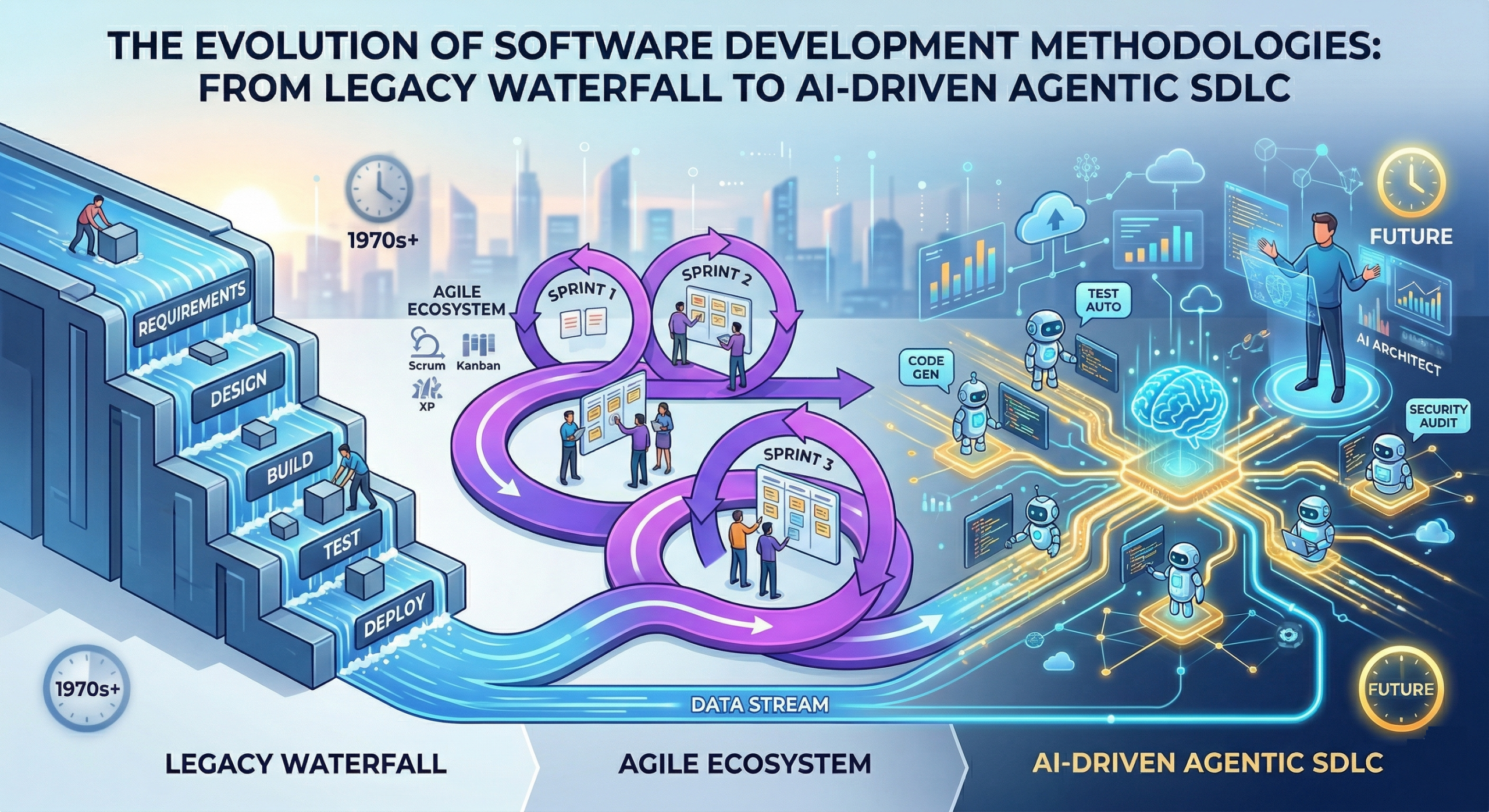
Software development methodologies: A complete guide from waterfall to AI-driven SDLC
Which methodology fits your project? Read our deep dive into Scrum, Kanban, Lean, and AI-powered development with a full comparison matrix -
 April 9, 2026Read in 10 min.
Microsoft PowerApps development services
Accelerate your digital transformation with expert PowerApps development services. We build custom, low-code mobile and web apps that integrate seamlessly with Microsoft 365, SQL, and your existing APIs. Get a free consultation today. -
 April 8, 2026Read in 12 min.
Top 10 Offshore software development companies: Expert review
Don't settle for legacy code. Discover the top offshore software development services company list, featuring vendors with advanced AI-tooling and DevOps maturity -
 April 3, 2026Read in 31 min.
AI software development services: A complete guide for business leaders and decision-makers
Transform your business with expert AI software development services. We build custom GenAI, machine learning, and autonomous agent solutions tailored for enterprise ROI. Get a free consultation today! -
 April 1, 2026Read in 17 min.
The strategic hub: Why global leaders choose software development outsourcing in Ukraine
Why global leaders choose software development outsourcing in Ukraine. Explore the top 10 IT companies, specialized tech stacks, and how to scale your business with a dedicated Ukrainian development team. -
 March 31, 2026Read in 22 min.
Selecting the best Java development companies
Top 10 Leading Java development companies - evaluation criteria, and delivery models to help you find the perfect strategic partners for scalable enterprise solutions -
 March 31, 2026Read in 14 min.
Top progressive web app development companies
Partner with a leading progressive web application development company. Explore our list of top PWA developers in the USA and globally, offering high-speed, offline-ready, and SEO-friendly web app solutions -
 March 23, 2026Read in 23 min.
Why data warehouses fail and how to design one that doesn’t
top building data swamps. Explore the evolution of DWH design, including ELT workflows, Data Vault 2.0, and high-performance cloud modeling strategies -
 March 18, 2026Read in 10 min.
Choosing React Native app development company
Top 10 React Native App Development Companies reviewed — evaluation criteria, tech stack depth, delivery models, and how to choose the best partner for your cross-platform mobile project. -
 March 17, 2026Read in 15 min.
Choosing the Right Computer Vision Development Company for Your Project
From computer vision consulting to full-scale software development, learn how modern vision systems automate defect detection and optimize operations across healthcare, retail, and manufacturing. -
 March 16, 2026Read in 12 min.
AI in data governance: Everything technology leaders need to know
Master Data Governance for AI. Learn how to manage data drift, bias mitigation, and active metadata using NIST standards. Expert guide on MLOps, RAG security, and EU AI Act compliance for 2026. -
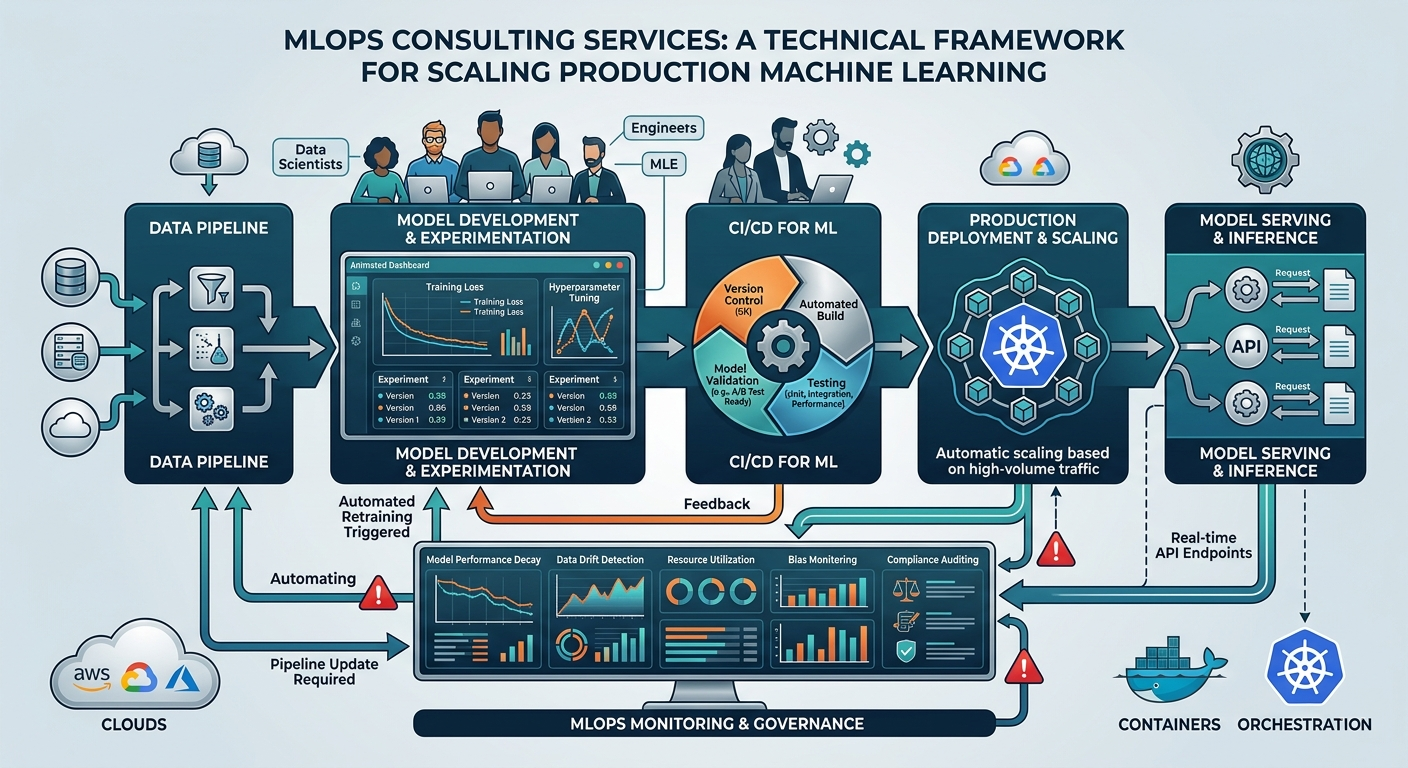 March 16, 2026Read in 16 min.
MLOps consulting services: A technical framework for scaling production machine learning
Operationalize ML with expert MLOps consulting. We bridge the gap between Data Science and DevOps using CI/CD/CT pipelines, automated drift detection, and feature stores to reduce Time-to-Value and technical debt. -
 March 12, 2026Read in 12 min.
Choosing your generative AI development company
Compare the best generative AI companies for your enterprise. From custom LLMs to agentic workflows, discover the top partners driving innovation and ROI in the AI-first era. -
 March 5, 2026Read in 15 min.
Choosing the best MVP development companies
Top-rated agencies providing bespoke MVP software development services to help startups validate ideas and scale fast -
 March 4, 2026Read in 19 min.
Top software testing companies: Leading QA partners
Leading software testing companies. Compare top QA service providers, evaluation criteria, and industry trends to find your ideal partner. -
 February 28, 2026Read in 27 min.
Top 10 software development companies in the USA
Find the best US-based software developers. From AI to enterprise web apps, here are the top 10 software development companies in the USA you should hire in 2026. -
 February 25, 2026Read in 12 min.
Top 10 Node.js Development Companies
Industry's leading Node.js development companies. Our deep-dive review covers technical maturity, cloud-native expertise, and architectural standards to help you find the perfect software partner. -
 February 23, 2026Read in 17 min.
Top 10 mobile application development companies: Selection & industry leaders
Top 10 mobile application development companies for your next project. Compare top-rated mobile app developers, explore custom app development company profiles, and learn the secrets to a successful technical partnership. -
 February 23, 2026Read in 12 min.
How to choose the best Android app development agency: Rankings & selection criteria
Compare the leading Android development companies. Our guide highlights the top 10 firms for enterprise architecture, security, and custom app engineering. -
 February 19, 2026Read in 29 min.
IT Managed Service Providers (MSPs): Why does your business need one?
Stop guessing. Compare the 10 leading IT Managed Service Providers (MSPs) for any-sized companies. Find proven security, cloud, and 24/7 support. View the comparison! -
 February 19, 2026Read in 45 min.
Top 30 software development companies: Categories, red flags, and the selection strategy
We’ve analyzed the top 30 software development companies based on expertise, client results, and innovation. Find your ideal match here! -
 February 11, 2026Read in 18 min.
Top 10 Cloud migration companies: Strategic architecture of cloud migration
Compare the top 10 cloud migration companies based on architectural depth, FinOps integration, and modernization capabilities. Expert insights into AWS, Azure, and GCP transformation strategies for enterprise leaders. -
 February 10, 2026Read in 12 min.
Top 10 Flutter development companies: Entities, ecosystems, and strategic selection
Compare the world’s leading Flutter agencies. Our expert analysis covers the top 10 firms, evaluating their mastery of Dart, Skia performance, and Clean Architecture. -
 February 6, 2026Read in 19 min.
Top 10 React development companies: Architecting high-performance digital products
Top-rated React development companies for your next project. Our expert guide analyzes the best React JS web development agencies on performance, scalability, and tech standards -
 February 3, 2026Read in 25 min.
Web application development companies: How to choose the right partner
Find the right web app development company. Explore services, technologies, engagement models, and 10 expert tips for choosing your strategic development partner. -
 February 3, 2026Read in 11 min.
Top 10 Python Development Companies
Looking for a top Python development company? Compare the industry's leading Python software development agencies. Get insights on pricing, expertise, and how to hire a Python development firm that scales your business. -
 January 27, 2026Read in 15 min.
Top cloud application development companies you should follow
Best Cloud Application Development companies for your project. Compare expertise in AWS, Azure, & GCP. See client reviews, specialization, and costs for top Cloud-Native firms -
 January 23, 2026Read in 21 min.
Dedicated development team model: Definition, benefits, and nuances
Scale your product fast with a Dedicated Development Team. Compare DDT vs. outsourcing, analyze costs, and get a management blueprint for success. -
 January 21, 2026Read in 15 min.
Best energy software development companies to partnership
Top 10 energy sector software development leaders. Learn how to choose the right partner for your renewable energy software project. -
 January 19, 2026Read in 8 min.
The Low-Code Revolution in Oil & Gas: Accelerating Digital Transformation
From real-time well monitoring to automated safety permits - see how low-code applications drive operational efficiency and ESG compliance in the energy sector’s volatile market. -
 January 19, 2026Read in 18 min.
Top 10 desktop application development companies to watch
Compare the world’s best desktop development firms. From legacy modernization to high-performance C++ and cross-platform Electron apps, find your perfect vendor here. -
 December 24, 2025Read in 10 min.
Software development company in Florida: What we do, how we work, and where we add value
Florida's premier custom software partner for enterprise-grade applications. We specialize in fintech, healthcare, and scalable cloud systems. Innovate with Florida experts. -
 December 9, 2025Read in 10 min.
Custom software development for San Diego businesses
Find out about the demands of software development in San Diego and how local companies are adapting to technology needs. -
 December 9, 2025Read in 9 min.
Specifics and perspectives of custom software development in Los Angeles
Find out why choosing a custom software development company in Los Angeles is essential for evolving industries like fintech and healthcare. -
 December 6, 2025Read in 8 min.
Software development in San Francisco: Custom solutions for Area
Find out how software development in San Francisco sets standards in technology and customer satisfaction. -
 November 28, 2025Read in 14 min.
Custom software development in Houston: State and perspectives
Partner with a leading custom software development company in Houston to harness the power of technology for your growth. -
 November 28, 2025Read in 12 min.
Custom software development Dallas businesses need
Find out how a custom software development company in Dallas can elevate your business in a booming tech landscape filled with opportunities. -
 November 27, 2025Read in 11 min.
Software development services in Austin
Find out how a custom software development company in Austin can elevate your business in a booming tech landscape filled with opportunities. -
 November 12, 2025Read in 34 min.
Top FinTech software development companies: The core of modern finance
Compare the top-rated FinTech software developers based on expertise in AI, Blockchain, and compliance. Choose your perfect partner now! -
 November 4, 2025Read in 12 min.
AI in biotech: Application, specifics, and challenges
How AI and Machine Learning are transforming biotechnology, accelerating drug discovery, genome sequencing, and personalized medicine. Learn the applications, challenges, and future. -
 October 28, 2025Read in 24 min.
The best AI development companies in the US
The definitive guide to hiring the best AI development company. See our ranking by MLOps maturity, GenAI expertise, and verified client ROI. Get transparent costs and a partnership blueprint -
 October 20, 2025Read in 16 min.
How to hire the best ReactJS developers in a constantly growing market
Hire the top ReactJS developers. Get pre-vetted, senior React & Next.js engineers matched to your project in 48 hours. Start risk-free -
 October 16, 2025Read in 25 min.
Top 10 AI chatbot development companies
Leading chatbot development companies. Our expert guide helps you choose the best firm for AI chatbot solutions, custom development, and seamless integration -
 October 9, 2025Read in 17 min.
Top biotech software companies: Choosing the right tech partner for life-changing innovations
Leading biotech software companies impacting drug discovery, R&D, and lab operations. See how their innovative platforms are speeding up scientific breakthroughs. -
 September 30, 2025Read in 16 min.
All you need to know about custom software development for small business
Stop wasting time on workarounds! Discover how custom software development empowers your small business with tailored workflows, maximum efficiency, and predictable ROI. -
 September 4, 2025Read in 14 min.
Top 10 leading application modernization companies
Top 10 application modernization companies that can transform your business with cloud, AI, and microservices for agility and growth -
 August 28, 2025Read in 14 min.
Develop once, run everywhere: .NET Core cross-platform development
Struggling with multi-OS development? Discover how .NET empowers you to build versatile, high-performance applications that run seamlessly across Windows, macOS, and Linux with ease. -
 August 21, 2025Read in 14 min.
Why offshore .NET development is the best choice for your business
Struggling with talent shortages or escalating development costs? Explores how embracing offshore .NET development can be the strategic advantage your business needs to build innovative solutions faster and more cost-effectively. -
 August 18, 2025Read in 21 min.
.NET vs Java: Comparison, use cases, pros and cons
Compare .NET vs Java across performance benchmarks, enterprise use cases, ecosystem, and AI integration. Expert guide by Blackthorn Vision’s .NET team. -
 August 11, 2025Read in 24 min.
Top 10 Angular development companies to keep an eye on
Leading Angular development companies. Expert Angular developers offering top-tier web application development, consulting, and solutions for your next project. -
 August 7, 2025Read in 15 min.
Hire Angular developers: What you need to know
Need hire Angular developers? Get access to skilled, dedicated Angular teams for your web projects. We provide expert Angular solutions with flexible engagement models. Contact us today! -
 August 1, 2025Read in 9 min.
Why choose Angular for web development
Why Angular is a leading choice for web development. Learn about its powerful features, scalability, and benefits for building robust, high-performance applications. -
 August 1, 2025Read in 12 min.
Hiring .NET developers: Step-by-step guide
Frustrated with the challenges of hiring skilled .NET developers? This article provides a proven framework to help you find, vet, and hire the right talent for your team, avoiding common recruiting mistakes. -
 February 13, 2025Read in 15 min.
What is HMI development, and why is it trending now?
Human-Machine Interface (HMI) development is revolutionizing the way humans interact with machines, driving innovation across industries. -
 December 11, 2024Read in 10 min.
Python vs Java: Key differences, pros, and cons for developers
Key differences between Python and Java, including syntax, performance, and use cases. Find out which language suits your project best -
 October 10, 2024Read in 11 min.
The future of web development: WordPress vs React.js?
Confused between WordPress or React.js? Explore our detailed comparison to find out which platform suits your needs best -
 August 8, 2024Read in 14 min.
AD and Azure AD: What is the difference, and which is better for you?
Differences between Azure Active Directory (AAD) and traditional Active Directory (AD) in this comprehensive comparison. -
 August 5, 2024Read in 15 min.
ESG software development services: Effective ESG software solutions
Innovative ESG software solutions can help your business achieve its sustainability goals. Develop customized software that enhances environmental, social, and governance (ESG) performance, ensuring compliance and driving positive impact -
 July 31, 2024Read in 7 min.
Benefits of Azure Active Directory
Key benefits of Azure Active Directory(AD), including enhanced security, simplified management, and cost savings for your business -
 April 22, 2024Read in 12 min.
Software modernization: What is it & why it matters
Discover the essence of software modernization and its pivotal role in contemporary software development. Uncover why it's crucial. -
 April 22, 2024Read in 20 min.
Legacy app modernization: A comprehensive guide
Revitalize your business with our guide on legacy application modernization. Transform your legacy systems to make them more efficient and innovative. -
 April 22, 2024Read in 16 min.
Digital product design: What is it and why you need it
Unlock innovation with expert digital product design insights. Explore the latest trends and strategies for creating exceptional user experiences. -
 April 21, 2024Read in 11 min.
Healthcare product design: Tips for app development success
Explore the art of healthcare product design in our latest blog post. Discover how innovative design principles are shaping the future of medical solutions -
 April 18, 2024Read in 9 min.
Azure app modernization: Benefits of migrating to Microsoft
Key benefits of Azure app modernization and how migrating to Microsoft can enhance performance, scalability, and compliance -
 March 11, 2024Read in 12 min.
How to choose asset management software for oil and gas in 2026
Explore more ways to optimize operations and streamline processes in oil and gas. Follow our tips to choose the best-fit assent management software in 2026 -
 March 11, 2024Read in 13 min.
AI software development for oil and gas: A comprehensive guide
Explore the transformative power of artificial intelligence software development for oil and gas and the practices of global industry leaders in our blog. -
 March 11, 2024Read in 19 min.
Cloud application modernization: How to improve your app
Cloud application modernization makes app more competitive and business more profitable. The key strategies, tips, and its benefits — in this article! -
 March 11, 2024Read in 12 min.
Enterprise application modernization: Revolutionize your business
Future-proof your business with our guide to enterprise app modernization. Learn strategic approaches, key technologies, and best practices for legacy system transformation and enhanced agility -
 March 11, 2024Read in 12 min.
LIMS integration: Benefits & how it works
Can LIMS integration be called a CRM for laboratories? What to keep in mind during LIMS software development and integration? Find out more in our article. -
 March 11, 2024Read in 11 min.
Active directory integration: What is it & how to do it effectively
Discover seamless Active Directory integration strategies in our latest blog post. Optimize user management with the Blackthorn Vision team! -
 March 5, 2024Read in 15 min.
Mobile app UX design: Basics that will improve user experience
Mobile app UX design differs from the web. Explore these differences, the process, and the main pitfalls with our experts in this article. -
 March 5, 2024Read in 11 min.
HIPAA compliance checklist for healthcare software development 2026
Check the updated HIPAA security guidelines to ensure the safety and privacy of patients' data, it is important to adhere it when creating applications -
 March 5, 2024Read in 9 min.
How to use business process automation to improve oil and gas production
Discover how business process automation can help optimize oil and gas production and improve your bottom line. -
 March 3, 2024Read in 14 min.
Desktop to web migration: everything you need to know
Planning a desktop to web migration? Get essential insights on strategy, technical challenges, approaches, and how to successfully modernize your legacy application. -
 March 3, 2024Read in 11 min.
The process of application migration to the cloud: stages, approaches, and tools
Find out how to effectively migrate your legacy system and data to the cloud without disrupting your business processes. -
 March 3, 2024Read in 16 min.
Benefits of outsourcing software development
Key advantages of outsourcing software development for businesses. Learn how outsourcing can reduce costs, increase efficiency, and provide access to specialized expertise -
 March 3, 2024Read in 13 min.
Boosting cloud security in healthcare with Azure Cloud Services
Explore the most common challenges in the cloud security of healthcare organizations and discover our tips on eliminating them efficiently. -
 March 3, 2024Read in 19 min.
Healthcare app design: how to create a great user experience
Struggling with medical app UX? Get insights into user-centered design, crucial security measures, and future trends to create impactful healthcare applications. -
 March 3, 2024Read in 16 min.
MVP vs. prototype in startup software development: what’s the difference?
Crucial differences between MVP and Prototype in startup software development. Learn how Blackthorn Vision leverages both to build successful products, reduce risk, and accelerate your time-to-market -
 March 3, 2024Read in 12 min.
How to build a custom EHR solution: tips for decision makers
We can augment your talent pool with dedicated developers proficient in healthcare business automation. Check the success stories from our clients. -
 March 3, 2024Read in 7 min.
What is software as a medical device and why it matters for the healthcare industry
From developing SaMD and SiMD to building efficient EHR systems, we unleash the value of business process automation for healthcare providers. -
 March 3, 2024Read in 6 min.
An overview of medical biotechnology in 2026 and beyond
We offer a full cycle of software development for leading biotech companies - from idea visualization to building an MVP and fully-fledged product. -
 March 3, 2024Read in 9 min.
Smart farming: agricultural technology of the future
We have expertise in data analytics, AI, and Machine Learning to build game-changing software tailored for your agricultural business. -
 March 3, 2024Read in 7 min.
BV people: a talk with Head of HR and recruitment in Blackthorn Vision
BV people: a talk with the Head of HR and Recruitment on candidate selection, the company's ideals, and the current state of the Ukrainian IT industry. -
 March 3, 2024Read in 9 min.
What is robotic process automation and how it changes the travel and hospitality industry
How does RPA work and, most importantly, how to utilize it in your travel and hospitality business? Find out in our new article now. -
 March 3, 2024Read in 12 min.
An overview of agricultural biotechnology in 2026
We cooperated with agricultural biotechnology industry leaders to design software that helps scientists and farmers automate and optimize all processes. -
 March 3, 2024Read in 10 min.
Everything you need to know about Microsoft Azure: benefits, use cases, applications
Microsoft Azure is a leading cloud service provider that offers numerous opportunities for businesses to optimize and secure their operations and services. -
 March 3, 2024Read in 10 min.
Smart manufacturing technology and trends for 2026 and beyond
Stay updated on the latest manufacturing technology trends, that drives innovation, efficiency, and growth in the industry to boost your project. -
 March 3, 2024Read in 8 min.
How to choose and manage your dedicated development team
While there are many benefits of working with dedicated software development teams, it’s not a universal solution. Discover why it is so. -
 March 3, 2024Read in 8 min.
What is the best cloud deployment model? Types of cloud computing that will benefit your business
With the guidance of our post, you can better understand various cloud computing deployment strategies. Examine cloud solutions for your company's needs. -
 March 3, 2024Read in 10 min.
Offshore vs. Nearshore outsourcing: what’s best for your business?
What is the difference between the three outsourcing types, and which one is better for your business? Please read our article to find out! -
 March 3, 2024Read in 14 min.
How to develop a medical app for doctors: everything you need to know
The mobile health industry is one of the most rapidly growing segments worldwide. Learn more about the mHealth industry in our new article. -
 March 3, 2024Read in 14 min.
Business analyst: a leading player in your software development team
Your guide to the Business Analyst's vital role in software development teams, including Agile practices, key responsibilities, techniques, and delivering real business value. -
 March 3, 2024Read in 9 min.
Hyperautomation – the future of business processes
Now business processes - Hyperautomation are increasingly not following stable and predictable scenarios. It creates a need for a new type of automation. -
 March 3, 2024Read in 6 min.
The future of Oil and Gas: industry trends and software solutions
Keep up to date on the most recent oil and gas the industry trends, which are driving modifications in technology, sustainability, and energy exploration. -
 March 3, 2024Read in 6 min.
What is an MVP, and why is it necessary? Minimum viable product examples
Even if you have just a basic vision of what your app should do, we will develop a presentable product that you can pitch to investors. -
 March 3, 2024Read in 14 min.
Top 5 soft skills to work in it successfully and resources to develop them
Are soft skills the new hard skills? Can you make a successful career in IT if you are not an effective communicator or lack creativity? -
 March 3, 2024Read in 5 min.
Mobile app development: Xamarin.Forms — a cross-platform solution that responds to modern challenges
When it comes to mobile development, there is a wide variety of solutions. Xamarin.Forms is a cross-platform solution that responds to modern challenges. -
 February 27, 2024Read in 8 min.
Top 10 programming languages of the future for web and mobile app development
Let’s have a look at the most popular programming languages that may become your business workhorse. -
 February 6, 2024Read in 16 min.
Pharmaceutical software development: Unleashing pharma innovation
Explore the future of pharmaceutical software development: innovative solutions revolutionizing healthcare efficiency & precision.