

Financial software development services cover the design, engineering, and deployment of custom software for financial institutions and companies building regulated financial products. The defining characteristic of this category is the combination of software engineering with financial domain knowledge and regulatory expertise – skills that generic development firms typically do not possess.
Top financial software development companies

 23 minutes read
Content
It’s hard to name a more complex and regulated industry than the financial sector. Maybe, only healthcare and healthtech. But while the health and wellness industry is more stable, norms, regulations, and demands in the financial sphere change every few months, not to mention the periods of crises when markets flip unexpectedly. Those are the reasons that stop numerous entrepreneurs – even those with brilliant ideas – from bringing those ideas to life.
The solution is a solid partnership with a financial software development company that, once trusted with your business project, brings its expertise not only in software development, but in the specific field and geographic area. You need a technical vendor able to adapt and offer the best solutions for difficult situations.
In the sea of software development companies that list financial software development services among their expertise, we’ve selected ones that deserve your attention and trust. In addition to presenting you with the list, this article explains the latest trends in the fintech software development sector and gives you hints on how to select the vendor for your project.
After reading, you’ll be all set to start within several weeks.


Book a Strategy Session with Our Financial Solutions Architects
Launch a Secure, PCI-DSS Compliant Platform Today
What a financial software development company actually does for your business
Why domain knowledge cuts project risk in half
Financial services software development carries obligations different from general software. Every design decision – how data is stored, how transactions are logged, how identities are verified – has a regulatory dimension. PCI DSS governs payment card data. GDPR governs the personal data of European users. PSD2 governs how third parties access bank account information. DORA, which took effect across the EU in 2025, governs operational resilience for financial institutions and their technology partners.
A generalist development firm can learn these frameworks over the course of your project, but a specialist has already built against them and knows where the traps are. That knowledge does not come from reading documentation, but from shipped projects and post-mortems.
How specialist partners compress financial software timelines
A functional MVP – a digital wallet, a neobanking prototype, a lending portal – typically takes four to six months to design, develop, and launch with a specialist firm. An equivalent in-house build, accounting for recruitment, onboarding, and compliance review, usually exceeds 18 months. Such a speed advantage comes from parallel execution: an experienced partner runs security architecture, regulatory mapping, and feature development simultaneously, because they have sequenced that work before. You, at the same time, take care of branding, marketing, PR, and partnerships.
The real cost comparison: External partner vs. in-house build
An in-house build carries recruitment costs, salaries, benefits, tooling licences, security audit fees, and the expense of rework when a compliance requirement shifts late in development. A specialist partner absorbs most of that burden. Their security infrastructure, compliance documentation processes, and testing pipelines are already at place. Companies that have shifted to cloud-native solutions report a significant average reduction in maintenance costs. The economics of partnership, particularly for cloud-native builds, are difficult to argue against.
Image idea: The diagram that demonstrates all these slices of a total price: recruitment costs, salaries, benefits, tooling licences, security audit fees, and the expense of rework when a compliance requirement shifts late in development.
Core services offered by leading financial software development firms
Custom financial application development: From trading platforms to digital banking
The core offering is software built to specification rather than adapted from a template: trading platforms, digital lending systems, neobanking infrastructure, insurance automation, payment gateways, wealth management portals, and compliance dashboards. What makes financial custom development distinct from other software categories is that the architecture must accommodate regulatory constraints from the start. A payment gateway built for one country may need a completely different data residency and authentication model in another. For the firms that handle this well, a client’s regulatory obligations are a part of an initial design.
Modernizing legacy banking systems without disrupting operations
Approximately 58% of financial institutions over 30 years old still run core systems built on COBOL, the programming language that dominated banking infrastructure in the 1970s and 1980s. Those systems are stable, but they were never designed to expose APIs, support real-time payments, or scale to handle the transaction volumes that digital channels generate.
The right modernization approach is incremental. The strangler-fig pattern involves building new capabilities alongside the existing system and progressively replacing legacy components, rather than attempting a single large cutover that risks a production outage. Migrating data from legacy systems to modern platforms increases project delivery time by an average of 37%, which makes phased delivery and risk management essential skills for any firm offering this service.
Blockchain and DeFi development for regulated financial institutions
Blockchain in financial services is often associated with cryptocurrency, but its most durable applications in regulated finance are more practical: immutable audit trails, programmable settlement logic, and smart contracts that automate the terms of financial agreements without requiring a central intermediary. In cross-border payments and inter-bank settlements, this can reduce reconciliation time from days to minutes.
Firms with genuine blockchain capability in finance have delivered cryptocurrency wallets, decentralized lending platforms, blockchain-based loan management systems, and tokenization infrastructure for real-world assets. The depth of expertise varies widely in this space. Ask any prospective partner for specific delivered examples rather than general capability claims.
AI and Machine Learning applications in financial software
AI and ML are already running in production across the financial industry. Real-time data analytics in financial services has reduced fraud losses by 38% and improved customer targeting accuracy by over 46% in documented deployments. The applications span the full product lifecycle: credit scoring models that incorporate real-time cash-flow data, anomaly detection systems that flag suspicious transactions before they clear, NLP tools that extract compliance obligations from regulatory documents, and portfolio rebalancing engines that respond to market movements without human intervention.
The firms that deliver the most value here can manage the full process – data governance, model training, production deployment, and the explainability requirements that regulators increasingly impose on algorithmic decisions.
How to evaluate a financial software development partner before you sign
Regulatory compliance experience: Questions to ask before signing
Compliance capability is the hardest thing to assess from a vendor’s marketing materials and the most important thing to get right. Ask specifically:
- Which regulatory frameworks has this firm built against — and in which jurisdictions?
- Can they produce a compliance architecture document from a prior engagement?
- Do they employ dedicated compliance engineers, or do they rely on the client to define regulatory requirements?
Firms that know how to build compliant financial software treat it as an engineering discipline with its own standards and checkpoints.
Security architecture standards for software development for finance
Financial software security is about building the system in a way that makes security features effective from the start. That begins with zero-trust architecture – the principle that no component of the system automatically trusts any other, regardless of where the request originates. It includes encrypting all sensitive data at rest and in transit, implementing role-based access controls, and running continuous penetration testing rather than scheduling a single annual audit.
Any firm that cannot speak clearly about its secure development lifecycle, its vulnerability management process, and its incident response documentation is not ready to build systems that handle real money.
Why financial portfolio specificity matters more than company size
A strong general portfolio is not the same as a strong financial software portfolio. The skills required to build a logistics platform or a healthcare records system are important, but they do not transfer automatically to a payment gateway or a core banking module.
When evaluating a firm, look for engagements directly analogous or similar to the work you need done – same product type, similar regulatory environment, comparable scale. The specificity of a firm’s financial experience determines how much of your budget funds their learning curve rather than your product.
Time zone and communication fit for long-term financial engagements
Time zone proximity has a direct effect on decision velocity, not just scheduling convenience. A partner team that overlaps with your working hours by four hours or more can join daily stand-ups, respond to blockers on the same working day, and raise risks before they compound into schedule problems.
Cultural alignment – shared expectations around how feedback is given, how scope changes are handled, and how problems are escalated – determines whether a partnership feels productive or managed. For compliance-heavy financial projects that run 12 months or more, the quality of that working relationship directly impacts or even defines the outcome – as much as technical capability does.
Top financial software development companies
Blackthorn Vision
Location: Lviv, Ukraine, and Warsaw, Poland.
Operating across the US, UK, and Europe
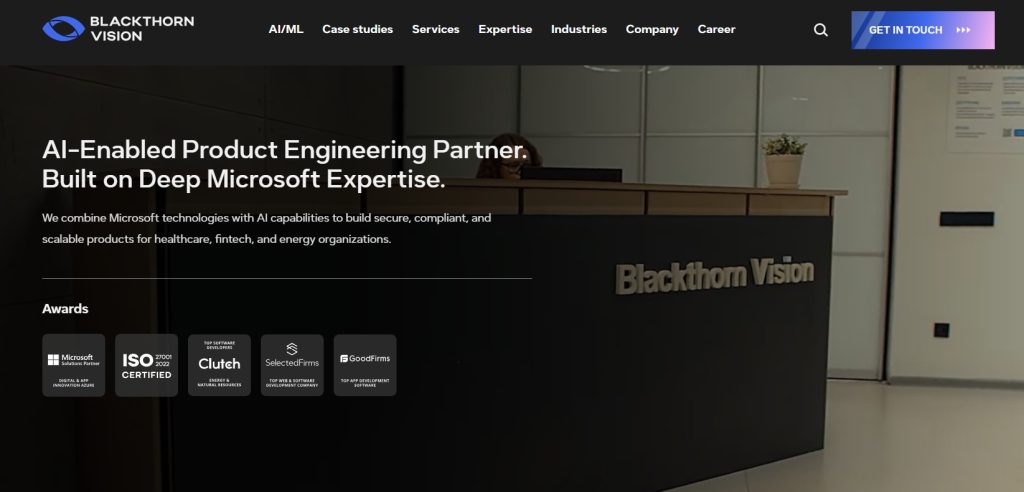
Blackthorn Vision has delivered compliance dashboards for audit teams preparing for SEC reviews and built reconciliation tools that replace the spreadsheet-based processes still common on legacy trading desks. In software development for finance, the firm applies a zero-trust security model and runs continuous penetration testing as standard practice on financial engagements. It operates as a Microsoft Solutions Partner, which means deep expertise in C#, .NET, and Azure – the stack that underpins a significant share of enterprise financial infrastructure.
Clients consistently describe the relationship as an embedded team rather than a vendor arrangement. Engineers who understand the product goals, ask the right questions, and contribute code within the first week of onboarding instead of spending months on setup.
What makes Blackthorn Vision stand out:
- Full-cycle development from discovery through post-launch optimization, with a track record in legacy modernization for financial operations
- Deep .NET and Azure expertise alongside JavaScript, React, Node.js, Python, and Golang
- Long-term partnership model with average engagement durations that reflect delivery consistency
- Security-first approach: zero-trust architecture, end-to-end encryption, and continuous penetration testing built into the delivery process
Plaid
Location: San Francisco, CA, USA
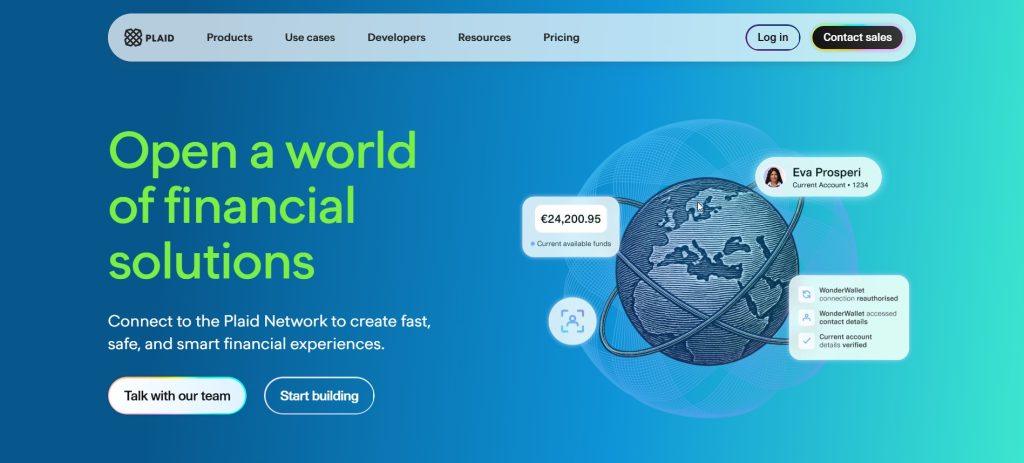
Plaid is the infrastructure that connects financial applications to bank accounts. It maintains live connections to more than 12,000 financial institutions, normalizes data formats across all of them, and processes nearly one million new account connections every day. For any company needing custom financial services software and building a product that requires users to link a bank account, Plaid eliminates the need to build and maintain those integrations individually.
The platform has expanded beyond basic account connectivity into income and employment verification, fraud prevention, bank-to-bank payment initiation, and lending decisioning – product lines that more than doubled in 2025 and surpassed 20% of annual recurring revenue.
What makes Plaid stand out:
- A single API surface that replaces thousands of individual bank integrations
- Network covering 12,000+ financial institutions across the US, Canada, the UK, and Europe
- Expanding product suite: fraud prevention, underwriting, and Pay by Bank
- Enterprise clients, including Citi, H&R Block, and Rocket, alongside its digital-native base
Accenture
Location: Dublin, Ireland (global operations)
Accenture’s financial & banking software development services practice operates at a scale no other firm in this list can match. It serves global investment banks, insurance carriers, asset managers, and neobanks with capabilities spanning cloud transformation, core banking modernization, risk platform development, and regulatory compliance.
For most mid-market companies, Accenture is not the right fit. The engagement model is optimized for large, multi-year programs. For enterprises running transformation programs that span multiple business units, multiple jurisdictions, and multiple technology platforms simultaneously, it is one of the few firms with the organizational depth to deliver.
What makes Accenture stand out:
- Regulatory architecture experience across SOX, Basel III, DORA, and multi-jurisdictional frameworks
- Proprietary accelerators that reduce build time on common financial workflows
- Deep partnership ecosystems with AWS, Microsoft, Google Cloud, and Salesforce
- The staffing scale to resource large transformation programs without creating delivery risk
DXC Technology
Location: Ashburn, Virginia, USA (global operations)
DXC Technology is a global enterprise technology company with deep expertise in banking and financial services. DXC’s financial services IT solutions help banks, asset managers, wealth management firms, and other financial institutions modernize mission-critical systems, improve data integrity, automate complex processes, and adopt AI while meeting demanding security and regulatory requirements.
The company combines custom software engineering with core banking modernization, trading and risk solutions, regulatory technology, cloud transformation, and legacy system modernization. Its Hogan core banking platform supports some of the largest financial institutions in the United States, while DXC also works with major industry platforms including Murex, Nasdaq, Finastra, Orchestrade, and Temenos.
What makes DXC Technology stand out:
- Extensive financial technology ecosystem with 50+ specialist software partnerships
- 45+ years of experience in banking technology and 350+ active financial services clients
- More than 10,000 financial services technology specialists worldwide
- Trusted by 17 of the world’s 20 largest banks for IT services and transformation
- Strong expertise in core banking, payments, trading and risk management, regulatory compliance, and wealth management
- Proven legacy modernization capabilities, including COBOL transformation and migration toward cloud-native architectures
Vention
Location: New York, USA
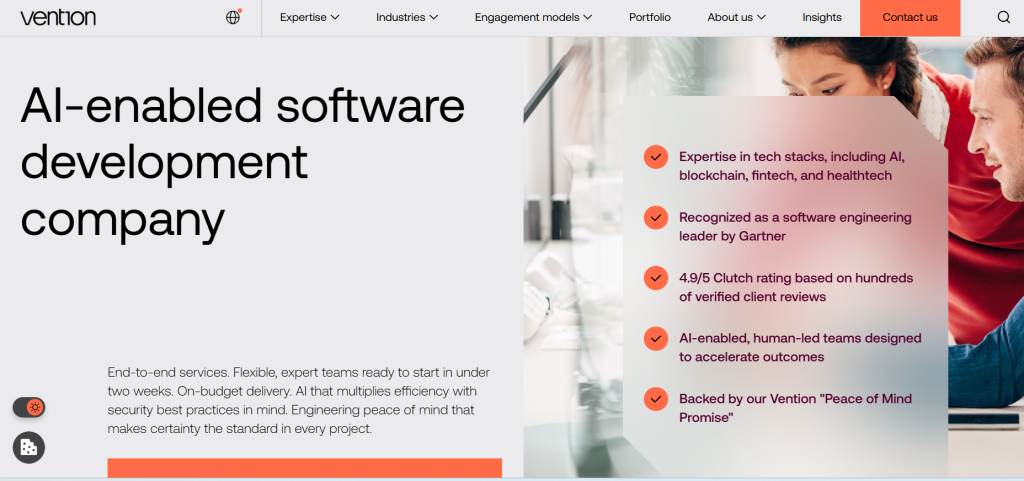
Vention’s model is staff augmentation at engineering depth. It provides senior software engineers, ML specialists, cloud architects, and security engineers who join client teams directly. For companies that have product clarity but need to scale engineering capacity quickly – to build a trading platform, launch a payment gateway, or develop a credit decision engine – Vention offers access to specialized talent without the overhead of permanent hiring. The firm holds ISO 27001 certification, and its average client relationship exceeds 36 months.
What makes Vention stand out:
- Direct team augmentation with senior engineers, ML experts, and cloud architects
- Particular strength in financial software backends, API infrastructure, and complex real-time systems
- ISO 27001-certified with R&D centers in Switzerland, Poland, and Ukraine
Simform
Location: Orlando, Florida, USA
Simform positions itself as a product engineering firm for the BFSI sector – banking, financial services, and insurance. It builds complex backend systems: trading platforms, payment processors, credit decisioning engines, and the cloud infrastructure that supports them.
The company highlights that the distinction between a product engineering firm and a traditional outsourcing vendor is that product engineers think about system design, not just task execution. They flag architectural risks and take responsibility for outcomes.
What makes Simform stand out:
- Product engineering orientation rather than traditional outsourcing
- Deep backend capability for trading platforms, payment processing, and credit systems
- Cloud-first architecture aligned with current financial infrastructure trends
Marqeta
Location: Oakland, California, USA
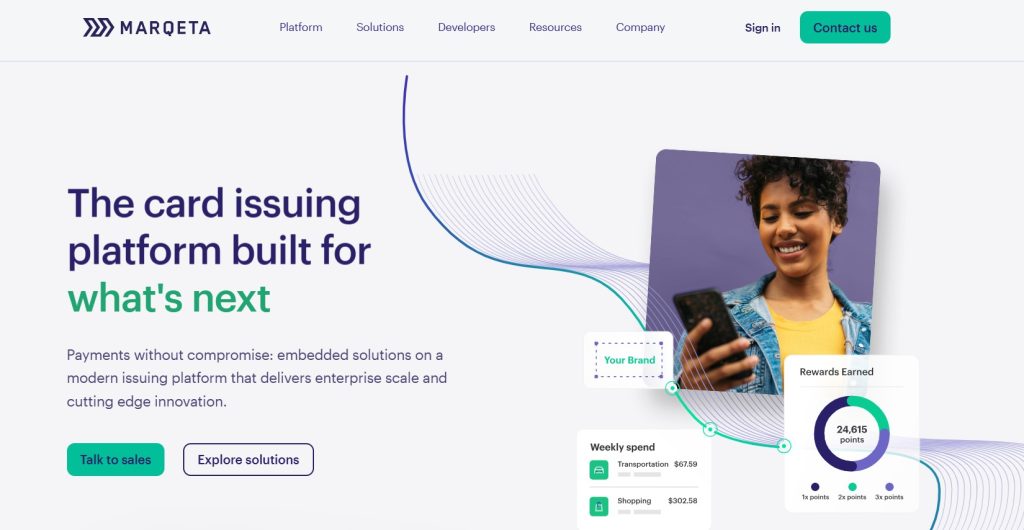
Marqeta is not a traditional financial services software development agency, but the infrastructure behind modern card programs. Companies like Square, Uber, Affirm, Instacart, and DoorDash use its platform to issue and manage payment cards without building the underlying card-issuing infrastructure themselves. Marqeta handles the card network relationships, the issuance of physical and virtual cards, the spend controls, the just-in-time funding logic, and the compliance obligations that come with operating in the payments ecosystem.
What makes Marqeta stand out:
- API-first card-issuing infrastructure: virtual cards, physical cards, tokenization, spend controls
- $291 billion in total processing volume in 2024, validating platform reliability at scale
- 2025 acquisition of TransactPay extending European EMI coverage across 25 countries
- Deep embedded finance positioning with payment program management for global companies
N-iX
Location: Lviv, Ukraine (offices across Europe and the Americas)
N-iX has been recognized in the Global Outsourcing 100 Leaders segment for eight consecutive years by the International Association of Outsourcing Professionals. The firm operates delivery centers in 25+ locations, holds AWS Consulting Partner, Microsoft Gold Partner, and Google Cloud Partner status, and brings depth in data engineering, ML, and embedded systems alongside its core software development capability. For financial finance software development services specifically, it builds core banking systems, payment platforms, and data infrastructure for global institutions.
What makes N-iX stand out:
- Eight consecutive years in IAOP’s Global Outsourcing 100 Leaders segment
- Multi-cloud delivery: AWS, Azure, and Google Cloud Partner status
- Strong data science and ML capability for fraud detection, credit modeling, and risk management
Cleveroad
Location: Dnipro, Ukraine (present in the EU and the US)
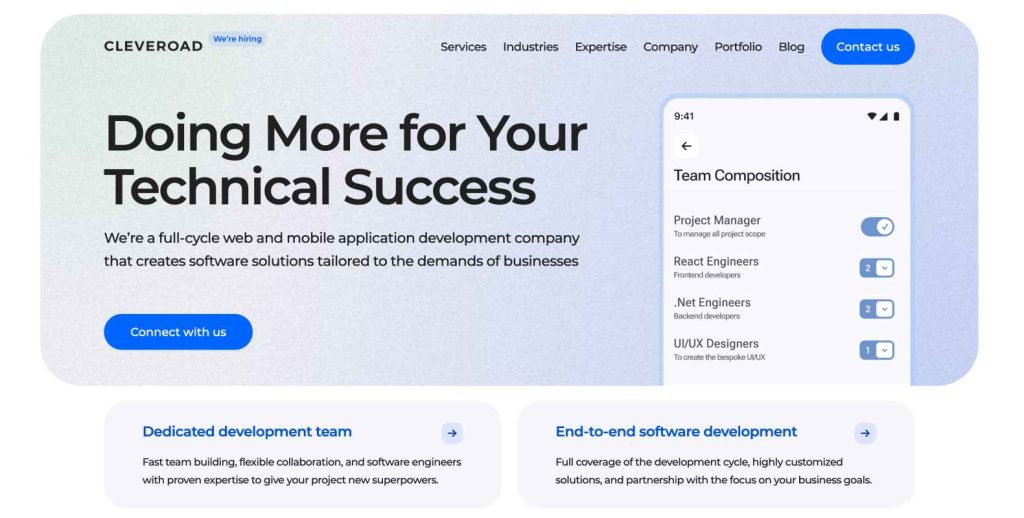
Cleveroad is a finance software development company that builds digital banking platforms, payment systems, trading applications, insurance automation tools, and micro-investment apps, with a mobile-first development approach. It operates with a lean team structure that keeps senior engineers close to client communication rather than behind account management layers. Its client list includes WISE, the international payments company, giving an indication of the scale and complexity of financial products it has delivered.
What makes Cleveroad stand out:
- Mobile-first development approach for financial products
- Full-cycle services: native mobile, web, microservices, cloud and DevOps, AI and Data Science, and QA automation
- Direct engineer access rather than account management intermediaries
- Experience with real-scale transactional financial products, including WISE
SoluLab
Location: Ahmedabad, India
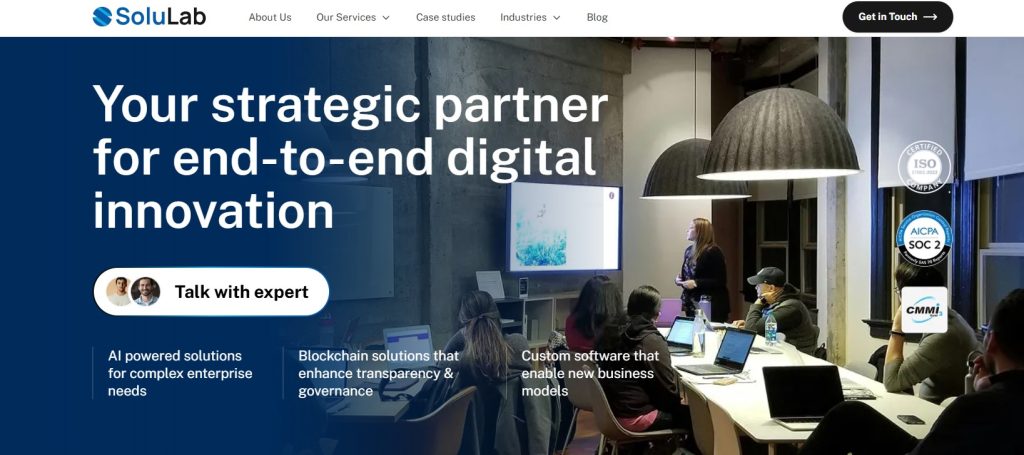
SoluLab is a specialist in blockchain-native financial applications, named among Clutch’s Top Web3 Software Development Companies. Its delivered portfolio includes cryptocurrency wallets, crypto trading platforms, decentralized lending systems, blockchain-based loan management, and NFT marketplaces. Its most cited project is the ZeCash protocol launch, where it developed the cryptocurrency, the underlying blockchain network, and the smart contracts that govern transaction processing. Over 50 million active users across its deployed applications indicate production-scale delivery.
What makes SoluLab stand out:
- Deep DeFi and blockchain expertise: smart contracts, ICO infrastructure, decentralized lending
- 50+ million active users across deployed applications
- Fortune 500 client experience alongside digital-native financial builds
- Combined AI, ML, and blockchain capability for complex financial applications
The technology stack behind secure financial software
Back-end languages and frameworks
Back-end technology choices of a financial software development company are driven by three requirements: type safety, performance under transactional load, and concurrency handling.
Go, also known as Golang, is the preferred language for high-throughput payment processing and API gateways.
Java and Kotlin remain standard in enterprise banking environments – they have decades of production use and a mature ecosystem of libraries for financial calculations, compliance tooling, and integration patterns.
Python handles risk modeling, machine learning pipelines, and data engineering.
For compliance-intensive systems with document-heavy workflows, C# and the .NET ecosystem continue to dominate, particularly where existing infrastructure is Microsoft-based.
Front-end technologies
React and Angular are the primary frameworks for financial dashboards, trading interfaces, and customer portals.
For mobile applications, React Native and Flutter allow a single codebase to run on both iOS and Android.
TypeScript – a stricter version of JavaScript that catches data-type errors before code runs – is now a standard requirement on financial frontend projects. In a payment interface, a type error that converts a string to a number incorrectly is a financial error, not a minor bug.
Cloud infrastructure choices
AWS, Microsoft Azure, and Google Cloud are the three infrastructure platforms that financial services organizations use at scale.
AWS leads in digital-native financial software builds.
Azure dominates in enterprise banking environments where existing Microsoft agreements and Active Directory integrations favor it.
Google Cloud leads in data-intensive and ML-driven applications.
Cloud deployments captured 62.4% of the financial services applications market in 2025, growing at 18.2% annually – reflecting both the performance advantages of cloud-native architectures and increasing regulatory comfort with cloud-hosted financial infrastructure.
Data infrastructure
PostgreSQL manages transactional data for most financial applications.
Apache Cassandra handles time-series data at the scale required by payment systems and trading infrastructure.
Apache Kafka sits between systems, managing the real-time event streams that fraud detection, transaction monitoring, and market data processing depend on.
Snowflake and Databricks power the analytical layer: regulatory reporting, portfolio analytics, and customer intelligence.
For institutions where data lineage and audit trails are regulatory requirements, governance tools like Apache Atlas, Collibra, and Alation provide the cataloging and provenance tracking that auditors expect.
See the blueprint for scalable financial success
How to shortlist and hire a financial software development company
Step 1: Define your core KPIs
Before issuing any RFP, decide what success looks like in measurable terms: time-to-market for a defined MVP, transaction throughput targets, compliance certification deadlines, fraud detection accuracy rates, or API response time SLAs. KPIs give the engagement a shared definition of done from day one, and prevent the most common failure mode – a system that is technically complete but does not improve the business outcome it was built to address. Define KPIs by phase: MVP, production launch, and 12-month operation.
Step 2: The RFP (Request for Proposal) process
An effective RFP for financial software development asks for more than a scope document and a rate request. It should require:
- A description of the firm’s compliance architecture approach for your specific regulatory context;
- A list of directly analogous prior engagements with scope and outcome detail;
- profiles of the engineers who would actually be assigned;
- A risk register covering the three most common failure modes in your engagement type;
- A proposed governance model for the engagement.
Step 3: Conducting technical deep-dives and security audits
Schedule a two-hour working session with the architects and senior engineers who will lead the engagement – not the business development team. Present a sanitized version of your actual technical situation: your existing stack, your integration points, your compliance requirements. Ask how they would approach the hardest three problems in the scope. The quality of the questions they ask in return is as informative as the answers they give.
Request a completed security questionnaire aligned to your applicable frameworks. Ask for their most recent penetration test executive summary and their incident response documentation.
A firm that treats this step as friction is communicating something important about how it will behave when a security issue surfaces in production.
Step 4: Trial periods and pilot projects
A paid pilot – four to six weeks, scoped around work that will actually be used in production – is the most reliable evaluation tool available. It reveals communication quality, code quality, responsiveness to feedback, and compliance awareness under real working conditions, none of which are visible in an RFP response or a reference call. The cost of a four-to-six-week paid trial is small relative to the cost of discovering a misaligned partner six months into a 12-month financial system build.
Emerging trends shaping financial software development in 2026 and beyond
Hyper-personalization: Building financial products that adapt to individual behavior
The next generation of financial products will respond to individual behavior in real time rather than segmenting customers by demographic group. That means credit offers that reflect actual spending patterns, savings features that respond to how a customer’s balance moves across the month, and advisor workflows built around individual portfolio history.
Real-time data analytics in financial services has already improved customer targeting. The organizations moving fastest are those that have resolved their data governance challenges and built ML pipelines capable of running inference at the speed of a transaction.
Quantum computing readiness: Why financial CISOs are planning now
Quantum computers do not yet threaten production financial systems. The encryption that protects financial data today – RSA, elliptic curve cryptography – will not hold against sufficiently powerful quantum hardware, and that hardware is advancing faster than most security planning cycles account for. NIST finalized its first post-quantum cryptography standards in 2024, providing a migration target. Financial software built now for systems with a ten-year operational life needs to be designed with cryptographic agility – the ability to swap encryption algorithms without rebuilding the system.
Green finance software: ESG reporting becomes mandatory
ESG reporting is transitioning from voluntary disclosure to a legal requirement across major markets. The EU’s Corporate Sustainability Reporting Directive, the SEC’s climate disclosure rules, and TCFD-aligned frameworks are creating demand for software that tracks carbon exposure, maps financial flows to sustainability taxonomies, and generates the audit-ready reports that regulators and investors increasingly require.
Financial leaders are integrating ESG reporting into the same platforms that manage general ledger, treasury, and risk functions – a signal that green finance software is becoming part of the standard compliance stack rather than a specialist overlay.
Conclusion
The financial software development market is crowded with firms claiming relevant expertise. But you need to look deeper and ask for the evidence behind it: the specificity of the financial portfolio, the depth of knowledge in the compliance architecture, the security certifications, and the quality of the engineering team that will actually staff the engagement.
The ten firms in this guide each serve a distinct use case. Blackthorn Vision for embedded long-term partnerships with precision-built financial tooling. Plaid for open-banking data infrastructure. Accenture for enterprise transformation programs. Fingent for workflow-heavy mid-market builds. Vention for rapid engineering scale. Simform for cloud-first product engineering. Marqeta for card-issuing infrastructure. N-iX for enterprise-grade engineering with multi-region delivery. Cleveroad for mobile-first financial products. SoluLab for blockchain-native financial applications.
Choose one that meets your needs and start bringing your financial software idea to life confidently and responsibly. If you have additional questions or require a free consultation, contact us!
FAQ
What are financial software development services?
What is the role of AI and Machine Learning in modern financial software?
AI and ML are deployed in production across the financial industry today: fraud detection, credit decisioning, compliance document analysis, algorithmic portfolio management, and customer-facing personalization. The firms delivering the most value manage the complete ML lifecycle – data governance, model training, production deployment, drift monitoring, and regulatory explain ability requirements.
Does your financial software development company provide ongoing maintenance and support after the software launch?
Reputable firms offer post-launch support as a standard service – a retainer covering bug resolution, security patching, performance monitoring, and minor feature development. For regulated financial systems, the agreement should explicitly cover regulatory update response: a defined process for assessing and implementing changes when a compliance requirement shifts.
How do I choose the right financial software development partner?
Evaluate: specificity of prior financial software work matching your use case; demonstrable compliance architecture capability; security certifications; seniority of the assigned team; time zone overlap; and engagement model transparency. A paid pilot project before full engagement commitment is the most reliable signal available.
What are the main types of financial software services available?
The primary categories are: digital banking platforms; payment processing and gateway infrastructure; lending and credit decisioning systems; wealth management and investment platforms; insurance automation; regulatory compliance and reporting systems; open banking and data connectivity infrastructure; blockchain and DeFi platforms; and fraud detection and AML monitoring systems.
Can you integrate new software with existing legacy banking systems?
Yes, and this is one of the most common engagement types. Where the legacy system exposes APIs, new software integrates directly. Where it does not, middleware handles the translation. The strangler-fig pattern – building new capability alongside the legacy system and retiring legacy components progressively – is the standard approach for managing operational risk.
How do you handle data security and fraud prevention in financial apps?
Data security requires a layered approach: encrypted data stores, encrypted data in transit, role-based access controls, and audit logging of every data access event. Fraud prevention combines rule-based detection – velocity checks, amount thresholds, geographic anomalies – with ML-based anomaly detection trained on historical transaction data, running in real time within the transaction authorization path.
What is the difference between custom financial software development and off-the-shelf solutions?
Off-the-shelf software is pre-built and available for immediate deployment, but imposes constraints on workflows and accumulates integration debt as the product evolves. Custom software is built to match a specific business’s processes, data models, and regulatory obligations. Off-the-shelf is faster and cheaper upfront; custom development produces a system that fits precisely and can change as the business changes.
How do you ensure compliance with financial regulations like GDPR, PCI DSS, and PSD2?
Compliance in financial software is an architectural decision made at the start of a project. GDPR requires data classification and consent management workflows. PCI DSS requires network segmentation and tokenization of payment card data. PSD2 requires strong customer authentication for payment initiation. A specialist partner designs each of these controls into the system architecture from the first design review – not the last.
Which technologies are best for building secure financial applications?
For backend systems, Go, Java, and Python are the dominant choices. For frontend and mobile, React, Angular, React Native, and Flutter are standard. The security baseline includes HashiCorp Vault for secrets management, OAuth 2.0 and OpenID Connect for identity, and Web Application Firewalls at the API layer. End-to-end encryption, HSM-backed key management, and zero-trust network architecture are requirements, not options.
How long does the software development for financial services lifecycle typically take?
A functional MVP takes four to six months. A fully regulated, production-ready platform – with security certification, compliance architecture, and integration testing – takes 9 to 18 months. Legacy modernization programs at enterprise scale commonly run 18 to 36 months when executed in phases.
How much does it cost to build a custom financial software solution?
A focused MVP – a digital wallet, a neobanking prototype, a basic lending portal – typically ranges from $80,000 to $300,000. Enterprise-grade core banking platforms or multi-jurisdiction payment systems run into the millions. Staff augmentation models for financial services software development are typically priced at $5,000 to $15,000 per engineer per month, depending on seniority and location.
You may also like
-
 September 8, 2026Read in 16 min.
The AI-Native SDLC: From Writing Software to Orchestrating It
An AI-native SDLC cuts delivery time by about half without loosening a single quality gate. See the three eras, the toolchain and the guardrails. -
 September 4, 2026Read in 36 min.
Custom software development cost: Real ranges, rate cards, and how to budget
How much custom software development costs. Explore real pricing ranges, hourly rates, key cost factors, hidden expenses, and budgeting tips. -
 September 2, 2026Read in 36 min.
Fitness app development companies: An independent shortlist
10 fitness app development companies compared on verified data, published pricing, and real client work. Only three have documented fitness delivery. -
 August 27, 2026Read in 36 min.
Top software development companies in the USA
Find the best US-based software developers. From AI to enterprise web apps, here are the top 30 software development companies in the USA you should hire in 2026. -
 August 19, 2026Read in 22 min.
Robotic Process Automation in healthcare: Definition, benefits, and real cases
From patient scheduling to claims processing: explore proven RPA use cases in healthcare, backed by real data, ROI benchmarks, and compliance guidance. -
July 16, 2026Read in 18 min.
Top 10 Banking Software Development Companies in the US
An independent, verified list of the top banking software development companies in the US, plus a practical guide to choosing the right partner -
 July 16, 2026Read in 17 min.
Custom ERP software for manufacturing – Built on Azure and .NET
Off-the-shelf ERP forcing workarounds? Blackthorn Vision, a manufacturing software company, builds ERP software for manufacturing on Azure and .NET. -
 June 30, 2026Read in 10 min.
Software development company in Boston: Custom solutions for a research-driven city
Boston software development company building HIPAA-aware healthcare, biotech, and enterprise software on .NET and Azure. Microsoft Solutions Partner, 4.8/5 on Clutch -
 June 18, 2026Read in 10 min.
Software Development Company in Washington State: Custom Solutions Across the Region
Software development company serving all of Washington State. Cloud-first custom software on .NET and Azure. Microsoft Solutions Partner since 2009. -
June 17, 2026Read in 12 min.
Software Development Company in Seattle: Cloud-First Custom Solutions
Seattle software development company building cloud-first custom software on .NET and Azure. Microsoft Solutions Partner trusted since 2009. Talk to us