

An enterprise software development company builds and maintains software systems designed for organization-wide use, under constraints that ordinary custom development does not face: high concurrent load, contractual uptime commitments, regulatory obligations such as HIPAA or GDPR, and integration with existing systems that cannot be taken offline. The distinguishing factor is the constraint set the vendor is built to work inside, not the size of the client.
How to choose the right enterprise software development company
 37 minutes read
Content
An enterprise software development company builds and maintains systems that carry a whole organization: high transaction volumes, strict regulatory obligations, integration with decades-old internal platforms, and uptime commitments written into contracts. That is a different discipline from building a product for a single team or a consumer audience. This shortlist compares 10 firms that publish enough verifiable evidence to be assessed, using company registration data, third-party workforce figures, Clutch review counts, and public filings. The order below is not a quality ranking. It groups vendors by the kind of engagement each one is actually built to run, because the right answer changes depending on whether you need 300 engineers or 12.
However, a massive gap exists between building standard software and engineering solutions that can sustain a global corporation. Standard development shops are excellent at launching fast mobile MVPs or content management systems for growing brands. But they quickly fracture when exposed to the rigid demands of a Fortune 500 infrastructure. Enterprise systems must handle millions of simultaneous transactions, process petabytes of secure data, and seamlessly communicate with decades-old legacy databases.
When a standard application crashes, it is an inconvenience. When an enterprise core system goes offline, it can cost up to $9,000 per minute in unplanned downtime, damaging brand equity and triggering massive compliance penalties. This article provides a comprehensive blueprint to help CIOs, CTOs, and enterprise technology leaders evaluate the landscape. We will examine what truly constitutes corporate-grade engineering and outline how to select an enterprise software development company that acts as a genuine strategic partner.
What makes a company an enterprise software development company
The label gets applied loosely. Plenty of agencies that build competent web products describe themselves as an enterprise software development firm because a large company once hired them. The distinction that matters is not client size but the set of constraints the vendor is built to work inside.
Four constraints separate enterprise engineering from general custom development.
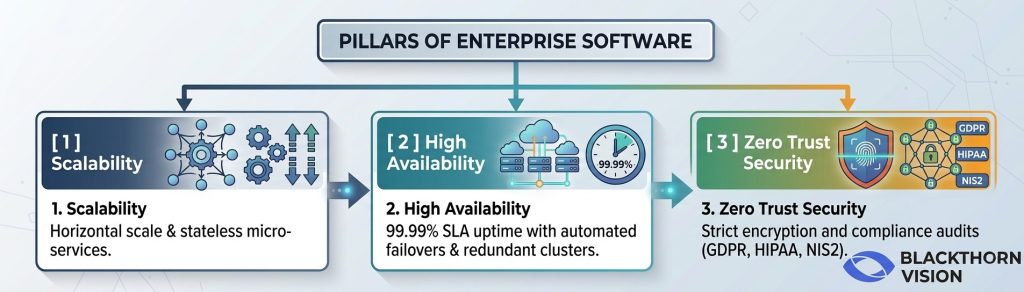
Scale that changes the architecture. Enterprise systems are designed around load characteristics rather than feature lists. That means stateless services, distributed caching, partitioned data stores, and asynchronous processing chosen before the first sprint rather than retrofitted after a load test fails. A system that holds sub-second response times at ten times its normal traffic passes this test. One that needs a rewrite to do so does not.
Availability that carries a contractual penalty. In enterprise contracts, uptime is a number with money attached. A 99.9% commitment permits roughly 8 hours 45 minutes of downtime per year. A 99.99% commitment permits about 52 minutes. Moving between those two tiers is not a configuration change: it requires redundant infrastructure across availability zones, automated failover, and monitoring that catches degradation before users do. Ask any candidate vendor which availability tier they have actually operated, and for how long.
Regulatory obligation as a design input. GDPR, HIPAA, PCI DSS, SOX, and NIS2 each impose specific requirements on data residency, audit logging, retention, consent, and breach notification. These have to shape the schema and the access model from the start. IBM’s Cost of a Data Breach Report 2025 put the average breach cost in the United States at $10.22 million, a record high, against a global average of $4.44 million. The same report put the average cost in healthcare at $7.42 million, the highest of any sector for the fifteenth consecutive year. Retrofitting compliance after a breach costs more than designing for it.
Integration with systems nobody wants to touch. Very few enterprise projects start on empty ground. Most involve an ERP that has been customized for fifteen years, a mainframe that still runs settlement, and a data warehouse whose original architect left in 2011. The skill being purchased is the ability to extend that estate without breaking it, which is closer to surgery than to construction.
A vendor that satisfies all four is doing enterprise software development. A vendor that satisfies two is doing custom software development for a large client, which is a legitimate service but a different one, and it should be priced differently.
Methodology and sources
How the shortlist was built. Candidates were drawn from firms with a documented presence in enterprise custom software development, a public review record, and verifiable corporate details. Blackthorn Vision was excluded from the ranked list by policy. Numbering reflects grouping by engagement profile, from largest-scale to most specialized, and is not a quality ranking.
How claims are sourced. Two kinds of statement appear in the vendor entries and they carry different weight. Independently sourced facts come from public filings, stock exchange listings, third-party workforce datasets, or Clutch’s verified review data. Company-reported figures come from vendor websites and profiles and have not been confirmed by us. Where a figure is the company’s own, the entry says so in the sentence itself.
Data currency. Clutch review counts and averages were recorded in September 2026 and change continuously. Headcount figures from third-party workforce datasets reflect the quarter stated. Verify both before making a decision. Where public sources conflicted, the conflict is noted in the vendor entry rather than resolved silently.
What we did not verify. ISO certifications, client logos, project counts and delivery outcomes reported by vendors were not independently audited. Request certificate numbers and reachable references directly.
Sources. EPAM Systems Form 8-K, first quarter 2026 (SEC EDGAR). New York Stock Exchange listing data. Clutch verified profiles for each listed vendor. Revelio Labs workforce datasets, March and September 2026. IBM Cost of a Data Breach Report 2025. Company websites and Crunchbase profiles for self-reported figures.
Related reading. For a broader market view, see our comparison of top software development companies in the USA and our shortlist of custom software development companies. For a category-level overview, see types of software development services.
10 enterprise software development companies at a glance
The table compares the shortlist on facts that can be checked from outside the vendor’s own marketing. Every custom enterprise software company below publishes enough verifiable detail to be assessed without relying on its own case studies. Headcount figures marked as verified come from third-party workforce datasets or public filings rather than company websites. Clutch review counts were recorded in September 2026 and move week to week, so re-check them before you act on them.
| # | Company | HQ | Founded | Team size | Independent signal | Best suited to |
|---|---|---|---|---|---|---|
| 1EPAM Systems | Blackthorn Vision | Lviv, Ukraine | 2009 | ~130 | 24 Clutch reviews | Multi-year transformation programs at Fortune 500 scale |
| 2N-iX | N-iX | Valletta, Malta | 2002 | ~2,400 | 35 Clutch reviews, $100,000+ minimum | Large cloud and data platform migrations |
| 3Intellias | Intellias | Lviv, Ukraine | 2002 | ~3,500 | Third-party headcount data, March 2026 | Automotive, telecom, geolocation, long roadmaps |
| 4ScienceSoft | ScienceSoft | McKinney, TX, US | 1989 | 750+ | 4.8 on Clutch across 42 reviews | Regulated healthcare and BFSI builds |
| 5Simform | Simform | Orlando, FL, US | 2010 | 1,000+ | 86 Clutch reviews, Azure Expert MSP | Cloud-native engineering on AWS or Azure |
| 6Intellectsoft | Intellectsoft | New York, NY, US | 2007 | Not disclosed | 46 Clutch reviews, $50,000+ minimum | Legacy brand modernization, mobile-to-backend work |
| 7Netguru | Netguru | Poznań, Poland | 2008 | 500 to 900 | Clutch Premier Verified, 4.8 across 71 reviews | Design-led products for consumer-facing enterprises |
| 8BairesDev | BairesDev | San Francisco, CA, US | 2009 | 4,000+ | 63 Clutch reviews, 4.9 average | Fast nearshore scaling in US time zones |
| 9Cleveroad | Cleveroad | Tallinn, Estonia | 2011 | Not disclosed | Clutch Premier Verified, 4.9 across 77 reviews | Logistics, insurance and healthcare mid-market builds |
| 10SumatoSoft | SumatoSoft | Boston, MA, US | 2012 | Not disclosed | 25 Clutch reviews, $50 to $99 hourly band | IoT and data-heavy web platforms |
Enterprise software development services explained
Vendors present their capabilities as service lines, which makes comparison harder than it needs to be because every firm names them differently. Underneath the naming, custom enterprise software development services fall into six categories. Knowing which one you are buying is the fastest way to shorten a vendor conversation.
Custom enterprise application development. Building a system that does not exist off the shelf, because the process it supports is a source of competitive advantage rather than a commodity. This is where custom enterprise software development earns its cost: you own the intellectual property, the workflow matches your operation instead of the reverse, and there is no license renewal negotiated from a position of weakness.
Enterprise resource planning and operations systems. ERP, supply chain management, warehouse and manufacturing execution systems. Most organizations run a packaged platform here and need extension rather than replacement, though there are operations where the packaged product forces enough workarounds that a custom ERP build is cheaper over five years.
Customer and workforce systems. CRM, customer portals, HR and human capital management, learning platforms. These are integration-heavy by nature because they sit between systems of record and the people using them.
Data, analytics and business intelligence. Warehouses, lakehouses, pipelines, and the reporting layer on top. This is where enterprise software development solutions most often stall, because the engineering is straightforward and the data governance is not.
Applied AI and automation. Moving from pilot to production. The gap between a model that works in a notebook and a model that runs under load with monitoring, versioning, rollback and audit logging is most of the actual work, and it is what AI integration services exist to close.
SaaS and product platforms. Multi-tenant systems built to be sold rather than used internally, where tenancy isolation, metering and provisioning are architectural concerns from day one. SaaS platform development has a different cost curve from internal enterprise software because the operational burden never ends.
A firm offering enterprise custom software development across all six is either very large or overstating its range. For a mid-sized vendor, depth in two or three is a better signal than breadth across all six.
The 10 enterprise software development companies reviewed
Blackthorn Vision
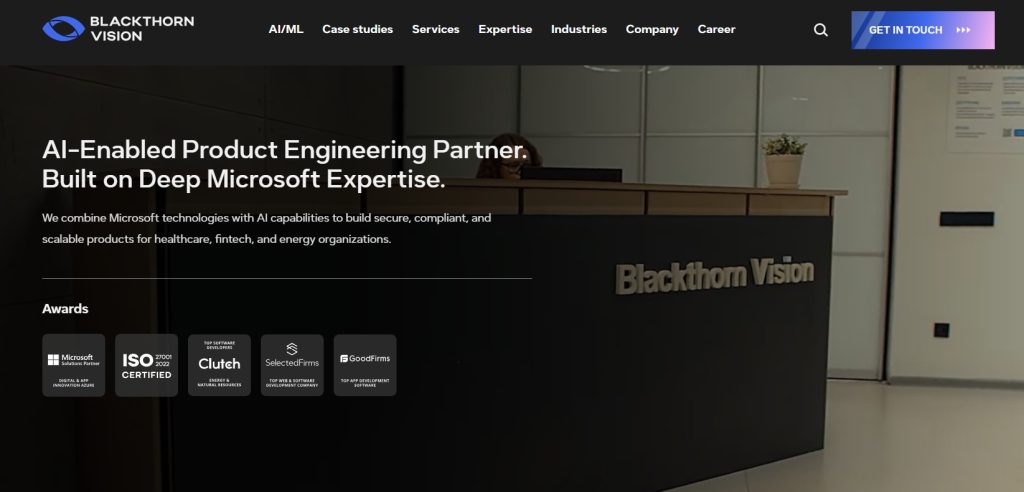
Blackthorn Vision is a custom software engineering company founded in 2009 and headquartered in Lviv, Ukraine, with offices in Warsaw and Wrocław. The company is a Microsoft Solutions Partner and holds a 4.8 average across 24 reviews on Clutch. Reported delivery record covers 150+ projects and 80+ long-term engagements, with roughly 75% of engineers at middle or senior level.
Our work concentrates on .NET and Azure engineering for regulated industries: healthcare, fintech, B2B SaaS and manufacturing. That focus is narrower than most firms on this list, and it is a deliberate trade. If your program is a fifteen-workstream global transformation, EPAM is a more appropriate counterparty than we are. If it is a regulated platform on the Microsoft stack where architectural depth matters more than headcount, that is the work we are built for. A summary of what we deliver is on our services overview, and you can start a conversation here.
Cleveroad
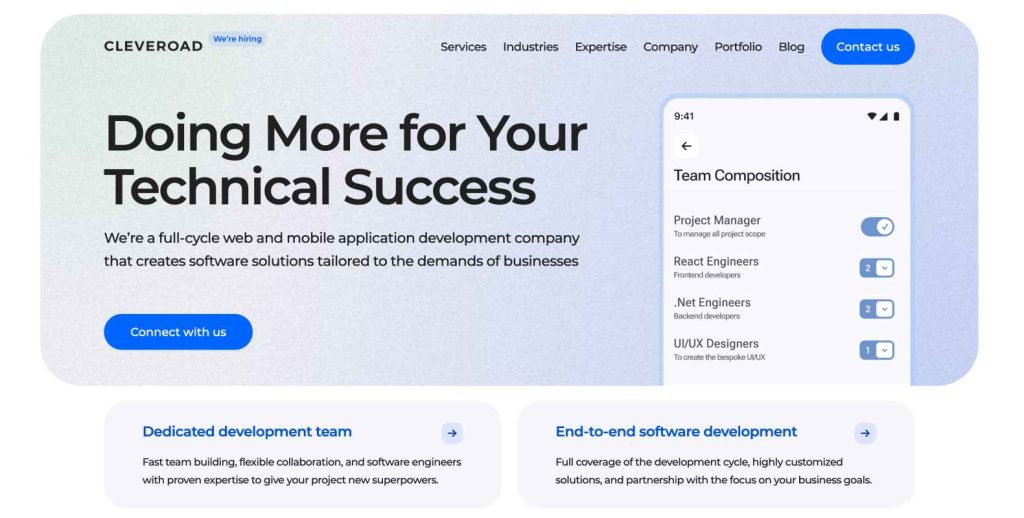
Cleveroad was founded in 2011 and operates its R&D center in Tallinn, Estonia. Clutch lists Cleveroad as Premier Verified with a 4.9 average across 77 verified reviews. The company reports 300+ delivered products, engineers in five countries, and certification to ISO 9001:2015 and ISO/IEC 27001.
Cleveroad’s strength is full-cycle delivery for mid-market organizations that need enterprise-grade discipline without enterprise-grade overhead. The published vertical focus covers logistics, insurance, healthcare and fintech, and the ISO 27001 claim is relevant where a build touches policyholder or patient data. As with any self-reported certification, ask for the certificate and the certifying body.
The realistic ceiling is scale. This is a firm for a defined platform build, not for a fifteen-workstream transformation program.
SumatoSoft
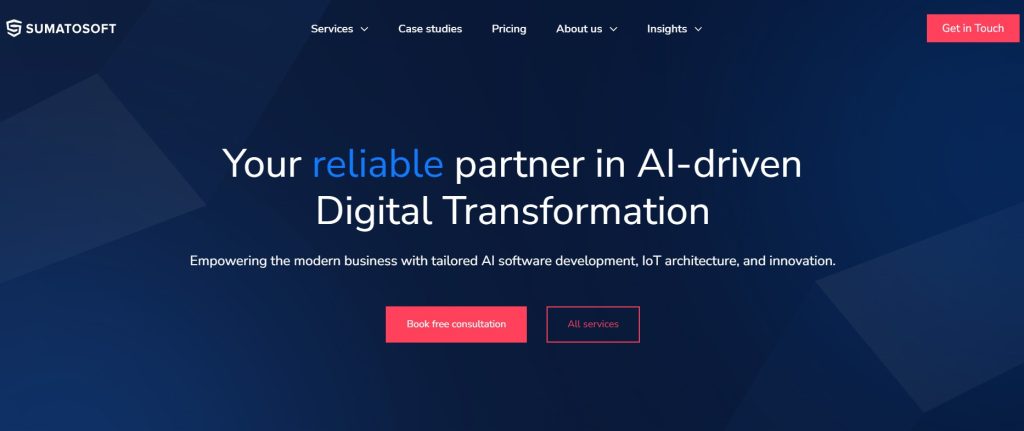
SumatoSoft holds 25 reviews on Clutch and lists an average hourly rate in the $50 to $99 band. The company reports a 2012 founding, a Boston headquarters, and specialization in IoT, big data analytics and complex business web applications.
SumatoSoft is the smallest firm in this comparison and it is included because small can be correct. For a data-heavy web platform or an IoT backend where the requirement is one competent team rather than a delivery organization, a boutique gives you direct access to the people writing the code and shorter decision paths.
The review base is thin relative to the others, and corporate details come mainly from the company’s own materials rather than independent registries. That is not disqualifying, but it means more of the diligence burden falls on you.
Choose SumatoSoft when the scope is a single well-defined data or IoT platform and you value direct access over organizational depth.
ScienceSoft
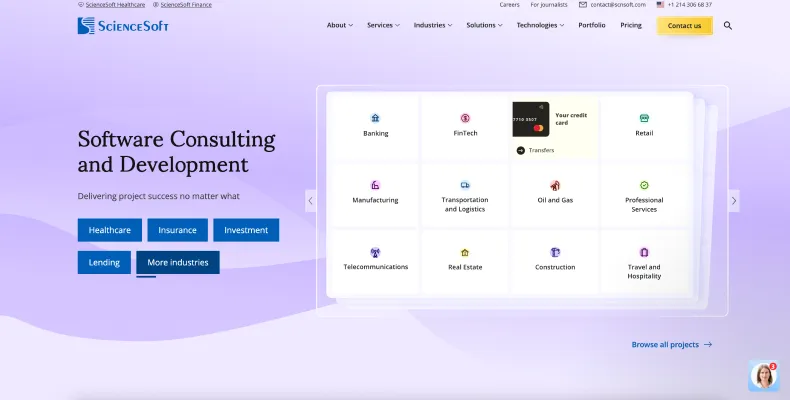
ScienceSoft USA Corporation was founded in 1989 and is headquartered in McKinney, Texas. It holds a 4.8 average across 42 Clutch reviews. The company reports 750+ technical staff, delivery operations across the US, EU and GCC, and certification to ISO 9001, ISO/IEC 27001 and ISO 13485.
ScienceSoft is one of the few firms on this list whose track record predates the web, and the practical value of that is a deep bench in regulated delivery. ISO 13485 is the quality management standard for medical devices, which is a meaningful signal if your build touches clinical software, because it means the company has already been audited against a regime most development shops never encounter. The healthcare and financial services practices are the strongest parts of the portfolio.
The certifications above are the company’s own statements. Certification registries are public, so ask for the certificate numbers and verify them directly rather than taking the logos at face value.
Choose ScienceSoft when the build is subject to HIPAA, medical device regulation, or financial services supervision.
N-iX
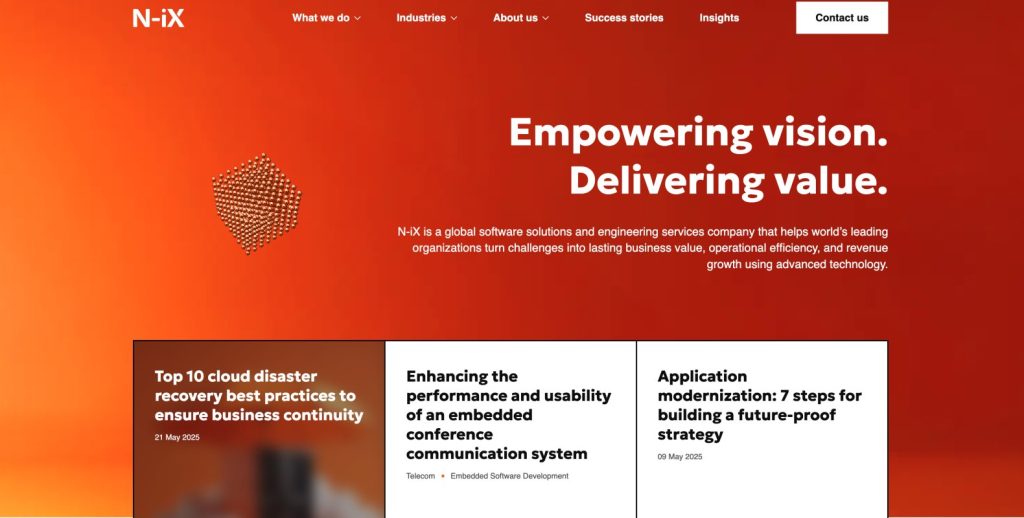
N-iX was founded in 2002 and is legally headquartered in Valletta, Malta, with its principal engineering base historically in Lviv, Ukraine. Third-party workforce data put headcount at roughly 2,400 as of March 2026. N-iX lists a minimum project size of $100,000 and an average hourly rate in the $50 to $99 band on Clutch, where it holds 35 reviews.
N-iX sits at the size where a vendor can staff a genuine platform migration without the client becoming a rounding error. The published minimum project size is a useful filter in both directions: it signals that the firm is not competing for staff augmentation contracts, and it tells you quickly whether your budget is in range. Work concentrates on cloud transformation, data platform engineering, and embedded software.
The delivery footprint spans multiple countries with a significant Ukrainian engineering base. N-iX states it has maintained continuous delivery since 2022, including relocating several hundred engineers. That is a self-reported continuity claim, and it is exactly the sort of claim to test against reachable client references rather than accept from a deck.
Choose N-iX when the work is a large cloud or data platform migration and you want a vendor big enough to staff it without being big enough to deprioritize it.
Simform
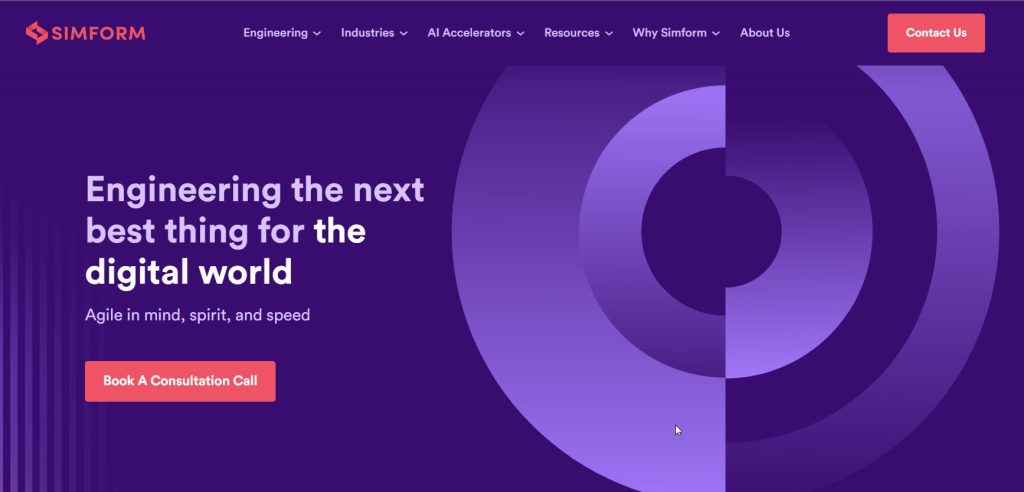
Simform holds 86 reviews on Clutch and is listed as a Microsoft Azure Expert MSP and an AWS Premier Partner. The company reports 1,000+ staff, a US headquarters in Florida, and delivery centers in India.
Azure Expert MSP is the most useful signal in Simform’s profile because it is awarded through an independent third-party audit rather than by accumulating certifications, and relatively few partners hold it. Combined with AWS Premier status, it indicates real depth on both major clouds, which matters for organizations running a deliberate multi-cloud strategy rather than an accidental one.
Public sources disagree on Simform’s exact headquarters city and founding year, listing both Florida and Arizona and both 2009 and 2010. Treat corporate detail here as needing confirmation from the company directly. Delivery is substantially offshore, so time zone overlap should be agreed explicitly in the contract rather than assumed.
Choose Simform when the priority is cloud-native architecture on AWS or Azure and you want partner status that was independently audited.
Intellias
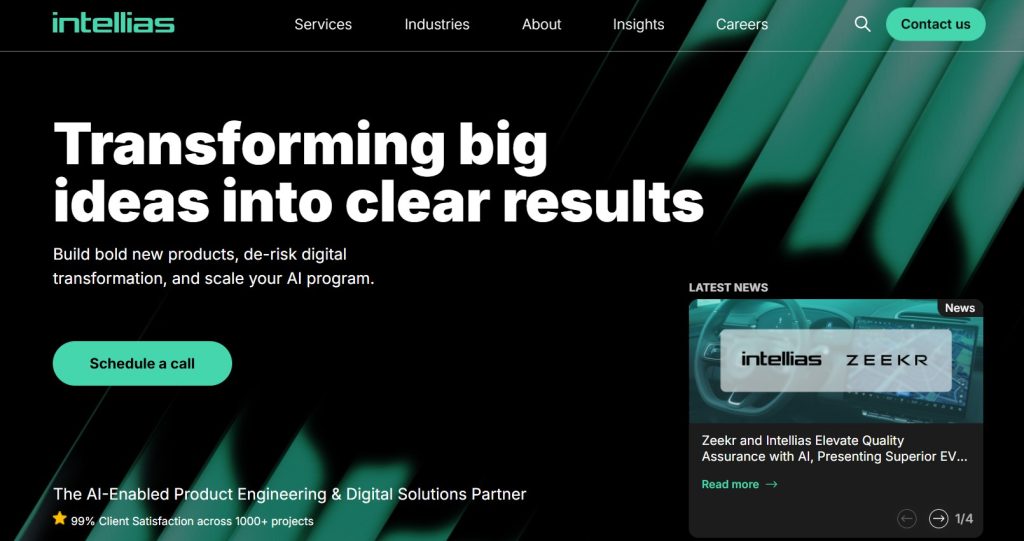
Intellias was founded in 2002 and is headquartered in Lviv, Ukraine. Third-party workforce data put headcount at roughly 3,500 as of March 2026. Intellias lists a minimum project size of $50,000 and an average hourly rate in the $50 to $99 band on Clutch, where it holds 30 reviews.
Intellias has concentrated on verticals where the software carries safety or regulatory weight: automotive, telecom, and location-based services. That specialization shows up as process discipline rather than marketing language, because functional safety and telecom certification regimes do not tolerate improvisation. The firm is a reasonable fit for connected-device platforms, digital twins, and large SaaS ecosystems with long roadmaps.
The corresponding limitation is that a vertical-heavy firm is strongest inside its verticals. For a claims platform or a hospital system, a healthcare-focused vendor will bring more relevant pattern recognition.
Choose Intellias when the domain is automotive, telecom, or geospatial and the roadmap runs for several years.
BairesDev
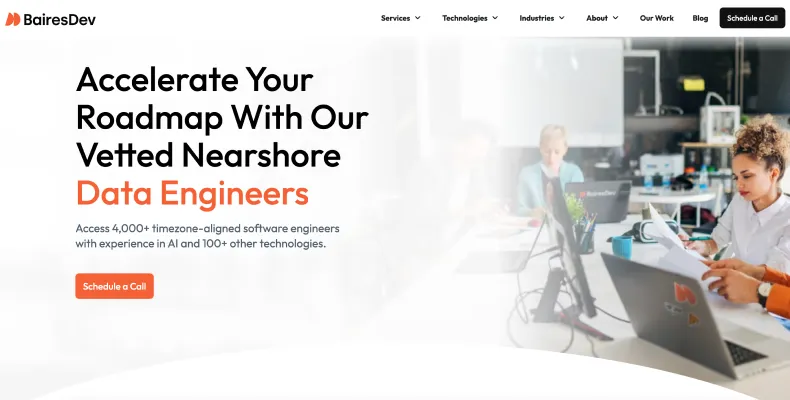
BairesDev was founded in 2009 and is headquartered in San Francisco, having started in Argentina. It holds a 4.9 average across 63 Clutch reviews, with client-reported project sizes ranging from $10,000 to over $5 million. The company reports 4,000+ professionals distributed across Latin America and beyond, and a remote-first operating model.
BairesDev solves a specific problem: getting senior engineers into a US-hours working day quickly. The Latin American talent base means overlap with US teams is nearly complete, which removes the single largest source of friction in offshore delivery. For a program that has fallen behind and needs capacity in weeks rather than quarters, that is the relevant capability.
The model is closer to staffing than to outcome ownership. Day-to-day technical direction stays with the client, so this is a poor fit if you need a vendor to own architecture and delivery risk. Independent reviews also note that pricing requires a sales conversation and that replacement terms are worth pinning down in the contract before signing.
Choose BairesDev when you need senior engineers in US time zones fast and you have the internal leadership to direct them.
Intellectsoft
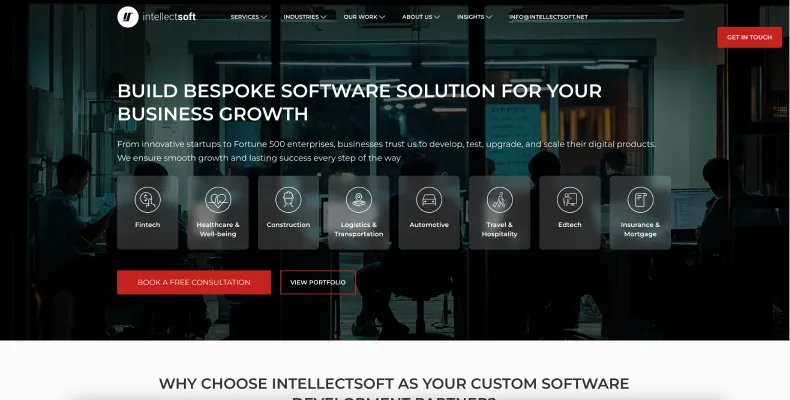
Intellectsoft was founded in 2007 and lists its headquarters in New York, with a minimum project size of $50,000 and an average hourly rate in the $50 to $99 band across 46 Clutch reviews. The company reports offices across the US, UK, Norway, Ukraine and Latin America, and names Ernst & Young, Harley-Davidson and Bombardier among its clients.
Intellectsoft’s positioning is modernization for established brands: taking companies with substantial legacy estates and building modern interfaces and integration layers on top of them. That is genuinely difficult work and it is undersupplied, because most vendors would rather start clean. The firm is a reasonable fit when the constraint is an existing backend that cannot be replaced.
Headcount is not disclosed through independent sources, which makes it harder to judge capacity. The named client logos are self-reported and should be treated as such until you have spoken to a reference.
Choose Intellectsoft when the job is putting modern software in front of a legacy estate that has to stay running.
Netguru
Netguru was founded in 2008 and is headquartered in Poznań, Poland. Clutch lists Netguru as Premier Verified with a 4.8 average across 71 verified reviews and a Creditsafe risk assessment of Low. The company is a certified B Corporation. Netguru reports a headcount in the 500 to 900 range and names IKEA, Volkswagen and Vinted among its clients.
Netguru is unusual in this group because design is a first-class function rather than a service line bolted onto engineering. For enterprises building customer-facing products where adoption depends on the interface, that changes outcomes. The Clutch Premier Verified status is worth noting specifically: it includes an independent check on legal registration and financial standing, which is a stronger signal than a review average alone.
The counterpoint is that a design-led firm is not the obvious first call for deep backend or data engineering work. Employee review data also shows a mixed internal picture, which is worth probing on a long engagement because delivery continuity depends on retention.
Choose Netguru when the product is customer-facing and the interface is a commercial risk, not a cosmetic one.
The enterprise software development process
Process is where large projects are won or lost, and it is the part of a vendor evaluation most often skipped because it is less interesting than technology. It is also the fastest way to tell a real enterprise software development company from a competent general contractor. The following five phases are common to credible enterprise delivery, whatever the vendor calls them.
Discovery and business analysis. Senior analysts map current-state processes, system dependencies and data flows before any architecture is proposed. The output is a documented scope with explicit assumptions. The purpose is not documentation for its own sake: it is to surface the integration nobody mentioned in the RFP. Skipping or compressing business analysis is the single most reliable predictor of a budget overrun.
Architecture and proof of concept. Architects define service boundaries, data ownership, security zones and integration contracts, then validate the riskiest assumption with working code. A proof of concept that fails at this stage is the cheapest failure available in the whole program.
Iterative delivery. Cross-functional teams build in sprints against a prioritized backlog, with working software demonstrated at fixed intervals. Programs spanning several teams need an explicit coordination layer, whether that is SAFe or a lighter alternative, and a vendor that cannot describe how they synchronize dependencies across teams has not run one.
Quality engineering. Automated regression suites, load and stress testing at projected peak volumes, and independent security testing. Quality assurance in an enterprise context means testing the system under conditions it will actually meet, not conditions convenient to reproduce.
Deployment and operations. CI/CD pipelines, infrastructure as code, observability, and a defined incident response path. This is the point where a project becomes a system somebody has to run at three in the morning.
Ask each vendor to walk through a past program against these five phases with specifics. Vendors who have done the work describe what went wrong and how they caught it. Vendors who have not describe the methodology.
Integration, migration and legacy modernization
Most enterprise engagements are modernization work wearing a different name. The existing estate is the constraint, and the question is how to change it without a service interruption the business will not accept.
Four strategies cover most cases, in ascending order of cost and risk.
Rehost. Move the workload to modern infrastructure without changing the code. Fastest and cheapest, and it resolves nothing about the application itself. Appropriate when the driver is data center exit or hardware end-of-life. Cloud migration services at this level are largely an infrastructure exercise.
Replatform. Keep the application largely intact but move to managed services: a managed database instead of a self-hosted one, containers instead of virtual machines. Meaningful operational savings for moderate effort.
Refactor. Restructure the code without changing external behavior. This is where technical debt actually gets paid down, and it is the hardest work to justify to a finance function because the system does the same thing afterwards.
Rebuild incrementally. Replace capabilities one at a time behind a routing layer that sends each request either to the legacy system or to its replacement, and retire the old component once traffic has moved. Commonly called the strangler fig pattern. It avoids the cutover event that makes big-bang replacement so dangerous, at the cost of running both systems in parallel for a period.
The decision is made per component, not per system. A realistic application modernization plan will apply different strategies to different parts of the same estate, and a vendor proposing one strategy across the board has not looked closely enough. Our longer treatment of the sequencing problem is in the guide to enterprise application modernization.
Security, compliance and governance
Security in enterprise development is an engineering practice with an audit trail, not a phase before launch.
Design. Threat modeling during architecture, so trust boundaries and authentication flows are decided deliberately. Zero trust in practice means no implicit trust based on network position: every request authenticates and authorizes regardless of origin.
Build. Static analysis and dependency scanning in the pipeline, secrets held in a managed vault rather than in configuration, and code review with security as an explicit criterion.
Data. Encryption in transit and at rest, role-based access control enforced server-side, field-level protection for regulated data, and audit logging that records who accessed what and when. Audit logging is the requirement most often deferred and the one auditors ask about first.
Operations. Continuous vulnerability scanning, a defined patch cadence, penetration testing by an independent party, and an incident response plan that has been rehearsed.
On certifications, the distinction that matters is between an organizational certification and a project artifact. ISO/IEC 27001 and SOC 2 Type II certify the vendor’s own management systems and are verifiable through the certifying body. HIPAA, GDPR and PCI DSS describe obligations that attach to your system, and a vendor cannot be certified compliant with them on your behalf. A vendor claiming to be “HIPAA certified” has told you something useful about their diligence.
Support, maintenance and service levels
The build is the smaller half of the cost. Enterprise systems run for a decade or more, and the support arrangement determines what that decade feels like. This is the section most often missing from vendor comparisons and the one that most reliably produces disputes.
Four things belong in the contract before signing.
Response and resolution targets by severity. Severity levels defined by business impact rather than technical symptom, with separate response and resolution commitments for each, and a stated escalation path with named roles.
Coverage hours and on-call. Business hours in whose time zone, and what happens outside them. For a system that supports operations across regions, follow-the-sun coverage is a different price from a single-region team with a pager.
What maintenance actually includes. Security patching, dependency upgrades, cloud provider deprecations and certificate renewals are ongoing obligations that arrive whether or not anyone requested a change. Confirm in writing whether these fall inside the retainer or bill as change requests, because the two readings differ by a large number over five years.
Knowledge transfer and exit. Documentation standards, source control and infrastructure access held by you rather than the vendor, and a defined transition process. The best time to negotiate an exit is before you need one.
A vendor that answers these precisely has run production systems. A vendor that answers with a service catalogue has not.
Industry applications and delivery evidence
Enterprise software concentrates where regulation, integration complexity and transaction volume overlap. Four sectors dominate.
Healthcare and life sciences. Clinical systems, diagnostic software, interoperability across HL7 and FHIR, and device software subject to regulatory clearance. The engineering constraint is that patient safety and data protection are both non-negotiable, which narrows the design space considerably. Blackthorn Vision’s work in healthcare software development includes delivering diagnostic software for a client product that received FDA 510(k) clearance. Clearance is granted to the client’s device rather than to a development vendor, and any firm describing an FDA clearance as its own certification is describing it incorrectly.
Financial services. Core banking integration, payments, lending and underwriting platforms, and reporting under supervisory regimes. Availability requirements are the strictest of any sector because a settlement window does not move.
Manufacturing and supply chain. ERP extension, warehouse and manufacturing execution, and increasingly the integration of operational technology data with enterprise systems. The hard part is usually that the shop floor systems were never designed to be integrated with anything.
B2B SaaS platforms. Multi-tenant products where scale, tenancy isolation and provisioning are architectural rather than operational concerns. Blackthorn Vision has delivered a SaaS platform serving more than 250,000 users, migrated a legacy Silverlight application to Azure, and accelerated a client’s release cadence by a factor of 15 through DevOps automation. These are self-reported outcomes; the underlying engagements are documented in our case studies.
When evaluating any enterprise software development agency, ask for delivery evidence in your sector specifically. General competence transfers less than vendors suggest, because most of the difficulty in regulated work is knowing which constraints are real.
The modern tech stack for enterprise
To build digital products capable of standing the test of time, a custom enterprise software development company must utilize a robust, modern technology stack. The days of relying on fragile, single-vendor ecosystems are long gone. Today’s corporate platforms are built on open, cloud-native, and highly secure foundations.
| Layer | Industry Standards | Strategic Importance |
| Cloud & Infrastructure | AWS, Microsoft Azure, Google Cloud | Enables multi-cloud and hybrid architectures to maximize uptime and optimize data residency. |
| Backend Ecosystem | Java (Spring Boot), .NET Core, Go | Provides enterprise-grade type safety, high concurrency handling, and long-term maintainability. |
| Data & Analytics | Python, Snowflake, Databricks | Facilitates complex data engineering, large-scale warehousing, and advanced AI model training. |
| Cybersecurity | IAM, OAuth 2.0, Zero Trust Frameworks | Restricts system access dynamically, protecting sensitive corporate assets from external and internal threats. |
Choosing the right components within this stack requires deep technical foresight. For example, selecting Java or .NET Core is rarely about following trends; it is a calculated decision based on the massive ecosystems, security patches, and backward compatibility these languages guarantee.
When paired with a modern cloud infrastructure, these backend tools allow an enterprise application development company to build highly containerized applications using Docker and Kubernetes. This approach ensures that whether an application is running in a private data center or across a public cloud environment, its behavior remains identical, predictable, and remarkably easy to manage.
Engagement models and pricing
Three models cover nearly all enterprise arrangements, and the choice determines where delivery risk sits.
Dedicated team. The vendor assembles a persistent cross-functional team that works only on your roadmap and accumulates domain knowledge over time. Best for evolving multi-year programs. Highest continuity, and it requires product ownership on your side. Our own approach to dedicated development teams sets this out in more detail.
Staff augmentation. Individual engineers join your existing team under your management. Fastest to start, cheapest per head, and it leaves architecture and delivery risk entirely with you. Appropriate for capacity gaps, not for outcome ownership.
Managed delivery. The vendor takes responsibility for a defined outcome, including timeline and quality. Transfers the most risk and costs the most, and it requires a scope specific enough to be contractually meaningful.
On budget, the honest answer is that no custom enterprise software development company can quote a range that means anything before discovery, because the variables are large. Published hourly rates for the firms above cluster in the $50 to $99 band for Eastern European and Latin American delivery, with US and Western European rates materially higher. Client-reported project sizes on Clutch for these vendors span roughly $10,000 to over $5 million. A useful planning heuristic is that integration count, compliance scope and data migration volume drive cost more than feature count does. The full breakdown of what moves the number is in our analysis of custom software development cost.
Two contractual points deserve explicit attention regardless of model. Intellectual property should transfer to you on payment, stated in the master service agreement rather than assumed. And source control, cloud accounts and CI/CD infrastructure should be owned by your organization with the vendor granted access, not the reverse.
Benefits and challenges of custom enterprise software
The case for building is strong in specific circumstances and weak in others. Vendor content rarely says the second part.
Where building wins. Custom software development for enterprise operations pays off in four situations. When the process is a source of advantage, packaged software forces you to operate like everyone else. When integration requirements are unusual, licensing a platform and then paying to bend it often costs more than building the thing you needed. When license costs scale with headcount or transaction volume, a build has a fixed cost and a variable saving. And you own the asset, which matters at acquisition or audit.
Where building loses. For commodity functions, packaged software is cheaper and better because the vendor amortizes development across thousands of customers. You take on the permanent obligation to maintain, patch and staff the system. Time to value is longer, sometimes by a year or more. And you carry key-person risk on a system only your team understands.
The failure modes worth naming. Scope expansion during a long build, where the requirement set grows faster than delivery. Integration surprises, where a system nobody documented turns out to be load-bearing. Compliance discovered late, which is the most expensive category because it can invalidate architectural decisions. And organizational change failure, where the software works and nobody uses it, which is a training and process problem that no vendor can fix for you.
The strongest position in a vendor conversation is knowing which of these applies to you before the vendor tells you.
Hiring an enterprise software development company in the USA
For US organizations, the sourcing decision has three realistic shapes and the trade-offs are consistent.
Onshore. US-based teams, full time zone alignment, simplest contracting and data residency position. Highest rate by a wide margin, and the domestic senior talent market remains tight.
Nearshore. Latin America for US clients. Nearly complete working-hour overlap, moderate rates, straightforward travel. BairesDev is the clearest example of this model in the shortlist above.
Offshore. Eastern Europe and Asia. The deepest senior engineering pools at the lowest rates, with the largest time zone gap. Eastern European delivery for US clients typically yields three to five hours of daily overlap with US Eastern time, which is workable when the working agreement is explicit about which hours are shared and what gets decided asynchronously.
Several firms above are structured as a US-based enterprise software development company with offshore delivery, which is the most common arrangement in practice. That arrangement gives you a US contracting entity and US-hours account management while the engineering happens elsewhere. It is a legitimate model, and the thing to verify is where the engineers actually sit, since a US headquarters on a website tells you about the legal entity rather than the delivery team.
Two US-specific points to settle early. Data residency: if your data must remain in US jurisdiction, that is a cloud region and contractual commitment, not a vendor location question. And sector regulation: HIPAA business associate agreements, PCI DSS scope and any state privacy obligations should be confirmed in writing before scoping, not after.
Vendor selection scorecard
Score each candidate from 1 to 5 on each criterion. Weight reflects how strongly each factor predicts outcomes on enterprise programs. The purpose is not a precise number: it is to force the comparison onto evidence rather than impression, and to make disagreement inside your own team explicit.
| Criterion | What to ask for | Weight |
|---|---|---|
| Domain delivery evidence | Two references in your sector, reachable by phone | 5 |
| Architectural depth | A past architecture decision record and the reasoning behind it | 5 |
| Security and compliance posture | Certificate numbers, certifying body, audit dates | 4 |
| Integration track record | A named legacy integration and what went wrong | 4 |
| Team composition and retention | Seniority mix on your team, and attrition on the last engagement | 4 |
| Support and SLA terms | Severity definitions, response targets, escalation path | 3 |
| Commercial transparency | Rate card, change request pricing, replacement terms | 3 |
| Financial stability | Filings, credit assessment, or years of continuous operation | 3 |
| Communication overlap | Contracted shared hours, not “flexible” | 2 |
| Exit and knowledge transfer | Written transition process and repository ownership | 2 |
Weight reflects how strongly each criterion predicts the outcome of an enterprise program, from 5 for the strongest predictors down to 2. Multiply each score by its weight and total the result per vendor. The number itself matters less than forcing the comparison onto evidence rather than impression.
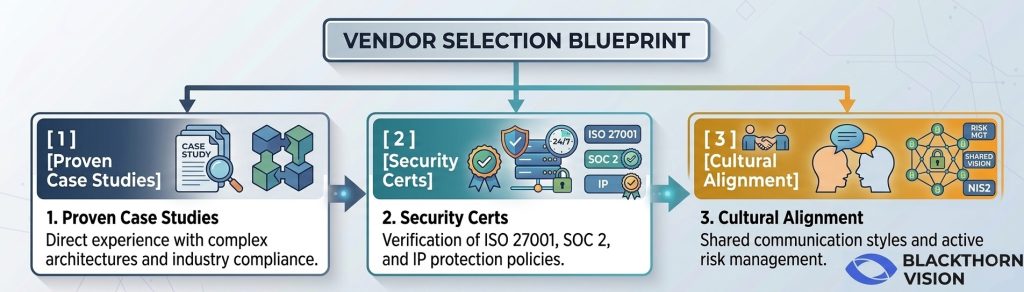
A candidate scoring 4 or 5 on domain evidence and architectural depth but 2 on commercial transparency is usually worth a second conversation. A candidate scoring well everywhere except domain evidence is usually worth a smaller first project.
FAQ
What is an enterprise software development company?
How do I verify a vendor's claims before signing?
Request certificate numbers for any ISO or SOC 2 claim and check them with the certifying body. Ask for two client references in your sector who will take a phone call. Ask for an architecture decision record from a past program and the reasoning behind a specific trade-off. Confirm review counts and ratings on Clutch directly, since they change weekly. For public companies, read the most recent filing. Claims that cannot survive this process should not be priced into your decision.
Does an enterprise software development company need to be in the USA?
No, though the contracting entity often is. Many firms serving US enterprises are US-headquartered with engineering delivered from Eastern Europe or Latin America, which gives a US contracting party and US-hours account management while the engineering happens elsewhere. What matters is where the engineers actually sit, how many working hours overlap with your team, and whether data residency and sector compliance obligations are met contractually. A US address on a website describes a legal entity, not a delivery team.
What technology stack do enterprise systems typically use?
Backend work concentrates on Java with Spring Boot, .NET, and Go, chosen for long-term support commitments and mature security patching rather than novelty. React and Angular dominate the frontend. AWS, Microsoft Azure and Google Cloud are the standard infrastructure platforms, with Docker and Kubernetes for workload portability. Data platforms commonly combine Python with Snowflake or Databricks. Backward compatibility and patch cadence matter more than performance benchmarks in this category, because the system will outlive several technology cycles.
Who owns the intellectual property in a custom enterprise build?
In standard practice, all intellectual property, source code, documentation and configuration transfer to the client on payment, established in the master service agreement and reinforced by non-disclosure agreements. This should be stated in writing rather than assumed. Source control, cloud accounts and CI/CD infrastructure should be owned by the client organization with the vendor granted access, which makes the ownership position practical rather than only contractual.
What should be in an enterprise software support agreement?
Severity levels defined by business impact, separate response and resolution targets per severity, a named escalation path, stated coverage hours and time zone, and an explicit list of what routine maintenance includes. Security patching, dependency upgrades and cloud provider deprecations should be named specifically as inside or outside the retainer, since they arrive whether or not anyone requests a change.
How do you modernize legacy systems without downtime?
By replacing capabilities incrementally rather than all at once. A routing layer directs each request either to the legacy system or to its replacement, traffic shifts gradually as each new component proves itself, and the old component is retired once nothing depends on it. This is commonly called the strangler fig pattern. It avoids the cutover event that makes big-bang replacement risky, at the cost of operating both systems in parallel during the transition.
How long does an enterprise software project take?
Discovery and architecture typically run four to eight weeks. A first production release commonly lands three to six months after that, depending on integration scope. Full rollout across an organization usually extends over a year or more, because the constraint after the software works is organizational change rather than engineering. Any vendor quoting a firm end-to-end timeline before discovery is quoting a guess.
What is the difference between an enterprise software development agency, firm and company?
There is no formal distinction. The three terms are used interchangeably in the market, though “agency” more often implies design and product work alongside engineering, while “firm” and “company” are used more broadly. Evaluate the delivery record rather than the label, because none of the three words carries any certification or minimum standard.
How much does custom enterprise software development cost?
Cost depends on integration count, compliance scope, data migration volume and team composition rather than feature count. Published hourly rates for established vendors cluster in the $50 to $99 band for Eastern European and Latin American delivery, with US and Western European rates materially higher. Client-reported project values on Clutch for the vendors in this comparison range from roughly $10,000 for small engagements to over $5 million for multi-year programs.
You may also like
-
 September 8, 2026Read in 16 min.
The AI-Native SDLC: From Writing Software to Orchestrating It
An AI-native SDLC cuts delivery time by about half without loosening a single quality gate. See the three eras, the toolchain and the guardrails. -
 September 4, 2026Read in 36 min.
Custom software development cost: Real ranges, rate cards, and how to budget
How much custom software development costs. Explore real pricing ranges, hourly rates, key cost factors, hidden expenses, and budgeting tips. -
 September 2, 2026Read in 36 min.
Fitness app development companies: An independent shortlist
10 fitness app development companies compared on verified data, published pricing, and real client work. Only three have documented fitness delivery. -
 August 27, 2026Read in 36 min.
Top software development companies in the USA
Find the best US-based software developers. From AI to enterprise web apps, here are the top 30 software development companies in the USA you should hire in 2026. -
 August 19, 2026Read in 22 min.
Robotic Process Automation in healthcare: Definition, benefits, and real cases
From patient scheduling to claims processing: explore proven RPA use cases in healthcare, backed by real data, ROI benchmarks, and compliance guidance. -
July 16, 2026Read in 18 min.
Top 10 Banking Software Development Companies in the US
An independent, verified list of the top banking software development companies in the US, plus a practical guide to choosing the right partner -
 July 16, 2026Read in 17 min.
Custom ERP software for manufacturing – Built on Azure and .NET
Off-the-shelf ERP forcing workarounds? Blackthorn Vision, a manufacturing software company, builds ERP software for manufacturing on Azure and .NET. -
 June 30, 2026Read in 10 min.
Software development company in Boston: Custom solutions for a research-driven city
Boston software development company building HIPAA-aware healthcare, biotech, and enterprise software on .NET and Azure. Microsoft Solutions Partner, 4.8/5 on Clutch -
 June 18, 2026Read in 10 min.
Software Development Company in Washington State: Custom Solutions Across the Region
Software development company serving all of Washington State. Cloud-first custom software on .NET and Azure. Microsoft Solutions Partner since 2009. -
June 17, 2026Read in 12 min.
Software Development Company in Seattle: Cloud-First Custom Solutions
Seattle software development company building cloud-first custom software on .NET and Azure. Microsoft Solutions Partner trusted since 2009. Talk to us