

Beyond basic automation, you should evaluate a partner’s mastery of Infrastructure as Code (IaC), their ability to impact DORA metrics (like deployment frequency and MTTR), and their experience with Platform Engineering. A top-tier devops solutions provider should not just offer tools but provide a strategic framework that reduces developer cognitive load while maintaining high security and compliance standards.
Top DevOps companies: Strategic partners for engineering excellence

 13 minutes read
Content
Software delivery has undergone a seismic shift in recent years. We have moved far beyond the “automation for automation’s sake” era that characterized the early days of the movement. Today, merely possessing a CI/CD pipeline or a few scripts is no longer a competitive advantage; it is the bare minimum for survival in a crowded marketplace. Organizations are now navigating a “Post-Automation” era, where the focus has shifted toward engineering resilience, cognitive load reduction, and autonomous operations. As digital ecosystems become increasingly fragmented across multi-cloud and edge environments, the role of DevOps development services has transitioned from being a technical support function to a core driver of business strategy.
Selecting the right partner from a sea of DevOps service providers is a high-stakes decision for CTOs and VPs of Engineering, particularly within the highly competitive USA market, where the cost of downtime can reach millions of dollars per hour. The goal is no longer just “faster deployments,” but rather the creation of a sustainable ecosystem where developer velocity and system stability coexist in a state of harmony. This guide is designed to cut through the marketing noise. We move beyond generic lists to provide a deep dive into the technical and strategic benchmarks that define a truly elite DevOps services company. Whether you are looking for DevOps infrastructure management services to overhaul a legacy monolith or seeking DevOps as a service companies to scale a cloud-native startup, understanding the modern maturity model is essential for a successful partnership.
Methodology: How we evaluate DevOps partners
To provide an objective ranking that surpasses the surface-level analysis found in most industry blogs, we employ a rigorous, multi-dimensional evaluation framework. Our methodology ignores flashy slogans and focuses on the “engine room” of DevOps solution providers. First, we analyze Technical Proficiency through the lens of Infrastructure as Code (IaC) mastery. A top-tier DevOps service provider company must demonstrate advanced capabilities in tools like Terraform, Pulumi, or Crossplane, ensuring that infrastructure is treated with the same rigor as application code – including unit testing and versioning.
Secondly, we evaluate a company’s impact on DORA Metrics (DevOps Research and Assessment). Industry data consistently shows that high-performing organizations are significantly more likely to exceed profitability and market share goals. Therefore, we look for DevOps service providers who can prove, through verifiable case studies, their ability to decrease Lead Time for Changes and improve Mean Time to Recovery (MTTR). We also vet their DevSecOps integration – evaluating how they bake security into the “inner loop” of development rather than treating it as a final hurdle. Finally, we look at cultural alignment. The best top DevOps consulting companies do not just deliver tools; they mentor internal teams, fostering a culture of shared responsibility that prevents the “silo effect” from returning once the consultants leave.
The Vanguard of excellence: Top 10 DevOps companies
Selecting a partner requires a balance between technical prowess and cultural fit. Below is a detailed look at ten industry leaders, ranging from global powerhouses to specialized boutique firms, each bringing a unique value proposition to the DevOps ecosystem.
1. Blackthorn Vision
Best for: Specialized Engineering & Digital Transformation.
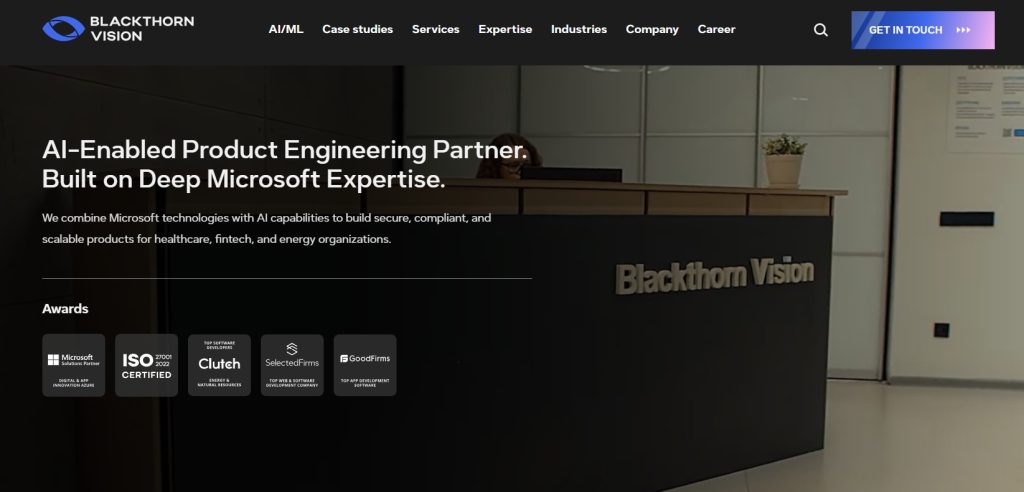
Blackthorn Vision has carved out a niche as a high-end DevOps development company that excels in complex, bespoke software ecosystems. Their approach is heavily focused on the “Discovery & Consulting” phase, ensuring that every automation strategy is rooted in specific business logic. In the competitive USA market, they are frequently sought after for their ability to integrate DevOps infrastructure management services within heavily regulated industries like Healthcare and Fintech. They don’t just “fix pipelines” – they architect scalable environments that treat infrastructure as a living, versioned product.

2. Accenture
Best for: Enterprise-Scale Global Transformation.
As a global giant, Accenture is the definitive DevOps solutions and service provider company for Fortune 500 firms. Their strength lies in their massive scale and deep industry-specific “playbooks.” Accenture excels at “Industrialized DevOps,” moving beyond pilot programs to implement DevOps managed services across thousands of applications simultaneously. While their methodology is highly structured and sometimes less “agile” than boutique firms, their ability to manage complex, multi-cloud global environments is unmatched.

3. BairesDev
Best for: Nearshore Staff Augmentation & Managed Teams.
BairesDev is widely recognized as a premier DevOps service provider specializing in the Latin American market. They have built a reputation on their “Top 1% talent” acquisition model, providing highly skilled senior engineers who work in time-zone alignment with North American clients. For companies looking for DevOps as a service companies that offer a high-touch managed relationship without the overhead of local US hiring, BairesDev provides a seamless blend of staff augmentation and project-based delivery.
4. Vention
Best for: DevOps Engineering for High-Growth and Enterprise Product Teams.
Vention is a global software development company with 3,000+ engineers and over 20 years of experience providing DevOps services across CI/CD, cloud infrastructure, and automation for clients in fintech, healthtech, and enterprise software. In a 12-year partnership with publicly traded StoneX, Vention built a QA automation framework that saves 64 days of testing per release; for healthcare platform Dialogue, the team deployed a multi-account AWS environment and supported SOC 2 certification preparation. Vention also helps client engineering organizations adopt AI across their delivery lifecycle through a proprietary AI SDLC transformation methodology. The company is ISO 27001 certified and a DevOps Excellence Award winner.
5. HashiCorp
Best for: Infrastructure Automation & Multi-Cloud Security.
Though primarily a product company (Terraform, Vault, Consul), HashiCorp’s professional services arm is a powerhouse for DevOps infrastructure management services. They are the architects of modern “Cloud Operating Models.” When an organization needs to standardize how they provision, secure, and connect infrastructure across AWS, Azure, and Google Cloud, HashiCorp’s experts provide the blueprint. They are essential for firms moving toward a “Zero Trust” security posture.

6. Infosys
Best for: Managed Operations & Legacy Modernization.
Infosys is a titan among DevOps service companies, particularly strong in the “Managed Services” and “Modernization” space. They excel at taking large, legacy monolithic systems and transitioning them into cloud-native architectures. Their DevOps managed service provider model is built on high-level automation and offshore efficiency, making them a cost-effective choice for long-term maintenance and steady-state operations of complex enterprise portfolios.
7. ScienceSoft
Best for: Mid-Market Reliability & Healthcare DevOps.
With over three decades of experience, ScienceSoft is a highly reliable DevOps services company known for its pragmatic and transparent approach. They have a particularly strong track record in the USA market for HIPAA-compliant DevOps development services. Their methodology is characterized by clear communication and a focus on “high-availability” systems, ensuring that mid-market firms can achieve enterprise-level stability without an enterprise-level price tag.
8. Jalasoft
Best for: Outcome-Based Nearshore Engineering.
Jalasoft stands out by operating as a DevOps solution provider that focuses on “execution certainty.” Unlike traditional “body shops,” they take full accountability for outcomes. Their proprietary talent engine – where they train their own engineers – ensures a level of consistency and continuity that is rare in the industry. They are a preferred partner for firms needing DevOps consulting and managed cloud services with a focus on long-term scalability and architectural integrity.

9. Itransition
Best for: Full-Cycle Software Engineering & Integration.
Itransition is a versatile DevOps development company that excels in integrating DevOps into the wider software development lifecycle. They are experts at “breaking down silos,” working with internal teams to implement DevOps services providers’ best practices from the very first line of code. Their strength lies in their ability to handle both the development and the operational side of the house, providing a holistic “Product Engineering” approach.
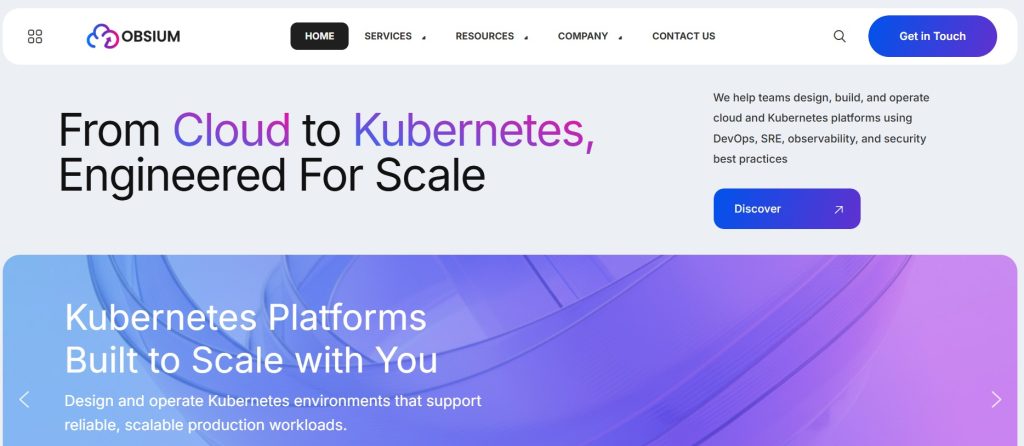
10. Obsium
Best for: Specialized DevOps Consulting & Platform Engineering.
Obsium is a “consulting-first” DevOps service provider company that focuses on the cutting edge: Platform Engineering and AIOps. They are ideal for startups and scale-ups that have outgrown basic automation and need a “Golden Path” for their developers. Obsium’s focus is on reducing “Toil” and improving the Developer Experience (DevEx). They are the partner you hire when you want to build a world-class, self-service infrastructure that empowers your engineers to move faster.
Emerging trends every top company must address
In the current technological climate, a DevOps solutions and service provider company is obsolete if they are not actively implementing AIOps and Platform Engineering. AIOps (Artificial Intelligence for IT Operations) has moved from a buzzword to a necessity for managing modern complexity. Recent studies suggest that enterprise spending on AIOps is growing rapidly as companies seek to manage the “data deluge” from microservices. An elite DevOps solutions provider utilizes machine learning to correlate alerts, predict potential system failures before they impact the end-user, and automate incident response.
Furthermore, the rise of Platform Engineering is a definitive trend. The most successful DevOps companies are now building Internal Developer Platforms (IDPs) to reduce the cognitive load on software engineers. Instead of every developer needing to be an expert in Kubernetes, a DevOps managed service provider creates a “golden path” – a self-service layer that allows developers to spin up environments and deploy code with one click, while maintaining compliance and cost controls in the background. Additionally, we see a massive surge in FinOps and GreenOps. As cloud costs continue to spiral, the best DevOps consulting and managed cloud services are those that provide real-time cost visibility and optimization, ensuring that high velocity does not result in a high financial price tag.
Selection framework: A 4-Step guide for CTOs
Selecting among various DevOps service companies requires a structured approach to avoid “vendor lock-in” and mismatched expectations. The first step is a candid Audit of Maturity. You must determine if your bottleneck is cultural (resistance to change), technical (legacy debt), or procedural (slow manual testing). A reputable DevOps development company will always start with a discovery phase to map your current value stream before suggesting tools.
The second step is defining your North Star Metric. If you are in a highly regulated industry like FinTech or Healthcare, your priority might be “Compliance as Code.” If you are a high-growth SaaS startup, it might be “Deployment Frequency.” Third, during the interview phase with potential DevOps services provider candidates, look for depth over breadth. Ask: “How do you handle stateful applications in Kubernetes?” or “Can you demonstrate your approach to ‘Shift-Left’ security in a serverless architecture?” A true DevOps solution provider will offer nuanced, experience-based answers rather than textbook definitions. Finally, always insist on a Trial Project or a “Proof of Value” (PoV). A 4-week engagement focused on a single pain point – such as optimizing a slow CI pipeline – will tell you more about a DevOps managed services partner than a hundred-page proposal ever could.
Strategic comparison: Managed services vs. Consulting
Understanding the distinction between DevOps managed services and top DevOps consulting companies is critical for long-term ROI. Consulting is typically an intensive, project-based engagement designed to solve a specific problem or architect a new system. This is ideal when you need high-level DevOps infrastructure management services strategy to migrate to a multi-cloud environment or implement a specialized DevOps support services framework. Consultants bring high-level expertise, set up the framework, and then hand the “keys to the kingdom” back to your internal team.
On the other hand, a DevOps managed service provider offers ongoing, operational support. This model, often referred to as cloud devops management services, is increasingly popular for companies that want to focus 100% of their internal resources on product features while outsourcing the “heavy lifting” of 24/7 monitoring, patching, and scaling. Market analysis indicates that the managed services model can reduce operational overhead by up to 30%, which is particularly attractive for firms operating within the high-overhead North American tech hubs. However, the most successful partnerships often involve a hybrid approach: using DevOps consulting and managed cloud services to first transform the architecture and then provide the steady-state management required to maintain 99.99% uptime. Selecting the right DevOps service providers depends entirely on whether your goal is to build internal muscle or to outsource the operational burden entirely.
Strategic comparison matrix: Identifying the right fit
When navigating the landscape of DevOps service provider options, a qualitative description is rarely enough. Decision-makers need a structured way to compare the capabilities of a DevOps solution provider against their specific organizational constraints. To truly outperform competitors, a strategic matrix should look beyond hourly rates and focus on ecosystem compatibility and operational maturity. For instance, a DevOps development company specializing in AWS may not be the ideal fit for a firm requiring a complex, data-sovereign private cloud setup.
The most effective comparison focuses on four key pillars: Industry Focus, Cloud Sovereignty, Tooling Agnosticism, and Compliance Depth. A DevOps service provider company that excels in the “High-Velocity Startup” category will prioritize rapid experimentation and “Golden Paths” for developers. Conversely, a provider focused on “Enterprise Transformation” will demonstrate deep expertise in DevOps managed services, focusing on governance, audit trails, and multi-layered security. According to recent industry benchmarks, companies that align their provider’s core competency with their primary business goal see a 40% faster return on investment compared to those who hire generic DevOps services companies. By visualizing these factors in a matrix, CTOs can quickly filter out providers that lack the specific regulatory experience (such as HIPAA or PCI-DSS) necessary for their sector, ensuring the selected DevOps services provider is a long-term strategic asset rather than a temporary fix.
“Price vs. Value” Gap: Beyond the hourly rate
A critical mistake many organizations make when evaluating DevOps as a service companies is focusing exclusively on the initial contract price. In the world of high-end engineering, the cheapest hourly rate often conceals a mountain of “Technical Debt” that will eventually come due. A low-cost DevOps solutions provider might set up a functional pipeline, but if that pipeline is brittle, undocumented, or lacks automated testing, the long-term cost of maintenance will far exceed the initial savings.
True value in DevOps consulting and managed cloud services is measured by the reduction of “Toil” – manual, repetitive tasks that drain your engineering budget. An elite DevOps managed service provider invests heavily in automation and self-healing infrastructure. While their upfront fees may be higher, the “Cost per Deployment” and “Cost of Downtime” significantly decrease over time. For businesses operating in the USA market, where senior engineering talent is both expensive and scarce, the value of a partner who can provide high-level DevOps infrastructure management services and mentor your internal team is immeasurable. The goal should be to find a DevOps solution provider that doesn’t just bill for hours but delivers a measurable increase in your organization’s “Economic Value Added” through improved stability and faster time-to-market.
Conclusion
As we have explored, the journey toward operational excellence is no longer a path you must walk alone. The role of DevOps service providers has evolved from simple outsourced labor to sophisticated strategic partnership. In an era where software defines the success of almost every business, the choice of a devops development services partner is, in reality, a choice about how fast your company can innovate. The right DevOps services company acts as a force multiplier, removing the friction from your delivery process and allowing your developers to focus on what they do best: building features that delight users.
FAQ
What should I look for when choosing a DevOps service provider?
What is DevSecOps, and why is it a Must-have for devops solutions?
DevSecOps is the integration of security at every stage of the software development lifecycle, rather than treating it as a final gate. By “shifting left,” a devops solutions and service provider company ensures that security audits, vulnerability scanning, and compliance checks are automated within the CI/CD pipeline, significantly reducing the risk of data breaches.
Is it better to hire a local USA-based devops service provider or a nearshore partner?
This depends on your budget and required level of collaboration. USA-based top devops consulting companies offer high-level strategy and local compliance expertise, which is critical for regulated industries like Healthcare. However, nearshore devops service provider companies (such as those in Latin America or Eastern Europe) offer a cost-effective way to access senior talent that operates within similar time zones.
What is the role of Platform Engineering in modern DevOps?
Platform Engineering is the practice of building Internal Developer Platforms (IDPs) that provide “golden paths” for software engineers. Instead of forcing every developer to manage complex infrastructure, a devops development company creates self-service tools that allow developers to deploy code independently while security and compliance are handled automatically in the background.
Why are DORA metrics important for evaluating a DevOps services company?
DORA (DevOps Research and Assessment) metrics—Deployment Frequency, Lead Time for Changes, Mean Time to Recovery (MTTR), and Change Failure Rate—are the industry gold standard for measuring engineering performance. High-performing devops companies use these metrics to prove their effectiveness, as they directly correlate with increased profitability and market share.
How do DevOps managed services differ from DevOps consulting?
DevOps consulting is typically a project-based engagement focused on architecting a new system, migrating to the cloud, or solving specific technical bottlenecks. In contrast, a devops managed service provider offers ongoing, 24/7 operational support, including monitoring, patching, and scaling. Many firms in the USA market prefer a hybrid approach—using consultants to transform their architecture and managed services to maintain long-term stability.
You may also like
-
 September 8, 2026Read in 16 min.
The AI-Native SDLC: From Writing Software to Orchestrating It
An AI-native SDLC cuts delivery time by about half without loosening a single quality gate. See the three eras, the toolchain and the guardrails. -
 September 4, 2026Read in 36 min.
Custom software development cost: Real ranges, rate cards, and how to budget
How much custom software development costs. Explore real pricing ranges, hourly rates, key cost factors, hidden expenses, and budgeting tips. -
 September 2, 2026Read in 36 min.
Fitness app development companies: An independent shortlist
10 fitness app development companies compared on verified data, published pricing, and real client work. Only three have documented fitness delivery. -
 August 27, 2026Read in 36 min.
Top software development companies in the USA
Find the best US-based software developers. From AI to enterprise web apps, here are the top 30 software development companies in the USA you should hire in 2026. -
 August 19, 2026Read in 22 min.
Robotic Process Automation in healthcare: Definition, benefits, and real cases
From patient scheduling to claims processing: explore proven RPA use cases in healthcare, backed by real data, ROI benchmarks, and compliance guidance. -
July 16, 2026Read in 18 min.
Top 10 Banking Software Development Companies in the US
An independent, verified list of the top banking software development companies in the US, plus a practical guide to choosing the right partner -
 July 16, 2026Read in 17 min.
Custom ERP software for manufacturing – Built on Azure and .NET
Off-the-shelf ERP forcing workarounds? Blackthorn Vision, a manufacturing software company, builds ERP software for manufacturing on Azure and .NET. -
 June 30, 2026Read in 10 min.
Software development company in Boston: Custom solutions for a research-driven city
Boston software development company building HIPAA-aware healthcare, biotech, and enterprise software on .NET and Azure. Microsoft Solutions Partner, 4.8/5 on Clutch -
 June 18, 2026Read in 10 min.
Software Development Company in Washington State: Custom Solutions Across the Region
Software development company serving all of Washington State. Cloud-first custom software on .NET and Azure. Microsoft Solutions Partner since 2009. -
June 17, 2026Read in 12 min.
Software Development Company in Seattle: Cloud-First Custom Solutions
Seattle software development company building cloud-first custom software on .NET and Azure. Microsoft Solutions Partner trusted since 2009. Talk to us