

Top partners embed MAS architectures both into their own delivery toolchains – using AI agents for code review, test generation, and deployment monitoring – and into the products they build for clients. Buyers evaluating partners for AI-native builds should ask for documented production delivery experience with LLM orchestration frameworks such as LangGraph or AutoGen, not just general “AI capability.”
Top 10 software product development companies for the USA
 21 minutes read
Content
The United States has consolidated its position as the world’s most demanding and most competitive market for product software development. The number of large companies and independent vendors has been growing for over a decade, and the biggest challenge for businesses appears to be choosing the most suitable one in the sea of options.
However, when it comes to product software development, the question changes. Product development ownership requires much more than technical versatility – it calls for strategic thinking, flexibility, and the ability to suggest software product development solutions, not simply complete tasks. Many companies claim to have such expertise, but in practice, not all of them are capable of becoming a reliable technical partner for a company and being completely responsible for the product development and maintenance.
To prepare this article, we filtered the companies that have proven experience in software product development in the USA, have a solid rating, proven case studies, and verified reviews. We researched outside their websites and listings, and paid extra attention to their business strategies and financial success, mentioned by reputable sources and media.
After reading, you’ll have a list of the top technical partners in software product development. You’ll be all set to choose a software product development company that fits your field, resources, and ambitions, and move on to the discovery and development.

Your product deserves a real partner
We handle the full technical lifecycle, from discovery to post-launch, so that you can focus on the business.
How we selected and ranked the top 10 software product development companies
The candidate pool for this ranking was built by cross-referencing five independent sources: Clutch’s Global Service Providers rankings, the Gartner Magic Quadrant for Custom Software Development Services, IDC MarketScape reports for software engineering, Inc. 5000 technology sector listings, and verified client referrals. Inclusion required a physical US presence, a nearshore model with US-timezone overlap, or a documented portfolio of US-headquartered enterprise clients.
Each firm was then scored across four criteria: technical prowess, strategic impact, industry certifications, and specific metrics. When two firms looked equally good, we identified which one could show more detailed, verifiable proof of results delivered for US clients.
Criterion 1: Technical prowess
We assessed the architecture ownership of the software product development company first. Whether firms produce independently defensible system designs, conduct structured pre-development reviews, and flag technical risks proactively, rather than treating the client’s backlog as a queue to execute against. Three capability domains carried the most weight: production AI/ML delivery, cloud-native engineering maturity (containerization, serverless architecture, infrastructure-as-code, and CI/CD pipeline discipline), and security-by-design practices embedded in the development pipeline from sprint one rather than applied as a final QA gate.
The product development services case studies that cited specific stack choices, architecture patterns, or infrastructure decisions were weighted more heavily than general capability claims.
Criterion 2: Strategic impact
We filtered Clutch reviews to identify concrete business outcomes such as reduced operational cost, measurable user growth, faster time to market, or a specific product milestone achieved. A citation by reputable media or a report for a defined capability area, such as GenAI implementation or cloud-native product engineering, carried more weight in our evaluation than broad directory inclusion. Client retention was treated as the strongest long-term signal: software product development services providers where clients demonstrably expanded scope over multi-year engagements scored higher than those completing discrete short-term projects.
Criterion 3: Industry certifications (ISO 27001, SOC 2, HIPAA)
We verified the currency of all the mentioned certifications. The credentials evaluated: ISO 27001 as the information security baseline; SOC 2 Type II, which carries substantially more weight than Type I because it covers an audited observation period rather than a point-in-time snapshot; CMMI Level 3+ as a signal of process consistency across projects and teams; Microsoft Solutions Partner or hyperscaler partnership tiers from AWS, GCP, or Azure as verified cloud delivery credentials; and HIPAA/HITRUST for any firm operating in the healthcare sector.
Firms serving regulated industries without the relevant active certifications were excluded from the list, regardless of their general technical standing.
Criterion 4: Verified metrics (Clutch ratings, analyst recognition, and client retention)
Clutch ratings were considered only where the review volume was high enough to carry statistical weight, at least ten. Clutch 1000 inclusion for 2024 and 2025 was a stronger signal, reflecting consistent client satisfaction over time. Inc. 5000 appearances served as a growth indicator.
For publicly traded companies, we looked into SEC filings and earnings transcripts that usually reveal whether revenue is growing or contracting, how concentrated the client base actually is, and whether the firm has the real-world capacity to staff the engagements it sells. The deciding factor across each criterion was which firm could show more detailed, verifiable proof of results delivered for US clients.
What software product development services do top-tier vendors deliver in the USA
Before examining individual companies, it is worth defining what separates a genuine product development partner from a staff augmentation vendor. The firms in this list were evaluated on technical capability and on whether their product development services model is structured to produce a working, revenue-generating product and maintain and support it afterwards.
Product discovery for a successful launch of your product
A structured discovery phase is non-negotiable for responsible firms. Before development, the team of analysts conducts workshops to define user personas and jobs-to-be-done, runs competitive landscape analysis, and identifies all possible risks. A discovery phase usually takes from two to four weeks. As the outcome, the team delivers a prioritized backlog, an initial system architecture, and a clear definition of the minimum viable feature set.
Thanks to the initial discovery, all the following decisions have solid ground and logic. Made blindly in sprint eight, they could be expensive or even fatal for a product. A technical partner who pushes straight to development is a massive red flag for companies, even in conditions of urgency.
AI-native engineering: Building with AI in mind from the beginning
In 2025, AI integration is an obvious add-on. Top-tier partners embed machine learning models, LLM-powered features, and intelligent automation into the product architecture from the start, rather than treating them as options to be considered post-launch. This distinction matters because retrofitting AI into a product built without it in mind typically requires rearchitecting data pipelines, rewriting API contracts, and revisiting the entire data model. All this work costs far more than designing for AI from day one.
The firms in this list either maintain dedicated AI/ML practices with production delivery track records or have demonstrated consistent AI-adjacent delivery in domains such as computer vision, predictive analytics, or LLM-powered user interfaces.
Read also: Top AI software development services: A complete guide for business leaders and decision-makers
DevOps and FinOps for constant control over the cloud costs
Cloud-native development without cost governance is a common, costly failure pattern. Infrastructure spend can double or even triple within 12 months of launch if no one is actively managing compute, storage, and data egress costs. Leading partners implement FinOps disciplines (continuous cloud spend visibility, resource tagging by product area, automated anomaly detection, and right-sizing based on observed usage) alongside CI/CD pipelines, infrastructure-as-code, and automated security scanning.
The outcome of such measures is a product whose operating costs scale proportionally with usage. Partners who treat cloud cost as a post-launch finance problem rather than an engineering discipline will deliver a product that works but cannot be profitably operated at scale.
Cybersecurity embedded in development
If you see the security measures being treated as a final QA gate, walk away from this vendor. The cost of remediating a vulnerability discovered in production is orders of magnitude higher than catching it during design or development. Responsible firms integrate threat modeling into the architecture phase, embed static application security testing and dependency scanning into the CI/CD pipeline, manage secrets through dedicated vaults rather than environment variables, and conduct penetration testing before each major release. It’s never a one-time pre-launch exercise for them, but a necessary software product development service.
For products operating in regulated sectors, this discipline is also the difference between passing a compliance audit and failing one after launch.
The top 10 software product development companies serving the USA
1. Blackthorn Vision
Location: Lviv, Ukraine, Warsaw, Poland (US-serving)
Team size: 100+ engineers
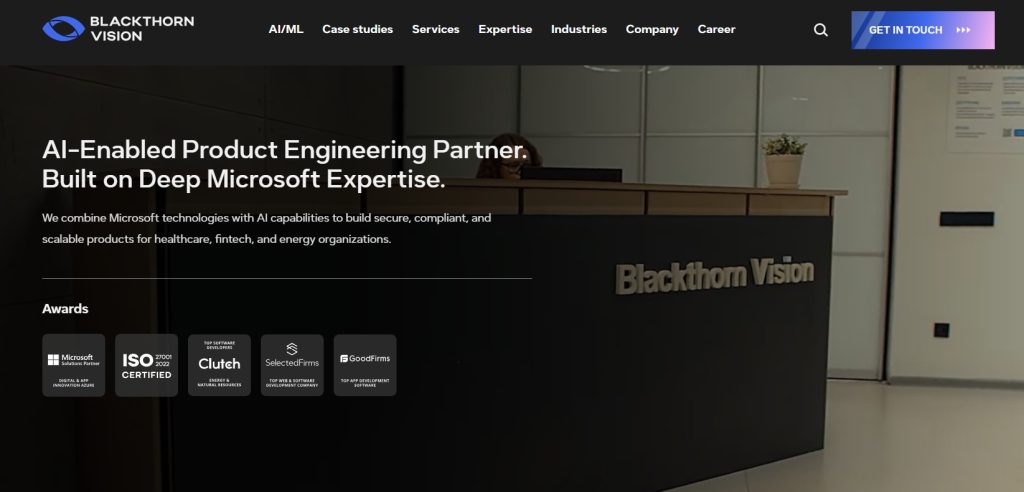
Blackthorn Vision has operated as a full-cycle custom software product development partner since 2009, building products across healthcare, biotech, energy, fintech, and hospitality for technology companies and enterprise clients primarily in North America. The firm holds Microsoft Solutions Partner status and has earned recognition across the top 10% of European development companies on the Aciety platform.
What sets Blackthorn Vision apart from larger delivery houses is the deliberate ownership model. Technical and project management responsibility sits with the Blackthorn team. Clients engage at the level of business requirements, product vision, and outcomes, not sprint ceremonies and resource allocation. That distinction makes the biggest difference for startups with limited internal bandwidth and enterprises that want a self-managing technology unit rather than an extension of an existing team.
The technical stack is centered on .NET and Azure, but extends to all modern and major technologies, including React, Angular, Node.js, Python, Golang, and native mobile (Swift, Kotlin). AI/ML cases in their portfolio include ML-powered diagnostic software, IoT platform engineering, and automation platforms for SRE teams.
Clutch reviewers consistently cite Blackthorn Vision’s proactive engineering. Multiple clients noted that the team proposed architectural improvements and feature enhancements in their software product development services that were not in the original brief, and that those contributions materially improved the product.
What makes Blackthorn Vision stand out:
- Full-cycle ownership from discovery through post-launch optimization, without handing off to a support team
- Microsoft Solutions Partner status with deep .NET and Azure expertise
- Demonstrated delivery in regulated and technically complex domains (biotech, oil and gas, healthcare)
- Engagement models that scale on demand during high-pressure delivery periods without relationship disruption
- A “tech partner, not vendor” positioning backed by multi-year client relationships
Ready to work with us?
Join the enterprises that have trusted Blackthorn Vision to build and scale their products since 2009.
2. EPAM Systems
Location: Newtown, PA, USA
Team size: ~63,000 employees
EPAM is one of the largest publicly traded software engineering and product development firms in the world, operating across more than 55 countries with 2025 revenues approaching $5.5 billion. The company has been recognized as a GenAI Consulting and Implementation Services leader by Gartner and holds Cloud and Data Partner of the Year status from Microsoft, AWS, and Google.
EPAM’s enterprise offering is built around its EPAM AI/RUN™ platform, which integrates AI acceleration into the product lifecycle, and its DIAL 3.0 infrastructure for enterprise generative AI governance. In 2025, the firm launched Agentic QA™ – an autonomous testing framework – as part of a broader push toward AI-native delivery at scale.
What makes EPAM stand out:
- Unmatched scale: delivery capacity across continents with deep vertical expertise in financial services, healthcare, manufacturing, and retail
- Analyst-recognized GenAI leadership per Gartner 2025
- AI/RUN™ platform for accelerated AI-integrated product engineering
3. ScienceSoft
Location: McKinney, TX, USA
Team size: 700+
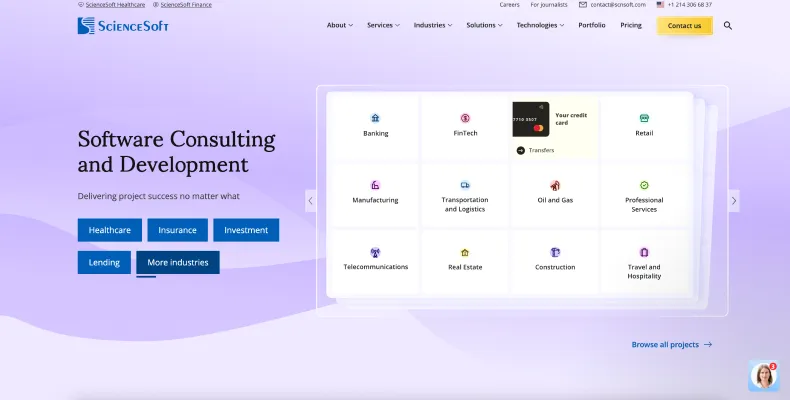
ScienceSoft is the oldest software product development agency in this category, with 36 years of continuous operation and 4,000+ completed projects. Its primary differentiator is rigorous governance: a dedicated PMO, architecture review center, and competency center structure that applies formal methods to project oversight rather than relying on individual team leads.
The firm holds multiple ISO certifications and is recognized by IAOP, making it the default choice for buyers in regulated industries such as banking, healthcare, and manufacturing, where architectural precision, audit trails, and compliance documentation are vital.
What makes ScienceSoft stand out:
- ISO-certified processes and formal PMO governance across all engagements
- 35+ years of enterprise delivery with documented compliance depth in HIPAA, PCI DSS, and SOC 2 environments
- Strong Microsoft Gold competencies and deep AWS investment
- Architecture-first approach that prevents technical debt accumulation from the first sprint

4. WillowTree (TELUS Digital)
Location: Charlottesville, VA, USA
Team size: 1000+ employees
WillowTree was acquired by TELUS International in 2023 and has since been rebranded as WillowTree, a TELUS Digital company. The firm retains its original identity and leadership structure, and its client roster, which includes PepsiCo, Marriott, Allianz, Dexcom, FOX Sports, and Domino’s, reflects its core strength: design-led, full-stack digital product development for consumer-facing and enterprise-grade applications.
The post-acquisition positioning gives WillowTree access to TELUS Digital’s enterprise AI platform (Fuel iX) and a 70,000-person global delivery network, while preserving the boutique product sensibility that earned it a 70+ Net Promoter Score. The combination is quite rare: consumer-grade software product design services backed by enterprise-scale infrastructure.
What makes WillowTree stand out:
- Industry-leading NPS of 70+ reflects client experience at the relationship level, not just delivery
- Design-native culture that treats UX as a product strategy discipline, not a handoff step
- Fuel iX enterprise AI engine for rapid, governed generative AI deployment at scale
- Post-acquisition scale through TELUS Digital’s 30-country delivery network
5. Thoughtworks
Location: Chicago, IL, USA
Team size: ~10,000
Thoughtworks is a technology consultancy with a 30-year history of shaping how enterprise software is built. The firm co-founded the Green Software Foundation, publishes the widely-cited Technology Radar, and applies what it calls “continuous modernization” – the ongoing practice of replacing legacy components before they become bottlenecks rather than after.
Taken private by Apax Partners in November 2024, Thoughtworks is in a restructuring and refocus phase. Its core offering – integrating strategy, design, and engineering into a single practice – remains intact and is particularly well suited to organizations where the bottleneck is organizational alignment as much as technical execution.
What makes Thoughtworks stand out:
- Pioneer of Agile and XP practices at enterprise scale; the methodological influence is industry-wide
- Co-founder of the Green Software Foundation, with genuine sustainability practices embedded in delivery
- Technology Radar as a signal of genuine investment in technical research and thought leadership
6. Slalom
Location: Seattle, WA, USA
Team size: ~12,000
Slalom operates on a local-market model that is deliberately different from the fly-in, fly-out consulting approach of larger firms. With offices in 45-49 markets across eight countries and a strategic technology hub in Mexico launched in late 2024, the firm delivers proximity to clients alongside genuine engineering capability in AI, cloud, and product engineering.
Slalom announced an expanded partnership with OpenAI, positioning it as a go-to partner for enterprises deploying generative AI in production environments. This custom software product development company’s AI upskilling program, launched internally in 2024, reflects a commitment to keeping its ~12,000 practitioners current with the methods they are recommending to clients.
What makes Slalom stand out:
- OpenAI partnership and generative AI program signals genuine AI delivery capability, not just advisory positioning
- Consistent recognition on Fortune 100 Best Companies to Work For lists, which correlates with lower staff turnover and more stable client teams
- Strong DevOps, cloud architecture, and product engineering alongside business strategy
7. Simform
Location: Ahmedabad, India / US offices
Team size: 1,000+
Simform ranked third globally in Clutch’s Spring 2025 rankings for custom software development across more than 41,000 listed firms, and ranked first in AI development and fifth in machine learning on Clutch 2025. Those rankings reflect a product engineering model built specifically around cloud-native architecture: serverless back ends, containerized microservices, and AI modules designed to integrate natively with AWS and Azure pipelines.
Each Simform engagement opens with an architecture sprint – a structured session where cloud architects, data scientists, and UX leads jointly design the system blueprint before any development begins. That front-loaded design phase is the primary reason clients report fewer expensive rearchitecting cycles later.
What makes Simform stand out:
- Clutch #3 globally in custom software development (Spring 2025) and #1 in AI development
- Architecture-first delivery model with dedicated pre-development blueprint phase
- US strategic leadership combined with India-based engineering delivery for cost-effective access to senior talent
- Demonstrated AI/ML delivery depth with measurable business outcomes across logistics, healthcare, and SaaS
8. BairesDev
Location: San Francisco, CA, USA (LATAM delivery)
Team size: 4,000+ engineers
BairesDev built its market position on a single, well-executed premise: source engineers from the top one percent of Latin American technical talent, align them with US time zones, and get them productive inside active client teams within days. Clients include Google and Rolls-Royce.
The nearshore model produces real-time collaboration; shared work hours for pairing, daily standups without scheduling across time zones, and faster iteration cycles. BairesDev has been named to the Clutch 1000 and the Inc. 5000 repeatedly, and its 4.9/5 Clutch rating across a large review base reflects consistent delivery quality.
What makes BairesDev stand out:
- True US-timezone alignment for real-time collaboration rather than asynchronous handoffs
- 4,000+ engineers across LATAM with rapid team assembly capability
- Documented delivery for Fortune 500 and technology companies across healthcare, fintech, and software
9. Vention
Location: New York, NY, USA
Team size: 3,000+ engineers
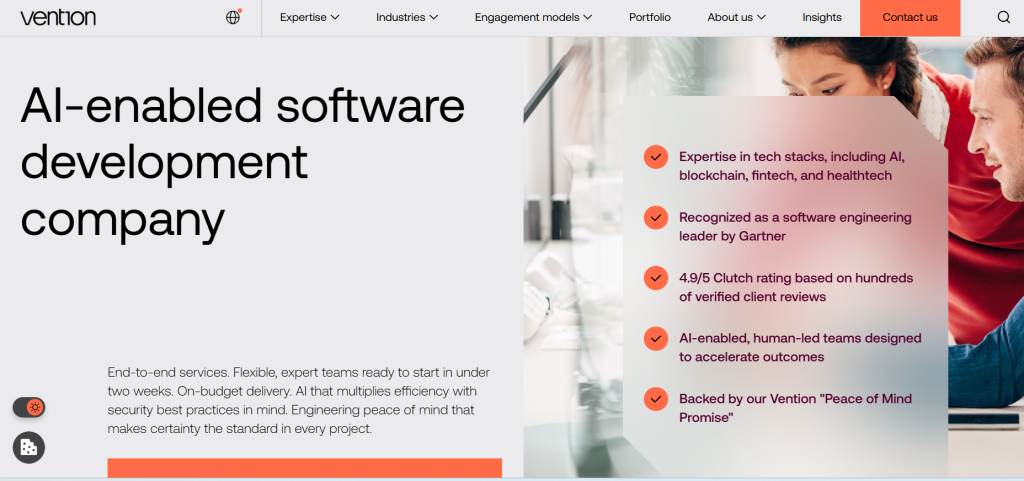
Vention is a New York-headquartered software development company with one of the largest engineering benches in this category – 3,000+ dedicated developers globally, with the promised ability to assemble expert teams in under two weeks. Its delivery model centers on dedicated engineering teams that integrate structurally with client organizations rather than operating as external contractors.
The firm’s vertical depth spans fintech, healthcare, and SaaS, with a notable track record in fintech MVP development and construction technology. Clients include ClassPass and Dialogue, among 500+ award-winning engagements. Vention’s appearance on the Clutch 1000 for 2025 reflects consistent client satisfaction at a scale that many firms cannot maintain.
What makes Vention stand out:
- Speed of team assembly: expert teams deployable in under two weeks
- 3,000+ engineers across North America and Europe for a stable engineering environment
- Strong in fintech and healthcare with a documented enterprise delivery track record
10. Intellectsoft
Location: Miami, FL, USA
Team: Covers 20 countries
Intellectsoft occupies a specific and defensible position in this market: a digital transformation consultancy for enterprise buyers who need bold technology (blockchain, AR, IoT, AI) built with the governance and predictability of a mature engineering partner. Its Innovation Labs model starts each engagement with a rapid ideation sprint, produces a working proof of concept within weeks, and then scales the approved concept into production using established delivery playbooks.
With 17+ years of market experience and presence in 20 countries, Intellectsoft consistently delivers for Fortune 500 clients pursuing ambitious digital initiatives. Product strategy happens in New York or London; engineering delivery is routed through Eastern Europe, producing enterprise-grade results at practical mid-market rates.
What makes Intellectsoft stand out:
- Innovation Labs model with rapid proof-of-concept delivery before full commitment
- Demonstrated depth in emerging technology: blockchain, AR, IoT, and enterprise AI
- Global delivery model balancing premium consulting presence with cost-effective engineering
Comparing the top 10 software product development companies
| Company | Best for | Key strength |
| Blackthorn Vision | Startups and enterprises needing full technical ownership | End-to-end delivery with Microsoft Solutions Partner status; .NET, Azure, AI/ML |
| EPAM Systems | Global enterprises with large-scale AI and cloud transformation programs | Gartner-recognized GenAI leader; AI/RUN™ platform; 55+ country delivery footprint |
| ScienceSoft | Regulated industries requiring formal governance and compliance depth | ISO-certified PMO; 36 years of enterprise delivery; HIPAA, PCI DSS, SOC 2 |
| WillowTree (TELUS Digital) | Consumer-facing brands where UX quality is a direct revenue driver | Design-led full-stack development; Fuel iX GenAI platform; TELUS global scale |
| Thoughtworks | Enterprises modernizing legacy systems with complex org and tech challenges | Agile/XP pioneer; Green Software Foundation co-founder; Technology Radar publisher |
| Slalom | Mid-market and enterprise clients wanting local presence with AI delivery capability | Local-market consulting model; OpenAI partnership; 45+ markets across 8 countries |
| Simform | High-growth companies building cloud-native and AI-core platforms | Clutch #1 in AI development 2025; architecture-sprint delivery model |
| BairesDev | North American teams needing senior engineering capacity fast, in US time zones | Top 1% Latin American talent; real-time US-timezone collaboration; rapid team assembly |
| Vention | Enterprises needing a large, stable engineering organization behind their product | Teams assembled in under two weeks; fintech and healthcare depth; dedicated team model |
| Intellectsoft | Enterprises pursuing bold tech (blockchain, AR, IoT, AI) with governance requirements | Innovation Labs rapid PoC model; emerging technology depth; Fortune 500 track record |
Three technology trends reshaping software product development
Understanding where the industry is heading is as important as evaluating where individual firms currently stand. Three trends are materially changing what it means to build software products in 2026 and beyond.
Hyper-automation: AI agents are taking over the development pipeline
Hyper-automation is the convergence of AI, machine learning, robotic process automation in healthcare, and low-code platforms into a single, integrated automation layer. In product development, this means AI agents are increasingly handling code review, test generation, documentation, deployment monitoring, and incident response. Previously, these tasks consumed significant engineering time. Top-tier partners are already embedding agentic workflows into their delivery pipelines, compressing development cycles without proportionally increasing headcount.
Sustainability and green IT: Carbon efficiency is becoming a procurement requirement
The Green Software Foundation, co-founded by Thoughtworks along with Microsoft, GitHub, and Accenture, has moved sustainability from a CSR checkbox to an engineering specification. Energy-efficient architecture, carbon-aware computing, and green metrics are now appearing alongside uptime and latency in enterprise RFPs. Partners who can demonstrate measurable reductions in software carbon intensity are gaining an edge in regulated industries and with enterprise buyers who face their own sustainability reporting obligations.
Read also: Effective Environmental, Social, and Governance (ESG) software solutions
Multi-Agent Systems (MAS): The architecture model moving from research to production
Multi-Agent Systems – architectures in which multiple autonomous AI agents collaborate to complete tasks – are transitioning from research to production. In practice, this means software products where AI agents handle user onboarding, support triage, fraud detection, content moderation, and supply chain optimization in parallel, with minimal human intervention required. Partners who understand MAS architecture are designing systems that think – and win the market.
How to choose a software product development company in the USA: A decision checklist
Cultural fit
The partnership dynamic: how the team communicates under pressure, handles disagreement, and responds to changing requirements determines whether a relationship survives months and years of real-world product development. Ask to speak directly with the engineers who will work on your product, not just the account team. Pay attention to whether the firm pushes back on your assumptions or just validates them.
Security certifications
Verify certifications such as ISO 27001 and SOC 2 Type II. They are the baseline for most enterprise engagements. Healthcare products require HIPAA-compliant processes and, in many cases, HITRUST certification. Financial services products bring their own regulatory stack. A firm that holds the relevant certifications has implemented the underlying controls; one that merely claims familiarity has not.
IP and code ownership
All intellectual property – source code, documentation, architecture diagrams, database schemas – should transfer to the client in full at the point of delivery, with no residual claims by the outsourced software product development services vendor. This should be explicit in the contract, not implied. Verify that the agreement covers work products created by subcontractors as well as direct employees.
The push-back test
The best development partners will be able to tell you when a feature is technically infeasible within your timeline, when an architecture decision will create problems at scale, and when a scope change will compromise delivery quality. A partner who never pushes back is either too deferential to protect your product or too inexperienced to know the risks. Structure your vendor interviews to test for this: present a technically questionable requirement and observe whether the firm flags the issue or absorbs it silently.
The next step takes 5 minutes
Book a no-obligation discovery call, and we’ll be happy to discuss your product idea.
FAQ
How do software development companies integrate Agentic AI and Multi-Agent Systems (MAS) into their workflow?
What security certifications (ISO, SOC2, HIPAA) should a top-tier software product development company hold?
ISO 27001 and SOC 2 Type II are the baseline for most enterprise engagements. Healthcare products require HIPAA-compliant processes; financial services may additionally require PCI DSS. Always ask for certificates with issue and expiry dates – not claims of familiarity.
Can a software product development company work alongside my existing in-house team?
Yes. The dedicated team model integrates external engineers directly into your workflows, ceremonies, and tooling. The key risk is knowledge silos; mitigate it by ensuring the external team participates in planning and retrospectives, not just sprint execution.
How do companies handle FinOps to prevent cloud costs from spiraling out of control after launch?
FinOps means tagging all cloud resources, setting cost anomaly alerts, and right-sizing infrastructure based on observed usage – ideally instrumented before the product goes live. Product development management software partners who treat cloud cost as a post-launch problem will hand you a bill that grows faster than your user base.
What engagement models are most effective for scaling a product: Fixed Price or Time & Materials?
Fixed Price suits well-defined, bounded scopes; Time and Materials suits iterative product development with evolving requirements. A hybrid is often the right call: Fixed Price for discovery and architecture design, T&M for iterative development thereafter.
How can I verify the AI maturity and technical depth of a software product development services provider?
Request case studies of AI features shipped to production, not prototypes. Ask specifically about LLM drift monitoring and evaluation frameworks – a team that has shipped AI to production will have encountered model drift and will have a documented process for managing it.
What are Green Software practices, and how do they impact the long-term cost of my product?
Green software engineering – right-sized compute, efficient algorithms, carbon-aware cloud scheduling – directly reduces infrastructure spend by running products on less hardware. A product built without these decisions in place from day one can cost significantly more to operate at scale than one where they were made deliberately.
How do top-tier companies ensure code ownership and Intellectual Property (IP) security?
The outsourced product development services agreement must explicitly assign all work products – source code, documentation, schemas, and derivative works – to the client, covering subcontractors as well as direct employees. Verify this is in the standard contract before any other negotiation; a firm that resists explicit IP assignment is a firm to avoid.
What is the Discovery Phase, and why is it mandatory for a successful product launch?
Discovery is the structured period before development begins, where user needs, architecture risks, and the minimum viable feature set are defined. Skipping it is the single most common cause of mid-development pivots and post-launch rewrites; the problems it prevents routinely cost multiples of what a two-to-four-week discovery engagement costs.
You may also like
-
 September 8, 2026Read in 16 min.
The AI-Native SDLC: From Writing Software to Orchestrating It
An AI-native SDLC cuts delivery time by about half without loosening a single quality gate. See the three eras, the toolchain and the guardrails. -
 September 4, 2026Read in 36 min.
Custom software development cost: Real ranges, rate cards, and how to budget
How much custom software development costs. Explore real pricing ranges, hourly rates, key cost factors, hidden expenses, and budgeting tips. -
 September 2, 2026Read in 36 min.
Fitness app development companies: An independent shortlist
10 fitness app development companies compared on verified data, published pricing, and real client work. Only three have documented fitness delivery. -
 August 27, 2026Read in 36 min.
Top software development companies in the USA
Find the best US-based software developers. From AI to enterprise web apps, here are the top 30 software development companies in the USA you should hire in 2026. -
 August 19, 2026Read in 22 min.
Robotic Process Automation in healthcare: Definition, benefits, and real cases
From patient scheduling to claims processing: explore proven RPA use cases in healthcare, backed by real data, ROI benchmarks, and compliance guidance. -
July 16, 2026Read in 18 min.
Top 10 Banking Software Development Companies in the US
An independent, verified list of the top banking software development companies in the US, plus a practical guide to choosing the right partner -
 July 16, 2026Read in 17 min.
Custom ERP software for manufacturing – Built on Azure and .NET
Off-the-shelf ERP forcing workarounds? Blackthorn Vision, a manufacturing software company, builds ERP software for manufacturing on Azure and .NET. -
 June 30, 2026Read in 10 min.
Software development company in Boston: Custom solutions for a research-driven city
Boston software development company building HIPAA-aware healthcare, biotech, and enterprise software on .NET and Azure. Microsoft Solutions Partner, 4.8/5 on Clutch -
 June 18, 2026Read in 10 min.
Software Development Company in Washington State: Custom Solutions Across the Region
Software development company serving all of Washington State. Cloud-first custom software on .NET and Azure. Microsoft Solutions Partner since 2009. -
June 17, 2026Read in 12 min.
Software Development Company in Seattle: Cloud-First Custom Solutions
Seattle software development company building cloud-first custom software on .NET and Azure. Microsoft Solutions Partner trusted since 2009. Talk to us