



For most enterprise contexts – multiple teams, long maintenance windows, regulated industries – Angular’s structure, formal LTS, and integrated toolchain reduce architectural risk. React is the better fit when talent pool size, React Native compatibility, or ecosystem flexibility are higher priorities. The decision depends more on team structure and domain than on raw technical capability.
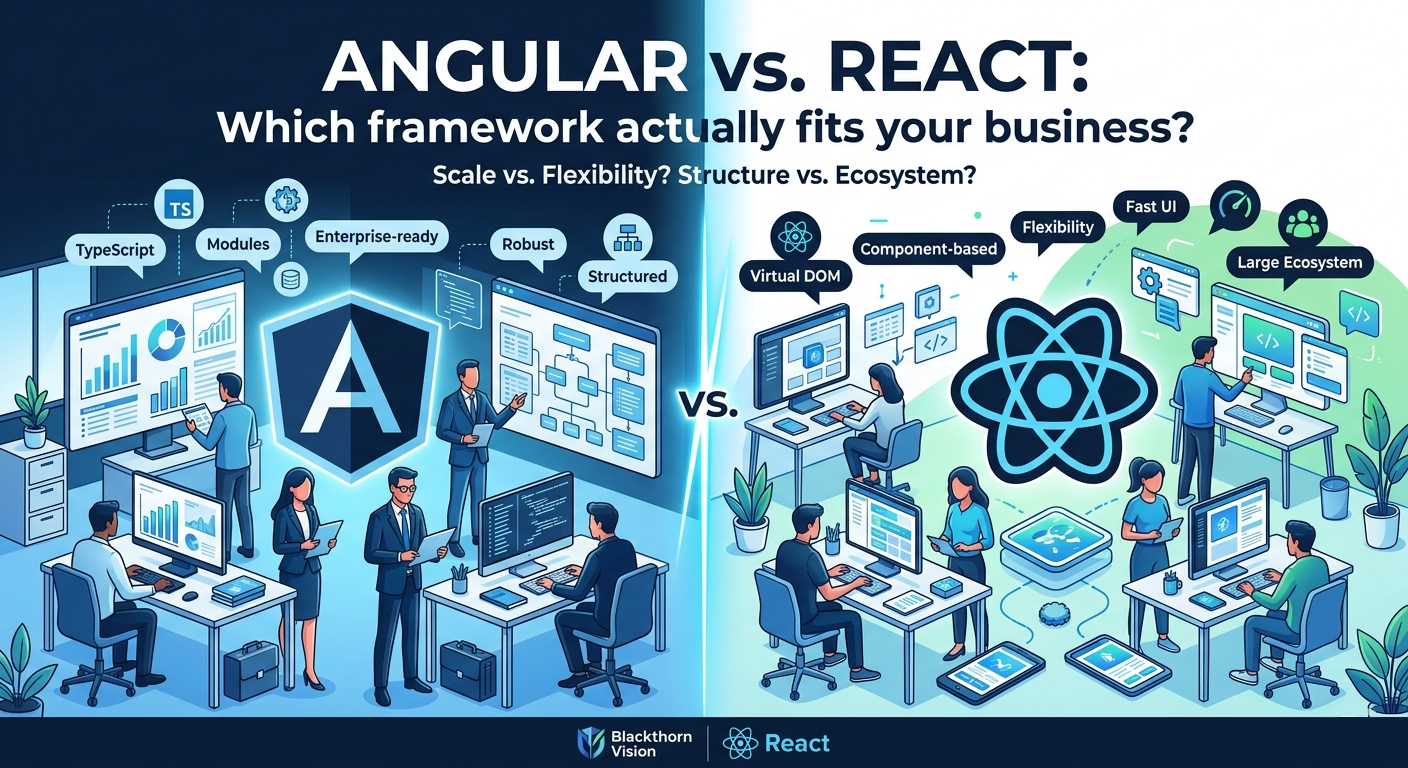
Angular vs. React: Which framework actually fits your business?
 13 minutes read
Content
React and Angular together account for nearly two-thirds of professional frontend development. React holds 44.7% usage; Angular – 18.2%. Both are actively maintained, enterprise-proven, and backed by organizations with a long-term stake in keeping them viable.
Neither framework is a bad choice, but when choosing, it’s vital to analyze and take into account the evolution of each. Many teams are making the comparison based on how these frameworks worked two or three years ago, before Angular replaced its core change detection engine with Signals, and before React shipped Server Components and a compiler that handles performance optimization automatically. Those updates are enormous and they change what each framework is good at, what it costs to operate, and who should be using it.
This article compares Angular vs React across architecture, reactivity, rendering, developer experience, state management, and market position. Our goal is to give engineering and product leaders an understanding of what is the difference between Angular and React, and equip them with a clear and current basis for the decision.


Your stack decision starts here
Tell us about your project and we’ll help you choose the framework that fits
Architectural philosophy: Structure and flexibility
Angular: One stack, one way of working
The differences between React and Angular start at the architectural level. Angular ships as a complete platform. Routing, HTTP, forms, dependency injection, SSR, testing utilities – all first-party, versioned together, documented in one place. You don’t assemble a stack, but adopt a ready-made one.
It makes a huge difference when your teams grow and scale. When 30 or 40 developers work on the same codebase, Angular’s structure means code written by one team reads the same as code written by another. Onboarding is faster because the patterns are consistent. TypeScript is built-in. The con is a more complex learning curve upfront and less flexibility when your requirements fall outside the framework’s opinions.
Recent versions, however, have reduced that rigidity. Standalone components are now the default, eliminating the module boilerplate that frustrated developers for years. The shift to Signals makes the reactivity model explicit and composable. Angular in 2026 is a genuinely different framework from Angular in 2021 – lighter, more modern, and easier to reason about.
React: Maximum flexibility and responsibility
React handles rendering and component composition. Everything else (routing, data fetching, state management, build tooling) is your decision. That means assembling a stack from independently maintained libraries: Next.js or TanStack Router for routing, TanStack Query or SWR for server state, Zustand or Jotai for client state, Vite or Turbopack for builds.
Pros: faster iteration, easier adoption of new patterns, and a larger ecosystem of solutions for unusual problems. Cons: architectural consistency is a team discipline problem, not a tooling problem. Also, React codebases diverge and they diverge more when the team turns over, and faster than most organizations expect.
In practice, the enterprise React stack is React plus Next.js, which layers routing, SSR, and deployment conventions on top of what React itself provides. When analyzing what is Angular vs React, we are considering not React in isolation, but the whole practical stack.
React vs Angular: Different approaches to the same problem
Angular Signals
Angular Signals, stabilized across versions 17-19, replace the Zone.js change detection model the framework used since 2016. A Signal is a reactive value that tracks its own dependents. When it changes, only those dependents update – no broad component tree traversal, no diffing overhead.
This way, the engineering teams can debug better. You can trace exactly which Signal changed, which components depended on it, and why a re-render happened. That’s a big thing in a codebase that’s two years old and maintained by people who didn’t write the original code.
Angular can now run entirely without Zone.js in “zoneless” mode (currently developer preview). Removing Zone.js shrinks the framework’s runtime footprint and eliminates bugs that came from Zone.js’s asynchronous patching behavior.
React 19 and the Compiler: Automatic optimization
React’s approach is the opposite of explicit. The React Compiler – production-ready as of React 19 – analyzes component code at build time and inserts memoization automatically. The equivalent of wrapping every component in React.memo and every derived value in useMemo, without writing any of that code yourself.
When it works, it works well: unnecessary re-renders disappear without changing how developers write components. The mental model stays the same. But, when something goes wrong, the compiler’s output adds a layer of indirection that makes debugging harder.
React Server Components add a separate dimension. Certain components run exclusively on the server, return pre-rendered HTML, and never ship JavaScript to the client. That reduces bundle size and eliminates client-side data-fetching waterfalls for content that doesn’t need to be interactive.
| Dimension | Angular Signals | React Compiler + RSC |
| Control model | Explicit, developer-defined | Automatic, compiler-inferred |
| Debugging | Deterministic, traceable | Compiler output adds indirection |
| Mental model shift | Moderate — new primitive to learn | Low — existing code improves |
| Bundle reduction | Via zoneless mode | Via RSC and tree-shaking |
| Maturity | Stable from v17 | RSC stable; Compiler production-ready in v19 |
ReactJS vs Angular: Rendering and performance
React Server Components
RSC is the most significant architectural change to React since hooks. Server components run on the server, access data directly, and send HTML to the client. No client-side JavaScript required for those components. Client components hydrate interactively where needed.
The business-relevant outcome: faster initial page loads, better SEO without separate SSR configuration, and smaller JavaScript bundles. Next.js App Router is the primary production implementation and handles the server-client boundary, streaming, and caching. Managing which code runs where requires discipline from the entire team, but the performance and SEO benefits are well-established.
Angular’s hydration approach
Angular Universal handles SSR, and recent versions added partial hydration: ship fully rendered HTML, then hydrate only the interactive components, not the entire tree. Combined with the @defer directive for lazy-loading component subtrees, Angular now has a credible, incremental path to reducing Time to Interactive without a full architecture change.
The Angular approach is less radical than RSC and easier to adopt in existing applications. The downside is that it doesn’t offer the same server-side data access patterns that RSC enables.
Performance benchmarks
Real-world performance differences between these frameworks, at equivalent implementation quality, are small. The meaningful differences in production applications are almost always architectural – data fetching strategy, hydration approach, bundle splitting – not framework-level. Framework microbenchmarks don’t translate to production outcomes.
Not sure which model fits your architecture?
We’ve implemented both RSC and Angular Universal, and we know where each one breaks down.
Developer experience and tooling
React JS vs Angular JS: Learning curve
Angular has a higher upfront cost. Developers need to understand TypeScript, dependency injection, decorators, the component lifecycle, and now Signals before they’re fully productive. That investment pays back over time – Angular’s consistency means senior developers onboard to new Angular codebases faster than they do to React codebases, because of the predictable patterns.
React moves faster at the start. JSX and hooks get developers productive quickly. The hidden cost is that production React development involves real architectural decisions – state management library, data-fetching pattern, server component boundaries, hydration strategy – that is usually complicated to less experienced developers. Teams that don’t make these decisions deliberately tend to quietly accumulate architectural debt.
Toolchain
Angular’s toolchain is official and managed. The Angular CLI handles project generation, builds, testing, linting, and upgrades. ng update runs automated migration schematics across major versions. Toolchain management overhead is close to zero.
React’s toolchain is fragmented by design. Vite is the current community standard for new projects; Next.js handles the production web case; React Native covers mobile. These are separate tools with separate release cycles. At enterprise scale, the overhead of managing that fragmentation adds up.
AI-assisted development
Both frameworks have strong support in current AI coding tools. GitHub Copilot, Cursor, and similar tools generate competent code in both Angular and React. Angular’s explicit structure tends to produce more predictable completions – the framework’s conventions give the model clear patterns to follow. React’s concise syntax produces shorter, more self-contained completions that fit naturally into its component-first model.
AI tooling makes a difference in navigating large codebases. Angular’s consistent architecture – predictable file structure, explicit dependency injection, standardized module patterns – makes it easier for tools like Cursor to index and reason about an unfamiliar project. React codebases vary significantly in structure depending on the choices the original team made, which can reduce the quality of context-aware suggestions in projects the model hasn’t seen before.
There isn’t a clear answer to what is Angular and React positions in this race. Neither framework has an advantage here, and the gap is narrowing as AI tools improve at handling architectural variation. For most teams, this should not impact their framework decision.
Read also: Top 10 React development companies: Architecting high-performance digital products
State management
Angular
For component-level state, Signals are now idiomatic. For shared application state, Angular services with Signal-based stores – using NgRx Signal Store or Angular’s native primitives – provide reactive, type-safe state at any level of the architecture. NgRx remains the standard in large Angular applications where complex async flows, action logging, and devtools support are required.
The dependency injection system means services are consistently accessible throughout the component tree regardless of how state management is implemented, which reduces the variability you see across large codebases.
React
React 19’s built-in useOptimistic and server actions handle optimistic UI and server mutations directly. TanStack Query is the current standard for async server state. For client state, Zustand handles most use cases with minimal boilerplate; Redux Toolkit remains the choice when predictability, time-travel debugging, and deep tooling support matter more than simplicity. Considering the ecosystem, there’s a well-maintained library for every state management pattern.
Therefore, neither framework has a meaningful advantage here. Angular’s integrated approach reduces the decision surface and produces consistent patterns at scale. React’s ecosystem gives you more granular control and better options for edge cases. The right choice depends on how much architectural surface area your team wants to own.
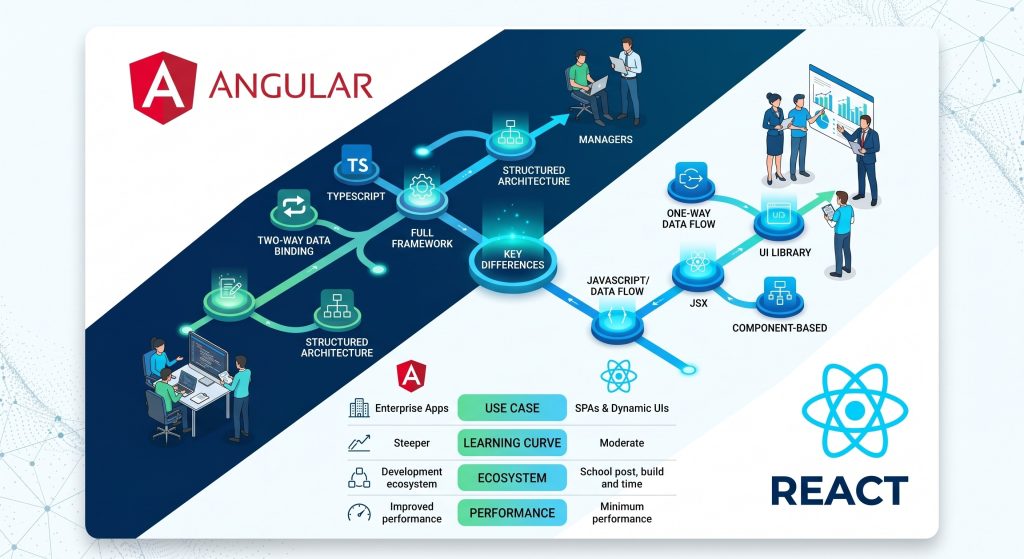
What is React and Angular ecosystem and market position?
Talent and hiring
React has a significantly larger developer population. React works well for teams that hire generalists or need to scale quickly. The candidate pool is larger and diverse regarding the skillset and expertise level, and React experience is more common at every seniority level.
Angular’s talent pool is smaller and concentrated in enterprise environments. Developers with deep Angular experience tend to have more structured, architecture-oriented backgrounds, which stems from the framework’s demands. Angular knowledge transfers more cleanly between codebases because of the consistent patterns. For businesses operating in regulated industries, that consistency is often worth a more complex and narrower hiring pool.
Regarding the React vs. Angular job market, React dominates in startups and product companies. Angular is well-represented in financial services, healthcare, insurance, and the public sector – heavily-regulated industries where it’s a must to invest into long-term stability and formal vendor support. Salaries for the senior-level engineers are more or less equal for two frameworks.
Read also: How to hire the best ReactJS developers in a constantly growing market
Long-term support
Angular operates on a formal LTS schedule: 18 months of active support per major version, followed by 12 months of LTS, backed by Google. Migration paths are documented, and automated schematics handle most breaking changes across major versions.
React’s LTS model is informal, though Meta’s investment and ecosystem scale make instability unlikely. The more relevant risk for enterprise React teams is the libraries surrounding React – Next.js, state management tools, and routing libraries each carry their own versioning and support considerations.
Table to compare Angular vs. React
| Feature | Angular | React + Next.js |
| Reactivity | Signals – fine-grained, push-based | Virtual DOM + React Compiler (auto-memoization) |
| SSR | Angular Universal + partial hydration | React Server Components (App Router) |
| Routing | Built-in Angular Router | Next.js App Router / TanStack Router |
| State management | Signals + NgRx Signal Store | Zustand / TanStack Query / Redux Toolkit |
| TypeScript | Native, load-bearing | Supported, opt-in |
| Learning curve | Higher upfront, consistent long-term | Lower upfront, steeper long-term |
| Toolchain | Integrated, officially managed | Fragmented, community-managed |
| LTS | 18 months active + 12 months LTS | Informal |
| Zoneless mode | Developer preview (v19) | N/A |
| Mobile | Ionic (third-party) | React Native (first-party ecosystem) |
See yourself in both columns?
Call us to get a clear recommendation based on your actual constraints.
Angular vs React JS: Which one should you choose?
Choose Angular if:
- You’re building a large-scale application with multiple teams and a long maintenance horizon
- Architectural consistency across the codebase is more critical for you than the ecosystem flexibility
- You operate in a regulated industry such as finance, healthcare, insurance, government
- Your engineering culture is oriented toward strong typing, dependency injection, and layered services
- Onboarding developers to consistent patterns is one of your recurring operational needs
Choose React if:
- You prioritize iteration speed and access to a large talent pool
- Your use case maps naturally to Next.js’s server-rendering and data-fetching model
- You plan to share code with a React Native mobile application
- Your team is experienced enough to make and consistently enforce architectural decisions
- Your requirements include edge cases that Angular’s opinionated structure doesn’t accommodate well
Conclusion
In 2026, Angular or React are both capable and well-maintained frameworks. The capability gap that existed several years ago has been closed and there’s not a conventionally better or worse framework between these two. There are different environments and features that fit different requirements and teams. Angular gives you structure and takes decisions off the table. React gives you flexibility and puts those decisions on your plate.
The framework you choose shapes hiring, onboarding, tooling, and codebase structure for years. Blackthorn Vision has helped businesses to position React versus Angular across dozens of projects. If you want an independent view of the difference between React and Angular and which framework fits your team and your roadmap, book a free consultation.
FAQ
Angular JS vs React JS: Which one to choose for a large-scale enterprise project?
How difficult is it to migrate a legacy Angular application to React?
In most cases, it’s equivalent to a rewrite. The architectures are different enough that mechanical translation doesn’t work – routing, forms, state management, and component logic all need re-evaluation. A strangler-fig approach — running React in isolated sections alongside the live Angular application – is more practical than a full cutover for large codebases. Before committing, assess whether the business case justifies the cost. Angular v17+ is a significantly better framework than the version most legacy codebases were written against.
Is the React Compiler better than Angular Signals at preventing unnecessary re-renders?
They approach the problem differently. The React Compiler infers and inserts memoization automatically – lower barrier, less developer overhead. Angular Signals make dependency tracking explicit and auditable – better for debugging complex state in large codebases. For teams that prioritize control and traceability, Signals are the stronger tool. For teams that want performance without the overhead of managing reactivity explicitly, the compiler is the easier path.
Angular or React: Which is better regarding the job opportunities in 2026?
React has a larger job market overall. Angular commands strong demand in enterprise and regulated-industry roles, where the smaller talent pool increases the value of specialization. At senior levels, framework-specific salary differences are not significant.
Does Angular's zoneless mode make it faster than React 19?
Removing Zone.js reduces Angular’s runtime overhead and eliminates a category of change detection bugs. React 19’s compiler addresses unnecessary re-renders through automatic memoization. They solve different bottlenecks. Neither is categorically faster – performance depends heavily on application type and implementation quality.
Can React Server Components achieve the same SEO benefits as Angular Universal?
Yes. RSC in Next.js produces fully server-rendered HTML with the same crawlability and initial payload benefits as Angular Universal. The implementation approaches differ, but the SEO outcomes are equivalent for most applications.
React JS vs Angular: Which one is more relevant?
Angular is actively used and actively developed, with strong representation in financial services, healthcare, insurance, and the public sector. React has the larger overall developer population and leads in product companies and startups. Both have long-term investment and active development behind them.
How do Angular Signals compare to React Hooks in terms of performance?
Signals and Hooks are different mechanisms. Signals track dependencies at the value level and update only affected components. Hooks trigger re-renders at the component level; the React Compiler improves this through automatic memoization. In state-dense, highly interactive applications, Signals have a measurable efficiency advantage. In typical product applications, the practical difference is small.
You may also like
-
 July 16, 2026Read in 18 min.
Top 10 Banking Software Development Companies in the US
An independent, verified list of the top banking software development companies in the US, plus a practical guide to choosing the right partner -
 July 16, 2026Read in 17 min.
Custom ERP software for manufacturing – Built on Azure and .NET
Off-the-shelf ERP forcing workarounds? Blackthorn Vision, a manufacturing software company, builds ERP software for manufacturing on Azure and .NET. -
 June 30, 2026Read in 10 min.
Software development company in Boston: Custom solutions for a research-driven city
Boston software development company building HIPAA-aware healthcare, biotech, and enterprise software on .NET and Azure. Microsoft Solutions Partner, 4.8/5 on Clutch -
 June 18, 2026Read in 10 min.
Software Development Company in Washington State: Custom Solutions Across the Region
Software development company serving all of Washington State. Cloud-first custom software on .NET and Azure. Microsoft Solutions Partner since 2009. -
 June 17, 2026Read in 12 min.
Software Development Company in Seattle: Cloud-First Custom Solutions
Seattle software development company building cloud-first custom software on .NET and Azure. Microsoft Solutions Partner trusted since 2009. Talk to us -
 June 11, 2026Read in 22 min.
Top 10 SEO Companies in the USA: An Honest, Research-Backed Guide
We compared 40+ professional SEO agencies on verified reviews, case studies, pricing, and AI search expertise — and ranked the top 10 with honest pros and cons. -
 June 10, 2026Read in 22 min.
Selecting elite Vue.js development company
Top Vue.js development companies vetted for Vue 3 architecture, high-performance rendering, and secure AI integration. Read our definitive guide for tech leaders. -
 June 1, 2026Read in 21 min.
iOS App development companies: How to choose a partner that actually ships
Leading iOS app development companies serving the US market, with verified portfolios, real pricing ranges, and a framework to choose the right fit -
 May 28, 2026Read in 27 min.
Azure Consulting Services: Migrating and Optimizing on Microsoft’s Cloud
Azure consulting services explained: migration, data, AI, security, and cost optimization. Learn what they include, how engagements work, and how to choose the right partner -
 May 26, 2026Read in 13 min.
How to choose the right enterprise software development company
Scale your architecture. Partner with a premier custom enterprise software development company to untangle technical debt and build secure platforms. -
 May 22, 2026Read in 16 min.
Top 10 Web Development Companies: How to Choose the Right Partner
Move past generic rankings. Learn the exact framework to evaluate web development agencies based on tech stacks, compliance standards, and pricing models. -
 May 15, 2026Read in 18 min.
Claude vs. ChatGPT: Which one is right for your work?
Should you switch to Claude for its Artifacts or stay with ChatGPT for its Omni-Agent capabilities? A hands-on comparison of reasoning, coding, and privacy. -
 May 11, 2026Read in 13 min.
Top DevOps companies: Strategic partners for engineering excellence
Top DevOps service providers. From Platform Engineering to DORA metrics, we review the best partners to scale your infrastructure and developer velocity in the USA. -
 April 24, 2026Read in 21 min.
Top financial software development companies
Compare the best financial software development partners. We rank firms based on ISO 27001 certifications, regulatory expertise (PSD3, GDPR), and successful delivery of 500+ Financial projects. -
 April 23, 2026Read in 20 min.
Top 10 software product development companies for the USA
Scale your transformation with the world's most reliable product development partners. We rank the top 10 firms for security, FinOps, and enterprise-grade architecture. -
 April 15, 2026Read in 17 min.
Outsourcing IT companies: Driving ROI and innovation
Maximize ROI with the right outsourced IT solutions. Discover how leading IT outsourcing service providers are using AI and automation to accelerate digital transformation. -
 April 9, 2026Read in 24 min.
Software development methodologies: A complete guide from waterfall to AI-driven SDLC
Which methodology fits your project? Read our deep dive into Scrum, Kanban, Lean, and AI-powered development with a full comparison matrix -
 April 9, 2026Read in 10 min.
Microsoft PowerApps development services
Accelerate your digital transformation with expert PowerApps development services. We build custom, low-code mobile and web apps that integrate seamlessly with Microsoft 365, SQL, and your existing APIs. Get a free consultation today. -
 April 8, 2026Read in 12 min.
Top 10 Offshore software development companies: Expert review
Don't settle for legacy code. Discover the top offshore software development services company list, featuring vendors with advanced AI-tooling and DevOps maturity -
 April 3, 2026Read in 31 min.
AI software development services: A complete guide for business leaders and decision-makers
Transform your business with expert AI software development services. We build custom GenAI, machine learning, and autonomous agent solutions tailored for enterprise ROI. Get a free consultation today! -
 April 1, 2026Read in 17 min.
The strategic hub: Why global leaders choose software development outsourcing in Ukraine
Why global leaders choose software development outsourcing in Ukraine. Explore the top 10 IT companies, specialized tech stacks, and how to scale your business with a dedicated Ukrainian development team. -
 March 31, 2026Read in 22 min.
Selecting the best Java development companies
Top 10 Leading Java development companies - evaluation criteria, and delivery models to help you find the perfect strategic partners for scalable enterprise solutions -
 March 31, 2026Read in 14 min.
Top progressive web app development companies
Partner with a leading progressive web application development company. Explore our list of top PWA developers in the USA and globally, offering high-speed, offline-ready, and SEO-friendly web app solutions -
 March 23, 2026Read in 23 min.
Why data warehouses fail and how to design one that doesn’t
top building data swamps. Explore the evolution of DWH design, including ELT workflows, Data Vault 2.0, and high-performance cloud modeling strategies -
 March 18, 2026Read in 10 min.
Choosing React Native app development company
Top 10 React Native App Development Companies reviewed — evaluation criteria, tech stack depth, delivery models, and how to choose the best partner for your cross-platform mobile project. -
 March 17, 2026Read in 15 min.
Choosing the Right Computer Vision Development Company for Your Project
From computer vision consulting to full-scale software development, learn how modern vision systems automate defect detection and optimize operations across healthcare, retail, and manufacturing. -
 March 16, 2026Read in 12 min.
AI in data governance: Everything technology leaders need to know
Master Data Governance for AI. Learn how to manage data drift, bias mitigation, and active metadata using NIST standards. Expert guide on MLOps, RAG security, and EU AI Act compliance for 2026. -
 March 16, 2026Read in 16 min.
MLOps consulting services: A technical framework for scaling production machine learning
Operationalize ML with expert MLOps consulting. We bridge the gap between Data Science and DevOps using CI/CD/CT pipelines, automated drift detection, and feature stores to reduce Time-to-Value and technical debt. -
 March 12, 2026Read in 12 min.
Choosing your generative AI development company
Compare the best generative AI companies for your enterprise. From custom LLMs to agentic workflows, discover the top partners driving innovation and ROI in the AI-first era. -
 March 6, 2026Read in 18 min.
PyTorch vs TensorFlow vs JAX: Differences, performance, and how to choose
Compare PyTorch, TensorFlow, and JAX on performance, ecosystem, production readiness, and use cases. Includes adoption statistics, decision guide, and alternatives. By Blackthorn Vision. -
 March 5, 2026Read in 15 min.
Choosing the best MVP development companies
Top-rated agencies providing bespoke MVP software development services to help startups validate ideas and scale fast -
 March 4, 2026Read in 19 min.
Top software testing companies: Leading QA partners
Leading software testing companies. Compare top QA service providers, evaluation criteria, and industry trends to find your ideal partner. -
 February 28, 2026Read in 27 min.
Top 10 software development companies in the USA
Find the best US-based software developers. From AI to enterprise web apps, here are the top 10 software development companies in the USA you should hire in 2026. -
 February 25, 2026Read in 12 min.
Top 10 Node.js Development Companies
Industry's leading Node.js development companies. Our deep-dive review covers technical maturity, cloud-native expertise, and architectural standards to help you find the perfect software partner. -
 February 23, 2026Read in 22 min.
Top 10 mobile application development companies: Selection & industry leaders
Top 10 mobile application development companies for your next project. Compare top-rated mobile app developers, explore custom app development company profiles, and learn the secrets to a successful technical partnership. -
 February 23, 2026Read in 12 min.
How to choose the best Android app development agency: Rankings & selection criteria
Compare the leading Android development companies. Our guide highlights the top 10 firms for enterprise architecture, security, and custom app engineering. -
 February 19, 2026Read in 29 min.
IT Managed Service Providers (MSPs): Why does your business need one?
Stop guessing. Compare the 10 leading IT Managed Service Providers (MSPs) for any-sized companies. Find proven security, cloud, and 24/7 support. View the comparison! -
 February 19, 2026Read in 45 min.
Top 30 software development companies: Categories, red flags, and the selection strategy
We’ve analyzed the top 30 software development companies based on expertise, client results, and innovation. Find your ideal match here! -
 February 11, 2026Read in 18 min.
Top 10 Cloud migration companies: Strategic architecture of cloud migration
Compare the top 10 cloud migration companies based on architectural depth, FinOps integration, and modernization capabilities. Expert insights into AWS, Azure, and GCP transformation strategies for enterprise leaders. -
 February 10, 2026Read in 12 min.
Top 10 Flutter development companies: Entities, ecosystems, and strategic selection
Compare the world’s leading Flutter agencies. Our expert analysis covers the top 10 firms, evaluating their mastery of Dart, Skia performance, and Clean Architecture. -
 February 6, 2026Read in 19 min.
Top 10 React development companies: Architecting high-performance digital products
Top-rated React development companies for your next project. Our expert guide analyzes the best React JS web development agencies on performance, scalability, and tech standards -
 February 3, 2026Read in 25 min.
Web application development companies: How to choose the right partner
Find the right web app development company. Explore services, technologies, engagement models, and 10 expert tips for choosing your strategic development partner. -
 February 3, 2026Read in 11 min.
Top 10 Python Development Companies
Looking for a top Python development company? Compare the industry's leading Python software development agencies. Get insights on pricing, expertise, and how to hire a Python development firm that scales your business. -
 January 27, 2026Read in 15 min.
Top cloud application development companies you should follow
Best Cloud Application Development companies for your project. Compare expertise in AWS, Azure, & GCP. See client reviews, specialization, and costs for top Cloud-Native firms -
 January 23, 2026Read in 21 min.
Dedicated development team model: Definition, benefits, and nuances
Scale your product fast with a Dedicated Development Team. Compare DDT vs. outsourcing, analyze costs, and get a management blueprint for success. -
 January 21, 2026Read in 15 min.
Best energy software development companies to partnership
Top 10 energy sector software development leaders. Learn how to choose the right partner for your renewable energy software project. -
 January 19, 2026Read in 8 min.
The Low-Code Revolution in Oil & Gas: Accelerating Digital Transformation
From real-time well monitoring to automated safety permits - see how low-code applications drive operational efficiency and ESG compliance in the energy sector’s volatile market. -
 January 19, 2026Read in 18 min.
Top 10 desktop application development companies to watch
Compare the world’s best desktop development firms. From legacy modernization to high-performance C++ and cross-platform Electron apps, find your perfect vendor here. -
 December 24, 2025Read in 10 min.
Software development company in Florida: What we do, how we work, and where we add value
Florida's premier custom software partner for enterprise-grade applications. We specialize in fintech, healthcare, and scalable cloud systems. Innovate with Florida experts. -
 December 9, 2025Read in 10 min.
Custom software development for San Diego businesses
Find out about the demands of software development in San Diego and how local companies are adapting to technology needs. -
 December 9, 2025Read in 9 min.
Specifics and perspectives of custom software development in Los Angeles
Find out why choosing a custom software development company in Los Angeles is essential for evolving industries like fintech and healthcare. -
 December 6, 2025Read in 8 min.
Software development in San Francisco: Custom solutions for Area
Find out how software development in San Francisco sets standards in technology and customer satisfaction. -
 November 28, 2025Read in 14 min.
Custom software development in Houston: State and perspectives
Partner with a leading custom software development company in Houston to harness the power of technology for your growth. -
 November 28, 2025Read in 12 min.
Custom software development Dallas businesses need
Find out how a custom software development company in Dallas can elevate your business in a booming tech landscape filled with opportunities. -
 November 27, 2025Read in 11 min.
Software development services in Austin
Find out how a custom software development company in Austin can elevate your business in a booming tech landscape filled with opportunities. -
 November 12, 2025Read in 34 min.
Top FinTech software development companies: The core of modern finance
Compare the top-rated FinTech software developers based on expertise in AI, Blockchain, and compliance. Choose your perfect partner now! -
 November 4, 2025Read in 12 min.
AI in biotech: Application, specifics, and challenges
How AI and Machine Learning are transforming biotechnology, accelerating drug discovery, genome sequencing, and personalized medicine. Learn the applications, challenges, and future. -
 October 28, 2025Read in 24 min.
The best AI development companies in the US
The definitive guide to hiring the best AI development company. See our ranking by MLOps maturity, GenAI expertise, and verified client ROI. Get transparent costs and a partnership blueprint -
 October 20, 2025Read in 16 min.
How to hire the best ReactJS developers in a constantly growing market
Hire the top ReactJS developers. Get pre-vetted, senior React & Next.js engineers matched to your project in 48 hours. Start risk-free -
 October 16, 2025Read in 25 min.
Top 10 AI chatbot development companies
Leading chatbot development companies. Our expert guide helps you choose the best firm for AI chatbot solutions, custom development, and seamless integration -
 October 9, 2025Read in 17 min.
Top biotech software companies: Choosing the right tech partner for life-changing innovations
Leading biotech software companies impacting drug discovery, R&D, and lab operations. See how their innovative platforms are speeding up scientific breakthroughs. -
 September 30, 2025Read in 16 min.
All you need to know about custom software development for small business
Stop wasting time on workarounds! Discover how custom software development empowers your small business with tailored workflows, maximum efficiency, and predictable ROI. -
 September 4, 2025Read in 14 min.
Top 10 leading application modernization companies
Top 10 application modernization companies that can transform your business with cloud, AI, and microservices for agility and growth -
 August 28, 2025Read in 14 min.
Develop once, run everywhere: .NET Core cross-platform development
Struggling with multi-OS development? Discover how .NET empowers you to build versatile, high-performance applications that run seamlessly across Windows, macOS, and Linux with ease. -
 August 21, 2025Read in 14 min.
Why offshore .NET development is the best choice for your business
Struggling with talent shortages or escalating development costs? Explores how embracing offshore .NET development can be the strategic advantage your business needs to build innovative solutions faster and more cost-effectively. -
 August 18, 2025Read in 21 min.
.NET vs Java: Comparison, use cases, pros and cons
Compare .NET vs Java across performance benchmarks, enterprise use cases, ecosystem, and AI integration. Expert guide by Blackthorn Vision’s .NET team. -
 August 11, 2025Read in 24 min.
Top 10 Angular development companies to keep an eye on
Leading Angular development companies. Expert Angular developers offering top-tier web application development, consulting, and solutions for your next project. -
 August 7, 2025Read in 15 min.
Hire Angular developers: What you need to know
Need hire Angular developers? Get access to skilled, dedicated Angular teams for your web projects. We provide expert Angular solutions with flexible engagement models. Contact us today! -
 August 1, 2025Read in 9 min.
Why choose Angular for web development
Why Angular is a leading choice for web development. Learn about its powerful features, scalability, and benefits for building robust, high-performance applications. -
 August 1, 2025Read in 24 min.
Hire Dedicated .NET Developers for Your Project
Hire dedicated .NET developers ready to start in two weeks. Microsoft-certified experts in C#, ASP.NET Core, and Azure, with 150+ projects delivered. -
 February 13, 2025Read in 15 min.
What is HMI development, and why is it trending now?
Human-Machine Interface (HMI) development is revolutionizing the way humans interact with machines, driving innovation across industries. -
 December 11, 2024Read in 10 min.
Python vs Java: Key differences, pros, and cons for developers
Key differences between Python and Java, including syntax, performance, and use cases. Find out which language suits your project best -
 October 10, 2024Read in 11 min.
The future of web development: WordPress vs React.js?
Confused between WordPress or React.js? Explore our detailed comparison to find out which platform suits your needs best -
 August 8, 2024Read in 14 min.
AD and Azure AD: What is the difference, and which is better for you?
Differences between Azure Active Directory (AAD) and traditional Active Directory (AD) in this comprehensive comparison. -
 August 5, 2024Read in 15 min.
ESG software development services: Effective ESG software solutions
Innovative ESG software solutions can help your business achieve its sustainability goals. Develop customized software that enhances environmental, social, and governance (ESG) performance, ensuring compliance and driving positive impact -
 July 31, 2024Read in 7 min.
Benefits of Azure Active Directory
Key benefits of Azure Active Directory(AD), including enhanced security, simplified management, and cost savings for your business -
 April 22, 2024Read in 12 min.
Software modernization: What is it & why it matters
Discover the essence of software modernization and its pivotal role in contemporary software development. Uncover why it's crucial. -
 April 22, 2024Read in 20 min.
Legacy app modernization: A comprehensive guide
Revitalize your business with our guide on legacy application modernization. Transform your legacy systems to make them more efficient and innovative. -
 April 22, 2024Read in 16 min.
Digital product design: What is it and why you need it
Unlock innovation with expert digital product design insights. Explore the latest trends and strategies for creating exceptional user experiences. -
 April 21, 2024Read in 11 min.
Healthcare product design: Tips for app development success
Explore the art of healthcare product design in our latest blog post. Discover how innovative design principles are shaping the future of medical solutions -
 April 18, 2024Read in 9 min.
Azure app modernization: Benefits of migrating to Microsoft
Key benefits of Azure app modernization and how migrating to Microsoft can enhance performance, scalability, and compliance -
 March 11, 2024Read in 12 min.
How to choose asset management software for oil and gas in 2026
Explore more ways to optimize operations and streamline processes in oil and gas. Follow our tips to choose the best-fit assent management software in 2026 -
 March 11, 2024Read in 13 min.
AI software development for oil and gas: A comprehensive guide
Explore the transformative power of artificial intelligence software development for oil and gas and the practices of global industry leaders in our blog. -
 March 11, 2024Read in 19 min.
Cloud application modernization: How to improve your app
Cloud application modernization makes app more competitive and business more profitable. The key strategies, tips, and its benefits — in this article! -
 March 11, 2024Read in 12 min.
Enterprise application modernization: Revolutionize your business
Future-proof your business with our guide to enterprise app modernization. Learn strategic approaches, key technologies, and best practices for legacy system transformation and enhanced agility -
 March 11, 2024Read in 12 min.
LIMS integration: Benefits & how it works
Can LIMS integration be called a CRM for laboratories? What to keep in mind during LIMS software development and integration? Find out more in our article. -
 March 11, 2024Read in 11 min.
Active directory integration: What is it & how to do it effectively
Discover seamless Active Directory integration strategies in our latest blog post. Optimize user management with the Blackthorn Vision team! -
 March 5, 2024Read in 15 min.
Mobile app UX design: Basics that will improve user experience
Mobile app UX design differs from the web. Explore these differences, the process, and the main pitfalls with our experts in this article. -
 March 5, 2024Read in 11 min.
HIPAA compliance checklist for healthcare software development 2026
Check the updated HIPAA security guidelines to ensure the safety and privacy of patients' data, it is important to adhere it when creating applications -
 March 5, 2024Read in 9 min.
How to use business process automation to improve oil and gas production
Discover how business process automation can help optimize oil and gas production and improve your bottom line. -
 March 3, 2024Read in 14 min.
Desktop to web migration: everything you need to know
Planning a desktop to web migration? Get essential insights on strategy, technical challenges, approaches, and how to successfully modernize your legacy application. -
 March 3, 2024Read in 11 min.
The process of application migration to the cloud: stages, approaches, and tools
Find out how to effectively migrate your legacy system and data to the cloud without disrupting your business processes. -
 March 3, 2024Read in 16 min.
Benefits of outsourcing software development
Key advantages of outsourcing software development for businesses. Learn how outsourcing can reduce costs, increase efficiency, and provide access to specialized expertise -
 March 3, 2024Read in 13 min.
Boosting cloud security in healthcare with Azure Cloud Services
Explore the most common challenges in the cloud security of healthcare organizations and discover our tips on eliminating them efficiently. -
 March 3, 2024Read in 19 min.
Healthcare app design: how to create a great user experience
Struggling with medical app UX? Get insights into user-centered design, crucial security measures, and future trends to create impactful healthcare applications. -
 March 3, 2024Read in 16 min.
MVP vs. prototype in startup software development: what’s the difference?
Crucial differences between MVP and Prototype in startup software development. Learn how Blackthorn Vision leverages both to build successful products, reduce risk, and accelerate your time-to-market -
 March 3, 2024Read in 12 min.
How to build a custom EHR solution: tips for decision makers
We can augment your talent pool with dedicated developers proficient in healthcare business automation. Check the success stories from our clients. -
 March 3, 2024Read in 7 min.
What is software as a medical device and why it matters for the healthcare industry
From developing SaMD and SiMD to building efficient EHR systems, we unleash the value of business process automation for healthcare providers. -
 March 3, 2024Read in 6 min.
An overview of medical biotechnology in 2026 and beyond
We offer a full cycle of software development for leading biotech companies - from idea visualization to building an MVP and fully-fledged product. -
 March 3, 2024Read in 9 min.
Smart farming: agricultural technology of the future
We have expertise in data analytics, AI, and Machine Learning to build game-changing software tailored for your agricultural business. -
 March 3, 2024Read in 7 min.
BV people: a talk with Head of HR and recruitment in Blackthorn Vision
BV people: a talk with the Head of HR and Recruitment on candidate selection, the company's ideals, and the current state of the Ukrainian IT industry. -
 March 3, 2024Read in 9 min.
What is robotic process automation and how it changes the travel and hospitality industry
How does RPA work and, most importantly, how to utilize it in your travel and hospitality business? Find out in our new article now. -
 March 3, 2024Read in 12 min.
An overview of agricultural biotechnology in 2026
We cooperated with agricultural biotechnology industry leaders to design software that helps scientists and farmers automate and optimize all processes. -
 March 3, 2024Read in 10 min.
Everything you need to know about Microsoft Azure: benefits, use cases, applications
Microsoft Azure is a leading cloud service provider that offers numerous opportunities for businesses to optimize and secure their operations and services. -
 March 3, 2024Read in 10 min.
Smart manufacturing technology and trends for 2026 and beyond
Stay updated on the latest manufacturing technology trends, that drives innovation, efficiency, and growth in the industry to boost your project. -
 March 3, 2024Read in 8 min.
How to choose and manage your dedicated development team
While there are many benefits of working with dedicated software development teams, it’s not a universal solution. Discover why it is so. -
 March 3, 2024Read in 8 min.
What is the best cloud deployment model? Types of cloud computing that will benefit your business
With the guidance of our post, you can better understand various cloud computing deployment strategies. Examine cloud solutions for your company's needs. -
 March 3, 2024Read in 10 min.
Offshore vs. Nearshore outsourcing: what’s best for your business?
What is the difference between the three outsourcing types, and which one is better for your business? Please read our article to find out! -
 March 3, 2024Read in 14 min.
How to develop a medical app for doctors: everything you need to know
The mobile health industry is one of the most rapidly growing segments worldwide. Learn more about the mHealth industry in our new article. -
 March 3, 2024Read in 14 min.
Business analyst: a leading player in your software development team
Your guide to the Business Analyst's vital role in software development teams, including Agile practices, key responsibilities, techniques, and delivering real business value. -
 March 3, 2024Read in 9 min.
Hyperautomation – the future of business processes
Now business processes - Hyperautomation are increasingly not following stable and predictable scenarios. It creates a need for a new type of automation. -
 March 3, 2024Read in 6 min.
The future of Oil and Gas: industry trends and software solutions
Keep up to date on the most recent oil and gas the industry trends, which are driving modifications in technology, sustainability, and energy exploration. -
 March 3, 2024Read in 6 min.
What is an MVP, and why is it necessary? Minimum viable product examples
Even if you have just a basic vision of what your app should do, we will develop a presentable product that you can pitch to investors. -
 March 3, 2024Read in 14 min.
Top 5 soft skills to work in it successfully and resources to develop them
Are soft skills the new hard skills? Can you make a successful career in IT if you are not an effective communicator or lack creativity? -
 March 3, 2024Read in 5 min.
Mobile app development: Xamarin.Forms — a cross-platform solution that responds to modern challenges
When it comes to mobile development, there is a wide variety of solutions. Xamarin.Forms is a cross-platform solution that responds to modern challenges. -
 February 27, 2024Read in 8 min.
Top 10 programming languages of the future for web and mobile app development
Let’s have a look at the most popular programming languages that may become your business workhorse. -
 February 6, 2024Read in 16 min.
Pharmaceutical software development: Unleashing pharma innovation
Explore the future of pharmaceutical software development: innovative solutions revolutionizing healthcare efficiency & precision.