Most platforms expire or void points within 30-90 days of departure. The unredeemed value typically reverts to the vendor as breakage or back to the client’s budget, depending on the contract structure. Always clarify this in contract negotiations.
Top 10 employee recognition software
 24 minutes read
Content
Imagine you lead a typical mid-size company. Growing fast, good product, strong leadership. Then someone in HR flags the engagement survey results.
Score for “My contributions are recognized” – 3.1 out of 5. Roughly one in three of your employees don’t feel valued. Some of them are already looking around.
Recognition is a retention mechanism with a direct line to the people walking out the door. To fix it, you search for employee recognition software. Only to find out that every vendor looks the same.
Is the employee recognition software market that crowded?
At the first sight, yes. But when you look closer, you notice that all vendors you find have polished websites, five-star reviews on landing pages, and sales decks that promise “meaningful employee experiences” and “culture transformation.”
Most of them will tell strictly what demo requires and nothing more, and there’s a good chance that you’ll be disappointed five or six months into implementation. The market looks crowded, but only a handful of vendors offer products that hold up.
Why we created this guide
We evaluated the platforms that keep coming up in HR conversations. We reviewed their technical architecture, pulled apart their pricing models, talked to HR leaders who have already lived through the implementation, and asked the questions that don’t appear on landing pages.
It is not a vendor-sponsored ranking, but an honest account of what these platforms do well, where they cut corners, what needs they meet, and how you can avoid solutions that look fine in a demo, but disappoint in practice.
Here’s what’s inside:
- The four criteria we used to vet every platform
- Deep-dive profiles of the top 10 platforms
- Three red flags in vendors that catched our eyes
- A 4-week implementation roadmap that includes the most important aspect – the people side of the launch
- A decision tree, comparison matrix, and cost breakdown
Let’s start with how we evaluated them.
Our methodology: How we vetted employee recognition programs
We’ve counted roughly 50 vendors in the employee recognition market right now. We evaluated every platform on four criteria that determine whether a recognition program survives its first year or gets abandoned.
Adoption rate metrics
We looked for platforms with documented adoption rates above 70% at the 90-day mark, verified through customer case studies and third-party HR analyst data.
We also examined what levers each platform provides to drive adoption – nudges, manager dashboards, and integration depth.
Financial integrity
We examined the full cost model: subscription fees, per-user pricing, reward markup structures, point expiration policies, and breakage revenue. Platforms that profit from unredeemed points have an obvious incentive to make redemption harder.
That’s a conflict of interest worth knowing about before you sign.
Workflow integration
Recognition that requires employees to log into a separate app will fail. In our evaluation, it meant a full stop.
We evaluated the depth of each platform’s integrations. Not just whether they connect to Slack or Teams, but whether recognition flows within those tools. If it just links out and sends notifications, it’s not a proper integration.
Global reach and fulfillment
If you have employees in more than one country, the reward catalog questions become more variable and diverse. You have to consider cultural aspects, nuances of asynchronous work, and different legal nuances.
We looked at reward availability by market, currency conversion approaches, VAT and tax handling, and whether the vendor actually owns its fulfillment infrastructure or outsources to a third party.
The top 10 employee recognition platforms: Deep-dive profiles
1. Recnice
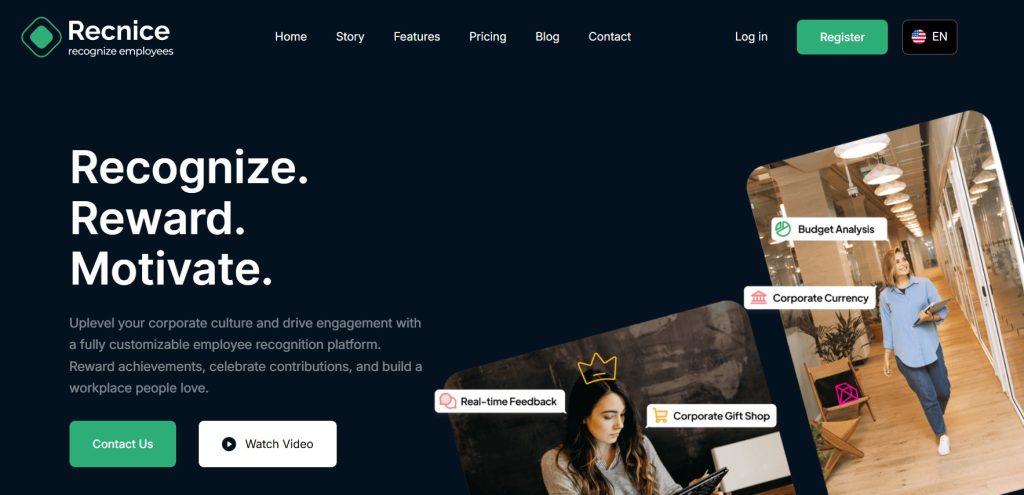
Recnice has built its product around a thesis that most recognition vendors get backwards: the platform should disappear into the tools your employees already use, not pull them toward something new.
The integration layer of this employee recognition program is unusually deep. Recognition can be triggered, given, and received entirely within Microsoft Teams or Slack without ever opening a separate interface.
What distinguishes Recnice on the culture side is its values-tagging system. Every recognition moment ties to a specific company value, and that data aggregates into a real-time culture dashboard.
You’re not just seeing who gave the most kudos last month. You’re seeing which values are being reinforced, by which teams, and what remains unnoticed.
Budget controls are role-based and real-time. Managers see their remaining allocation as they give recognition.
Where most employee recognition software charges extra for anything beyond basic peer-to-peer, Recnice includes it out of the box. Milestone celebrations, performance-based rewards, reward-based surveys, a configurable corporate store for company benefits and branded merchandise, and a non-monetary recognition layer.
Gift certificates are supported natively, too. Having monetary and non-monetary recognition in one place sounds like a small thing until you’re trying to stitch it together from two different tools.
Recnice tracks recognition trends over time, breaks down engagement by team and department, and gives HR data they can actually use to improve the program. At this price point, that reporting depth is unusual.
Best fit: Mid-market to enterprise organizations. Businesses running Microsoft 365 or Google Workspace, where IT governance and adoption within existing tools are priorities.
2. Achievers
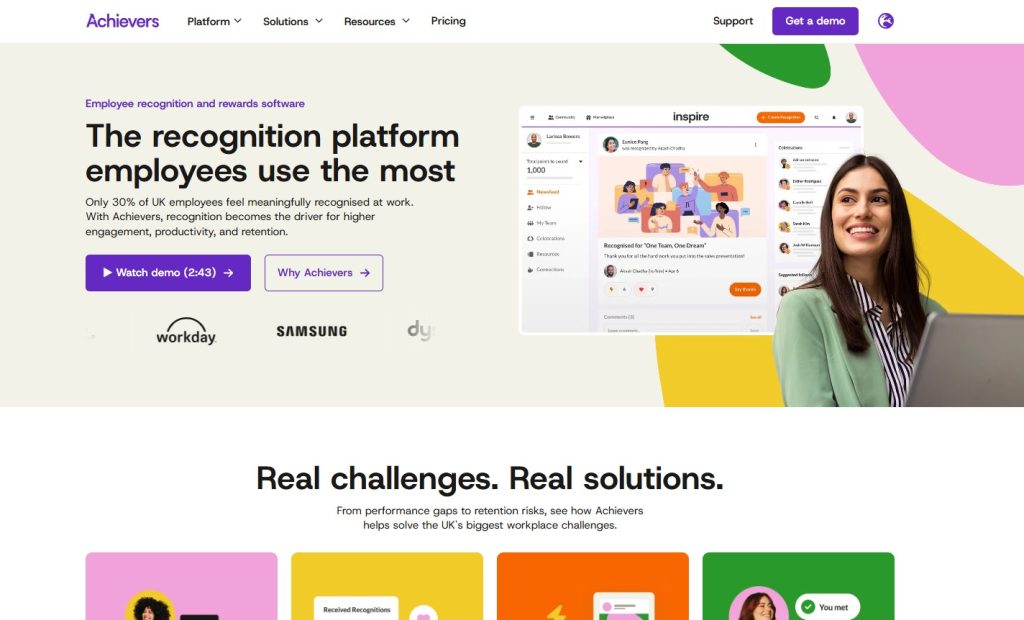
Achievers is one of the most data-sophisticated employee recognition programs. The platform has built predictive flight-risk models that can identify attrition patterns before they show up in exit interview data.
This is one of the most proactive employee appreciation programs. Achievers adds a forward-looking layer – the employee recognition system surfaces which employees or teams are underrecognized relative to their peers, without requiring every manager to be a motivation expert.
Their global infrastructure is quite mature. Achievers operates meaningful reward fulfillment in over 190 countries.
The Listen product – Achievers’ engagement survey layer – integrates directly with recognition data. When recognition frequency drops and engagement scores follow two weeks later, you can see that correlation in the same platform.
The platform receive an average of 13 recognitions per year, roughly twice the rate of other platforms. Clients include General Motors, Samsung, Dyson, Scotiabank, and CVS Health.
The rewards catalog is impressive. 11,000+ gift card options, 2,500+ brands across 190 countries. On the flipside, some users say the interface for navigating it needs work. There were also requests for more granular manager-level reporting that doesn’t require full admin access to pull. Neither of these will kill a deal at enterprise scale, but they’re worth knowing before you sit down for the demo.
Besides, Achievers sits at the higher end of the pricing spectrum. Implementation typically requires 6-10 weeks with dedicated support. If you’re looking for a quick and simpler solution, you should consider other vendors.
Best fit: Enterprise organizations with global headcount, mature people analytics functions, and those treating employee recognition as a data discipline.
3. Awardco
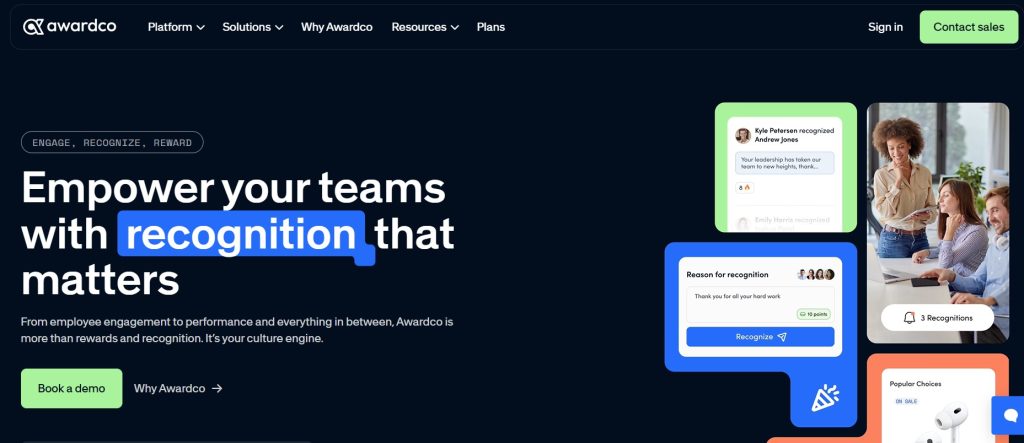
Awardco’s core differentiator is its Amazon Business integration. Employees redeem recognition points across millions of Amazon Business SKUs at face value, no markup.
Most employee recognition software platforms mark up gift cards 2-8% and merchandise 10-30% above retail. Awardco’s model eliminates that. A $50 recognition award buys $50 of product.
Beyond Amazon, Awardco has expanded to include experiences, charity donations, and custom company merchandise through a configurable branded storefront.
While impressive, international availability of the Amazon integration varies by country. In markets where Amazon Business isn’t well-established, this employee recognition program’s advantage greatly shrinks.
Awardco has one of the highest satisfaction scores in the category. It hit a $1 billion valuation and landed 20th on G2’s 2025 Best Software list overall. Needless to say, it’s a rare placement for an HR-specific tool. Reviewers keep coming back to the same things: easy to use, strong rewards selection through the Amazon integration, and reliable automated gifting for work anniversaries and service milestones. On the admin side, budget visibility and HRIS integration get consistent praise too.
The complaint that surfaces most often in verified reviews is support quality over time. Several admins describe post-implementation customer success as getting slower and less responsive the longer the account has been live.
Best fit: North America-heavy organizations that prioritize reward value and redemption breadth, and those who want to avoid hidden reward markups.
4. Nectar
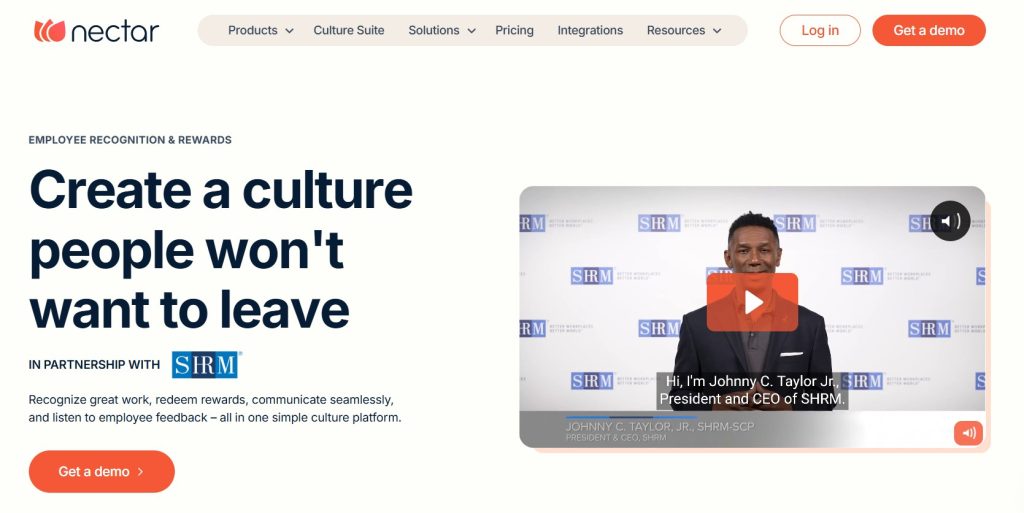
Nectar is an employee recognition program priced for smaller and mid-market organizations but built with an architectural philosophy usually associated with enterprise thinking – value alignment.
Every shoutout is tagged to a defined value. This creates two outcomes: a recognition moment that feels important, and a data record that tells HR which values are actually being lived rather than just posted on the wall.
The separation between peer acknowledgment (lower friction, higher frequency) and manager recognition (more deliberate, higher value) mirrors how actual human relationships work and improves the quality of recognition given.
Pricing is transparent and among the most competitive in the market. For organizations with lower budget flexibility, Nectar wins on cost per active user.
Nectar’s client list includes Redfin, SHRM, Heineken, MLB, Calendly, and the Golden State Warriors. That’s a range that tells us where the platform fits best: mid-market brands in competitive talent environments where culture actually has to do some work.
The Challenges feature is worth a specific look. It lets HR teams attach recognition points to activities outside of direct work performance – wellness initiatives, training completions, DEI participation. For teams trying to build habits around specific behaviors rather than just celebrate milestones, that’s a significant distinction.
Nectar holds a 4.7/5 on G2 and consistently ranks at the top of SMB-focused recognition platforms.Where it has room for improvement is their analytics, which lack the depth larger organizations need for executive reporting. Their integration library is also smaller than that of enterprise platforms.
Best fit: SMBs and growing mid-market companies building a values-driven culture from scratch, without enterprise-level complexity or cost.
5. Motivosity
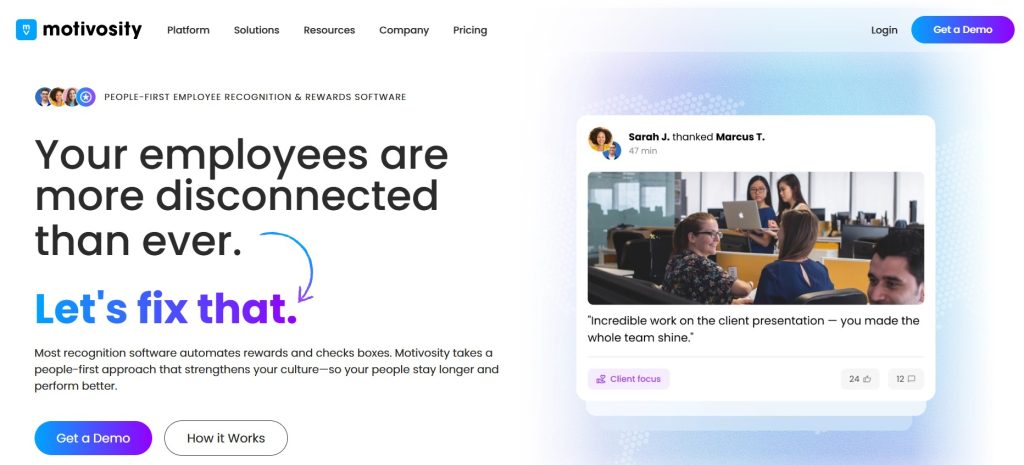
Motivosity’s design philosophy is that recognition should feel like a social act rather than a transactional exchange. For them, it’s an instrument that builds relationships and visibility.
The peer allocation model gives every employee a small monthly budget (typically $5-10) to distribute as they see fit. No approval workflow. No manager gating. No minimum threshold.
That low-friction design creates high recognition frequency. High frequency, in turn, creates habit.
The social feed adds transparency that drives participation through social proof. It also creates visibility across silos. A developer in Austin can see a customer success manager in Dublin getting recognized, building the ambient connection that distributed teams lose.
Motivosity has grown well beyond recognition into what it now calls a full people-first engagement platform. The suite includes 1:1 management tools, performance check-ins, pulse surveys, eNPS, and career development features.
The ThanksMatter card is worth being named specifically. It’s a Visa-enabled debit card that lets employees load their reward balance and spend it anywhere. That solves a problem most recognition platforms ignore: what happens when nobody wants anything in the catalog.
Notable clients include Bosch, KPMG, WGU, Great Clips, Cotopaxi, and FUJIFILM.
What we noticed in reviews is a recurring critique of the feed noise the employee recognition system creates. Important communications can get buried if employees aren’t checking regularly, and the Microsoft Teams notification integration draws consistent complaints from users who want more control over what actually triggers an alert. This, however, is a tension that comes with any social-feed-based platform.
Besides, while the platform is optimized for culture and connection, it’s not a good fit for complex corporate recognition programs with tiered governance or compliance requirements.
Best fit: Remote-first and distributed teams where social connection is a challenge. Growing SMBs that want recognition to build culture rather than mere reward performance.
6. Workhuman
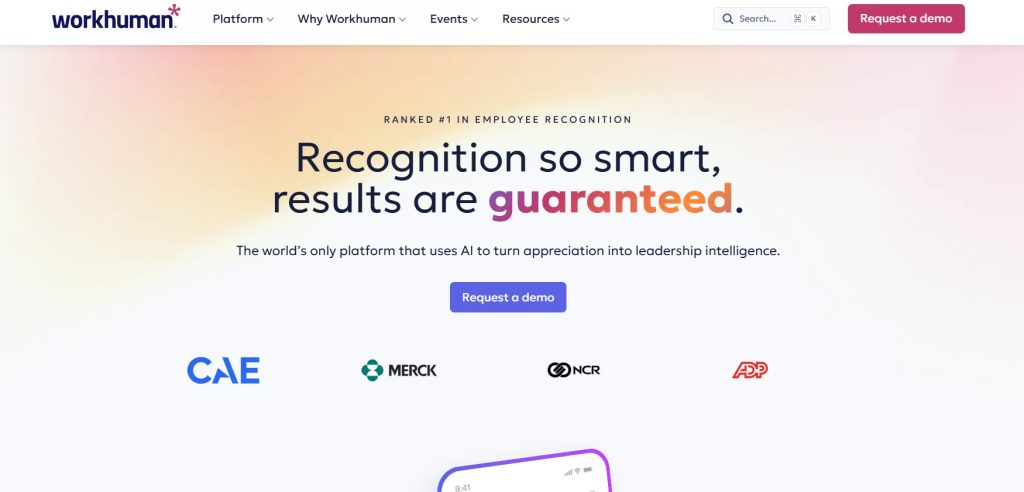
Workhuman is arguably the most research-grounded employee recognition program. Their relationship with SHRM and published data on recognition’s impact on retention and performance gives them credibility that most vendors can’t match.
Their human intelligence tools can surface correlations between recognition patterns and retention risk, team performance, and even safety incident rates in manufacturing environments.
The lifecycle recognition tools are more developed here than most competitors. They cover work anniversaries, promotions, life events, and service milestones
Workhuman was ranked #1 on G2’s Enterprise Grid for Employee Recognition through 2024 and 2025, was named the only Star Performer in Everest Group’s 2025 Rewards and Recognition PEAK Matrix – the sole vendor to receive that designation in the Leaders category – and landed at #10 on G2’s Best Software Products 2025 list, putting it in the top 1% of all software on the platform.
The unconscious bias detection tool, which flags potentially biased language in recognition messages before they’re sent, gets cited repeatedly as an industry-first capability. The AI-powered tone suggestions that nudge managers toward more meaningful recognition language show up just as often in positive reviews.
What is worth remembering is that Workhuman has historically structured pricing in a way that unused recognition budgets can roll into a breakage model. Clarify this in contract negotiations before you sign.
Best fit: Large enterprises with mature people analytics functions, multi-country operations, and a C-suite committed to quantifying the business case for recognition.
7. Bonusly
Bonusly built its product around a simple idea: make giving recognition as easy as sending a text message, and you’ll get tremendously higher participation rates. That idea was winning.
Every employee receives a small monthly point allocation to distribute however they choose, with recognition visible in a public feed integrated into Slack and Teams.
The points-to-rewards pipeline is clean and fast. Employees can redeem for gift cards, cash via PayPal, charitable donations, and merchandise. Speed of redemption keeps points feeling like real value rather than shelved currency.
More than 3,400 organizations use Bonusly globally. The platform fits naturally in fast-moving, people-forward companies where peer culture is part of what makes the job worth showing up for.
Recent product development has pushed Bonusly toward continuous performance data. The platform now surfaces recognition signals, feedback trends, and sentiment patterns to help managers see where collaboration is strong and where someone might need support. It’s a credible attempt to move from “fun employee recognition award program” to something closer to a culture intelligence platform.
In case of limits, Bonusly isn’t well-designed for large-scale performance-based recognition with variable budgets or complex organizational hierarchies. Global reward catalog availability is also uneven.
Bonusly points expire on a rolling basis, and employees who don’t redeem within the window lose them. For someone carefully accumulating points toward a larger reward, that’s genuinely frustrating.
Best fit: Tech-forward SMBs and mid-market companies where peer culture is important, and where the management layer is open to giving employees more autonomy.
8. Guusto
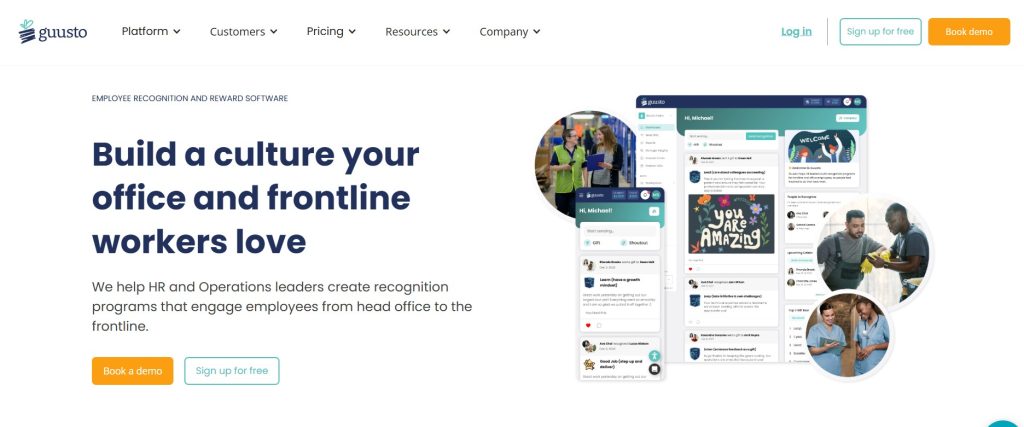
Guusto solves a problem most employee recognition systems ignore: what do you do about employees who don’t have a corporate email address or regular computer access? Contractors, for example.
Recognition is delivered via a unique code – via SMS, print, or a physical card – that the employee redeems on any device at their convenience, without the need to create a corporate account.
That removes the biggest friction point for frontline adoption – the login workflow that non-desk workers reliably abandon.
The platform charges only for sent rewards, not for the platform itself or unused allocations. That structure significantly reduces waste for seasonal businesses or organizations with high frontline turnover.
Guusto’s notable clients include Marriott, The Body Shop, Unilever, and Fairmont Hotels and Resorts – exactly the industries you’d expect from a platform built around frontline coverage. Hospitality, retail, and large-scale service operations where frontline staff are the majority.
Guusto holds a 4.9/5 on G2 based on over 3,000 reviews. This is noteworthy because high-volume frontline deployments tend to surface operational issues that drag scores down on other platforms.
The free tier lets organizations pilot without a budget commitment, and paid plans start at $40 per sender per month – recipients are unlimited. You pay for the people doing the recognizing, not the people being recognized.
Best fit: Organizations with significant frontline or non-desk worker populations – retail, hospitality, healthcare, logistics. Businesses, where traditional recognition platforms underperform or cost too much.
9. WorkTango
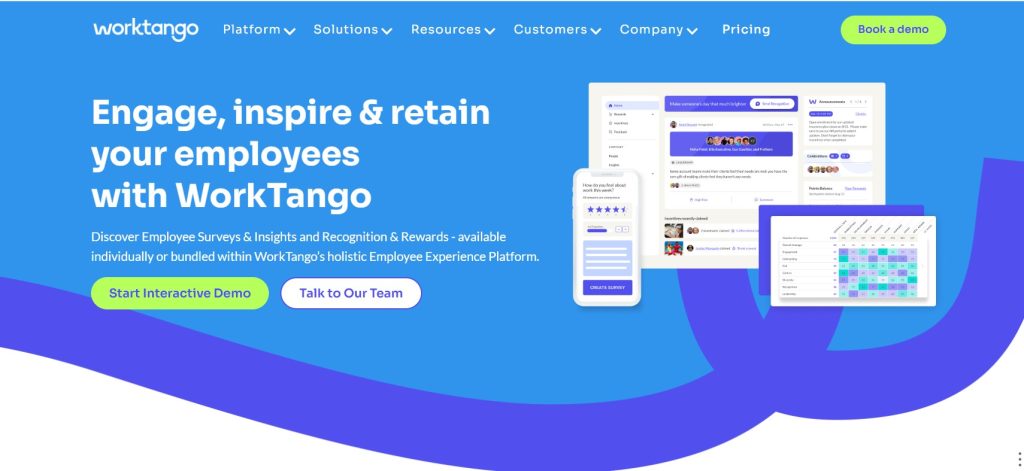
WorkTango sits at the intersection of recognition and performance management. It’s a combination that makes conceptual sense but is surprisingly rare in practice.
The platform integrates recognition activity with goal tracking, feedback tools, and performance check-ins. Recognition becomes contextually connected to what someone was actually working toward, not a separate activity layer.
The Journeys feature provides automated check-in sequences for key employee lifecycle moments such as onboarding, manager transitions, and project completion, feeding a continuous engagement signal alongside recognition data.
WorkTango holds a 4.6/5 on G2 and counts HUB International, KIA, Goodwill, Rexall, and Accruent among its notable clients. Users who get deep into the platform consistently point to how recognition data starts pulling weight in performance contexts.
One G2 reviewer described downloading their recognition history and incorporating it directly into their annual self-evaluation. This is exactly what the platform is designed for. Recognition as evidence of contribution, not just a feel-good moment that disappears in several weeks.
The criticism in reviews tends to fall into two camps. The first is reporting: several users describe the reconciliation reporting for escrow accounts as limited, requiring manual monthly requests to support rather than self-service exports. The second is the learning curve.
Besides, the breadth of WorkTango’s feature set creates serious implementation work. Organizations looking for a lightweight recognition-only tool will find WorkTango’s surface area overwhelming.
Best fit: Mid-market to enterprise organizations ready to connect recognition with performance management and wanting engagement data in the same system.
10. Kudos
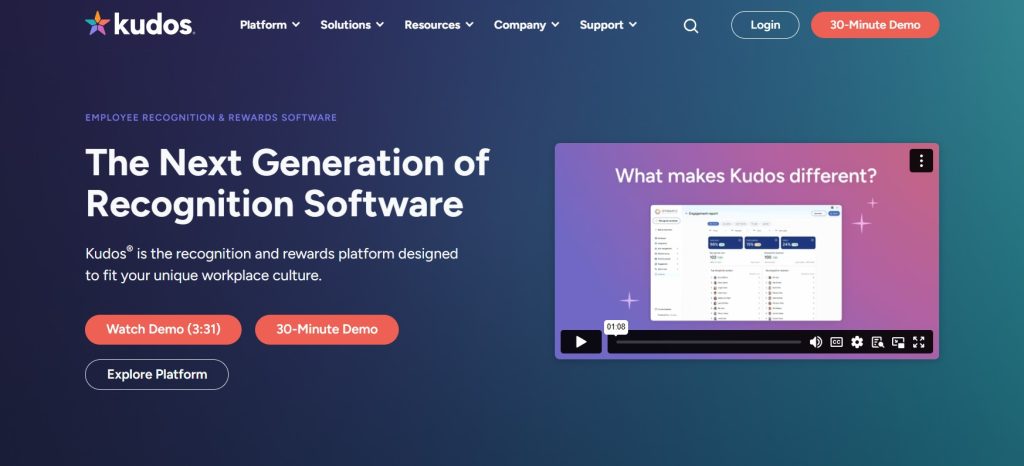
Kudos was built for the kind of organizations that other recognition platforms secretly hope don’t book a demo. We are talking about complex approval chains, multi-entity structures, union environments, and strict compliance requirements that, for most vendors, are edge cases.
Kudos addresses that with configurable governance controls: tiered approval workflows, budget segregation by business unit or location, and custom recognition types that map to existing HR policies.
The values alignment tools are well-developed. Culture trend data is useful for People teams running post-acquisition integration work or culture-change initiatives.
Kudos’ client list is a mix of consumer-facing brands and regulated-sector organizations that says something about the platform’s range. The inclusion analytics are a genuine differentiator: Kudos tracks not just who is being recognized, but whether recognition is distributed equitably across demographics, tenure levels, and departments.
For organizations managing DEI commitments with any seriousness, that’s accountability most recognition platforms don’t even attempt. The group eCards feature, which lets teams collectively sign and send recognition for milestones, handles a use case that many platforms skip.
Pricing isn’t listed publicly and requires a sales conversation, which is standard for governance-heavy enterprise platforms. Reviewers with larger deployments note that customization – adapting recognition types, visual language, and workflows to their specific environment – is more extensive than most platforms, but still has limits. Worth stress-testing in the demo before you assume full configurability.
Kudos isn’t as fluid or engaging as Recnice or Motivosity. Governance depth comes with interface complexity that some employees find to be extra work.
Best fit: Organizations in regulated industries, multi-entity businesses, or any environment where HR governance rigor is non-negotiable.
Top questions that surface red flags in vendors
What happens to unused points?
Ask vendors what happens to points that employees never redeem?
In most recognition programs for employees, unredeemed points are called “breakage.” Unused, they become revenue for the vendor.
A vendor that profits from unredeemed points has a financial interest in redemption friction. That friction might have a form of a catalog that’s slightly less appealing, interfaces that aren’t optimized, and expiration windows that catch employees off guard.
Ask them directly about their breakage rate, and what happens to unredeemed point value? No vendor will proactively bring up this subject.
Also, examine point expiration policies. Points that expire on a fixed schedule can leave employees who miss the window feeling their recognition was retrospectively invalidated. That’s a culture problem dressed up as an accounting feature.
Who do I share my gift card with?
When a vendor sells you a $50 Amazon gift card through their rewards catalog, they typically purchase it at $46-48 and charge you $50. The employee gets $50 of credit; the vendor pocketed $2-4.
An organization spending $500,000 annually on recognition rewards can easily lose $20,000–$40,000 to gift card markup before noticing it.
Ask vendors specifically, during procurement, what their gift card and merchandise margin structure is. Get the answer in writing.
Is the workflow complicated?
Too often, what vendors demonstrate in sales calls and what employees experience are two different realities. The difference between a platform that integrates with Slack and one that works within Slack is huge. You have to bear that in mind when doing your research.
Ask vendors to show you the full recognition flow from within a collaboration tool. Not describe, but actually demonstrate.
How many clicks does it take to go from “I want to recognize someone” to “recognition is sent and visible”? If the employee recognition program demo requires opening a new browser tab, that’s a red flag.
Implementation roadmap: How to ensure a smooth launch
Even with the best platform, you’re not protected from failing during launch. The first rule is not treating launch as the end of the road; it’s only the first step.
Before you go live, make sure you have:
- HRIS sync configured and tested with live employee data
- SSO set up and validated across all user segments
- Budget structure defined: manager allocations, peer-to-peer amounts, milestone tiers
- Recognition champions identified: 8-12 employees across departments and geographies
- Manager training completed, including expected frequency benchmarks
- A soft launch plan that lets champions seed the feed before company-wide rollout
Phase 1: Preparation and foundation work
Technical implementation runs in parallel with the organizational foundation work that defines adoption.
On the technical side: HRIS sync, SSO setup, Slack or Teams integration, and budget allocation structure. On the people side: identify your recognition champions who will model recognition behavior from day one.
Budget structure decisions are much easier to make before the platform is live than to revise after employees have already formed expectations.
Phase 2: Manager enablement
Employee recognition program fails at the manager layer more often than anywhere else.
Managers who are uncomfortable with public recognition, unclear about when to use the platform, or skeptical of its value will eventually stop using it. Their direct reports will take that as a signal and do the same.
Manager enablement should include the “why” behind recognition investment, not just the “how” of using the tool. Additionally – concrete frequency guidance.
“Recognize your team regularly” is not helpful. But, “we’d expect each manager to use the platform at least twice per week during the first 90 days” is.
Phase 3: Launch and monitoring
A soft launch with your champions first creates visible social proof. When the company-wide launch happens, employees see an active feed rather than an empty interface. That difference is very important in practice.
During the first 30 days, watch for: departments with low activity, managers with zero give rate, and geographic regions with low redemption. They are easy to act on early, but hard to recover from if you wait until the 90-day review.
The engineering and architecture of modern employee recognition software
As an IT leader or a CTO selecting the best employee recognition programs, you naturally pay attention to the technical architecture. These systems sit between your HRIS, your collaboration tools, and your financial systems.
Microservices vs. Monoliths
Modern platforms have generally moved to microservices architectures. Recognition events, rewards fulfillment, analytics, and notifications run as independent services.
The key advantage is that platform updates are less likely to cause system-wide outages. You can also scale individual components to handle demand spikes without affecting other functionality.
Legacy monolithic architectures are typically more stable in normal operation, but harder to update, scale, or integrate with. Always ask vendor to explain their architecture decisions. If they can’t and don’t want to, that’s worth pressing on or skipping.
Native and webhook integrations
True native integration requires significantly more engineering than the “we integrate with Slack” claim that most vendors make. Native integration means recognition can be given and received entirely within the collaboration tool’s interface using slash commands or native app surfaces.
When evaluating depth, ask vendors to share their Slack App Directory or Microsoft AppSource listing. Native integrations are listed there; webhook integrations typically are not.
The financial register and reward routing
Every recognition event that carries financial value is a financial transaction. Specific rules govern expiration, transferability, taxation, and redemption against a reward catalog.
Global organizations add currency conversion, local tax compliance, and reward fulfillment logistics. To handle this well, platforms build a dedicated financial infrastructure.
Security, privacy, and compliance
Recognition platforms store sensitive employee behavioral data. The following are table-stakes for enterprise procurement:
- SOC 2 Type II certification – confirm it is current, not expired
- GDPR compliance documentation with data residency options for EU employees
- SSO via SAML 2.0 or OAuth 2.0 – no shared service account credentials
- Role-based access controls granular enough to match your IT governance requirements
- Data retention policy – where is data stored geographically, and for how long?
- Named employee access: who within the vendor organization can access your data, and under what conditions?
Conclusion
The rewards and recognition tools market has gotten crowded, but that hasn’t made the decision any easier. What works for a 200-person tech startup in Austin will not work for a 10,000-person manufacturing company spread across 15 countries. No amount of polished sales decks will change that.
Clarify your non-negotiables: frontline coverage, HRIS integration depth, and global fulfillment. Once those are clear, your list will be much shorter, and decision-making will be much easier.
Most recognition tools will offer you a free trial or a pilot period. Use them, because the demo is not the product. Eventually, you need to focus on what your managers and employees will do with this software on a random Tuesday afternoon, three months after the purchase.
FAQ
What is the standard implementation timeline from signing the contract to the platform being live?
Mid-market platforms: 2-4 weeks. Enterprise platforms: 6–12 weeks. The timeline that vendors quote is usually the technical component only. The organizational enablement work runs in parallel and is the buyer’s responsibility.
How do these platforms handle currency conversion if a manager in the US recognizes an employee in another country?
Enterprise platforms handle currency conversion automatically at the point of redemption. Mid-market platforms often convert to local currency at the time of award using a fixed rate, which creates winner/loser dynamics when exchange rates move.
Why should we buy a dedicated platform instead of just using a free, custom-built solution?
Custom-built tools are excellent at demonstrating the value of recognition early. They stop being satisfactory when you need reward fulfillment, global operations, tax compliance, analytics, HRIS sync, and formal governance.
The maintenance burden grows nonlinearly with scale. What one developer maintains for 50 people becomes a part-time job at 500. Dedicated platforms solve problems that custom tools structurally can’t.
Do we pay for the software subscription and the rewards budget separately, or is it combined?
Almost universally, these are separate budget lines. A rough rule of thumb: platform fees running $2-8 per user per month and rewards budgets of $25-$150 per employee per year, depending on program design.
How secure is the data integration between the recognition software and our HRIS?
Enterprise-grade employee recognition companies offer SOC 2 Type II certification and configurable data residency options. The HRIS integration should use OAuth 2.0 or SCIM, not credential sharing. Confirm the integration doesn’t require service account credentials with elevated permissions. It’s a common shortcut that creates a significant security risk.
What is the typical adoption rate, and how do we prevent the platform from becoming shelfware?
Industry benchmarks suggest 70-80% active participation within 90 days for well-implemented programs. Manager behavior is the single largest predictor of team-level adoption. Programs where managers model the behavior consistently within the first 30 days sustain adoption. Programs where managers are passive see participation drop very quickly.
Can we implement a recognition program if our frontline workers don’t have corporate email or computer access?
Yes, but you need to choose the best employee recognition software for your needs. Guusto, for example, is purpose-built for this use case. Their recognition is delivered via SMS or printable codes that don’t require account creation.
How do employee recognition platforms handle local taxes and global compliance?
The leading enterprise platforms have built dedicated tax compliance infrastructure handling fringe benefit rules and reporting obligations in most major markets. Mid-market platforms often rely on guidance documents and client-side tax handling. For employees in Germany, France, the UK, or Australia, this is worth investigating carefully.
Are there hidden markups on gift cards and merchandise rewards inside these recognition programs?
Yes, for most platforms. Gift cards are typically marked up 2-8% above face value; merchandise can carry a 10-30% margin over retail. Ask vendors about their markup structure during procurement. Get the answer in writing.
You may also like
-
 October 14, 2026Read in 25 min.
Retail software development companies: 12 vetted partners for store, omnichannel, and supply chain tech
Compare 12 vetted retail software development companies for POS, omnichannel, and inventory builds. Independent review with costs and selection tips. -
 September 28, 2026Read in 19 min.
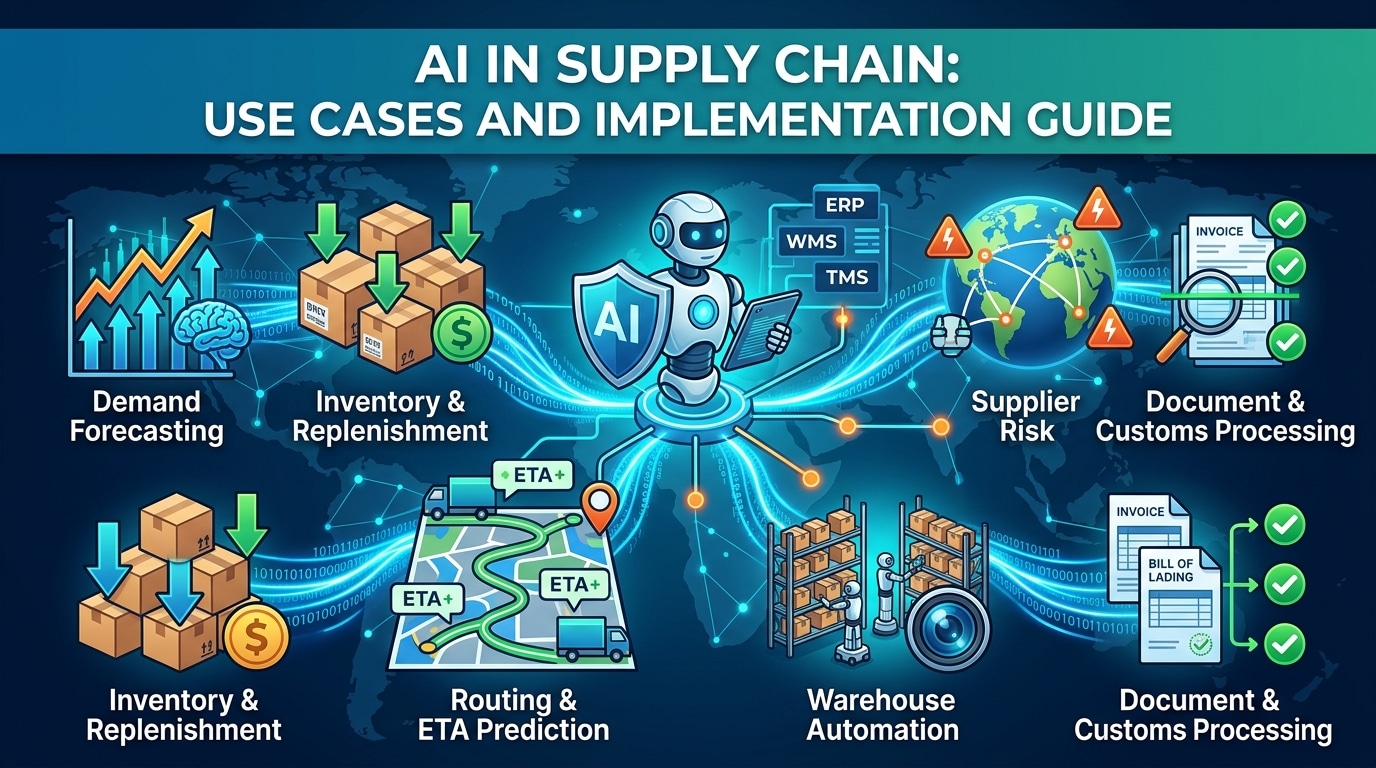
AI in supply chain: Use cases and implementation guide
What is AI in supply chain management? -
 September 21, 2026Read in 19 min.
AI in banking: Use cases, explainable AI, and how to deploy it in regulated environments
AI in banking: use cases, explainable AI and governance, generative AI, ROI, and how to deploy it in a regulated environment -
 September 8, 2026Read in 16 min.
The AI-Native SDLC: From Writing Software to Orchestrating It
An AI-native SDLC cuts delivery time by about half without loosening a single quality gate. See the three eras, the toolchain and the guardrails. -
 September 4, 2026Read in 36 min.
Custom software development cost: Real ranges, rate cards, and how to budget
How much custom software development costs. Explore real pricing ranges, hourly rates, key cost factors, hidden expenses, and budgeting tips. -
 September 2, 2026Read in 36 min.
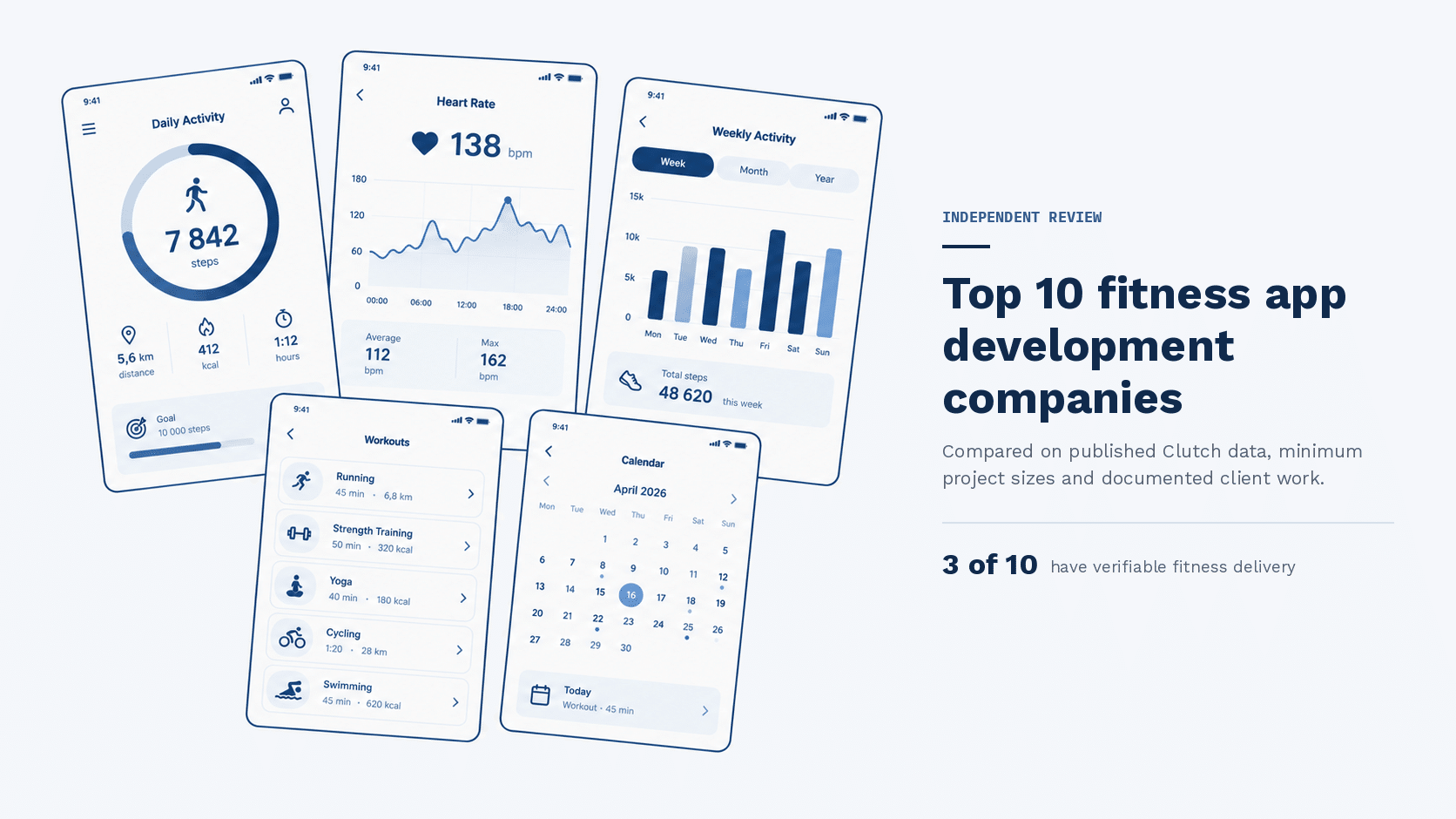
Fitness app development companies: An independent shortlist
10 fitness app development companies compared on verified data, published pricing, and real client work. Only three have documented fitness delivery. -
 August 27, 2026Read in 36 min.
Top software development companies in the USA
Find the best US-based software developers. From AI to enterprise web apps, here are the top 30 software development companies in the USA you should hire in 2026. -
 August 19, 2026Read in 22 min.
Robotic Process Automation in healthcare: Definition, benefits, and real cases
From patient scheduling to claims processing: explore proven RPA use cases in healthcare, backed by real data, ROI benchmarks, and compliance guidance. -
 July 22, 2026Read in 21 min.
AI Use Cases: 25+ Real Enterprise Examples Across Industries
Most impactful AI use cases in business - from generative AI and agentic AI to predictive analytics. Real examples by industry with ROI data and implementation priorities. -
July 22, 2026Read in 17 min.
AI in manufacturing: How to implement, use cases and benefits
How artificial intelligence is transforming manufacturing - from predictive maintenance and quality control to supply chain optimization and digital twins. Real ROI data and implementation roadmap.