



A standard website is mainly designed to present information. Users can read content, view pages, and sometimes submit simple forms. Overall interaction is limited. A custom web application allows users to log in, manage data, perform tasks, and interact with systems in real time.
Web application development companies: How to choose the right partner

 24 minutes read
Content
Web application development companies build software that runs in a web browser and can be accessed instantly, without installation. Examples include Google Docs, Trello, Evernote, and Shopify. These are products and internal systems used daily by millions of people.
As more business processes move online and automation becomes the norm, companies increasingly rely on custom web applications to support operations, scale, and stay competitive. Choosing the right development company plays a critical role in whether these applications deliver long-term business value.
But how do you do this? And what criteria should you consider while choosing?
Let’s explore the types and operational models of app and website development companies, along with the tips on choosing the right one for a successful partnership.
What do web app development companies do?
Businesses usually look for more than a quick digital solution. They expect their tech partner to create a working digital system that grows, evolves, and remains competitive to achieve their ultimate business goals.
To do so, a web application development company clarifies all nuances of the future product, its characteristics, specifics, and functions. They consider your business goals, user groups, and constraints such as budget, timelines, or existing systems. Sharing these details helps you avoid overspending on unnecessary features or taking the wrong direction.
During the development, tech vendors design architecture, handle frontend and backend engineering, database structuring, QA, and third-party integrations. The most reliable ones offer post-launch maintenance and support that includes performance monitoring, feature testing, adjusting, and implementation. This way, they ensure your application meets market needs and regulatory demands.
In short, a web application development company becomes your technical partner, responsible for the digital implementation of your business ideas.


Let’s build a web application that works as hard as you do.
Ready to scale your digital presence with a partner who speaks the language of ROI?
The development cycle in detail
A web application development process is a sequence of traditional stages that each firm adjusts to the specific client or project. As a business owner, you must understand these stages to evaluate the company’s approach, readiness for long-term commitment, and out-of-the-box thinking.
Stage 1: Analyzing and strategizing
The first step for web app development companies is to define business goals and direction for the development before it begins. Conducted well, it results in a list of business objectives, target users, competitors, and measurable outcomes. It answers critical questions such as what problem the application should solve or how success will be evaluated. It also gives teams a clear understanding of possible constraints such as budget and timeline.
Stage 2: Design
Once the strategy is in place, the design team can translate it into structure and interaction. The UX part of the process defines the ways users move through the application, make decisions, and complete tasks. UI design is about the aesthetics. Designers deliver wireframes and prototypes for the following idea validation and user testing, which is vital to avoid costly rework and early reputational damage.
Stage 3: Development
When testing and refining cycles are finished, backend and frontend development teams can move to core functionality implementation. Frontend developers handle forms, dashboards, and navigation – everything users interact with. Backend developers manage business logic, data processing, integrations, and permissions – the invisible part of the product.
This stage includes another big step – database structuring. It determines how data is stored, retrieved, and secured.
Stage 4: Quality Assurance
Testing and quality assurance measures help developers ensure the application works as expected in real life, not only in controlled conditions of development environments. Functional testing checks that features behave as intended and that user actions lead to predictable outcomes. Load testing examines how the application performs when usage increases. It helps identify bottlenecks that only appear with a large number of users.
Security testing focuses on protecting data and preventing unauthorised access. It is particularly critical for applications that handle personal or financial information, which is most modern software.
Stage 5: Launch
Deployment is the transition from a development environment to live operation. It involves configuring servers, databases, access controls, and monitoring tools. It can’t be ruched and demands clear planning to avoid downtime or data issues.
To make the release as smooth as possible, web app development companies thoroughly test deployment procedures, define rollback options, and constantly monitor system behavior. Such readiness allows for a quick response when something doesn’t go as expected.
Stage 6: Maintenance and support
Launch is not the end of the work; it’s the end of the development phase. Released, your application needs maintenance and support to remain stable, secure, and up-to-date. The development team fixes bugs, monitors performance, applies security updates, and responds to changes in user behaviour. It also moves the app from an MVP to a more complex, fully-functional product.
Besides, your application should mirror your business strategy changes. New features, changes in payment options, or regulatory demands require updates and constant monitoring.
What development expertise do they offer?
Web application development is a cluster of services. Companies usually offer expertise from several distinct categories, depending on the goal: to build something new, scale an existing product, or modernise legacy systems that no longer meet business needs. Let’s take a closer look at those services.
Custom web application development
Custom web application development means building software tailored to specific business processes and operational needs. Unlike off-the-shelf tools, custom applications are designed around the company’s processes and goals. This is particularly useful when it comes to complex internal workflows or unique functionality.
Tailored internal management systems, customer portals, or industry-specific platforms offer greater control, a suitable feature set, and user roles built around real operational requirements. If this is your requirement, consider partnering with a bespoke web application development company.
SaaS platform development
SaaS development involves building applications that work as subscription-based services. Microsoft Office 365, for example. These platforms are complex and must support multiple users, data isolation, billing logic, and regular updates on the go, without disruptions. Like any long-term business project, SaaS products require strong architecture consideration. Scalability, performance, and security are critical, as failures, if they appear, affect numerous users at the same time.
Legacy system modernization
When applications become hard to maintain, expensive to run, or incompatible with modern tools, they require modernization. The process can take different forms, from the replacement of some parts to the complete rewriting of the entire system. Some systems get gradually refactored, others – rebuilt in stages, or partially migrated to newer technologies. What doesn’t change is the goal – to improve performance and flexibility, while reducing risks.
Third-party integrations (APIs)
Most modern web applications rely on external services. Payment providers, analytics tools, CRM systems, and communication platforms are usually integrated through APIs. Effective integration is more than connecting two systems; it involves managing data consistency, error handling, and security. Poor implementation, in turn, harms system stability and the business budget.

What technological stack and specialization to look for?
A technology stack is another broad term that combines frontend, backend, cloud, DevOps, and other solutions the development teams use to build digital products. The more modern technologies the company uses, the higher the chances of getting exactly what you want and not a template solution. Here is a brief overview.
Frontend technologies
Frontend technologies shape everything users see and interact with. They define how fast the application feels, how intuitive it is, and how well it works across devices and browsers.
JavaScript frameworks: React, Angular, Vue.js
JavaScript frameworks help developers build complex user interfaces. React is widely used for dynamic, component-based interfaces and suits applications that need frequent updates. Angular provides a more structured approach, often preferred for large, enterprise-scale projects. Vue.js is known for its simplicity and flexibility, making it easier to adopt for smaller teams.
HTML5 / CSS3
HTML5 and CSS3 form the foundation of all web interfaces. Strong frontend teams use them to create consistent, accessible interfaces that load quickly and remain usable across different environments. HTML defines structure, while CSS controls layout, responsiveness, and visual presentation.
Modern HTML and CSS enable responsive design, ensuring applications work well on desktops, tablets, and mobile devices. This offers broader accessibility without building separate products.
Backend technologies
Backend technologies handle logic, data processing, and system integrations. They are responsible for how the application functions behind the scenes and how reliably it performs.
Languages and frameworks
Backend developers often use Node.js, Python frameworks such as Django or Flask, Ruby on Rails, Java with Spring, or PHP frameworks like Laravel and Symfony. Each option offers different trade-offs.
Some excel at rapid development, others at performance or long-term stability. The choice depends on application complexity, team expertise, and expected growth. For businesses, the right backend technology supports scalability and easier maintenance rather than locking the product into hard-to-change decisions.
Node.js: Fast development, strong ecosystem, good for real-time features, same language on frontend and backend. Less suited for CPU-heavy tasks; performance depends on the architecture. Commonly used for real-time apps, APIs, and SaaS platforms.
Python (Django / Flask): Clear syntax and rapid prototyping, strong for data-driven features. Lower raw performance and more complex scaling. Used for business applications, dashboards, and MVPs.
Ruby on Rails: Very fast to build with strong conventions. Performance limits at scale and a smaller talent pool. Used for startups, internal tools, and SaaS products.
Java (Spring): High performance, strong security, long-term stability. Slower development and higher complexity. Used for enterprise systems and financial applications.
PHP (Laravel / Symfony): Cost-effective with wide adoption. Quality depends on team discipline. Used for content platforms, portals, and e-commerce.
.NET (C# / ASP.NET): Strong performance and tooling, especially in Microsoft environments. Less flexible outside that ecosystem. Used for enterprise and B2B systems.
Go (Golang): High-performance and efficient concurrency. Smaller ecosystem, slower for complex features. Used for high-load services and cloud-native APIs.
Databases
Databases store and manage application data. The choice affects performance, scalability, and how easily data can be analysed or integrated with other systems.
SQL Databases
SQL databases like PostgreSQL and MySQL use structured schemas and are well-suited for transactional systems where data consistency matters. They are commonly used for applications involving payments, reporting, or complex relationships between data.
NoSQL Databases
NoSQL databases such as MongoDB and Redis prioritise flexibility and speed. They handle large volumes of unstructured or rapidly changing data more efficiently. These databases are often used for real-time features, caching, or analytics.
Cloud and DevOps
Cloud and DevOps practices define how an application is deployed, updated, and operated day to day. They determine how quickly you can release changes, how reliably the system runs under pressure, and how well infrastructure costs are monitored and controlled over time.
AWS, Azure, Google Cloud
Most modern web applications rely on infrastructure and services provided by cloud platforms such as AWS, Azure, and Google Cloud. Instead of owning servers, businesses rent computing power, storage, and managed services as needed.
Each platform offers similar core capabilities but with different strengths. AWS is often chosen for its breadth of services and maturity. Azure integrates well with Microsoft-based environments. Google Cloud is frequently used for data-intensive workloads and analytics.
The main benefit for business here is flexibility. Infrastructure can scale automatically as usage grows and scale down when demand drops. This reduces upfront investment and helps align costs with actual activity.
Containerization
Containerization is a way of packaging an application so it runs consistently across different environments. Docker is commonly used to create these containers, while Kubernetes manages how they are deployed, scaled, and updated.
This approach reduces inconsistencies between development, testing, and production environments. What works locally is more likely to work in production. Kubernetes automates tasks such as scaling and recovery, reducing manual intervention. Over time, this supports continuous improvement without frequent downtime or disruption to users.
Engagement models and pricing
To know the company’s offering is not enough. Engagement models and pricing are common deciding factors. The cooperation model should be defined by the maturity of the project, the level of clarity of business demands, financial potential, and other factors we talk about later. Let’s explore different collaboration models.
Collaboration models
Fixed price
A fixed-price model works best for projects with clearly defined requirements, timelines, and responsibilities. When the scope is agreed upfront, the price can be agreed upon in advance. Such collaboration is the most predictable, since investments are clear from the start.
The trade-off is limited flexibility, as any change would require renegotiation. As a result, fixed-price contracts are not a good fit for projects where requirements are likely to evolve.
Time & Material
The Time & Materials pricing model is based on actual effort and is best suited to flexible, long-term projects. Instead of paying for a fixed scope, businesses pay for the hours worked. This approach is particularly effective when requirements are expected to evolve or when discovery is conducted in parallel to development.
This model offers businesses much greater flexibility. The scope can change without formal contract revisions, and teams can adapt as new insights emerge.
Dedicated team
A dedicated team model suggests hiring a stable development team that works exclusively on your product. They are fully integrated into internal workflows and usually work as a remote IT team.
Such an option enables smooth product updates over time, as the team builds a deep understanding of both the product and the broader business context. In terms of monthly costs, they remain predictable and agreed upfront. This model works best for long-term cooperation with growing products that require ongoing development and close, day-to-day communication.
Pricing structures
What factors influence costs?
Application complexity: More user roles, workflows, business logic, and integrations increase the architecture, development, and testing effort, and, consequently, the price.
Number and type of integrations: Connecting external services such as payment systems, CRMs, or analytics tools adds implementation, error handling, and ongoing maintenance costs.
Technology stack: Some technologies require more specialised expertise or stricter performance and security considerations, increasing development and testing effort.
Team seniority: Senior engineers cost more per hour. However, they usually reduce total cost as they deliver faster and offer better web application development solutions.
Geography: The labour market is broad and uneven. Two developers with similar skill sets can cost very different amounts depending on where they are based and the time zone they work in.
Clarity of requirements: Vague requirements almost always lead to revisions and higher final spend.
What are the hourly rates across regions?
In North America, web application development rates typically range from $120 to $200+ per hour. The costs reflect higher operating costs and a concentration of senior engineers, especially in regulated or enterprise environments.
Eastern Europe is a preferred region for many businesses because it combines strong technical education with more moderate pricing. Rates commonly fall between $40 and $80 per hour, offering a balance between cost efficiency and engineering quality. This region is often chosen for long-term projects.
In Asia, rates are generally lower, often between $25 and $50 per hour. While this can reduce upfront costs, projects may require additional management effort due to time zone gaps, higher team turnover, or varying quality standards.
Let’s build a web application that works as hard as you do.
Ready to scale your digital presence with a partner who speaks the language of ROI?
How to choose the best development partner?
Define your requirements
Clearly define and outline your requirements to understand what questions to ask, what solutions to expect, and what red flags to avoid. For your potential tech partner, it will be easier to understand your demand and offer you the best suitable solution. It’s a simple but very efficient way to achieve mutual understanding and avoid guesswork.
Create a Clear Technical Specification (TS) or MVP concept
A technical specification or MVP concept clarifies what needs to be built and why. It should outline core functionality, target users, and key constraints, without attempting to define every implementation detail.
For early-stage projects, an MVP description is often enough. It focuses on essential features and assumptions to be tested. More mature initiatives may require clearer documentation around integrations, performance expectations, or compliance needs.
Set budget constraints and deadlines
Technical decisions depend on budget and timelines. Be open about them to help your future vendor propose optimal approaches rather than idealised, often non-realistic ones. A fixed budget may require phased delivery. A tight deadline may influence team size or technology choices. All these nuances must be considered upfront.
What criteria to evaluate?
There isn’t a universally best company. But there is the best company for your project and your needs. The following is the criteria to evaluate to find the web application development company to partner with.
Portfolio and case studies
In the portfolio, you can see whether a company has experience handling challenges similar to yours. Case studies describe context, constraints, and outcomes rather than just delivered features. Experience with comparable complexity or operating conditions is usually more valuable than high-profile but unrelated projects. Longevity is also an important signal. Applications still in use years after deployment reflect the developer’s better architectural and delivery decisions.
Reviews and testimonials
Reviews show values beyond the sales process. By evaluating independent reviews, you can learn vital information on the company’s collaboration approach and communication practices. Platforms such as Clutch or G2 often reveal how teams manage scope and respond to problems.
Look for patterns rather than isolated opinions. Consistent feedback about transparency or missed deadlines is more meaningful than individual positive comments.
Processes and methodologies
Strong teams follow defined delivery processes. Agile or Scrum frameworks support incremental delivery, frequent feedback, and early issue detection. What matters for you is consistency. Clear planning, regular reviews, and documented decisions indicate maturity.
For businesses, structured processes improve predictability and reduce unpleasant surprises during delivery.
Culture match and communication
Communication quality directly affects outcomes. Poor communication leads to stress, rework, and delays. Assess how clearly teams explain ideas, respond to questions, and incorporate feedback. Cultural alignment is also important, particularly for long-term cross-border collaboration.
The selection process: Step-by-step
Create a shortlist of companies: Start by narrowing the market to a small number of relevant companies. Use filters such as experience with similar projects, industry exposure, and delivery model. For most businesses, three to five candidates is ideal.
Issue a consistent Request for Proposal (RFP): Share the same background information, requirements, and constraints with every shortlisted company. Ask specific questions about approach, timeline, team composition, and pricing. From the way different vendors respond to the same inputs, you can see the differences in thinking and maturity.
Review proposals: Look beyond formatting and sales language. Strong proposals explain assumptions, highlight risks, and clarify trade-offs. Overly optimistic timelines or vague estimates are early warning signs.
Hold working meetings and technical discussions: Use meetings to understand how teams think. Ask them to walk through decisions, past challenges, and alternatives. The goal is not to test theory, but to assess problem-solving, communication style, and transparency.
Validate fit and alignment: Pay attention to how easily conversations flow. Conversational and cultural misalignment here often predicts later challenges. Technical skill matters, but working fit matters just as much.
Formalise the partnership: Finalise expectations through NDAs and SLAs. These define confidentiality, ownership, responsibilities, and service levels. Clear agreements set the foundation for a stable, long-term relationship built on confidence and mutual trust.
Top web application development companies
Blackthorn Vision
Blackthorn Vision develops custom web applications and SaaS platforms for companies that expect their systems to grow and change over time. System modernization is another big part of their work. The team puts strong emphasis on early requirement definition and architectural decisions, which helps avoid rework later in delivery.
Blackthorn Vision works across frontend, backend, cloud, and DevOps, designing applications that scale without driving up infrastructure or maintenance costs. In recent years, Blackthorn Vision has also integrated AI capabilities into web applications, mainly for data processing, automation, and decision-support use cases.
Clients often highlight the team’s ability to translate technical decisions into business terms and keep delivery aligned with commercial goals. Engagements are typically long-term and include post-launch optimisation, performance tuning, and ongoing development. Blackthorn Vision is a good fit for organisations that value predictability, technical continuity, strong communication practices, and systems built to evolve rather than be replaced.
Geniusee
Geniusee works primarily with startups and product-led teams building web and mobile applications. Projects often begin at the discovery or MVP stage and continue into scaling once product direction becomes clearer.
The company is accustomed to working with incomplete or changing requirements. Delivery is iterative, with frequent checkpoints that allow teams to validate assumptions and adjust priorities. This makes Geniusee suitable for businesses still refining product–market fit.
Geniusee’s communication and transparency are recurring themes in client feedback. The company tends to perform best where flexibility matters more than rigid scope control and where learning speed is part of the business strategy.
Wolfpack Digital
Wolfpack Digital focuses on web and mobile product development, particularly for customer-facing applications. The company works closely with founders and product owners, helping turn product ideas into usable, market-ready software.
Delivery is iterative and feedback-driven. Teams prioritise usability and clarity over feature volume. Technically, the company relies on modern frameworks and cloud infrastructure to support maintainability and growth.
Wolfpack Digital is well-suited to businesses where user experience, adoption, and time to market directly affect commercial performance.
Cheesecake Labs
Cheesecake Labs delivers web and mobile applications with a strong focus on design execution. UI/UX, engineering, and quality assurance are handled as a single delivery stream rather than separate functions.
Projects follow a clear progression from discovery and design through development and launch. This structure helps reduce misalignment and late-stage surprises. Design decisions are closely tied to implementation, which improves consistency between concept and final product.
Cheesecake Labs is typically chosen for products where usability, visual quality, and interaction design impact engagement or conversion.
INOXOFT
INOXOFT develops custom web applications for domains where security, reliability, and compliance are critical. The company provides custom web application development services in healthcare, logistics, real estate, and other regulated environments.
Delivery is process-driven. Documentation, defined workflows, and predictable communication are central to how projects are run. INOXOFT provides full-cycle services, including consulting, architecture, development, testing, deployment, and support.
The company is usually selected when long-term stability and governance matter more than rapid experimentation. It suits organisations building systems that support core operations rather than short-term product validation.
Imaginary Cloud
Imaginary Cloud builds web and mobile applications with a strong product focus. The company works with both startups and established businesses, delivering software in stages rather than large upfront builds.
Delivery combines agile execution with structured planning. Teams move quickly but maintain visibility through regular checkpoints and documentation. Technical choices favour scalability and long-term maintainability.
Imaginary Cloud fits organisations that need momentum without sacrificing delivery discipline or architectural clarity.
Brainhub
Brainhub specialises in web application development with a strong emphasis on modern JavaScript and frontend-heavy systems. This custom web app development firm often works with scale-ups, building complex interfaces or performance-sensitive products.
Code quality and maintainability are central to their delivery. Processes include clear technical standards, regular reviews, and structured planning to limit technical debt.
Brainhub is a strong option for products where frontend performance, responsiveness, and scalability directly influence revenue, retention, or user engagement.
Merixstudio
Merixstudio provides web application development with a strong emphasis on usability and accessibility. It is more of an enterprise web application development company and works across sectors such as SaaS, education, and e-commerce, where user experience plays a central role.
Merixstudio integrates design, development, and quality assurance into a unified workflow. This ensures that usability considerations are addressed alongside technical implementation rather than added later.
Projects typically follow a structured delivery process with clear communication and documentation. This helps align stakeholders and maintain quality as applications evolve.
For businesses building customer-facing platforms, Merixstudio offers reliability and attention to user experience. It is well-suited to organisations that value consistency, clarity, and inclusive design as part of their digital strategy.
StudioLabs
StudioLabs is one of the web application development companies with a strong focus on startups and innovation-led projects. The company often works at early stages, where ideas are still being tested and refined.
StudioLabs supports rapid prototyping and iterative development. Teams collaborate closely with founders and product owners to validate assumptions, test features, and adjust direction based on early feedback. This helps reduce the risk of investing heavily in unproven ideas.
From a delivery perspective, the emphasis is on speed and learning rather than long-term optimisation from day one. Architecture decisions are pragmatic, with the expectation that systems may evolve as the product matures.
StudioLabs is a good fit for businesses that prioritize experimentation and time to market. It works best for early-stage products that need quick idea validation before scaling.
Plavno
Plavno provides web and custom web application development services for startups and small businesses. The company focuses on practical execution rather than complex or over-engineered solutions.
Plavno often works on MVPs, internal tools, and customer portals. Projects are typically scoped to deliver core functionality efficiently, allowing businesses to launch quickly and iterate based on real usage. The company emphasises cost efficiency and straightforward collaboration. Client feedback highlights direct communication and clear processes.
Plavno would suit businesses of all sizes, including those with limited internal technical capacity or those managing tight budgets. As a startup web app development company, it offers an accessible and pragmatic option for small organisations looking to turn ideas into working software.
In conclusion
First impression is everything. When someone walks into a physical store, they start developing a first impression of this business immediately. The same applies to your online presence. Your web application is often the first place where customers encounter your business, and it shapes how reliable, professional, and unique you are.
Blackthorn Vision approaches web application development with this mindset. We focus on building systems that are thoughtfully designed, technically sound, and practical to maintain. We use well-established tools and proven technologies, while being dynamic, creative, and open-minded. Our teams create web applications that feel reliable to users and adaptable for businesses as they grow.
Contact us to learn more about custom web application development services, along with our cooperation model and approach.
FAQ
What is the difference between a custom web application and a standard website?
What are the key red flags to look out for when evaluating a web application development company?
Common red flags include vague estimates, unclear communication, reluctance to discuss risks, and poorly defined ownership terms. Overpromising speed or low cost without understanding requirements is another warning sign in a custom web application development services provider.
Will the development company provide support and maintenance after the application has launched?
Most professional development companies offer post-launch support. This includes fixing issues, applying updates, monitoring performance, and adapting the system as requirements change.
What is the role of a discovery phase, and is it necessary?
The discovery phase helps align business goals, user needs, and technical constraints before development starts. While not strictly required, discovery is especially valuable for complex or new products. It often saves time and cost by preventing misalignment and rework later.
How do custom web application development companies manage security and protect intellectual property?
Security is managed through access controls, secure coding practices, encryption, and regular testing. Intellectual property is protected through clear contractual agreements that define ownership of code, data, and deliverables from the start.
Which technology stack should I choose for a scalable application?
There is no single best technology stack for scalability. The right choice depends on your use case, expected growth, and the expertise of your development team. A well-understood, proven stack often performs better than a newer technology chosen by a web app development services company without sufficient experience.
What is technical debt, and how does a good development company minimise it?
Technical debt means future maintenance work created by quick or poor technical decisions. These decisions may save time initially, but make systems harder to modify or scale later. Good custom web application development services vendors manage technical debt by using clear architecture, consistent coding standards, automated testing, and regular code reviews. They also document decisions so future teams understand the reasoning behind them.
Which pricing model is best suited for a startup with evolving requirements?
For startups, flexible pricing models work best. Time and Material or Dedicated Team arrangements allow custom web application development companies to change the scope without renegotiating contracts. Fixed Price, in turn, would create tension between cost, quality, and speed.
How long does it take for a web application development company to develop an MVP?
An MVP development usually takes between eight and sixteen weeks. The exact timeline depends on scope, design complexity, and the number of integrations involved. The project duration heavily depends on the requirement clarity and stability – the more frequently they change, the longer it will take for the web application development firm to make adjustments or rework.
You may also like
-
 April 3, 2026Read in 31 min.
AI software development services: A complete guide for business leaders and decision-makers
Transform your business with expert AI software development services. We build custom GenAI, machine learning, and autonomous agent solutions tailored for enterprise ROI. Get a free consultation today! -
 April 1, 2026Read in 17 min.
The strategic hub: Why global leaders choose software development outsourcing in Ukraine
Why global leaders choose software development outsourcing in Ukraine. Explore the top 10 IT companies, specialized tech stacks, and how to scale your business with a dedicated Ukrainian development team. -
 March 31, 2026Read in 19 min.
Selecting the best Java development companies
Leading Java development companies. Analyzes top-tier Java software development services, evaluation criteria, and delivery models to help you find the perfect strategic partner for scalable enterprise solutions -
 March 31, 2026Read in 14 min.
Top progressive web app development companies
Partner with a leading progressive web application development company. Explore our list of top PWA developers in the USA and globally, offering high-speed, offline-ready, and SEO-friendly web app solutions -
 March 23, 2026Read in 23 min.
Why data warehouses fail and how to design one that doesn’t
top building data swamps. Explore the evolution of DWH design, including ELT workflows, Data Vault 2.0, and high-performance cloud modeling strategies -
 March 18, 2026Read in 13 min.
Choosing React Native app development company
Partner with a premier react native development company. Compare the top 10 firms offering elite react native app development services for high-performance apps. -
 March 17, 2026Read in 15 min.
Choosing the Right Computer Vision Development Company for Your Project
From computer vision consulting to full-scale software development, learn how modern vision systems automate defect detection and optimize operations across healthcare, retail, and manufacturing. -
 March 16, 2026Read in 12 min.
AI in data governance: Everything technology leaders need to know
Master Data Governance for AI. Learn how to manage data drift, bias mitigation, and active metadata using NIST standards. Expert guide on MLOps, RAG security, and EU AI Act compliance for 2026. -
 March 16, 2026Read in 16 min.
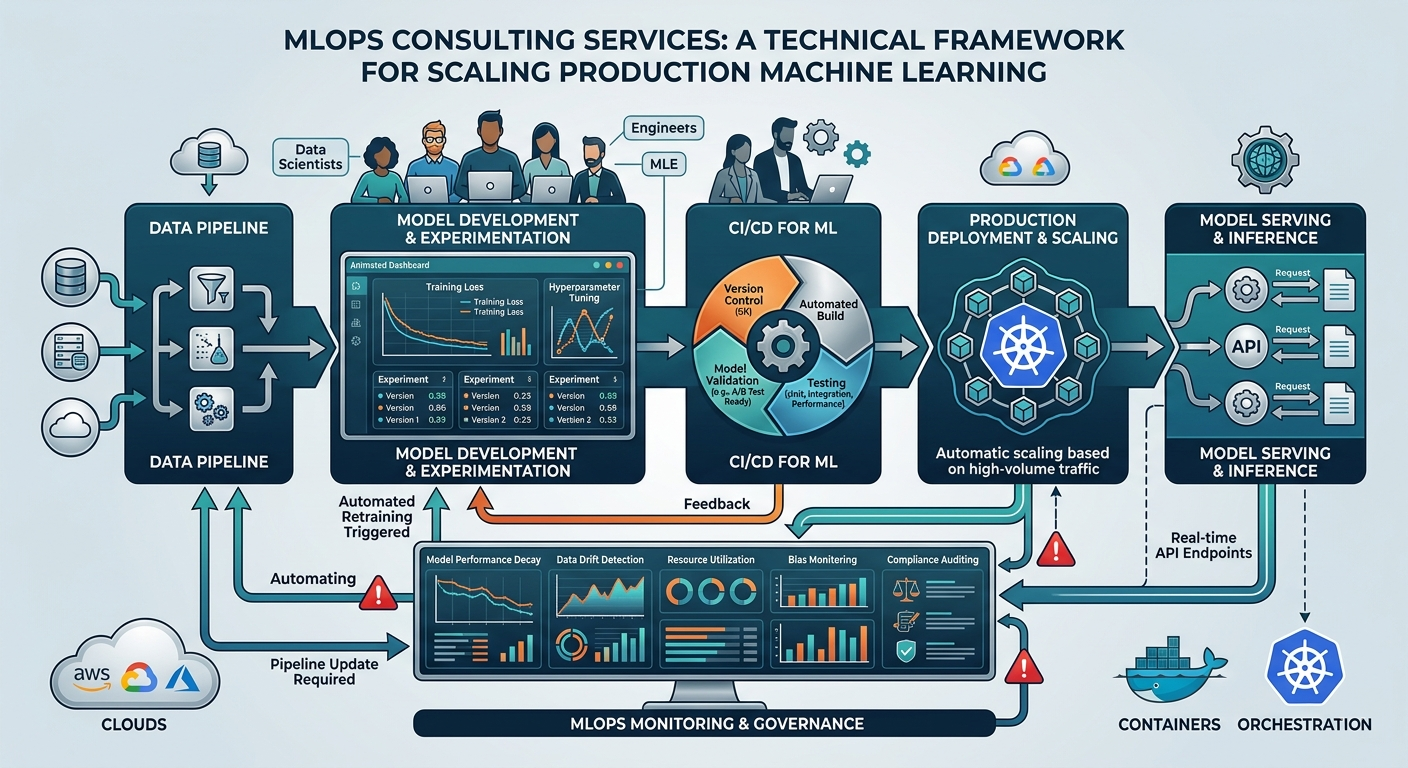
MLOps consulting services: A technical framework for scaling production machine learning
Operationalize ML with expert MLOps consulting. We bridge the gap between Data Science and DevOps using CI/CD/CT pipelines, automated drift detection, and feature stores to reduce Time-to-Value and technical debt. -
 March 12, 2026Read in 12 min.
Choosing your generative AI development company
Compare the best generative AI companies for your enterprise. From custom LLMs to agentic workflows, discover the top partners driving innovation and ROI in the AI-first era. -
 March 6, 2026Read in 15 min.
PyTorch vs TensorFlow: What’s the difference and which one wins
Stop choosing between research and production. Learn how Keras 3 and multi-backend architectures are unifying the AI ecosystem. A professional developer’s deep dive into performance, cost, and scalability. -
 March 5, 2026Read in 15 min.
Choosing the best MVP development companies
Top-rated agencies providing bespoke MVP software development services to help startups validate ideas and scale fast -
 March 4, 2026Read in 19 min.
Top software testing companies: Leading QA partners
Leading software testing companies. Compare top QA service providers, evaluation criteria, and industry trends to find your ideal partner. -
 February 28, 2026Read in 22 min.
Top 10 software development companies in the USA
Find the best US-based software developers. From AI to enterprise web apps, here are the top 10 software development companies in the USA you should hire in 2026. -
 February 25, 2026Read in 12 min.
Top 10 Node.js Development Companies
Industry's leading Node.js development companies. Our deep-dive review covers technical maturity, cloud-native expertise, and architectural standards to help you find the perfect software partner. -
 February 23, 2026Read in 16 min.
Top 10 mobile application development companies: Selection & industry leaders
Top 10 mobile application development companies for your next project. Compare top-rated mobile app developers, explore custom app development company profiles, and learn the secrets to a successful technical partnership. -
 February 23, 2026Read in 12 min.
How to choose the best Android app development agency: Rankings & selection criteria
Compare the leading Android development companies. Our guide highlights the top 10 firms for enterprise architecture, security, and custom app engineering. -
 February 19, 2026Read in 18 min.
IT Managed Service Providers (MSPs): Why does your business need one?
Stop guessing. Compare the 10 leading IT Managed Service Providers (MSPs) for any-sized companies. Find proven security, cloud, and 24/7 support. View the comparison! -
 February 19, 2026Read in 45 min.
Top 30 software development companies: Categories, red flags, and the selection strategy
We’ve analyzed the top 30 software development companies based on expertise, client results, and innovation. Find your ideal match here! -
 February 11, 2026Read in 18 min.
Top 10 Cloud migration companies: Strategic architecture of cloud migration
Compare the top 10 cloud migration companies based on architectural depth, FinOps integration, and modernization capabilities. Expert insights into AWS, Azure, and GCP transformation strategies for enterprise leaders. -
 February 10, 2026Read in 12 min.
Top 10 Flutter development companies: Entities, ecosystems, and strategic selection
Compare the world’s leading Flutter agencies. Our expert analysis covers the top 10 firms, evaluating their mastery of Dart, Skia performance, and Clean Architecture. -
 February 6, 2026Read in 19 min.
Top 10 React development companies: Architecting high-performance digital products
Top-rated React development companies for your next project. Our expert guide analyzes the best React JS web development agencies on performance, scalability, and tech standards -
 February 3, 2026Read in 11 min.
Top 10 Python Development Companies
Looking for a top Python development company? Compare the industry's leading Python software development agencies. Get insights on pricing, expertise, and how to hire a Python development firm that scales your business. -
 January 27, 2026Read in 15 min.
Top cloud application development companies you should follow
Best Cloud Application Development companies for your project. Compare expertise in AWS, Azure, & GCP. See client reviews, specialization, and costs for top Cloud-Native firms -
 January 23, 2026Read in 21 min.
Dedicated development team model: Definition, benefits, and nuances
Scale your product fast with a Dedicated Development Team. Compare DDT vs. outsourcing, analyze costs, and get a management blueprint for success. -
 January 21, 2026Read in 15 min.
Best energy software development companies to partnership
Top 10 energy sector software development leaders. Learn how to choose the right partner for your renewable energy software project. -
 January 19, 2026Read in 8 min.
The Low-Code Revolution in Oil & Gas: Accelerating Digital Transformation
From real-time well monitoring to automated safety permits - see how low-code applications drive operational efficiency and ESG compliance in the energy sector’s volatile market. -
 January 19, 2026Read in 18 min.
Top 10 desktop application development companies to watch
Compare the world’s best desktop development firms. From legacy modernization to high-performance C++ and cross-platform Electron apps, find your perfect vendor here. -
 December 24, 2025Read in 10 min.
Software development company in Florida: What we do, how we work, and where we add value
Florida's premier custom software partner for enterprise-grade applications. We specialize in fintech, healthcare, and scalable cloud systems. Innovate with Florida experts. -
 December 9, 2025Read in 10 min.
Custom software development for San Diego businesses
Find out about the demands of software development in San Diego and how local companies are adapting to technology needs. -
 December 9, 2025Read in 9 min.
Specifics and perspectives of custom software development in Los Angeles
Find out why choosing a custom software development company in Los Angeles is essential for evolving industries like fintech and healthcare. -
 December 6, 2025Read in 8 min.
Software development in San Francisco: Custom solutions for Area
Find out how software development in San Francisco sets standards in technology and customer satisfaction. -
 November 28, 2025Read in 14 min.
Custom software development in Houston: State and perspectives
Partner with a leading custom software development company in Houston to harness the power of technology for your growth. -
 November 28, 2025Read in 12 min.
Custom software development Dallas businesses need
Find out how a custom software development company in Dallas can elevate your business in a booming tech landscape filled with opportunities. -
 November 27, 2025Read in 11 min.
Software development services in Austin
Find out how a custom software development company in Austin can elevate your business in a booming tech landscape filled with opportunities. -
 November 12, 2025Read in 34 min.
Top FinTech software development companies: The core of modern finance
Compare the top-rated FinTech software developers based on expertise in AI, Blockchain, and compliance. Choose your perfect partner now! -
 November 4, 2025Read in 12 min.
AI in biotech: Application, specifics, and challenges
How AI and Machine Learning are transforming biotechnology, accelerating drug discovery, genome sequencing, and personalized medicine. Learn the applications, challenges, and future. -
 October 28, 2025Read in 20 min.
The best AI development companies in the US
The definitive guide to hiring the best AI development company. See our ranking by MLOps maturity, GenAI expertise, and verified client ROI. Get transparent costs and a partnership blueprint -
 October 20, 2025Read in 16 min.
How to hire the best ReactJS developers in a constantly growing market
Hire the top ReactJS developers. Get pre-vetted, senior React & Next.js engineers matched to your project in 48 hours. Start risk-free -
 October 16, 2025Read in 25 min.
Top 10 AI chatbot development companies
Leading chatbot development companies. Our expert guide helps you choose the best firm for AI chatbot solutions, custom development, and seamless integration -
 October 9, 2025Read in 17 min.
Top biotech software companies: Choosing the right tech partner for life-changing innovations
Leading biotech software companies impacting drug discovery, R&D, and lab operations. See how their innovative platforms are speeding up scientific breakthroughs. -
 September 30, 2025Read in 16 min.
All you need to know about custom software development for small business
Stop wasting time on workarounds! Discover how custom software development empowers your small business with tailored workflows, maximum efficiency, and predictable ROI. -
 September 4, 2025Read in 14 min.
Top 10 leading application modernization companies
Top 10 application modernization companies that can transform your business with cloud, AI, and microservices for agility and growth -
 August 28, 2025Read in 14 min.
Develop once, run everywhere: .NET Core cross-platform development
Struggling with multi-OS development? Discover how .NET empowers you to build versatile, high-performance applications that run seamlessly across Windows, macOS, and Linux with ease. -
 August 21, 2025Read in 14 min.
Why offshore .NET development is the best choice for your business
Struggling with talent shortages or escalating development costs? Explores how embracing offshore .NET development can be the strategic advantage your business needs to build innovative solutions faster and more cost-effectively. -
 August 18, 2025Read in 14 min.
.NET vs Java: Comparison, use cases, pros and cons
Unsure whether to use .NET or Java? This guide breaks down their strengths, weaknesses, and ideal applications to help you pick the best technology. -
 August 11, 2025Read in 24 min.
Top 10 Angular development companies to keep an eye on
Leading Angular development companies. Expert Angular developers offering top-tier web application development, consulting, and solutions for your next project. -
 August 7, 2025Read in 15 min.
Hire Angular developers: What you need to know
Need hire Angular developers? Get access to skilled, dedicated Angular teams for your web projects. We provide expert Angular solutions with flexible engagement models. Contact us today! -
 August 1, 2025Read in 9 min.
Why choose Angular for web development
Why Angular is a leading choice for web development. Learn about its powerful features, scalability, and benefits for building robust, high-performance applications. -
 August 1, 2025Read in 12 min.
Hiring .NET developers: Step-by-step guide
Frustrated with the challenges of hiring skilled .NET developers? This article provides a proven framework to help you find, vet, and hire the right talent for your team, avoiding common recruiting mistakes. -
 February 13, 2025Read in 15 min.
What is HMI development, and why is it trending now?
Human-Machine Interface (HMI) development is revolutionizing the way humans interact with machines, driving innovation across industries. -
 December 11, 2024Read in 10 min.
Python vs Java: Key differences, pros, and cons for developers
Key differences between Python and Java, including syntax, performance, and use cases. Find out which language suits your project best -
 October 10, 2024Read in 11 min.
The future of web development: WordPress vs React.js?
Confused between WordPress or React.js? Explore our detailed comparison to find out which platform suits your needs best -
 August 8, 2024Read in 14 min.
AD and Azure AD: What is the difference, and which is better for you?
Differences between Azure Active Directory (AAD) and traditional Active Directory (AD) in this comprehensive comparison. -
 August 5, 2024Read in 15 min.
ESG software development services: Effective ESG software solutions
Innovative ESG software solutions can help your business achieve its sustainability goals. Develop customized software that enhances environmental, social, and governance (ESG) performance, ensuring compliance and driving positive impact -
 July 31, 2024Read in 7 min.
Benefits of Azure Active Directory
Key benefits of Azure Active Directory(AD), including enhanced security, simplified management, and cost savings for your business -
 April 22, 2024Read in 12 min.
Software modernization: What is it & why it matters
Discover the essence of software modernization and its pivotal role in contemporary software development. Uncover why it's crucial. -
 April 22, 2024Read in 20 min.
Legacy app modernization: A comprehensive guide
Revitalize your business with our guide on legacy application modernization. Transform your legacy systems to make them more efficient and innovative. -
 April 22, 2024Read in 16 min.
Digital product design: What is it and why you need it
Unlock innovation with expert digital product design insights. Explore the latest trends and strategies for creating exceptional user experiences. -
 April 21, 2024Read in 11 min.
Healthcare product design: Tips for app development success
Explore the art of healthcare product design in our latest blog post. Discover how innovative design principles are shaping the future of medical solutions -
 April 18, 2024Read in 9 min.
Azure app modernization: Benefits of migrating to Microsoft
Key benefits of Azure app modernization and how migrating to Microsoft can enhance performance, scalability, and compliance -
 March 11, 2024Read in 12 min.
How to choose asset management software for oil and gas in 2026
Explore more ways to optimize operations and streamline processes in oil and gas. Follow our tips to choose the best-fit assent management software in 2026 -
 March 11, 2024Read in 13 min.
AI software development for oil and gas: A comprehensive guide
Explore the transformative power of artificial intelligence software development for oil and gas and the practices of global industry leaders in our blog. -
 March 11, 2024Read in 19 min.
Cloud application modernization: How to improve your app
Cloud application modernization makes app more competitive and business more profitable. The key strategies, tips, and its benefits — in this article! -
 March 11, 2024Read in 12 min.
Enterprise application modernization: Revolutionize your business
Future-proof your business with our guide to enterprise app modernization. Learn strategic approaches, key technologies, and best practices for legacy system transformation and enhanced agility -
 March 11, 2024Read in 12 min.
LIMS integration: Benefits & how it works
Can LIMS integration be called a CRM for laboratories? What to keep in mind during LIMS software development and integration? Find out more in our article. -
 March 11, 2024Read in 11 min.
Active directory integration: What is it & how to do it effectively
Discover seamless Active Directory integration strategies in our latest blog post. Optimize user management with the Blackthorn Vision team! -
 March 5, 2024Read in 15 min.
Mobile app UX design: Basics that will improve user experience
Mobile app UX design differs from the web. Explore these differences, the process, and the main pitfalls with our experts in this article. -
 March 5, 2024Read in 11 min.
HIPAA compliance checklist for healthcare software development 2026
Check the updated HIPAA security guidelines to ensure the safety and privacy of patients' data, it is important to adhere it when creating applications -
 March 5, 2024Read in 9 min.
How to use business process automation to improve oil and gas production
Discover how business process automation can help optimize oil and gas production and improve your bottom line. -
 March 3, 2024Read in 14 min.
Desktop to web migration: everything you need to know
Planning a desktop to web migration? Get essential insights on strategy, technical challenges, approaches, and how to successfully modernize your legacy application. -
 March 3, 2024Read in 11 min.
The process of application migration to the cloud: stages, approaches, and tools
Find out how to effectively migrate your legacy system and data to the cloud without disrupting your business processes. -
 March 3, 2024Read in 16 min.
Benefits of outsourcing software development
Key advantages of outsourcing software development for businesses. Learn how outsourcing can reduce costs, increase efficiency, and provide access to specialized expertise -
 March 3, 2024Read in 13 min.
Boosting cloud security in healthcare with Azure Cloud Services
Explore the most common challenges in the cloud security of healthcare organizations and discover our tips on eliminating them efficiently. -
 March 3, 2024Read in 19 min.
Healthcare app design: how to create a great user experience
Struggling with medical app UX? Get insights into user-centered design, crucial security measures, and future trends to create impactful healthcare applications. -
 March 3, 2024Read in 16 min.
MVP vs. prototype in startup software development: what’s the difference?
Crucial differences between MVP and Prototype in startup software development. Learn how Blackthorn Vision leverages both to build successful products, reduce risk, and accelerate your time-to-market -
 March 3, 2024Read in 12 min.
How to build a custom EHR solution: tips for decision makers
We can augment your talent pool with dedicated developers proficient in healthcare business automation. Check the success stories from our clients. -
 March 3, 2024Read in 7 min.
What is software as a medical device and why it matters for the healthcare industry
From developing SaMD and SiMD to building efficient EHR systems, we unleash the value of business process automation for healthcare providers. -
 March 3, 2024Read in 6 min.
An overview of medical biotechnology in 2026 and beyond
We offer a full cycle of software development for leading biotech companies - from idea visualization to building an MVP and fully-fledged product. -
 March 3, 2024Read in 9 min.
Smart farming: agricultural technology of the future
We have expertise in data analytics, AI, and Machine Learning to build game-changing software tailored for your agricultural business. -
 March 3, 2024Read in 7 min.
BV people: a talk with Head of HR and recruitment in Blackthorn Vision
BV people: a talk with the Head of HR and Recruitment on candidate selection, the company's ideals, and the current state of the Ukrainian IT industry. -
 March 3, 2024Read in 9 min.
What is robotic process automation and how it changes the travel and hospitality industry
How does RPA work and, most importantly, how to utilize it in your travel and hospitality business? Find out in our new article now. -
 March 3, 2024Read in 12 min.
An overview of agricultural biotechnology in 2026
We cooperated with agricultural biotechnology industry leaders to design software that helps scientists and farmers automate and optimize all processes. -
 March 3, 2024Read in 10 min.
Everything you need to know about Microsoft Azure: benefits, use cases, applications
Microsoft Azure is a leading cloud service provider that offers numerous opportunities for businesses to optimize and secure their operations and services. -
 March 3, 2024Read in 10 min.
Smart manufacturing technology and trends for 2026 and beyond
Stay updated on the latest manufacturing technology trends, that drives innovation, efficiency, and growth in the industry to boost your project. -
 March 3, 2024Read in 8 min.
How to choose and manage your dedicated development team
While there are many benefits of working with dedicated software development teams, it’s not a universal solution. Discover why it is so. -
 March 3, 2024Read in 8 min.
What is the best cloud deployment model? Types of cloud computing that will benefit your business
With the guidance of our post, you can better understand various cloud computing deployment strategies. Examine cloud solutions for your company's needs. -
 March 3, 2024Read in 10 min.
Offshore vs. Nearshore outsourcing: what’s best for your business?
What is the difference between the three outsourcing types, and which one is better for your business? Please read our article to find out! -
 March 3, 2024Read in 14 min.
How to develop a medical app for doctors: everything you need to know
The mobile health industry is one of the most rapidly growing segments worldwide. Learn more about the mHealth industry in our new article. -
 March 3, 2024Read in 14 min.
Business analyst: a leading player in your software development team
Your guide to the Business Analyst's vital role in software development teams, including Agile practices, key responsibilities, techniques, and delivering real business value. -
 March 3, 2024Read in 9 min.
Hyperautomation – the future of business processes
Now business processes - Hyperautomation are increasingly not following stable and predictable scenarios. It creates a need for a new type of automation. -
 March 3, 2024Read in 6 min.
The future of Oil and Gas: industry trends and software solutions
Keep up to date on the most recent oil and gas the industry trends, which are driving modifications in technology, sustainability, and energy exploration. -
 March 3, 2024Read in 6 min.
What is an MVP, and why is it necessary? Minimum viable product examples
Even if you have just a basic vision of what your app should do, we will develop a presentable product that you can pitch to investors. -
 March 3, 2024Read in 14 min.
Top 5 soft skills to work in it successfully and resources to develop them
Are soft skills the new hard skills? Can you make a successful career in IT if you are not an effective communicator or lack creativity? -
 March 3, 2024Read in 5 min.
Mobile app development: Xamarin.Forms — a cross-platform solution that responds to modern challenges
When it comes to mobile development, there is a wide variety of solutions. Xamarin.Forms is a cross-platform solution that responds to modern challenges. -
 February 27, 2024Read in 8 min.
Top 10 programming languages of the future for web and mobile app development
Let’s have a look at the most popular programming languages that may become your business workhorse. -
 February 6, 2024Read in 16 min.
Pharmaceutical software development: Unleashing pharma innovation
Explore the future of pharmaceutical software development: innovative solutions revolutionizing healthcare efficiency & precision.