



A software development methodology is a structured framework used to plan, manage, and control the process of developing an information system. It defines the roles, activities, and deliverables required to move a project from initial concept to final deployment and maintenance.
Software development methodologies: A complete guide from waterfall to AI-driven SDLC
 23 minutes read
Content
I suggest you know the principles and the definitions of the main methodologies that apply to software development. What will you be able to define them in the context of your teams, the specific codebases, projects, clients, and deadlines?
This guide is for technical decision-makers who need more than a summary or an abstract concept. You need to understand what are the common methods of software development, what each methodology actually costs, where it breaks, and how to construct a working hybrid before the project kick-off slide is even finished.
What is software development methodology?
Definition
Software design methodologies are structured systems of principles, practices, and roles that govern how a team moves from a problem statement to deployed, maintainable software. It determines how work is planned, how risk is managed, how progress is measured, and how teams communicate – both internally and with stakeholders.
Methodology is not process documentation. It’s the operating model underneath your process documentation.


Not sure if your current methodology is actually serving your team?
Business cost
Choose well, and your systems development methodology becomes an accelerant: faster decisions, cleaner handoffs, predictable delivery. Choose poorly or apply the right methodology in the wrong context, and you get the opposite: scope creep camouflaged by sprint ceremonies, compliance gaps that surface during audits, and a team running fast in the wrong direction.
Choosing wrong software development methods results in rework, attrition (developers leave dysfunctional processes), and strategic drift. A significant share of large software projects still fail or are substantially challenged, and methodology misalignment is consistently among the root causes.
Evolution
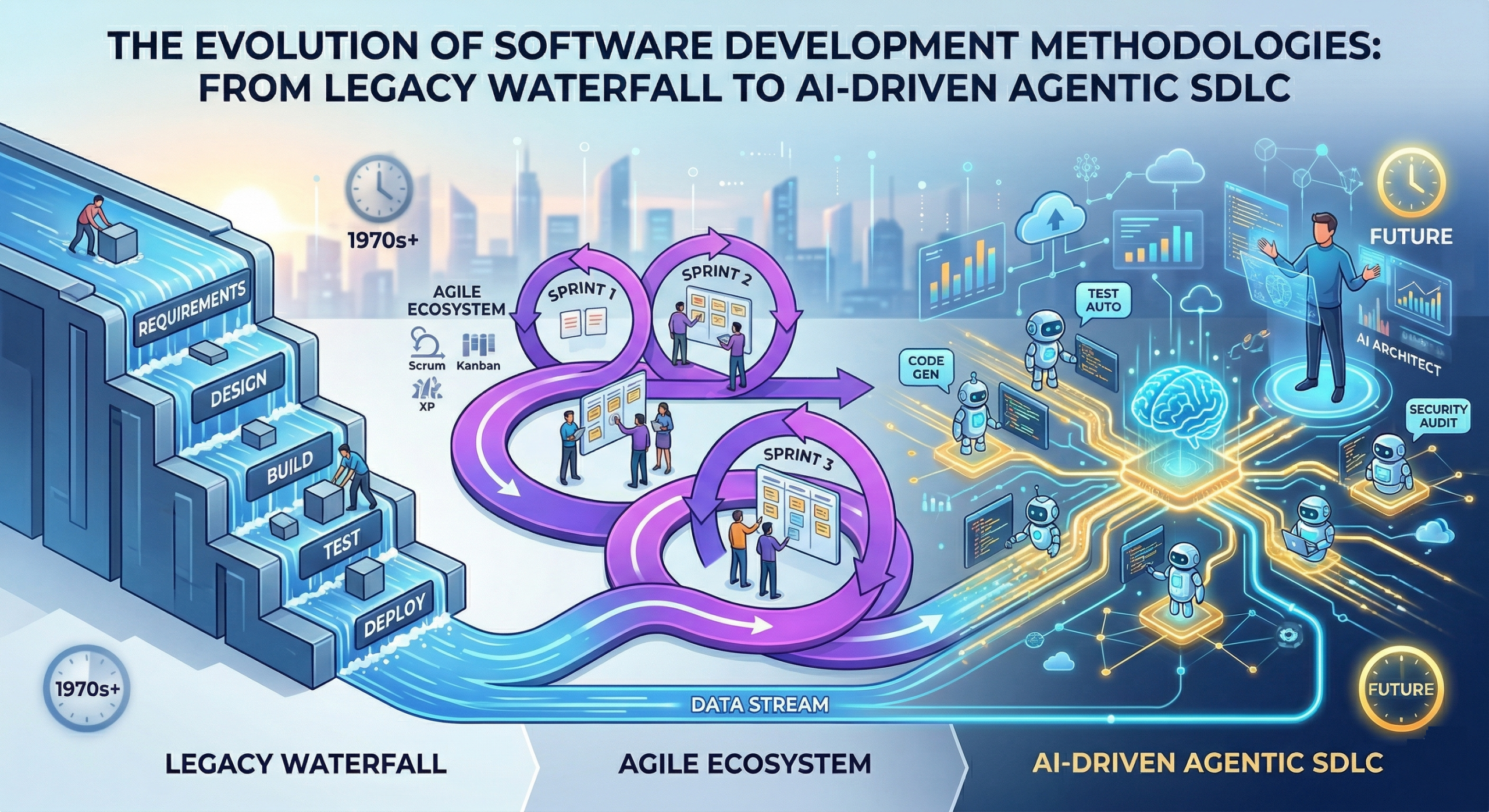
Software development methodologies have evolved in response to repeated, expensive failures:
- 1950s-70s: No formal methodology, projects ran on individual heroics.
- 1970s-80s: Waterfall emerges from manufacturing and defense.
- 1990s: The complexity of commercial software exposed Waterfall’s rigidity, and iterative approaches began to appear.
- 2001: The Agile Manifesto, which became a cultural shift as much as a process shift.
- 2010s: DevOps, Lean, and scaling frameworks close the gap between development speed and deployment reliability.
- 2020s: AI enters the development loop – first as a code assistant, then as an agent capable of autonomous task execution. The SDLC is being restructured again.
Understanding this arc is very important because every development methodology carries assumptions baked in at its founding moment. The failures of the ancestors became the pillars for the new ones. Consequently, applying a 1970s methodology to a 2025 AI-native product team is not just inefficient, it’s structurally incompatible.
Linear and traditional methodologies: Waterfall, V-model, and spiral
These software development processes and methodologies remain relevant in specific, well-defined contexts, particularly where compliance, documentation, and predictability are more important than adaptability. Let’s take a closer look at each of the models.
Waterfall
What it is: Sequential development in discrete phases: Requirements → Design → Implementation → Testing → Deployment → Maintenance. Each phase must be formally completed before the next begins.
Where it works: Government contracts, defense systems, medical device software, and any domain where requirements are legally fixed before development starts. If a regulator needs a complete design specification before approving development, Waterfall provides that audit trail.
Where it doesn’t: Any product where market requirements, user behavior, or technology can shift mid-project. Which, in 2026, is most products.
Decision signal: If your requirements document has legal standing or regulatory approval before development begins, Waterfall deserves serious consideration. If it doesn’t, look elsewhere.
V-model
What it is: An extension of Waterfall that pairs each development phase with a corresponding testing phase. Design → Acceptance Test Plan. Architecture → System Test Plan. Every build artifact has a mirror test artifact created in parallel.
Where it works: Safety-critical systems (medical devices, aerospace, automotive software, industrial control systems). It aligns with IEC 62304, ISO 26262, and similar standards.
The real value: V-Model makes test coverage a first-class deliverable, not an afterthought. You cannot skip a testing phase without explicitly breaking a documented contract — which is exactly what regulators want to see.
Cost: High upfront planning overhead. Changes late in the cycle are expensive. Expect up to half of total project time to be spent in documentation before you write a single line of code.
Spiral
What it is: An iterative model built around risk management. Each spiral cycle involves: planning → risk analysis → engineering → customer evaluation. You spiral outward, progressively elaborating the system while explicitly managing risk at each turn.
Where it works: Large, complex systems with significant technical uncertainty: enterprise platforms, defense systems, novel engineering problems. It’s the methodology for when you genuinely don’t know what you don’t know.
The catch: It requires skilled risk analysts and disciplined management. Without that, it collapses into expensive, unstructured iteration. It’s also rarely used in its pure form as most teams adopt its risk-management principles into hybrid models.
Types of software development methodologies: Scrum, Kanban, XP, and FDD
Despite the common belief, Agile is not a methodology. It’s a set of values and principles. So, what are software development methodologies, what principles they embody, and how they operationalize them?
Scrum
What it is: A lightweight framework built around fixed-length iterations (Sprints, typically 2 weeks), three roles (Product Owner, Scrum Master, Development Team), and four ceremonies (Sprint Planning, Daily Standup, Sprint Review, Sprint Retrospective).
What it does well: Creates a regular cadence for decision-making and a clear accountability structure. The Product Owner role forces prioritization – someone has to decide what goes into the Sprint backlog.
What it does poorly: Scrum says almost nothing about engineering practices. Teams that adopt Scrum without accompanying technical discipline (automated testing, CI/CD, clean code practices) often end up with a faster way to produce technical debt.
Decision signal: Scrum fits product teams building customer-facing software with active stakeholder involvement. It struggles with maintenance-heavy teams, infrastructure work, and projects where the work is not easily decomposed into two-week chunks.
Talk to our delivery team
about what Agile looks like when it’s working properly.
Kanban
What it is: A flow-based system that visualizes work on a board (columns representing workflow stages), limits Work in Progress (WIP), and optimizes for continuous delivery rather than iteration cycles.
The core mechanism: WIP limits. If your In progress column has a limit of 3 and it’s full, no new work starts until something moves. This forces teams to finish work rather than start new work, which is a discipline most teams lack.
Where it excels: Operations teams, support engineering, maintenance work, and any context where work arrives unpredictably and can’t be pre-batched into sprints.
Decision signal: If your team is regularly context-switching between urgent production issues and planned work, Kanban or a Scrum-Kanban hybrid gives more realistic throughput visibility than sprint velocity metrics.
Extreme programming (XP)
What it is: An Agile methodology built around engineering excellence. Its practices include: Test-Driven Development (TDD), pair programming, continuous integration, small releases, collective code ownership, and on-site customer collaboration.
What distinguishes it: XP is the only major Agile framework that mandates specific technical practices. This is its strength. Teams running XP tend to produce more maintainable codebases because the methodology builds quality in at the practice level.
The cost: Pair programming and TDD require discipline and often feel counterproductive to developers new to them. Organizations that try to adopt XP without management buy-in for its productivity model (which looks slower in the short term) typically abandon it within months.
Decision signal: XP is worth serious consideration for teams building software that must remain maintainable for years – complex domain logic, high-change business rules, fintech, healthcare records systems.
Feature-Driven Development (FDD)
What it is: A model-driven, iterative methodology that organizes development around a feature list derived from a domain model. Key practices include: developing an overall model, building a features list, planning by feature, designing by feature, and building by feature.
Where it fits: Mid-to-large teams (20-200+ developers) building complex domain systems. FDD provides structure that Scrum lacks at scale without requiring the overhead of Waterfall. It was influential in the 2000s, and many of its patterns appear in scaled Agile frameworks today.
Practical note: FDD is rarely adopted wholesale in greenfield projects today, but its feature-centric decomposition approach is useful in any context where domain modeling is a prerequisite to development.
Scaling and efficiency methodologies: Lean, SAFe, LeSS, and RAD
Lean software development
What it is: An adaptation of Toyota Production System principles to software: eliminate waste, amplify learning, decide as late as possible, deliver as fast as possible, empower the team, build integrity in, see the whole.
The seven wastes in the software context: Partially done work, extra processes, extra features (over-engineering), task switching, waiting, motion (unnecessary handoffs), and defects.
Why it matters for decision-makers: Lean is less a methodology and more a diagnostic lens. Running a Lean analysis on your current process often reveals that half of the cycle time is waiting – for approvals, environments, reviews, and deployments. That’s recoverable time without changing your core framework.
Decision signal: If your team’s delivery speed is limited by process overhead rather than technical complexity, apply Lean principles before adopting a new framework. Fix the system, not the people.
Scaling Agile (SAFe, LeSS, DaAD)
When a single Agile team becomes ten teams building interdependent software, Agile’s team-level ceremonies break down. Three frameworks attempt to solve this:
SAFe (Scaled Agile Framework): The most comprehensive and most controversial. Adds Program Increment (PI) Planning, Agile Release Trains (ARTs), and multiple organizational layers. It imposes significant structure and ceremony overhead but provides clear accountability and portfolio-level visibility. Common in large enterprises, financial institutions, and government agencies running 500+ engineers.
LeSS (Large-Scale Scrum): Takes the opposite approach: apply Scrum at scale with as little additional process as possible. One Product Backlog, one Product Owner, multiple teams. Less overhead than SAFe, but requires significant organizational discipline.
DaAD (Disciplined Agile at scale): A context-sensitive toolkit rather than a prescriptive framework. It maps decisions to contexts and lets teams choose practices based on their situation. More flexible than SAFe, more structured than LeSS.
How to decide: SAFe if you need audit trails and portfolio management for executives. LeSS if you want minimal overhead and strong Scrum discipline. DaAD, if your organization has enough process maturity to make context-driven choices without a prescriptive map.
Rapid Application Development (RAD)
What it is: A methodology prioritizing speed through prototyping, user feedback loops, and reuse of existing components. Requirements and design phases are compressed; the prototype is the specification.
Where it works: Internal tools, MVPs, proof-of-concept projects, and any situation where time-to-first-feedback matters more than architectural elegance.
The risk: RAD prototypes have a tendency to become production systems before anyone intended them to. “We’ll clean it up later” is one of the most expensive phrases in software development.
Decision signal: RAD is legitimate for bounded, low-stakes applications. Build in an explicit architectural review gate before any RAD prototype crosses into production infrastructure.
DevOps, DevSecOps, and platform engineering
DevOps
What it is: A cultural and technical movement that merges development and operations responsibilities, automates the software delivery pipeline, and enables continuous deployment. It’s not a framework, but a set of practices and a cultural posture.
The three ways: Flow (optimize delivery from dev to ops), Feedback (amplify signals from ops back to dev), Continuous Learning (build a culture of experimentation and improvement).
What it actually requires: Organizational restructuring. DevOps fails when it’s implemented as a tooling project (we bought Jenkins / GitLab CI / GitHub Actions) without changing who owns production reliability. The tools are the easy part.
Decision signal: If development teams deploy to production and own what they deploy, you have the cultural foundation for DevOps. If operations is a separate gating function that approves deployments, you have Waterfall with better tools.
DevSecOps
What it is: DevOps with security integrated at every pipeline stage – shift-left security. Threat modeling in design, SAST/DAST in CI pipelines, dependency scanning, secrets management, infrastructure-as-code security scanning, and runtime protection.
Why it’s no longer optional: The average time-to-exploit for a disclosed CVE has dropped to days. Security reviews at the end of a release cycle are too slow. DevSecOps is the architectural response.
Practical implementation: Start with the highest-leverage gates — dependency scanning (Snyk, Dependabot), secrets scanning (GitGuardian, GitHub Advanced Security), and container image scanning. Don’t try to implement the full security pipeline in one quarter.
Decision signal: If your organization handles customer PII, financial data, or operates in a regulated industry, DevSecOps is a compliance and risk management requirement, not a nice-to-have.
Platform engineering
What it is: Building and maintaining an internal developer platform (IDP) – a self-service layer of tools, templates, and automated workflows that lets product teams deploy, monitor, and scale applications without deep operations expertise.
The business case: Developer cognitive load is a real throughput constraint. When every team maintains its own Kubernetes configuration, CI pipeline, secrets management, and observability stack, you have N teams solving the same problems N times. Platform engineering centralizes that into a product that other teams consume.
The investment: Platform engineering requires treating your internal platform as a product – with a roadmap, SLOs, and dedicated engineers. Organizations that treat it as DevOps team doing extra work see a very low adoption.
Decision signal: If you have more than 5 product teams and significant time is being spent on infrastructure undifferentiated from team to team, Platform engineering has a calculable ROI.
FinOps-integrated development
What it this software development method: The practice of embedding cloud cost awareness into the development workflow – not as a post-deployment audit, but as a design and sprint-level constraint.
Why it matters now: Cloud-native architectures can generate cost surprises that dwarf the salary cost of the engineers who built the feature. A poorly tuned data pipeline, an unoptimized ML inference endpoint, or a misconfigured auto-scaling group can produce a five-figure monthly bill from a single sprint’s work.
In practice: Cost tagging in infrastructure-as-code, cost estimates in architectural decision records (ADRs), per-team cloud spend dashboards visible at the sprint level, and engineering involvement in reserved capacity planning.
Decision signal: If your cloud bill is growing faster than your revenue or user base, FinOps integration in development is the diagnostic starting point.
AI-augmented software development
Productivity gains, risks, and governance in AI-driven development
What it is: The use of AI models as active participants in the development cycle – code generation, code review, test generation, documentation, architectural analysis, and bug investigation.
Current state: AI coding assistants (GitHub Copilot, Cursor, JetBrains AI) are in production use across most technology organizations. Studies from Google, Microsoft, and academic institutions consistently show productivity gains of 20-55% on well-scoped coding tasks, with higher gains on boilerplate-heavy work and lower gains on complex algorithmic problems.
The governance gap: AI-generated code requires the same or even stricter review standards as human-generated code. Organizations that have relaxed code review rigor on AI-generated output are accumulating subtle bugs and security vulnerabilities that are harder to detect precisely because the code looks polished.
Decision signal: Establish AI code contribution policies before widespread adoption, not after. Define what AI tools are approved, what data can be sent to external models, and what review standards apply to AI-generated code.
Read also: AI data governance: Everything technology leaders need to know
Vibe coding and prompt-first development
What it is: A development mode where developer describes intent in natural language and iterates on AI-generated implementations, spending minimal time writing code directly.
The honest assessment: Vibe Coding is highly effective for prototyping, internal tooling, and well-understood problem domains. It has significant limitations for systems requiring deep domain knowledge, complex architectural decisions, or security-sensitive implementations. AI can generate a payment processing endpoint; whether it correctly handles idempotency, race conditions, and PCI scope is a different question.
Organizational risk: Junior developers who learn primarily through Vibe Coding may develop gaps in foundational understanding that become visible only under operational pressure – incidents, debugging sessions, architectural trade-offs.
Decision signal: Vibe Coding belongs in the prototyping and internal tooling category. Production systems require engineers who understand what the code does, regardless of who or what generated it.
Low-code and no-code in enterprise development
What it is: Platforms such as Retool, OutSystems, Mendix, Microsoft Power Platform, Bubble enable application development with minimal hand-coding – configuration-based UI building, workflow automation, and data integration.
Where it belongs: Internal operational tools, business process automation, reporting dashboards, approval workflows, and any application where the primary challenge is configuration rather than algorithmic complexity.
The enterprise reality: Low-code platforms work best at the edges of your technology stack, not at the core. They create problems when used to build systems with complex business logic, high transaction volumes, or strict performance requirements. They also create vendor lock-in that can be expensive to exit.
Green software engineering
What it is: The practice of designing software to minimize energy consumption and carbon footprint at the algorithmic, infrastructure, and architectural levels.
Why is it mentioned in the methodology conversation: The EU Corporate Sustainability Reporting Directive (CSRD) and similar regulations are pushing software’s energy footprint into ESG reporting scope. More directly, efficient code is also faster and cheaper to run which is exactly the point where the business case and the environmental case intersect.
In practice: Profiling energy consumption, preferring efficient algorithms over raw compute scaling, right-sizing cloud resources, choosing data center regions by carbon intensity, and making architectural choices (edge vs. cloud, batch vs. real-time) with energy cost as an explicit variable.
Decision signal: If your organization has ESG commitments or operates under sustainability reporting requirements, Green Engineering practices need to be present in your SDLC documentation. Even without regulatory pressure, computing efficiency has direct cost implications.
Software methodology comparison
| Methodology | Best fit | Risk profile | Team size | Change tolerance | Compliance readiness |
| Waterfall | Fixed-requirement, regulated | Low process, high change risk | Any | Very low | High |
| V-Model | Safety-critical systems | Very low process, high change risk | Mid- Large | Very low | Very high |
| Spiral | High-uncertainty, complex systems | Moderate | Mid- Large | Moderate | Moderate |
| Scrum | Product development, SaaS | Moderate | Small- Mid (5-9 per team) | High | Low- Moderate |
| Kanban | Ops, support, maintenance | Low | Any | Very High | Low |
| XP | Long-lived, complex domain software | Low (with discipline) | Small | High | Moderate |
| Lean | Process optimization | Low | Any | High | Low |
| SAFe | Large enterprise, regulated at scale | High overhead | Large (100+) | Moderate | High |
| DevOps | Cloud-native, continuous delivery | Moderate | Any | Very high | Moderate |
| DevSecOps | Regulated, security-sensitive | Moderate | Any | High | Very high |
| Platform Eng. | Multi-team organizations | High investment | Large | High | Moderate |
| AI-Augmented | Modern product teams | Tooling/governance risk | Any | Very high | Low (evolving) |
When software methodologies fail: Common red flags and how to spot them
If the methodology failed, it means some patterns were missed. These patterns tend to accumulate quietly, and usually arise from the sprint reviews nobody attends, architectural decisions made before the first ticket was written, or Confluence pages that describe a process the team stopped following months ago. Three patterns described below are the most common for organizations of different sizes. To have the ability to identify them directly means the ability to avoid them and to ensure the success and longevity of your project.
Zombie Scrum
If you have regular standups, the board full of columns, and regular retrospectives in your schedule, but nothing changes from sprint to sprint — the backlog grows without meaningful prioritization, retrospective action items carry forward indefinitely, and the Product Owner is either absent or functionally a ticket-taker rather than a decision-maker.
This situation is called Zombie Scrum – when Scrum is performed as a ritual rather than practiced as a system for delivering value. The root cause is almost always organizational. Scrum was adopted as a process without establishing the conditions it requires, such as an empowered Product Owner with genuine authority over scope, meaningful stakeholder participation in sprint reviews, and management trust in the team’s capacity to self-organize.
To fix this, you don’t need more Scrum. You actually need to stop running all these actions and define whether the foundational commitments are in place. Who owns the product? What does Done look like for this particular team? What is the team accountable for delivering, and to whom? Until those questions have real answers, you will not reach any measureable effect on outcomes.
Water-Agile-Fall
The Water-Agile-Fall pattern usually occurs like this: the development team runs sprints, and a backlog, a Scrum Master, and velocity metrics are in place. And yet requirements arrive as fully-specified documents after months of business analysis. Architecture is decided in a steering committee before development begins. The release date was fixed in a contract signed a year ago and cannot be moved regardless of what the team learns in the interim.
This pattern happens when Agile is adopted at the team level without any corresponding change to how the organization makes commitments. The team is iterating inside a waterfall container. The sprints are real, but there is no actual agility.
It’s a particularly expensive failure mode because it produces the overhead of both approaches without the benefits of either. The team carries the cost of Agile processes, while the organization carries the rigidity cost of sequential planning. Escaping it requires addressing the structures that sit above the development team: contract models, budget cycles, governance gates, and the tolerance for scope to evolve mid-project. Until those changes, asking the team to be more Agile is asking them to run faster inside a locked room.
The tooling trap
When engineers spend a significant amount of time configuring and maintaining the toolchain rather than building a product, the tools become the work.
The tooling trap springs when organizations mistake purchasing decisions for process decisions. Tools amplify existing processes – functional ones and dysfunctional ones equally. A planning process that produces unclear requirements will produce unclear Jira tickets. A deployment process with too many approval gates will reproduce those gates in the CI/CD pipeline. The tool makes the dysfunction more visible and more expensive, but it does not resolve it.
The discipline required before adding any new tool is the same in every case: define the process the tool is meant to support, and identify the specific, measurable signal that will tell you whether it is working. If neither of those things can be articulated clearly before the procurement decision, the tool is being used to avoid a harder organizational conversation, not to enable a better one.
How to choose a software development methodology: a step-by-step framework
Step 1: Map your constraints – budget, timeline, and compliance
Start with the things you can’t change. Regulatory requirements, contractual structures, compliance standards, and hard deadlines are constraints, they can not be negotiated.
To define your constraints, ask these three questions:
- What does our compliance environment require? (SOC 2, ISO 27001, HIPAA, FedRAMP, FDA, CE marking – each has methodology implications.) If certification requires complete design documentation before build, Waterfall or V-Model is not optional.
- What does our budget cycle look like? Annual fixed budgets favor phase-gate approaches. Rolling quarterly budgets enable iterative methodology.
- What is the actual deadline structure? Is there a hard external deadline (regulatory submission, contract delivery, market launch)? Or is the deadline a planning assumption? The answer changes the trade-off between speed and quality.
Step 2: Assess your team’s maturity, technical practices, and existing stack
Methodology choice is bounded by what your team can actually execute. It’s about your current capabilities, not about your goals or aspirations.
Team maturity signals:
- Can your team decompose a feature into testable increments? (Required for Scrum, XP)
- Do engineers own production reliability, or does a separate ops team? (Required for DevOps)
- Is there a functioning code review culture? (Required for any methodology to maintain quality)
- Can your team run a sprint without PM intervention on daily decisions? (Required for genuine Agile)
Tech stack signals:
- Automated test coverage below 40% makes continuous deployment risky regardless of methodology.
- Manual deployment processes cap delivery frequency – a DevOps aspiration without deployment automation is performance without substance.
- Legacy monoliths change the economics of iterative delivery – factor in refactoring cost when choosing a methodology.
Step 3: Design your hybrid methodology
Most organizations run a textbook methodology. The difference hides in the definition of your principled hybrid.
A principled hybrid is one where:
- The core delivery model is clearly defined (Scrum for product teams, for example)
- Supplementary practices are explicitly chosen for specific needs (Kanban for ops, V-Model documentation for compliance artifacts, DevSecOps pipeline for all teams)
- Trade-offs between frameworks are documented and understood
- The hybrid is reviewed and adjusted as the organization scales
An unprincipled hybrid is what you get when teams adopt practices opportunistically, abandon them when they create friction, and can’t articulate why they do what they do. Document your methodology stack the same way you document your architecture. It should be a living decision record, not an onboarding slide.
Conclusion
Methodology debates often generate more heat than light because they’re proxies for deeper organizational questions: Who owns decisions? How much uncertainty can we tolerate? What are we actually optimizing for?
What separates organizations that get the methodologies and tooling question right from those that don’t is not the methodology itself but the questions they ask before choosing, and whether they had the discipline to evaluate and adjust after.
At Blackthorn Vision, we help teams design and implement systems development methods that match their actual constraints, not their aspirational ones. If you’re evaluating a methodology change, a scaling challenge, or building a platform engineering function, let’s have a direct conversation about your context.
FAQ
What is a software development methodology?
How do I choose the right methodology for my project?
The choice depends on several factors:
- Project Size & Complexity: Agile is great for complexity; Waterfall is better for simple, fixed scopes.
- Regulatory Requirements: Highly regulated industries (like MedTech) often require the documentation-heavy V-Model or Waterfall.
- Team Expertise: Modern methodologies like DevSecOps require a high level of technical maturity.
- Time to Market: If speed is the priority, Lean or AI-driven methodologies are usually the best choice.
Can you combine different methodologies?
Yes, this is known as a Hybrid Methodology. Many organizations use a “Water-Agile” approach—applying Waterfall for high-level planning and budgeting, while using Agile/Scrum for the actual execution and development of the software.
What is "Platform Engineering" and how does it fit in?
Platform Engineering is a methodology focused on building internal developer platforms (IDPs). It aims to reduce the cognitive load on developers by providing self-service tools and automated infrastructure, effectively acting as an evolution of DevOps for larger enterprises.
How does AI affect modern development methodologies?
AI has introduced the Agentic SDLC, where AI agents assist in automated code generation, real-time bug detection, and predictive project management. This allows teams to move away from rigid manual “sprints” toward a more fluid, continuous stream of AI-assisted development.
Agile vs. Waterfall: What is the main difference?
The primary difference lies in the approach to change and sequence:
- Waterfall is a linear, sequential approach where each phase (requirements, design, etc.) must be completed before the next begins. It is best for projects with fixed requirements.
- Agile is iterative and incremental. It focuses on continuous feedback and allows for changes at any stage of the development process.
Which software development methodology is most popular today?
As of 2026, Agile (specifically Scrum) remains the most widely used methodology due to its flexibility. However, it is increasingly being integrated with DevOps practices and AI-augmented workflows to accelerate delivery cycles and improve code quality.
You may also like
-
 April 9, 2026Read in 10 min.
Microsoft PowerApps development services
Accelerate your digital transformation with expert PowerApps development services. We build custom, low-code mobile and web apps that integrate seamlessly with Microsoft 365, SQL, and your existing APIs. Get a free consultation today. -
 April 8, 2026Read in 11 min.
Top 10 Offshore software development companies: Expert review
Don't settle for legacy code. Discover the top offshore software development services company list, featuring vendors with advanced AI-tooling and DevOps maturity -
 April 3, 2026Read in 31 min.
AI software development services: A complete guide for business leaders and decision-makers
Transform your business with expert AI software development services. We build custom GenAI, machine learning, and autonomous agent solutions tailored for enterprise ROI. Get a free consultation today! -
 April 1, 2026Read in 17 min.
The strategic hub: Why global leaders choose software development outsourcing in Ukraine
Why global leaders choose software development outsourcing in Ukraine. Explore the top 10 IT companies, specialized tech stacks, and how to scale your business with a dedicated Ukrainian development team. -
 March 31, 2026Read in 19 min.
Selecting the best Java development companies
Leading Java development companies. Analyzes top-tier Java software development services, evaluation criteria, and delivery models to help you find the perfect strategic partner for scalable enterprise solutions -
 March 31, 2026Read in 14 min.
Top progressive web app development companies
Partner with a leading progressive web application development company. Explore our list of top PWA developers in the USA and globally, offering high-speed, offline-ready, and SEO-friendly web app solutions -
 March 23, 2026Read in 23 min.
Why data warehouses fail and how to design one that doesn’t
top building data swamps. Explore the evolution of DWH design, including ELT workflows, Data Vault 2.0, and high-performance cloud modeling strategies -
 March 18, 2026Read in 13 min.
Choosing React Native app development company
Partner with a premier react native development company. Compare the top 10 firms offering elite react native app development services for high-performance apps. -
 March 17, 2026Read in 15 min.
Choosing the Right Computer Vision Development Company for Your Project
From computer vision consulting to full-scale software development, learn how modern vision systems automate defect detection and optimize operations across healthcare, retail, and manufacturing. -
 March 16, 2026Read in 12 min.
AI in data governance: Everything technology leaders need to know
Master Data Governance for AI. Learn how to manage data drift, bias mitigation, and active metadata using NIST standards. Expert guide on MLOps, RAG security, and EU AI Act compliance for 2026. -
 March 16, 2026Read in 16 min.
MLOps consulting services: A technical framework for scaling production machine learning
Operationalize ML with expert MLOps consulting. We bridge the gap between Data Science and DevOps using CI/CD/CT pipelines, automated drift detection, and feature stores to reduce Time-to-Value and technical debt. -
 March 12, 2026Read in 12 min.
Choosing your generative AI development company
Compare the best generative AI companies for your enterprise. From custom LLMs to agentic workflows, discover the top partners driving innovation and ROI in the AI-first era. -
 March 6, 2026Read in 15 min.
PyTorch vs TensorFlow: What’s the difference and which one wins
Stop choosing between research and production. Learn how Keras 3 and multi-backend architectures are unifying the AI ecosystem. A professional developer’s deep dive into performance, cost, and scalability. -
 March 5, 2026Read in 15 min.
Choosing the best MVP development companies
Top-rated agencies providing bespoke MVP software development services to help startups validate ideas and scale fast -
 March 4, 2026Read in 19 min.
Top software testing companies: Leading QA partners
Leading software testing companies. Compare top QA service providers, evaluation criteria, and industry trends to find your ideal partner. -
 February 28, 2026Read in 22 min.
Top 10 software development companies in the USA
Find the best US-based software developers. From AI to enterprise web apps, here are the top 10 software development companies in the USA you should hire in 2026. -
 February 25, 2026Read in 12 min.
Top 10 Node.js Development Companies
Industry's leading Node.js development companies. Our deep-dive review covers technical maturity, cloud-native expertise, and architectural standards to help you find the perfect software partner. -
 February 23, 2026Read in 16 min.
Top 10 mobile application development companies: Selection & industry leaders
Top 10 mobile application development companies for your next project. Compare top-rated mobile app developers, explore custom app development company profiles, and learn the secrets to a successful technical partnership. -
 February 23, 2026Read in 12 min.
How to choose the best Android app development agency: Rankings & selection criteria
Compare the leading Android development companies. Our guide highlights the top 10 firms for enterprise architecture, security, and custom app engineering. -
 February 19, 2026Read in 18 min.
IT Managed Service Providers (MSPs): Why does your business need one?
Stop guessing. Compare the 10 leading IT Managed Service Providers (MSPs) for any-sized companies. Find proven security, cloud, and 24/7 support. View the comparison! -
 February 19, 2026Read in 45 min.
Top 30 software development companies: Categories, red flags, and the selection strategy
We’ve analyzed the top 30 software development companies based on expertise, client results, and innovation. Find your ideal match here! -
 February 11, 2026Read in 18 min.
Top 10 Cloud migration companies: Strategic architecture of cloud migration
Compare the top 10 cloud migration companies based on architectural depth, FinOps integration, and modernization capabilities. Expert insights into AWS, Azure, and GCP transformation strategies for enterprise leaders. -
 February 10, 2026Read in 12 min.
Top 10 Flutter development companies: Entities, ecosystems, and strategic selection
Compare the world’s leading Flutter agencies. Our expert analysis covers the top 10 firms, evaluating their mastery of Dart, Skia performance, and Clean Architecture. -
 February 6, 2026Read in 19 min.
Top 10 React development companies: Architecting high-performance digital products
Top-rated React development companies for your next project. Our expert guide analyzes the best React JS web development agencies on performance, scalability, and tech standards -
 February 3, 2026Read in 24 min.
Web application development companies: How to choose the right partner
Find the right web app development company. Explore services, technologies, engagement models, and 10 expert tips for choosing your strategic development partner. -
 February 3, 2026Read in 11 min.
Top 10 Python Development Companies
Looking for a top Python development company? Compare the industry's leading Python software development agencies. Get insights on pricing, expertise, and how to hire a Python development firm that scales your business. -
 January 27, 2026Read in 15 min.
Top cloud application development companies you should follow
Best Cloud Application Development companies for your project. Compare expertise in AWS, Azure, & GCP. See client reviews, specialization, and costs for top Cloud-Native firms -
 January 23, 2026Read in 21 min.
Dedicated development team model: Definition, benefits, and nuances
Scale your product fast with a Dedicated Development Team. Compare DDT vs. outsourcing, analyze costs, and get a management blueprint for success. -
 January 21, 2026Read in 15 min.
Best energy software development companies to partnership
Top 10 energy sector software development leaders. Learn how to choose the right partner for your renewable energy software project. -
 January 19, 2026Read in 8 min.
The Low-Code Revolution in Oil & Gas: Accelerating Digital Transformation
From real-time well monitoring to automated safety permits - see how low-code applications drive operational efficiency and ESG compliance in the energy sector’s volatile market. -
 January 19, 2026Read in 18 min.
Top 10 desktop application development companies to watch
Compare the world’s best desktop development firms. From legacy modernization to high-performance C++ and cross-platform Electron apps, find your perfect vendor here. -
 December 24, 2025Read in 10 min.
Software development company in Florida: What we do, how we work, and where we add value
Florida's premier custom software partner for enterprise-grade applications. We specialize in fintech, healthcare, and scalable cloud systems. Innovate with Florida experts. -
 December 9, 2025Read in 10 min.
Custom software development for San Diego businesses
Find out about the demands of software development in San Diego and how local companies are adapting to technology needs. -
 December 9, 2025Read in 9 min.
Specifics and perspectives of custom software development in Los Angeles
Find out why choosing a custom software development company in Los Angeles is essential for evolving industries like fintech and healthcare. -
 December 6, 2025Read in 8 min.
Software development in San Francisco: Custom solutions for Area
Find out how software development in San Francisco sets standards in technology and customer satisfaction. -
 November 28, 2025Read in 14 min.
Custom software development in Houston: State and perspectives
Partner with a leading custom software development company in Houston to harness the power of technology for your growth. -
 November 28, 2025Read in 12 min.
Custom software development Dallas businesses need
Find out how a custom software development company in Dallas can elevate your business in a booming tech landscape filled with opportunities. -
 November 27, 2025Read in 11 min.
Software development services in Austin
Find out how a custom software development company in Austin can elevate your business in a booming tech landscape filled with opportunities. -
 November 12, 2025Read in 34 min.
Top FinTech software development companies: The core of modern finance
Compare the top-rated FinTech software developers based on expertise in AI, Blockchain, and compliance. Choose your perfect partner now! -
 November 4, 2025Read in 12 min.
AI in biotech: Application, specifics, and challenges
How AI and Machine Learning are transforming biotechnology, accelerating drug discovery, genome sequencing, and personalized medicine. Learn the applications, challenges, and future. -
 October 28, 2025Read in 20 min.
The best AI development companies in the US
The definitive guide to hiring the best AI development company. See our ranking by MLOps maturity, GenAI expertise, and verified client ROI. Get transparent costs and a partnership blueprint -
 October 20, 2025Read in 16 min.
How to hire the best ReactJS developers in a constantly growing market
Hire the top ReactJS developers. Get pre-vetted, senior React & Next.js engineers matched to your project in 48 hours. Start risk-free -
 October 16, 2025Read in 25 min.
Top 10 AI chatbot development companies
Leading chatbot development companies. Our expert guide helps you choose the best firm for AI chatbot solutions, custom development, and seamless integration -
 October 9, 2025Read in 17 min.
Top biotech software companies: Choosing the right tech partner for life-changing innovations
Leading biotech software companies impacting drug discovery, R&D, and lab operations. See how their innovative platforms are speeding up scientific breakthroughs. -
 September 30, 2025Read in 16 min.
All you need to know about custom software development for small business
Stop wasting time on workarounds! Discover how custom software development empowers your small business with tailored workflows, maximum efficiency, and predictable ROI. -
 September 4, 2025Read in 14 min.
Top 10 leading application modernization companies
Top 10 application modernization companies that can transform your business with cloud, AI, and microservices for agility and growth -
 August 28, 2025Read in 14 min.
Develop once, run everywhere: .NET Core cross-platform development
Struggling with multi-OS development? Discover how .NET empowers you to build versatile, high-performance applications that run seamlessly across Windows, macOS, and Linux with ease. -
 August 21, 2025Read in 14 min.
Why offshore .NET development is the best choice for your business
Struggling with talent shortages or escalating development costs? Explores how embracing offshore .NET development can be the strategic advantage your business needs to build innovative solutions faster and more cost-effectively. -
 August 18, 2025Read in 14 min.
.NET vs Java: Comparison, use cases, pros and cons
Unsure whether to use .NET or Java? This guide breaks down their strengths, weaknesses, and ideal applications to help you pick the best technology. -
 August 11, 2025Read in 24 min.
Top 10 Angular development companies to keep an eye on
Leading Angular development companies. Expert Angular developers offering top-tier web application development, consulting, and solutions for your next project. -
 August 7, 2025Read in 15 min.
Hire Angular developers: What you need to know
Need hire Angular developers? Get access to skilled, dedicated Angular teams for your web projects. We provide expert Angular solutions with flexible engagement models. Contact us today! -
 August 1, 2025Read in 9 min.
Why choose Angular for web development
Why Angular is a leading choice for web development. Learn about its powerful features, scalability, and benefits for building robust, high-performance applications. -
 August 1, 2025Read in 12 min.
Hiring .NET developers: Step-by-step guide
Frustrated with the challenges of hiring skilled .NET developers? This article provides a proven framework to help you find, vet, and hire the right talent for your team, avoiding common recruiting mistakes. -
 February 13, 2025Read in 15 min.
What is HMI development, and why is it trending now?
Human-Machine Interface (HMI) development is revolutionizing the way humans interact with machines, driving innovation across industries. -
 December 11, 2024Read in 10 min.
Python vs Java: Key differences, pros, and cons for developers
Key differences between Python and Java, including syntax, performance, and use cases. Find out which language suits your project best -
 October 10, 2024Read in 11 min.
The future of web development: WordPress vs React.js?
Confused between WordPress or React.js? Explore our detailed comparison to find out which platform suits your needs best -
 August 8, 2024Read in 14 min.
AD and Azure AD: What is the difference, and which is better for you?
Differences between Azure Active Directory (AAD) and traditional Active Directory (AD) in this comprehensive comparison. -
 August 5, 2024Read in 15 min.
ESG software development services: Effective ESG software solutions
Innovative ESG software solutions can help your business achieve its sustainability goals. Develop customized software that enhances environmental, social, and governance (ESG) performance, ensuring compliance and driving positive impact -
 July 31, 2024Read in 7 min.
Benefits of Azure Active Directory
Key benefits of Azure Active Directory(AD), including enhanced security, simplified management, and cost savings for your business -
 April 22, 2024Read in 12 min.
Software modernization: What is it & why it matters
Discover the essence of software modernization and its pivotal role in contemporary software development. Uncover why it's crucial. -
 April 22, 2024Read in 20 min.
Legacy app modernization: A comprehensive guide
Revitalize your business with our guide on legacy application modernization. Transform your legacy systems to make them more efficient and innovative. -
 April 22, 2024Read in 16 min.
Digital product design: What is it and why you need it
Unlock innovation with expert digital product design insights. Explore the latest trends and strategies for creating exceptional user experiences. -
 April 21, 2024Read in 11 min.
Healthcare product design: Tips for app development success
Explore the art of healthcare product design in our latest blog post. Discover how innovative design principles are shaping the future of medical solutions -
 April 18, 2024Read in 9 min.
Azure app modernization: Benefits of migrating to Microsoft
Key benefits of Azure app modernization and how migrating to Microsoft can enhance performance, scalability, and compliance -
 March 11, 2024Read in 12 min.
How to choose asset management software for oil and gas in 2026
Explore more ways to optimize operations and streamline processes in oil and gas. Follow our tips to choose the best-fit assent management software in 2026 -
 March 11, 2024Read in 13 min.
AI software development for oil and gas: A comprehensive guide
Explore the transformative power of artificial intelligence software development for oil and gas and the practices of global industry leaders in our blog. -
 March 11, 2024Read in 19 min.
Cloud application modernization: How to improve your app
Cloud application modernization makes app more competitive and business more profitable. The key strategies, tips, and its benefits — in this article! -
 March 11, 2024Read in 12 min.
Enterprise application modernization: Revolutionize your business
Future-proof your business with our guide to enterprise app modernization. Learn strategic approaches, key technologies, and best practices for legacy system transformation and enhanced agility -
 March 11, 2024Read in 12 min.
LIMS integration: Benefits & how it works
Can LIMS integration be called a CRM for laboratories? What to keep in mind during LIMS software development and integration? Find out more in our article. -
 March 11, 2024Read in 11 min.
Active directory integration: What is it & how to do it effectively
Discover seamless Active Directory integration strategies in our latest blog post. Optimize user management with the Blackthorn Vision team! -
 March 5, 2024Read in 15 min.
Mobile app UX design: Basics that will improve user experience
Mobile app UX design differs from the web. Explore these differences, the process, and the main pitfalls with our experts in this article. -
 March 5, 2024Read in 11 min.
HIPAA compliance checklist for healthcare software development 2026
Check the updated HIPAA security guidelines to ensure the safety and privacy of patients' data, it is important to adhere it when creating applications -
 March 5, 2024Read in 9 min.
How to use business process automation to improve oil and gas production
Discover how business process automation can help optimize oil and gas production and improve your bottom line. -
 March 3, 2024Read in 14 min.
Desktop to web migration: everything you need to know
Planning a desktop to web migration? Get essential insights on strategy, technical challenges, approaches, and how to successfully modernize your legacy application. -
 March 3, 2024Read in 11 min.
The process of application migration to the cloud: stages, approaches, and tools
Find out how to effectively migrate your legacy system and data to the cloud without disrupting your business processes. -
 March 3, 2024Read in 16 min.
Benefits of outsourcing software development
Key advantages of outsourcing software development for businesses. Learn how outsourcing can reduce costs, increase efficiency, and provide access to specialized expertise -
 March 3, 2024Read in 13 min.
Boosting cloud security in healthcare with Azure Cloud Services
Explore the most common challenges in the cloud security of healthcare organizations and discover our tips on eliminating them efficiently. -
 March 3, 2024Read in 19 min.
Healthcare app design: how to create a great user experience
Struggling with medical app UX? Get insights into user-centered design, crucial security measures, and future trends to create impactful healthcare applications. -
 March 3, 2024Read in 16 min.
MVP vs. prototype in startup software development: what’s the difference?
Crucial differences between MVP and Prototype in startup software development. Learn how Blackthorn Vision leverages both to build successful products, reduce risk, and accelerate your time-to-market -
 March 3, 2024Read in 12 min.
How to build a custom EHR solution: tips for decision makers
We can augment your talent pool with dedicated developers proficient in healthcare business automation. Check the success stories from our clients. -
 March 3, 2024Read in 7 min.
What is software as a medical device and why it matters for the healthcare industry
From developing SaMD and SiMD to building efficient EHR systems, we unleash the value of business process automation for healthcare providers. -
 March 3, 2024Read in 6 min.
An overview of medical biotechnology in 2026 and beyond
We offer a full cycle of software development for leading biotech companies - from idea visualization to building an MVP and fully-fledged product. -
 March 3, 2024Read in 9 min.
Smart farming: agricultural technology of the future
We have expertise in data analytics, AI, and Machine Learning to build game-changing software tailored for your agricultural business. -
 March 3, 2024Read in 7 min.
BV people: a talk with Head of HR and recruitment in Blackthorn Vision
BV people: a talk with the Head of HR and Recruitment on candidate selection, the company's ideals, and the current state of the Ukrainian IT industry. -
 March 3, 2024Read in 9 min.
What is robotic process automation and how it changes the travel and hospitality industry
How does RPA work and, most importantly, how to utilize it in your travel and hospitality business? Find out in our new article now. -
 March 3, 2024Read in 12 min.
An overview of agricultural biotechnology in 2026
We cooperated with agricultural biotechnology industry leaders to design software that helps scientists and farmers automate and optimize all processes. -
 March 3, 2024Read in 10 min.
Everything you need to know about Microsoft Azure: benefits, use cases, applications
Microsoft Azure is a leading cloud service provider that offers numerous opportunities for businesses to optimize and secure their operations and services. -
 March 3, 2024Read in 10 min.
Smart manufacturing technology and trends for 2026 and beyond
Stay updated on the latest manufacturing technology trends, that drives innovation, efficiency, and growth in the industry to boost your project. -
 March 3, 2024Read in 8 min.
How to choose and manage your dedicated development team
While there are many benefits of working with dedicated software development teams, it’s not a universal solution. Discover why it is so. -
 March 3, 2024Read in 8 min.
What is the best cloud deployment model? Types of cloud computing that will benefit your business
With the guidance of our post, you can better understand various cloud computing deployment strategies. Examine cloud solutions for your company's needs. -
 March 3, 2024Read in 10 min.
Offshore vs. Nearshore outsourcing: what’s best for your business?
What is the difference between the three outsourcing types, and which one is better for your business? Please read our article to find out! -
 March 3, 2024Read in 14 min.
How to develop a medical app for doctors: everything you need to know
The mobile health industry is one of the most rapidly growing segments worldwide. Learn more about the mHealth industry in our new article. -
 March 3, 2024Read in 14 min.
Business analyst: a leading player in your software development team
Your guide to the Business Analyst's vital role in software development teams, including Agile practices, key responsibilities, techniques, and delivering real business value. -
 March 3, 2024Read in 9 min.
Hyperautomation – the future of business processes
Now business processes - Hyperautomation are increasingly not following stable and predictable scenarios. It creates a need for a new type of automation. -
 March 3, 2024Read in 6 min.
The future of Oil and Gas: industry trends and software solutions
Keep up to date on the most recent oil and gas the industry trends, which are driving modifications in technology, sustainability, and energy exploration. -
 March 3, 2024Read in 6 min.
What is an MVP, and why is it necessary? Minimum viable product examples
Even if you have just a basic vision of what your app should do, we will develop a presentable product that you can pitch to investors. -
 March 3, 2024Read in 14 min.
Top 5 soft skills to work in it successfully and resources to develop them
Are soft skills the new hard skills? Can you make a successful career in IT if you are not an effective communicator or lack creativity? -
 March 3, 2024Read in 5 min.
Mobile app development: Xamarin.Forms — a cross-platform solution that responds to modern challenges
When it comes to mobile development, there is a wide variety of solutions. Xamarin.Forms is a cross-platform solution that responds to modern challenges. -
 February 27, 2024Read in 8 min.
Top 10 programming languages of the future for web and mobile app development
Let’s have a look at the most popular programming languages that may become your business workhorse. -
 February 6, 2024Read in 16 min.
Pharmaceutical software development: Unleashing pharma innovation
Explore the future of pharmaceutical software development: innovative solutions revolutionizing healthcare efficiency & precision.