



Beyond general software engineering skills, you should prioritize technical depth in specific AI architectures (like CNNs or Transformers) and a proven track record of hardware-software integration. A high-quality computer vision software company will demonstrate a strong data strategy, showing how they handle data labeling, synthetic data, and “edge cases” that occur in real-world environments.
Choosing the Right Computer Vision Development Company for Your Project
 15 minutes read
Content
As digital transformation advances, demand for specialized firms grows. The right partner understands both hardware constraints and algorithmic efficiency.
This evolving landscape calls for a different breed of expertise. Success in this market requires deep expertise in image data processing across sectors. Unlike general IT firms, dedicated computer vision companies offer superior mathematical precision and hardware knowledge. They transform raw image data into actionable insights through real-time object detection (identifying objects in images as they appear) or facial recognition (detecting and verifying individuals’ faces). The objective is to develop digital vision systems that outperform humans in speed, accuracy, and reliability.
Understanding the complexity and demands of computer vision
Many organizations now consider outsourcing as a strategic approach. Why outsource computer vision development? A primary reason to outsource computer vision development is the scarcity of specialized talent. Building an in-house team requires experts in linear algebra, calculus, and deep learning, including CNNs and ViTs. Recruiting and retaining PhDs and senior researchers is costly and time-consuming. Partnering with an established firm grants immediate access to experienced professionals skilled in training complex models and managing large datasets.
In addition to accessing scarce talent, outsourcing computer vision development reduces infrastructure costs. Providers already possess the necessary GPU arrays and data labeling pipelines, which lowers upfront expenses and often delivers ROI within 12 to 18 months. Proprietary frameworks and pre-trained models also accelerate deployment, enabling rapid implementation of scalable solutions.
Core Services Offered by Top CV Companies
A comprehensive computer vision partner offers services beyond basic image recognition (identifying simple image features), including image and video analysis such as object detection (locating and identifying objects), tracking (following objects across frames), and semantic segmentation (assigning a label to every pixel in an image). These tools enable machines to identify items, track movement, and understand context. In retail and logistics, this might involve monitoring customer journeys or package flow. Integrating these services automates observation tasks prone to human error or fatigue. This holistic approach ensures the computer vision solution functions as a fully integrated component of the client’s broader digital ecosystem.


Ready to transform your visual data into actionable insights?
Book a free consultation with our computer vision experts today!
Real-world impact: Precision quality control in manufacturing
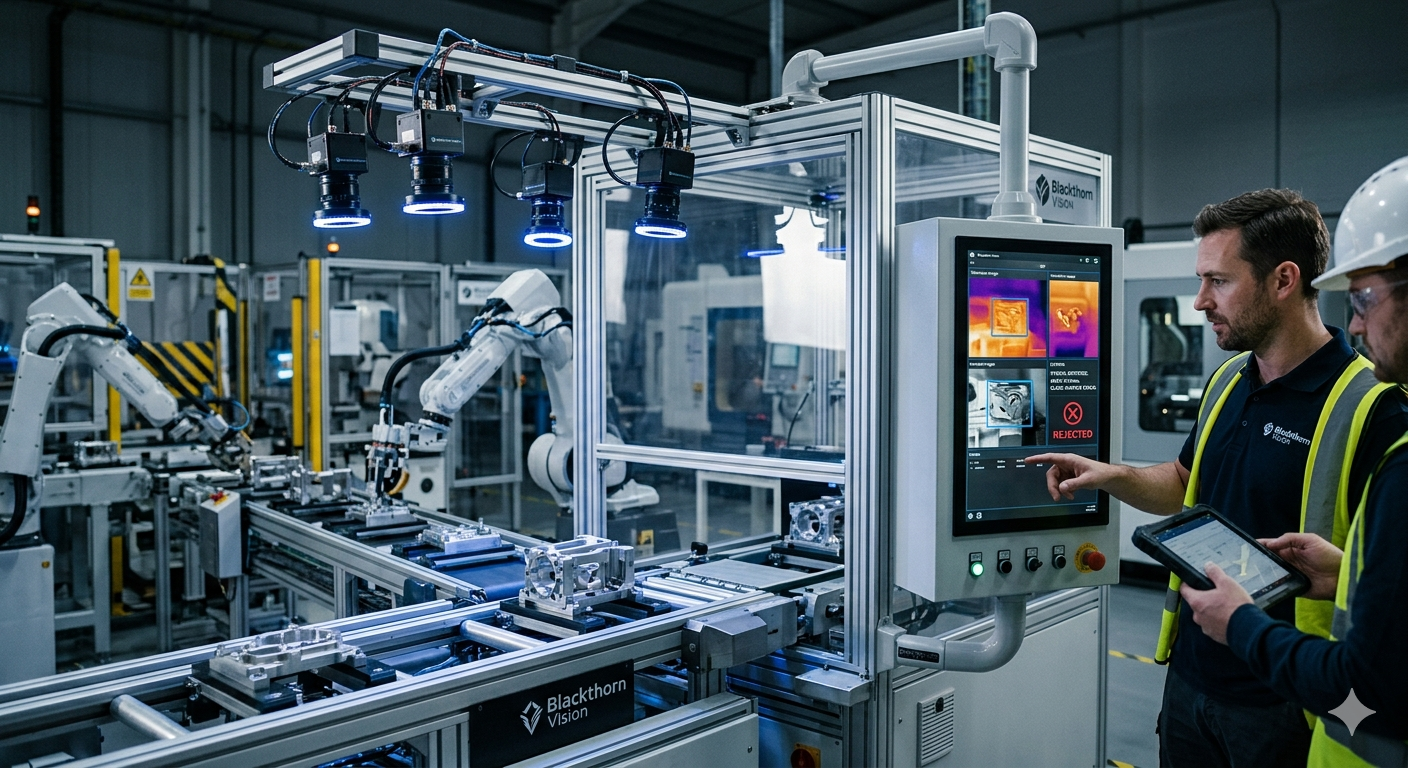
A prime example of a high-impact computer vision solution can be seen in the development of automated quality control systems for high-precision manufacturing. In complex production environments, such as those involving the assembly of intricate mechanical parts, even a microscopic deviation can lead to catastrophic failure. A specialized computer vision software company recently addressed this by implementing a multi-camera inspection system designed to detect defects that are invisible to the human eye. By utilizing high-resolution imaging and custom-trained deep learning models, the system performs real-time analysis of component geometry and surface integrity, ensuring that only flawless products move forward on the assembly line.
This implementation highlights the critical intersection of computer vision and software development. The project involved not only the algorithmic challenge of identifying subtle cracks and misalignments but also the engineering feat of integrating the software with high-speed industrial hardware. By deploying this computer vision service, the manufacturer was able to achieve near-zero latency in defect detection, significantly reducing manual inspection costs and eliminating the risk of human error. Such case studies prove that when a business chooses to hire computer vision developer teams with deep domain expertise, the result is a robust, scalable system that provides a measurable return on investment through improved product quality and operational throughput.
Selection Framework: How to Evaluate a CV Partner
When hiring computer vision teams, prioritize technical depth over a broad portfolio. Confirm the company specializes in architectures relevant to your needs, such as GANs for synthetic data or compact models for edge devices. A competent provider will be transparent about their data strategy. Since AI relies on the quality of its training data, ensure they have strict protocols for data collection, cleaning, and annotation. They should also explain how they handle edge cases – rare, unexpected scenarios that many models struggle with.
Ask these key questions when evaluating vendors:
- What is your experience with projects like ours?
- Describe your data acquisition and management process.
- How do you validate model effectiveness in variable conditions?
- What is your infrastructure for scalable deployment and support?
- How do you ensure data privacy and regulatory compliance?
- How do you optimize models for edge and resource-limited devices?
- Can you provide case studies showing business impact and ROI?
- How do you manage maintenance, upgrades, and monitoring after deployment?
These questions will help executives cut through technical jargon and assess whether a partner has the practical expertise and operational maturity to deliver real, lasting value.
Evaluate the provider’s experience with hardware-software integration. Many AI models perform well in cloud environments but struggle on edge devices such as the Jetson Nano or OAK-D cameras. Also assess their ability to integrate solutions with existing IT infrastructure and legacy systems. Leading vendors enable seamless integration with backend platforms, ERP tools, security systems, and manufacturing software, minimizing disruption. Look for firms with strong API development, flexible middleware, or adapter modules to connect new AI components with legacy systems. Top companies offer consulting to select suitable cameras and processors. They should provide case studies demonstrating not only lab accuracy but proven ROI under challenging conditions such as low light, high speed, or extreme weather. Assessing scalability from prototype to large deployments distinguishes research projects from successful commercial products.
Top 10 computer vision companies
1. Blackthorn Vision
Persona: The Full-Cycle Engineering Specialist.
Blackthorn Vision is a premier computer vision software development company that bridges the gap between complex quantitative research and stable, scalable business products. Their approach is based on deep engineering rigor, focusing on building architectures that can handle high-load data processing while maintaining keen precision. They are particularly adept at integrating AI into existing enterprise ecosystems, making sure that a computer vision solution is not a siloed tool but a functional part of the client’s infrastructure.
- The Depth: Leveraging a firm foundation in .NET and cloud-native environments (Azure/AWS), they specialize in vital fields such as medical imaging, diagnostics, and industrial automation. Their expertise includes developing custom algorithms for instant 2D/3D object tracking and high-precision OCR. By providing end-to-end computer vision software development services – from initial data feasibility studies to long-term DevOps support – they enable businesses to scale seamlessly from a single prototype to a global deployment.
2. Clarifai
Persona: The Pioneer of “AI-as-a-Service” Platforms.
Clarifai was one of the first companies to democratize deep learning by offering it through a strong, developer-friendly API. Founded by a winner of the ImageNet challenge, the company focuses on “label-efficient” AI, permitting businesses to build powerful models with significantly less labeled data through advanced Transfer Learning methods.
- The Depth: Their platform features Scribe Label, an automated data labeling tool that solves the most significant bottleneck in AI development. Beyond ordinary RGB images, Clarifai’s models can process infrared (EO/IR), satellite, and radar data. This versatility makes them a prime option for both government defense contracts (for autonomous surveillance) and global e-commerce brands looking to implement visual search and automated content moderation.
3. Standard AI
Persona: The Architect of Independent Retail.
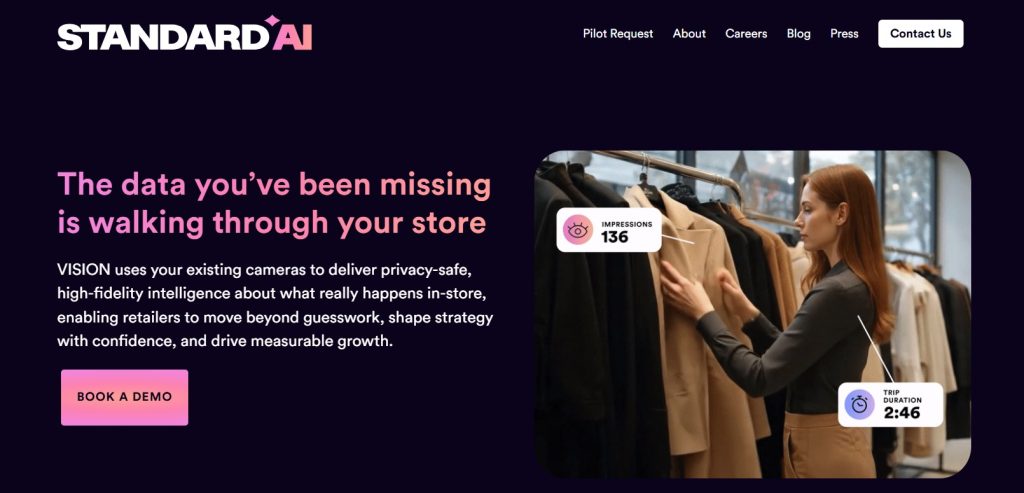
Standard AI is redefining the physical shopping experience by creating an “in-store operating system.” Their primary innovation is “checkout-free” technology that relies exclusively on ceiling-mounted cameras, eliminating the need for expensive “smart shelves” or specialized sensor-equipped carts.
- The Depth: Their technology is built on a complex fusion of pixel-level segmentation and person re-identification (ReID) algorithms. The system accurately maps the trajectory of multiple shoppers simultaneously, identifying exactly when an item is removed from a shelf and matching it to the correct virtual cart. Because they avoid using facial recognition or biometrics, their computer vision solution is inherently privacy-preserving, which is a major advantage for global retail compliance.
4. Samsara
Persona: The Leader in Connected Industrial Operations.
Samsara leverages computer vision services to provide digital visibility into physical operations, particularly in fleet management and logistics. Their hardware-software integration enables the instant analysis of millions of miles of driving data, transforming raw video into actionable safety scores and operational alerts.
- The Depth: Their AI-powered dash cams perform Edge Computing to detect over 30 types of hazardous behaviors – such as distracted driving, tailgating, or rolling stops – directly on the device. This enables instant in-cab voice coaching, which can reduce accidents by up to 75%. By syncing this data with their “Connected Operations Cloud,” they provide a unified dashboard that lets managers monitor safety, efficiency, and maintenance across their entire fleet.
5. Verkada
Persona: The Modern Standard for Cloud-Managed Security.
Verkada has disrupted the traditional enterprise security market by merging industrial-grade hardware with a sleek, cloud-based software interface. Their cameras are built to operate on a hybrid-cloud architecture, where video is stored locally for bandwidth efficiency while high-powered AI analytics are performed in the cloud.
- The Depth: Their People Analytics and Vehicle Analytics suites allow users to search across their entire global camera network in seconds. For example, a security team can search for “all individuals wearing a blue backpack” or “all red SUVs that entered the parking lot after 10 PM.” This level of instantaneous, attribute-based searching significantly reduces investigation times and improves the overall security posture of large-scale corporate campuses.

6. Anduril Industries
Persona: The Software-First Defense Innovator.
Anduril is a defense technology company that treats computer vision as the “nervous system” of modern security. Their flagship platform, Lattice, is an AI backbone that fuses data from thousands of distributed sensors, drones, and towers into a single, cohesive “God-eye” view of a given territory.
- The Depth: The core value of Anduril’s computer vision development is Sensor Fusion. Their algorithms take disparate data points and automatically classify threats – distinguishing between a civilian vehicle, a drone, or a person – and alert operators by mobile or VR interfaces. This autonomous “sensemaking” layer enables a single person to monitor vast areas (such as national borders or military bases) that would otherwise require hundreds of manual observers.
7. AMP
Persona: The Catalyst for the Circular Economy.
AMP is applying computer vision and software development to one of the most unstructured and “noisy” environments: waste management. Their AI platform, AMP Neuron, is trained to recognize millions of distinct items on high-speed recycling conveyor belts, making the sorting process faster and more accurate than humans could achieve.
- The Depth: The AI doesn’t just recognize material types (like plastic or paper); it can identify specific brands and packaging shapes, which delivers valuable data to consumer goods companies about their product lifecycle. Their robotic arms can perform up to 160 “picks” per minute with near-perfect accuracy. By making the recovery of high-value recyclables economically viable, AMP is turning computer vision into a key tool for global sustainability.
8. Mobileye
Persona: The Automotive Authority on Visual Intelligence.
Mobileye, an Intel company, is the undisputed leader in Advanced Driver Assistance Systems (ADAS). Their philosophy is “Vision First,” believing that cameras – when paired with specialized silicon – can provide enough positional awareness for full autonomy without depending heavily on expensive lidar devices.
- The Depth: Their EyeQ chips and REM (Road Experience Management) technology are their primary differentiators. REM uses crowdsourced data from millions of camera-equipped vehicles to build and update high-definition maps in real-time. This “collective intelligence” allows cars to understand not just where they are, but the details of the road ahead, such as temporary lane changes or traffic patterns, at a global scale.
9. Microsoft (Azure AI Vision)
Persona: The Global Enterprise Cloud Ecosystem.
Microsoft offers one of the most comprehensive suites of computer vision software development services through its Azure AI platform. Their strength resides in their massive research budget and their ability to integrate “Large Language Models” like Florence into an easy-to-use API for developers.
- The Depth: The Florence model is a versatile architecture that excels at multimodal tasks, effortlessly linking text and images. This allows Microsoft to offer superior services in spatial analysis (measuring the movement of people in a space), Document AI (extracting data from complex forms), and customized model training. For enterprises, Microsoft provides the security and global compliance (GDPR/HIPAA) that small boutiques often cannot match.
10. Google (Cloud Vision AI)
Persona: The Research Leader in Multimodal Intelligence.
Google continues to set the industry pace through its pioneering research on Transformers and the Gemini family of models. Their Cloud Vision AI is a suite of tools that permits businesses to leverage the same technology that powers Google Search and Photos.
- The Depth: One of their most specialized products is Visual Inspection AI, which is custom-built for high-accuracy manufacturing. It can detect microscopic anomalies in products such as semiconductors and medical devices with a fraction of the training data required by traditional models. Furthermore, Google’s ability to combine computer vision with Natural Language Processing (NLP) enables “Video Intelligence,” in which the AI can understand the narrative context of a video, not just its objects.
Industry-Specific Applications
The versatility of modern computer vision is evident across industries. In manufacturing, vision systems underpin Industry 4.0 by detecting microscopic defects on high-speed production lines, preventing faulty products, and reducing waste. In healthcare, computer vision assists radiologists in detecting early-stage tumors in X-rays and MRIs with accuracy that supplements human expertise. These examples show that the technology is now essential for operational quality and safety.
In retail and agriculture, computer vision is similarly transformative. Retailers create smart stores using heatmaps to analyze customer behavior and automated checkouts to eliminate lines. In agriculture, autonomous tractors and drones with vision sensors monitor field health and target weeds, reducing chemical use and boosting yields. As consulting firms innovate, industries are becoming data-driven. Extracting digital insights from the physical world is today’s key competitive advantage.
Have a specific vision project in mind?
Get a custom quote and see how our development services can bring your idea to life
The Workflow of a Typical CV Project
A professional computer vision project starts with a thorough discovery and feasibility phase. Experts assess whether available visual data can solve the problem. If data is noisy, poorly lit, or insufficient, the project will likely fail regardless of the algorithm. This upfront honesty defines a quality partner. They help establish a data acquisition strategy, sometimes using synthetic data to fill gaps, assuring a solid scientific foundation before costly development begins.
After preparing data, the focus moves to model training, optimization, and deployment. Teams trade off accuracy with inference latency – the speed of image processing. In security systems or self-driving cars, even a half-second delay can be critical. Post-deployment, monitoring for model drift is essential as changing conditions may degrade performance. A dedicated computer vision company offers ongoing maintenance to keep the system aligned with its environment and maintain peak performance.
Key Challenges in Computer Vision Implementation
Even advanced computer vision systems encounter challenges due to the variable physical world. Environmental variation – such as moving shadows, lens flares, or extreme weather – can confuse models trained within controlled environments. The key challenge is to build stability to retain accuracy despite these changes. This calls for rigorous stress testing across different datasets and edge-case scenarios that mirror real-world chaos. Without this, systems that perform well in labs may fail under everyday conditions, such as rain or flashing lights.
Data privacy and ethics create significant challenges. Deploying systems in public spaces requires navigating rules such as GDPR and CCPA, especially for facial recognition and identity tracking. Solutions must anonymize data at the source or process it locally (Edge AI), which is now a legal requirement. Algorithmic discrimination, where performance varies by lighting or demographics, must be handled with transparent, inclusive training data. To reduce legal and reputational risks, choose partners with compliance systems and certifications such as ISO 27001 or SOC 2. Best practices include clear data governance, detailed audit trails, and periodic compliance reviews. Proper deployment depends as much on ethics and compliance as on neural network design.
Future Trends in Visual Intelligence
The shift to Edge AI is a transformative trend in computer vision. Moving processing from centralized clouds to cameras or local sensors achieves near-zero latency. This is crucial for products like self-driving drones and industrial robots that require instant decisions without data center delays. Edge AI also enhances security by keeping sensitive data local. Organizations seeking computer vision talent should prioritize experts in hardware acceleration and model compression for edge devices.
ViTs and Core Models are transforming the development of computer vision. Unlike traditional models that require large tagged datasets per task, these architectures are pre-trained on vast, diverse data and fine-tuned for specific applications. This enables the delivery of high-performing systems with less custom data. Synthetic data – CGI-generated environments – also addresses data scarcity in rare or hazardous scenarios. These advances make computer vision services more accessible, accurate, and powerful across industries.
Conclusion: Selecting Your Vision Partner
Implementing a world-class computer vision solution requires more than coding skills. It demands strategic alignment between your business challenges and the expertise of a specialized development company. The right partner provides not only algorithms but a comprehensive framework, including data strategy, hardware consulting, and long-term maintenance. Selecting firms with deep technical discipline and proven real-world experience ensures your investment delivers a tangible competitive advantage, not a stalled research project.
To proceed confidently, outline your business objectives and prepare a high-level requirements brief detailing key use cases and datasets. Schedule discovery sessions with shortlisted computer vision partners to discuss goals, technical restrictions, and timelines. These steps will clarify your needs, align you with the right expertise, and accelerate progress from concept to deployment.
The goal of integrating computer vision is to give your organization perception beyond human limits. Whether automating production, securing facilities, or innovating products, your business’s “eyes” determine its ability to scale in an automated world. Use the selection frameworks and the insights in this guide to evaluate potential partners. With the right team, translating raw pixels into business intelligence is not merely possible – it is inevitable.
FAQ
What should I look for when choosing a computer vision development company?
What is the difference between Cloud AI and Edge AI?
Cloud AI processes data on centralized servers (like Azure or Google Cloud), which offers massive computing power but may have higher latency. Edge AI processes data directly on the camera or a local device. This is crucial for applications like autonomous driving or industrial quality control, where split-second decisions are required and data privacy is a priority.
Can computer vision work in low-light or outdoor environments?
Yes, but it requires specialized expertise. A professional computer vision development company will use techniques like image enhancement, infrared sensors, or thermal imaging to ensure the system remains robust. They also utilize data augmentation—simulating various weather and lighting conditions during the training phase—to ensure the computer vision products perform reliably in the “wild.”
How long does it take to develop a custom computer vision product?
A typical timeline ranges from 3 to 9 months. The process begins with a feasibility study and data collection, followed by model training, optimization, and finally, integration. Working with an established computer vision software development company can often accelerate this timeline by leveraging pre-existing frameworks and proprietary toolsets.
How much does it cost to implement a computer vision solution?
The cost varies significantly based on the project’s complexity, the accuracy requirements, and the deployment environment. Factors include the volume of data needing annotation, whether you need custom hardware integration, and if the processing happens in the cloud or on the edge. Engaging in computer vision consulting at the start can help define a clear roadmap and provide a more accurate budget estimate based on your specific ROI goals.
You may also like
-
 April 3, 2026Read in 31 min.
AI software development services: A complete guide for business leaders and decision-makers
Transform your business with expert AI software development services. We build custom GenAI, machine learning, and autonomous agent solutions tailored for enterprise ROI. Get a free consultation today! -
 April 1, 2026Read in 17 min.
The strategic hub: Why global leaders choose software development outsourcing in Ukraine
Why global leaders choose software development outsourcing in Ukraine. Explore the top 10 IT companies, specialized tech stacks, and how to scale your business with a dedicated Ukrainian development team. -
 March 31, 2026Read in 19 min.
Selecting the best Java development companies
Leading Java development companies. Analyzes top-tier Java software development services, evaluation criteria, and delivery models to help you find the perfect strategic partner for scalable enterprise solutions -
 March 31, 2026Read in 14 min.
Top progressive web app development companies
Partner with a leading progressive web application development company. Explore our list of top PWA developers in the USA and globally, offering high-speed, offline-ready, and SEO-friendly web app solutions -
 March 23, 2026Read in 23 min.
Why data warehouses fail and how to design one that doesn’t
top building data swamps. Explore the evolution of DWH design, including ELT workflows, Data Vault 2.0, and high-performance cloud modeling strategies -
 March 18, 2026Read in 13 min.
Choosing React Native app development company
Partner with a premier react native development company. Compare the top 10 firms offering elite react native app development services for high-performance apps. -
 March 16, 2026Read in 12 min.
AI in data governance: Everything technology leaders need to know
Master Data Governance for AI. Learn how to manage data drift, bias mitigation, and active metadata using NIST standards. Expert guide on MLOps, RAG security, and EU AI Act compliance for 2026. -
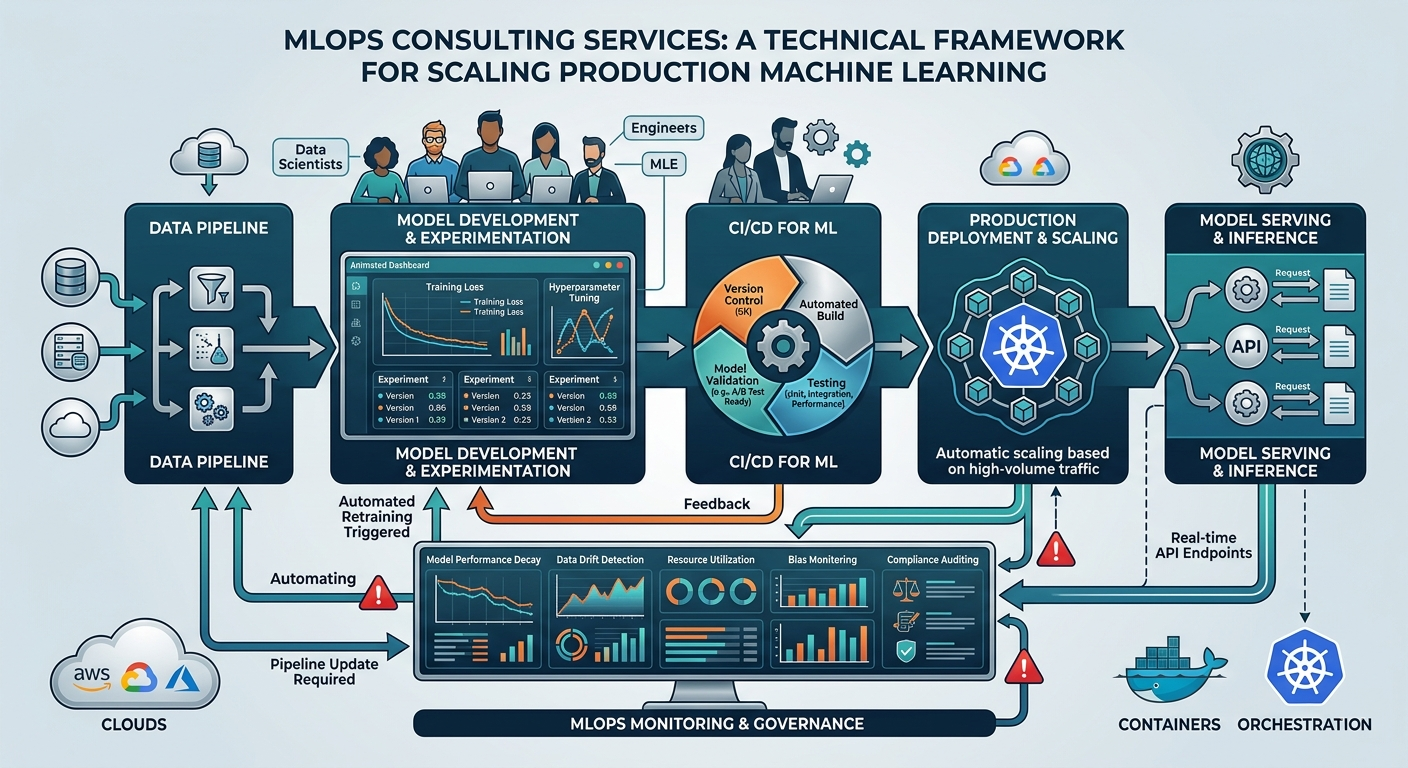 March 16, 2026Read in 16 min.
MLOps consulting services: A technical framework for scaling production machine learning
Operationalize ML with expert MLOps consulting. We bridge the gap between Data Science and DevOps using CI/CD/CT pipelines, automated drift detection, and feature stores to reduce Time-to-Value and technical debt. -
 March 12, 2026Read in 12 min.
Choosing your generative AI development company
Compare the best generative AI companies for your enterprise. From custom LLMs to agentic workflows, discover the top partners driving innovation and ROI in the AI-first era. -
 March 6, 2026Read in 15 min.
PyTorch vs TensorFlow: What’s the difference and which one wins
Stop choosing between research and production. Learn how Keras 3 and multi-backend architectures are unifying the AI ecosystem. A professional developer’s deep dive into performance, cost, and scalability. -
 March 5, 2026Read in 15 min.
Choosing the best MVP development companies
Top-rated agencies providing bespoke MVP software development services to help startups validate ideas and scale fast -
 March 4, 2026Read in 19 min.
Top software testing companies: Leading QA partners
Leading software testing companies. Compare top QA service providers, evaluation criteria, and industry trends to find your ideal partner. -
 February 28, 2026Read in 22 min.
Top 10 software development companies in the USA
Find the best US-based software developers. From AI to enterprise web apps, here are the top 10 software development companies in the USA you should hire in 2026. -
 February 25, 2026Read in 12 min.
Top 10 Node.js Development Companies
Industry's leading Node.js development companies. Our deep-dive review covers technical maturity, cloud-native expertise, and architectural standards to help you find the perfect software partner. -
 February 23, 2026Read in 16 min.
Top 10 mobile application development companies: Selection & industry leaders
Top 10 mobile application development companies for your next project. Compare top-rated mobile app developers, explore custom app development company profiles, and learn the secrets to a successful technical partnership. -
 February 23, 2026Read in 12 min.
How to choose the best Android app development agency: Rankings & selection criteria
Compare the leading Android development companies. Our guide highlights the top 10 firms for enterprise architecture, security, and custom app engineering. -
 February 19, 2026Read in 18 min.
IT Managed Service Providers (MSPs): Why does your business need one?
Stop guessing. Compare the 10 leading IT Managed Service Providers (MSPs) for any-sized companies. Find proven security, cloud, and 24/7 support. View the comparison! -
 February 19, 2026Read in 45 min.
Top 30 software development companies: Categories, red flags, and the selection strategy
We’ve analyzed the top 30 software development companies based on expertise, client results, and innovation. Find your ideal match here! -
 February 11, 2026Read in 18 min.
Top 10 Cloud migration companies: Strategic architecture of cloud migration
Compare the top 10 cloud migration companies based on architectural depth, FinOps integration, and modernization capabilities. Expert insights into AWS, Azure, and GCP transformation strategies for enterprise leaders. -
 February 10, 2026Read in 12 min.
Top 10 Flutter development companies: Entities, ecosystems, and strategic selection
Compare the world’s leading Flutter agencies. Our expert analysis covers the top 10 firms, evaluating their mastery of Dart, Skia performance, and Clean Architecture. -
 February 6, 2026Read in 19 min.
Top 10 React development companies: Architecting high-performance digital products
Top-rated React development companies for your next project. Our expert guide analyzes the best React JS web development agencies on performance, scalability, and tech standards -
 February 3, 2026Read in 24 min.
Web application development companies: How to choose the right partner
Find the right web app development company. Explore services, technologies, engagement models, and 10 expert tips for choosing your strategic development partner. -
 February 3, 2026Read in 11 min.
Top 10 Python Development Companies
Looking for a top Python development company? Compare the industry's leading Python software development agencies. Get insights on pricing, expertise, and how to hire a Python development firm that scales your business. -
 January 27, 2026Read in 15 min.
Top cloud application development companies you should follow
Best Cloud Application Development companies for your project. Compare expertise in AWS, Azure, & GCP. See client reviews, specialization, and costs for top Cloud-Native firms -
 January 23, 2026Read in 21 min.
Dedicated development team model: Definition, benefits, and nuances
Scale your product fast with a Dedicated Development Team. Compare DDT vs. outsourcing, analyze costs, and get a management blueprint for success. -
 January 21, 2026Read in 15 min.
Best energy software development companies to partnership
Top 10 energy sector software development leaders. Learn how to choose the right partner for your renewable energy software project. -
 January 19, 2026Read in 8 min.
The Low-Code Revolution in Oil & Gas: Accelerating Digital Transformation
From real-time well monitoring to automated safety permits - see how low-code applications drive operational efficiency and ESG compliance in the energy sector’s volatile market. -
 January 19, 2026Read in 18 min.
Top 10 desktop application development companies to watch
Compare the world’s best desktop development firms. From legacy modernization to high-performance C++ and cross-platform Electron apps, find your perfect vendor here. -
 December 24, 2025Read in 10 min.
Software development company in Florida: What we do, how we work, and where we add value
Florida's premier custom software partner for enterprise-grade applications. We specialize in fintech, healthcare, and scalable cloud systems. Innovate with Florida experts. -
 December 9, 2025Read in 10 min.
Custom software development for San Diego businesses
Find out about the demands of software development in San Diego and how local companies are adapting to technology needs. -
 December 9, 2025Read in 9 min.
Specifics and perspectives of custom software development in Los Angeles
Find out why choosing a custom software development company in Los Angeles is essential for evolving industries like fintech and healthcare. -
 December 6, 2025Read in 8 min.
Software development in San Francisco: Custom solutions for Area
Find out how software development in San Francisco sets standards in technology and customer satisfaction. -
 November 28, 2025Read in 14 min.
Custom software development in Houston: State and perspectives
Partner with a leading custom software development company in Houston to harness the power of technology for your growth. -
 November 28, 2025Read in 12 min.
Custom software development Dallas businesses need
Find out how a custom software development company in Dallas can elevate your business in a booming tech landscape filled with opportunities. -
 November 27, 2025Read in 11 min.
Software development services in Austin
Find out how a custom software development company in Austin can elevate your business in a booming tech landscape filled with opportunities. -
 November 12, 2025Read in 34 min.
Top FinTech software development companies: The core of modern finance
Compare the top-rated FinTech software developers based on expertise in AI, Blockchain, and compliance. Choose your perfect partner now! -
 November 4, 2025Read in 12 min.
AI in biotech: Application, specifics, and challenges
How AI and Machine Learning are transforming biotechnology, accelerating drug discovery, genome sequencing, and personalized medicine. Learn the applications, challenges, and future. -
 October 28, 2025Read in 20 min.
The best AI development companies in the US
The definitive guide to hiring the best AI development company. See our ranking by MLOps maturity, GenAI expertise, and verified client ROI. Get transparent costs and a partnership blueprint -
 October 20, 2025Read in 16 min.
How to hire the best ReactJS developers in a constantly growing market
Hire the top ReactJS developers. Get pre-vetted, senior React & Next.js engineers matched to your project in 48 hours. Start risk-free -
 October 16, 2025Read in 25 min.
Top 10 AI chatbot development companies
Leading chatbot development companies. Our expert guide helps you choose the best firm for AI chatbot solutions, custom development, and seamless integration -
 October 9, 2025Read in 17 min.
Top biotech software companies: Choosing the right tech partner for life-changing innovations
Leading biotech software companies impacting drug discovery, R&D, and lab operations. See how their innovative platforms are speeding up scientific breakthroughs. -
 September 30, 2025Read in 16 min.
All you need to know about custom software development for small business
Stop wasting time on workarounds! Discover how custom software development empowers your small business with tailored workflows, maximum efficiency, and predictable ROI. -
 September 4, 2025Read in 14 min.
Top 10 leading application modernization companies
Top 10 application modernization companies that can transform your business with cloud, AI, and microservices for agility and growth -
 August 28, 2025Read in 14 min.
Develop once, run everywhere: .NET Core cross-platform development
Struggling with multi-OS development? Discover how .NET empowers you to build versatile, high-performance applications that run seamlessly across Windows, macOS, and Linux with ease. -
 August 21, 2025Read in 14 min.
Why offshore .NET development is the best choice for your business
Struggling with talent shortages or escalating development costs? Explores how embracing offshore .NET development can be the strategic advantage your business needs to build innovative solutions faster and more cost-effectively. -
 August 18, 2025Read in 14 min.
.NET vs Java: Comparison, use cases, pros and cons
Unsure whether to use .NET or Java? This guide breaks down their strengths, weaknesses, and ideal applications to help you pick the best technology. -
 August 11, 2025Read in 24 min.
Top 10 Angular development companies to keep an eye on
Leading Angular development companies. Expert Angular developers offering top-tier web application development, consulting, and solutions for your next project. -
 August 7, 2025Read in 15 min.
Hire Angular developers: What you need to know
Need hire Angular developers? Get access to skilled, dedicated Angular teams for your web projects. We provide expert Angular solutions with flexible engagement models. Contact us today! -
 August 1, 2025Read in 9 min.
Why choose Angular for web development
Why Angular is a leading choice for web development. Learn about its powerful features, scalability, and benefits for building robust, high-performance applications. -
 August 1, 2025Read in 12 min.
Hiring .NET developers: Step-by-step guide
Frustrated with the challenges of hiring skilled .NET developers? This article provides a proven framework to help you find, vet, and hire the right talent for your team, avoiding common recruiting mistakes. -
 February 13, 2025Read in 15 min.
What is HMI development, and why is it trending now?
Human-Machine Interface (HMI) development is revolutionizing the way humans interact with machines, driving innovation across industries. -
 December 11, 2024Read in 10 min.
Python vs Java: Key differences, pros, and cons for developers
Key differences between Python and Java, including syntax, performance, and use cases. Find out which language suits your project best -
 October 10, 2024Read in 11 min.
The future of web development: WordPress vs React.js?
Confused between WordPress or React.js? Explore our detailed comparison to find out which platform suits your needs best -
 August 8, 2024Read in 14 min.
AD and Azure AD: What is the difference, and which is better for you?
Differences between Azure Active Directory (AAD) and traditional Active Directory (AD) in this comprehensive comparison. -
 August 5, 2024Read in 15 min.
ESG software development services: Effective ESG software solutions
Innovative ESG software solutions can help your business achieve its sustainability goals. Develop customized software that enhances environmental, social, and governance (ESG) performance, ensuring compliance and driving positive impact -
 July 31, 2024Read in 7 min.
Benefits of Azure Active Directory
Key benefits of Azure Active Directory(AD), including enhanced security, simplified management, and cost savings for your business -
 April 22, 2024Read in 12 min.
Software modernization: What is it & why it matters
Discover the essence of software modernization and its pivotal role in contemporary software development. Uncover why it's crucial. -
 April 22, 2024Read in 20 min.
Legacy app modernization: A comprehensive guide
Revitalize your business with our guide on legacy application modernization. Transform your legacy systems to make them more efficient and innovative. -
 April 22, 2024Read in 16 min.
Digital product design: What is it and why you need it
Unlock innovation with expert digital product design insights. Explore the latest trends and strategies for creating exceptional user experiences. -
 April 21, 2024Read in 11 min.
Healthcare product design: Tips for app development success
Explore the art of healthcare product design in our latest blog post. Discover how innovative design principles are shaping the future of medical solutions -
 April 18, 2024Read in 9 min.
Azure app modernization: Benefits of migrating to Microsoft
Key benefits of Azure app modernization and how migrating to Microsoft can enhance performance, scalability, and compliance -
 March 11, 2024Read in 12 min.
How to choose asset management software for oil and gas in 2026
Explore more ways to optimize operations and streamline processes in oil and gas. Follow our tips to choose the best-fit assent management software in 2026 -
 March 11, 2024Read in 13 min.
AI software development for oil and gas: A comprehensive guide
Explore the transformative power of artificial intelligence software development for oil and gas and the practices of global industry leaders in our blog. -
 March 11, 2024Read in 19 min.
Cloud application modernization: How to improve your app
Cloud application modernization makes app more competitive and business more profitable. The key strategies, tips, and its benefits — in this article! -
 March 11, 2024Read in 12 min.
Enterprise application modernization: Revolutionize your business
Future-proof your business with our guide to enterprise app modernization. Learn strategic approaches, key technologies, and best practices for legacy system transformation and enhanced agility -
 March 11, 2024Read in 12 min.
LIMS integration: Benefits & how it works
Can LIMS integration be called a CRM for laboratories? What to keep in mind during LIMS software development and integration? Find out more in our article. -
 March 11, 2024Read in 11 min.
Active directory integration: What is it & how to do it effectively
Discover seamless Active Directory integration strategies in our latest blog post. Optimize user management with the Blackthorn Vision team! -
 March 5, 2024Read in 15 min.
Mobile app UX design: Basics that will improve user experience
Mobile app UX design differs from the web. Explore these differences, the process, and the main pitfalls with our experts in this article. -
 March 5, 2024Read in 11 min.
HIPAA compliance checklist for healthcare software development 2026
Check the updated HIPAA security guidelines to ensure the safety and privacy of patients' data, it is important to adhere it when creating applications -
 March 5, 2024Read in 9 min.
How to use business process automation to improve oil and gas production
Discover how business process automation can help optimize oil and gas production and improve your bottom line. -
 March 3, 2024Read in 14 min.
Desktop to web migration: everything you need to know
Planning a desktop to web migration? Get essential insights on strategy, technical challenges, approaches, and how to successfully modernize your legacy application. -
 March 3, 2024Read in 11 min.
The process of application migration to the cloud: stages, approaches, and tools
Find out how to effectively migrate your legacy system and data to the cloud without disrupting your business processes. -
 March 3, 2024Read in 16 min.
Benefits of outsourcing software development
Key advantages of outsourcing software development for businesses. Learn how outsourcing can reduce costs, increase efficiency, and provide access to specialized expertise -
 March 3, 2024Read in 13 min.
Boosting cloud security in healthcare with Azure Cloud Services
Explore the most common challenges in the cloud security of healthcare organizations and discover our tips on eliminating them efficiently. -
 March 3, 2024Read in 19 min.
Healthcare app design: how to create a great user experience
Struggling with medical app UX? Get insights into user-centered design, crucial security measures, and future trends to create impactful healthcare applications. -
 March 3, 2024Read in 16 min.
MVP vs. prototype in startup software development: what’s the difference?
Crucial differences between MVP and Prototype in startup software development. Learn how Blackthorn Vision leverages both to build successful products, reduce risk, and accelerate your time-to-market -
 March 3, 2024Read in 12 min.
How to build a custom EHR solution: tips for decision makers
We can augment your talent pool with dedicated developers proficient in healthcare business automation. Check the success stories from our clients. -
 March 3, 2024Read in 7 min.
What is software as a medical device and why it matters for the healthcare industry
From developing SaMD and SiMD to building efficient EHR systems, we unleash the value of business process automation for healthcare providers. -
 March 3, 2024Read in 6 min.
An overview of medical biotechnology in 2026 and beyond
We offer a full cycle of software development for leading biotech companies - from idea visualization to building an MVP and fully-fledged product. -
 March 3, 2024Read in 9 min.
Smart farming: agricultural technology of the future
We have expertise in data analytics, AI, and Machine Learning to build game-changing software tailored for your agricultural business. -
 March 3, 2024Read in 7 min.
BV people: a talk with Head of HR and recruitment in Blackthorn Vision
BV people: a talk with the Head of HR and Recruitment on candidate selection, the company's ideals, and the current state of the Ukrainian IT industry. -
 March 3, 2024Read in 9 min.
What is robotic process automation and how it changes the travel and hospitality industry
How does RPA work and, most importantly, how to utilize it in your travel and hospitality business? Find out in our new article now. -
 March 3, 2024Read in 12 min.
An overview of agricultural biotechnology in 2026
We cooperated with agricultural biotechnology industry leaders to design software that helps scientists and farmers automate and optimize all processes. -
 March 3, 2024Read in 10 min.
Everything you need to know about Microsoft Azure: benefits, use cases, applications
Microsoft Azure is a leading cloud service provider that offers numerous opportunities for businesses to optimize and secure their operations and services. -
 March 3, 2024Read in 10 min.
Smart manufacturing technology and trends for 2026 and beyond
Stay updated on the latest manufacturing technology trends, that drives innovation, efficiency, and growth in the industry to boost your project. -
 March 3, 2024Read in 8 min.
How to choose and manage your dedicated development team
While there are many benefits of working with dedicated software development teams, it’s not a universal solution. Discover why it is so. -
 March 3, 2024Read in 8 min.
What is the best cloud deployment model? Types of cloud computing that will benefit your business
With the guidance of our post, you can better understand various cloud computing deployment strategies. Examine cloud solutions for your company's needs. -
 March 3, 2024Read in 10 min.
Offshore vs. Nearshore outsourcing: what’s best for your business?
What is the difference between the three outsourcing types, and which one is better for your business? Please read our article to find out! -
 March 3, 2024Read in 14 min.
How to develop a medical app for doctors: everything you need to know
The mobile health industry is one of the most rapidly growing segments worldwide. Learn more about the mHealth industry in our new article. -
 March 3, 2024Read in 14 min.
Business analyst: a leading player in your software development team
Your guide to the Business Analyst's vital role in software development teams, including Agile practices, key responsibilities, techniques, and delivering real business value. -
 March 3, 2024Read in 9 min.
Hyperautomation – the future of business processes
Now business processes - Hyperautomation are increasingly not following stable and predictable scenarios. It creates a need for a new type of automation. -
 March 3, 2024Read in 6 min.
The future of Oil and Gas: industry trends and software solutions
Keep up to date on the most recent oil and gas the industry trends, which are driving modifications in technology, sustainability, and energy exploration. -
 March 3, 2024Read in 6 min.
What is an MVP, and why is it necessary? Minimum viable product examples
Even if you have just a basic vision of what your app should do, we will develop a presentable product that you can pitch to investors. -
 March 3, 2024Read in 14 min.
Top 5 soft skills to work in it successfully and resources to develop them
Are soft skills the new hard skills? Can you make a successful career in IT if you are not an effective communicator or lack creativity? -
 March 3, 2024Read in 5 min.
Mobile app development: Xamarin.Forms — a cross-platform solution that responds to modern challenges
When it comes to mobile development, there is a wide variety of solutions. Xamarin.Forms is a cross-platform solution that responds to modern challenges. -
 February 27, 2024Read in 8 min.
Top 10 programming languages of the future for web and mobile app development
Let’s have a look at the most popular programming languages that may become your business workhorse. -
 February 6, 2024Read in 16 min.
Pharmaceutical software development: Unleashing pharma innovation
Explore the future of pharmaceutical software development: innovative solutions revolutionizing healthcare efficiency & precision.