



SaaS development is built around the assumption that many customers will share the same platform at the same time. That requires careful separation of data, constant updates without downtime, and systems designed to scale smoothly. Traditional web development usually targets a single deployment and faces far fewer operational constraints.
Top SaaS development companies to follow in 2026

 20 minutes read
Content
The Software-as-a-Service (SaaS) model has long since passed its experimental phase. What began as a cost-saving alternative to on-premise software has matured into the default operating system of modern business. From CRM platforms to AI-powered analytics engines, SaaS products now serve everything, from payroll to predictive decision-making.
In 2024, the global SaaS market surpassed $317 billion in value and is projected to reach over $1 trillion by 2032. Enterprises are consolidating tooling, startups are building product-led growth engines, and investors are scrutinising unit economics with new intensity. Against this backdrop, choosing a SaaS development partner is a strategic decision that shapes scalability, security posture, and long-term product viability.


Ready to transform your vision into a subscription-based powerhouse?
Let’s build a multi-tenant solution that’s engineered for growth.
What is the current state of SaaS?
SaaS has entered its efficiency era. The focus has shifted from “can we build it?” to “can we scale it profitably?” Rising cloud costs, tighter compliance requirements, and customer expectations shaped by consumer-grade UX have significantly raised the bar.
At the same time, architectural mistakes made in early MVPs are now surfacing as technical debt. Monolithic backends struggle with multi-tenant demands. API limitations block ecosystem integrations. Security models designed for single-region deployments crack under global expansion.
What is the problem with SaaS?
Many SaaS products fail not because of weak ideas, but because of fragile foundations. Founding teams often prioritise speed over structure, shipping features before establishing the architectural guardrails required for scale. That’s when issues appear – when revenue grows, customers diversify, and regulators start asking questions.
Common failure points include:
- Poor tenant isolation leading to security risks
- Inefficient infrastructure scaling that inflates cloud spend
- Limited API design that blocks partnerships and integrations
- Engineering teams optimised for delivery, not product thinking
How to address it?
With a specialised SaaS development agency, of course. It brings more than extra hands; it brings pattern recognition. Teams that have built and scaled multiple SaaS platforms understand where systems break, where costs hide, and where shortcuts become liabilities.
The best agencies approach SaaS as an evolving product ecosystem, not a one-off software build.
Why partner with a SaaS development agency?
Partnering with a SaaS-focused development agency is less about outsourcing execution and more about importing operational maturity. At scale, SaaS success depends on repeatable engineering decisions, economic discipline, and product governance, which are the areas where experienced external teams often outperform internal teams built under time pressure. According to McKinsey, companies that combine strong product management with advanced engineering practices are 60% more likely to outperform competitors on revenue growth.
Shorter Time-to-Market (TTM)
Speed in SaaS is about avoiding architectural dead ends. Experienced SaaS agencies operate with battle-tested reference architectures covering tenancy models, identity management, CI/CD pipelines, observability, and compliance baselines. This allows teams to bypass the trial-and-error phase that slows internal builds. Instead of debating how to structure environments, handle migrations, or secure APIs, execution begins on day one with proven patterns.
Access to a more sophisticated talent pool
Modern SaaS platforms require specialists in cloud cost optimisation, distributed data consistency, zero-trust security models, and increasingly, AI integration and MLOps. Hiring this breadth of expertise internally is slow and structurally inefficient. Senior SaaS architects, security engineers, and AI specialists are scarce, expensive, and often unnecessary on a full-time basis once foundational work is complete. Agencies provide on-demand access to these roles, embedded precisely where they add the most value.
Ensured and quick scalability
SaaS growth rarely follows predictable hiring curves. Product launches, funding rounds, enterprise deals, or compliance deadlines create sharp, temporary spikes in engineering demand. Agencies allow companies to respond to these inflection points without permanently inflating headcount. Teams can scale rapidly for delivery phases such as platform rebuilds, feature expansions, or security audits, and contract once stability returns. This elasticity protects operating margins and reduces the risk of post-growth layoffs, which are costly both financially and culturally.
More detailed and strategic product thinking
The most valuable SaaS agencies behave less like vendors and more like product counterparts. They interrogate roadmaps, question feature prioritisation, and surface trade-offs between speed, scalability, and monetisation. Rather than measuring success by sprint completion, mature partners focus on SaaS-specific metrics: activation rates, churn drivers, expansion revenue, and long-term total cost of ownership. This perspective is particularly valuable for founding teams transitioning from MVP to the growth stage.
How did we rank SaaS companies for our list?
RRR: Reputable, reliable ratings
Public reviews were analysed for patterns, not averages. Greater weight was given to consistency across multiple projects, repeat engagements, and detailed feedback on communication, ownership, and post-launch support. One-off testimonials and unusually polarised reviews were discounted in favour of sustained performance indicators, particularly those reflecting long-term client relationships.
How deep and wide is their portfolio?
Portfolios were assessed for architectural complexity rather than visual polish. Companies demonstrating experience with multi-tenant SaaS platforms, subscription billing logic, role-based access control, and large-scale data handling were prioritised over teams focused primarily on single-instance web applications or marketing-driven builds.
What tech stack do they proudly use?
Evaluation centred on practical, production-grade expertise. Preference was given to teams fluent in cloud-native architectures, API-first design, and modular backend systems, alongside modern frontend frameworks capable of supporting complex, data-heavy interfaces. Teams advocating a single stack for all use cases were treated as a risk signal rather than a strength.
What are their security standards?
Security maturity was treated as foundational, not optional. Companies were assessed on their ability to design for compliance from day one, including secure tenant isolation, audit readiness, and operational processes aligned with enterprise and regulated-industry requirements. Demonstrated experience in environments where security failures carry commercial or legal consequences was considered a critical differentiator.
What are the top SaaS development companies to partner with in 2026?
1. Blackthorn Vision
Blackthorn Vision treats SaaS development as systems engineering. The company is known for working on complex, data-intensive platforms where architectural decisions directly affect scalability and cost efficiency. Its teams combine strong backend engineering, often involving distributed systems, advanced data processing, and cloud optimisation, with a product-oriented mindset.
Blackthorn Vision is particularly effective in re-architecting legacy SaaS platforms, enabling companies to modernise infrastructure, introduce multi-tenancy, or refactor monoliths without disrupting live customers or revenue streams. The company provides full-cycle SaaS development, ranging from initial product discovery and MVP creation to legacy system modernization and cloud migration. They are known for their ability to handle “challenging” engineering tasks, such as integrating AI-powered analytics into SaaS platforms and optimizing cloud infrastructure for cost-efficiency. Their dedicated development teams work as an extension of the client’s workforce, ensuring that the software not only meets technical requirements but also aligns with long-term business goals. With over a decade of experience, Blackthorn Vision has established itself as a reliable technical partner for enterprises looking to build robust, secure, and user-centric SaaS products that can grow alongside their user base.
2. Belitsoft
Belitsoft has established itself in enterprise-grade SaaS development across healthcare, education, and fintech. The company’s strength lies in building platforms designed for longevity, where compliance, data integrity, and predictable evolution are critical. Its teams are experienced in developing SaaS products that must align with strict regulatory frameworks, while still remaining flexible enough to support feature expansion and changing market demands over time.
In the SaaS domain, Belitsoft excels at creating scalable, multi-tenant applications using a wide range of technologies such as .NET, Java, and Python. They specialize in full-cycle SaaS product development, from initial architecture design to deployment and ongoing maintenance. Their teams focus on building modular systems that allow for easy feature updates and seamless integration with third-party services. Belitsoft is particularly adept at developing complex learning management systems (LMS) and enterprise resource planning (ERP) platforms as SaaS models. By emphasizing security, data isolation, and user-friendly interfaces, they help companies launch robust SaaS products that can efficiently handle growing user bases while maintaining high performance and cost-effectiveness in the cloud.
3. Radixweb
Radixweb focuses on engineering SaaS platforms that scale efficiently under real-world usage. The company is frequently engaged to modernise existing products that suffer from performance bottlenecks, rising cloud costs, or architectural rigidity. Its work often involves refactoring backend services, optimising cloud infrastructure, and improving system observability, making it a strong partner for SaaS businesses transitioning from early growth to operational maturity.
When it comes to SaaS, Radixweb focuses on “future-proof” engineering. They specialize in building cloud-native SaaS platforms that are designed for high availability and elastic scalability. Their expertise spans across major cloud environments, including AWS, Azure, and Google Cloud. Radixweb offers comprehensive SaaS services, including custom application development, legacy software modernization, and SaaS migration. They are known for their proficiency in developing multi-tenant architectures that ensure robust security and personalized user experiences. By utilizing DevOps practices and automated testing, Radixweb ensures rapid deployment cycles and continuous improvement of the SaaS product. Their commitment to transparency and adherence to international quality standards make them a top choice for businesses looking to build reliable, enterprise-grade SaaS solutions that drive revenue and customer engagement.
4. Syndicode
Syndicode sits at the intersection of product design and SaaS engineering. The company is well-suited to customer-facing platforms where usability, onboarding, and retention directly impact revenue. Its teams pay close attention to how technical decisions influence user experience, particularly in subscription-based models. This makes Syndicode a solid choice for SaaS products competing in crowded or design-sensitive markets.
Syndicode is a specialist in the rapid development of SaaS MVPs and scaling them into full-fledged market leaders. Their SaaS development process is deeply rooted in agile principles, enabling fast iterations based on user feedback. They excel at building marketplaces, e-commerce platforms, and management tools delivered via the SaaS model. Syndicode’s technical stack, centered around Ruby on Rails, React, and Node.js, is ideal for creating highly interactive and responsive SaaS interfaces. They pay special attention to the “Service” part of SaaS, ensuring that the backend architecture supports complex subscription models, billing integrations, and multi-user access controls. For companies looking to disrupt the market with a beautifully designed, functional, and fast-to-market SaaS product, Syndicode offers the perfect blend of creative design and solid technical execution.
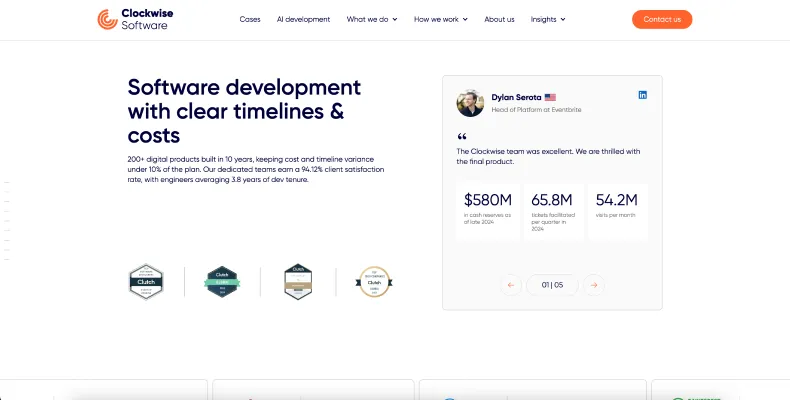
5. Clockwise Software
Clockwise Software specialises in technically demanding SaaS products, with a strong focus on data analytics, workflow automation, and custom business logic. The company is often selected for projects that require non-trivial data processing, complex permission models, or bespoke operational workflows. Its engineering approach favours clarity and robustness over rapid feature sprawl, which suits SaaS platforms with sophisticated internal logic.
Clockwise Software has a deep specialization in building SaaS products from the ground up. They understand that a successful SaaS requires a balance between a powerful backend and an intuitive frontend. Their development process includes thorough market research and product discovery to ensure that the SaaS architecture is built to solve specific market pain points. They are experts in building multi-tenant web applications, implementing complex cloud infrastructures, and ensuring data security. Clockwise Software is particularly skilled at integrating advanced analytics and reporting features into SaaS platforms, providing end-users with valuable insights. Their transparent communication and commitment to lean development help clients minimize waste and focus on features that deliver the most value. This makes them an excellent partner for entrepreneurs who need a reliable team to navigate the complexities of SaaS product development and scaling.
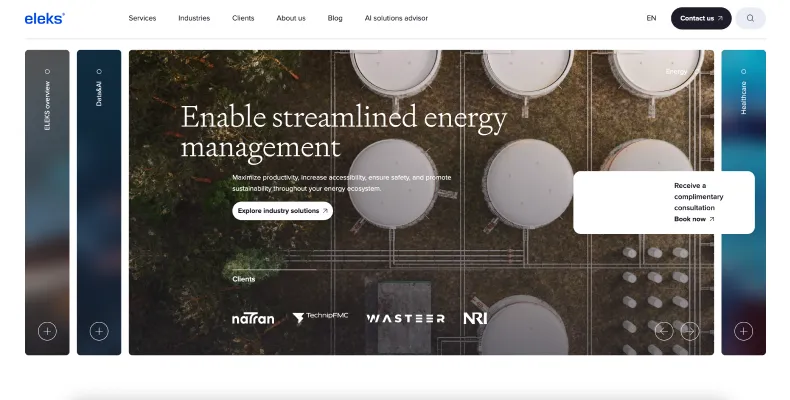
6. Eleks
Eleks operates at enterprise scale, supporting global SaaS platforms with distributed development teams and mature delivery frameworks. The company is accustomed to working within complex organisational structures, integrating SaaS products into broader digital ecosystems that include legacy systems, third-party services, and multiple stakeholder groups. Its strength lies in governance, process consistency, and the ability to sustain long-term, large-scale programmes.
Eleks brings a scientific approach to SaaS development. They specialize in building complex, data-intensive SaaS platforms that require advanced algorithms and high-level security. Their SaaS services include building custom cloud architectures, optimizing cloud costs, and ensuring that platforms can handle massive amounts of data in real-time. Eleks is a leader in integrating AI and Machine Learning into SaaS products, allowing companies to offer intelligent features like predictive maintenance or automated decision-making. They also provide comprehensive quality assurance and security auditing to ensure that the SaaS platform is resilient against any threats. For enterprises looking to build a “Next-Gen” SaaS product that leverages the latest in data science and cloud technology, Eleks offers the deep technical expertise and innovation capacity required to lead the market.
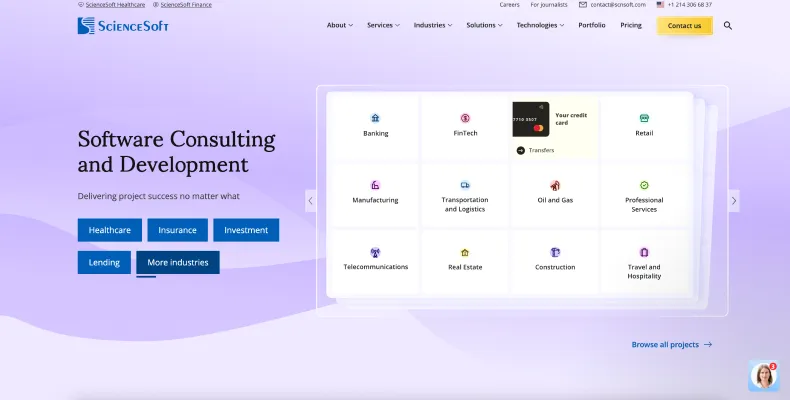
7. ScienceSoft
ScienceSoft brings decades of enterprise software experience into the SaaS domain, particularly within regulated industries such as healthcare and manufacturing. The company excels at building platforms where reliability, compliance, and auditability are as important as feature velocity. Its teams are well-versed in translating traditional enterprise requirements into cloud-based SaaS architectures without compromising control or security.
ScienceSoft is a powerhouse in SaaS development, offering end-to-end services that range from SaaS consulting to development and support. They excel at building multi-tenant SaaS solutions that are secure, scalable, and easy to maintain. Their expertise includes developing complex SaaS platforms for Healthcare (HIPAA compliant), Finance (SEC compliant), and Manufacturing. ScienceSoft focuses on creating robust API layers to ensure that their SaaS products can seamlessly integrate into any client’s existing ecosystem. They also offer specialized services in SaaS modernization, helping businesses transition from on-premise software to the cloud. With a strong focus on ROI and user adoption, ScienceSoft ensures that the SaaS products they build are not only technically sound but also commercially successful. Their mature project management and quality management systems guarantee predictable results and high-performance software.
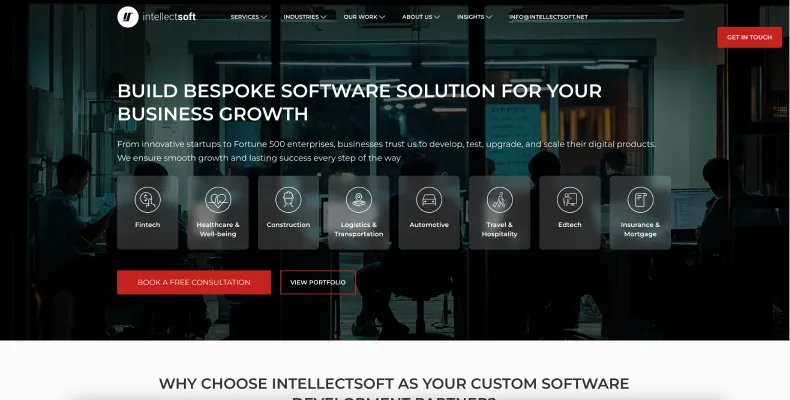
8. Intellectsoft
Intellectsoft focuses on SaaS initiatives tied to broader digital transformation efforts within large organisations. Rather than isolated products, its work often involves embedding SaaS platforms into complex enterprise environments, integrating with existing systems, data sources, and operational processes. This makes the company a strong fit for organisations modernising legacy operations through SaaS-based delivery models.
In the SaaS space, Intellectsoft focuses on building high-end, enterprise-grade platforms. They specialize in creating scalable cloud-native architectures that support complex business workflows and high-volume data processing. Their SaaS development process incorporates the latest technologies, including AI, Blockchain, and IoT, to create innovative and secure platforms. Intellectsoft is particularly adept at building SaaS solutions that require high levels of customization and complex integrations with existing enterprise systems. They provide full-cycle development, starting from product strategy and UI/UX design to DevOps and ongoing support. Their focus on security and compliance ensures that their SaaS platforms meet the highest industry standards. For large organizations looking to build or migrate to a SaaS model, Intellectsoft provides the strategic consulting and engineering excellence needed to ensure a successful digital transformation.
9. Simform
Simform positions itself as a cloud-native SaaS partner with a strong emphasis on DevOps culture and microservices-based architectures. Its teams are particularly effective in designing systems that support continuous delivery, rapid experimentation, and infrastructure automation. Simform is often engaged by SaaS companies aiming to improve deployment velocity and operational resilience as they scale.
Simform is highly regarded for its expertise in building scalable, performance-oriented SaaS applications. They specialize in cloud-native development, utilizing microservices and serverless architectures to ensure that SaaS platforms are both agile and cost-effective. Their “Performance Engineering” approach ensures that SaaS products can handle rapid growth in user traffic without compromising speed or reliability. Simform offers a full range of SaaS services, including multi-tenant architecture design, API development, and cloud infrastructure management. They are also experts in implementing advanced DevOps practices, enabling continuous delivery and high-quality software releases. By focusing on data-driven development and user-centric design, Simform helps SaaS providers create products that not only meet technical specifications but also drive high levels of user engagement and retention. Their ability to rapidly scale development teams makes them an ideal partner for fast-growing SaaS startups.
10. BairesDev
BairesDev offers SaaS development at scale, with the ability to rapidly assemble large, distributed engineering teams. The company frequently supports fast-growing, venture-backed SaaS products that need to expand development capacity quickly without sacrificing engineering standards. Its strength lies in execution speed combined with the organisational structure required to support high-growth environments.
BairesDev provides exceptional SaaS development services by leveraging a massive pool of elite engineering talent. They excel at building scalable, secure, and high-performance SaaS platforms across a wide range of technology stacks, including .NET, Java, Python, and JavaScript. Their teams are experts in cloud architecture and have extensive experience working with AWS, Azure, and Google Cloud. BairesDev focuses on delivering SaaS solutions that are robust and highly available, ensuring that clients can provide a seamless experience to their end-users. Their services include everything from architecture design and backend engineering to frontend development and quality assurance. Because they hire only the top tier of talent, BairesDev is able to tackle the most complex SaaS engineering challenges with speed and precision. For companies that need to scale their SaaS development efforts rapidly with high-quality engineers, BairesDev offers a reliable and highly scalable solution.
What are the technical pillars of modern SaaS?
Behind every successful SaaS product is a set of technical decisions that quietly determine whether the business scales smoothly or strains under its own weight. These pillars are less about trend-chasing and more about building software that behaves predictably as customers, data, and expectations grow.
Multi-tenant architecture
Multi-tenancy is what separates true SaaS from hosted software. At its best, it allows thousands of customers to share the same platform while feeling as though it was built just for them. At its worst, it becomes a source of security risk, performance bottlenecks, and operational headaches.
Strong SaaS platforms treat tenant isolation as another design principle. Data boundaries are clearly defined, permissions are enforceable without custom logic, and one customer’s usage never degrades another’s experience. When this foundation is weak, scaling becomes expensive and trust erodes quickly.
API-first design
APIs are no longer hidden infrastructure. They are how SaaS products connect to the outside world – partners, customers’ internal systems, and increasingly, other SaaS tools. Designing APIs first forces clarity. It encourages clean domain models, reduces coupling between systems, and makes it easier to introduce new interfaces without breaking existing ones. For many SaaS companies, APIs also become growth channels, enabling integrations that lock products deeper into customer workflows.
The “AI-first” pivot
For modern SaaS, AI is becoming part of the core experience. Features like recommendations, forecasting, automation, and natural language interfaces all rely on AI pipelines that must be designed into the platform from the start. This shift introduces new responsibilities: managing data quality, controlling inference costs, monitoring model behaviour, and ensuring outputs remain explainable and compliant.
Security and compliance
Security and compliance have moved from the legal department to the sales conversation. For many buyers, the absence of SOC 2, GDPR readiness, or industry-specific compliance is a deal-breaker, regardless of product quality. Well-designed SaaS platforms assume audits will happen. They log actions by default, enforce least-privilege access, and make data handling transparent. Retrofitting these controls after customers are onboarded is costly and disruptive, which is why mature teams build for compliance long before it is formally required.
What tech stack is necessary for a SaaS development company?
- Frontend: Modern SaaS interfaces are built with frameworks like React and Vue, chosen as much for ecosystem maturity as for performance. Increasingly, teams rely on shared design systems and server-driven UI patterns to ship changes faster without fragmenting the user experience.
- Backend: SaaS backends typically rely on Node.js, Java, .NET, or Python, structured as microservices or carefully managed modular monoliths. The real differentiator is not the language, but how clearly responsibilities are defined and how gracefully the system handles failure.
- Database: PostgreSQL remains the backbone of most SaaS data layers, valued for stability and flexibility. Redis is commonly used to keep frequently accessed data fast, while Elasticsearch supports search-heavy and analytics-driven features where responsiveness matters.
- Cloud / DevOps: Most SaaS platforms run on AWS, Azure, or GCP, with Kubernetes providing controlled scaling and deployment consistency. Infrastructure-as-Code and automated pipelines are now baseline expectations, ensuring environments can be reproduced, audited, and evolved without manual intervention.
Ready to transform your vision into a subscription-based powerhouse?
Let’s build a multi-tenant solution that’s engineered for growth.
Engagement models and pricing details
- Fixed price: Fixed-price engagements suit narrowly defined initiatives such as MVPs, proofs of concept, or isolated technical tasks where scope, timelines, and dependencies are well understood from the outset. The trade-off is rigidity. SaaS products evolve through feedback, not prediction, and fixed contracts can discourage experimentation. Changes tend to trigger renegotiation, which slows iteration and shifts focus from learning to scope management. For anything beyond early validation, this model can become a constraint rather than a safeguard.
- Dedicated team: The dedicated team model aligns closely with how SaaS products actually grow. Engineers remain embedded over time, developing deep familiarity with the domain, users, and architectural trade-offs. This continuity leads to better technical judgment and fewer short-term compromises that later turn into costly rewrites. Because capacity is flexible, roadmaps can adapt as market signals change without the overhead of contract revisions. For companies moving from MVP into growth, this model supports sustained momentum while preserving architectural coherence.
Average hourly rates
Mid-market SaaS development agencies typically operate within the $40–$80 per hour range, influenced by geography, seniority, and specialisation. While hourly rates are often used as a comparison metric, they rarely reflect true cost.
The more significant variable is how early a team designs for scale, security, and maintainability. Lower rates can mask future expenses caused by re-architecture, performance fixes, or compliance remediation. In practice, teams that make disciplined architectural choices from the beginning tend to deliver lower total cost of ownership, even at higher hourly rates.
Final word
What once passed as a “good enough” architecture now tends to fall apart quickly once real customers, real data, and real expectations arrive. Shortcuts taken early can’t stay hidden. The companies featured in this list share a pragmatic understanding of that reality. They approach SaaS as a long-term commercial system, not a collection of features to be shipped as fast as possible. Their focus extends to how products behave under pressure, how costs evolve with growth, and how platforms remain adaptable as markets change.
Choosing a SaaS development partner, then, is less about who can move fastest today and more about who can support you tomorrow. In a subscription economy where switching is painful and patience is thin, the strength of your technical foundation quietly defines how far and how safely you can grow.
FAQ
What’s the difference between SaaS and web development?
What security certifications should a SaaS vendor support?
For B2B SaaS, SOC 2 is typically the starting point. GDPR compliance is essential for European customers, and additional standards may apply in sectors like healthcare or finance. Increasingly, security readiness is evaluated early in the buying process, not after a deal is signed.
How long does it take to build a SaaS MVP?
Most production-ready SaaS MVPs take between three and six months. The timeline depends less on the number of features and more on how much attention is paid to security, data handling, and future scalability. These elements are harder to add later than to design upfront.
Should I always go cloud-native for SaaS?
Often, but not always. Cloud-native platforms offer speed and flexibility, but they also introduce cost and complexity. For some predictable workloads or regulated environments, a hybrid approach can offer better control without sacrificing scalability.
You may also like
-
 March 31, 2026Read in 14 min.
Top progressive web app development companies
Partner with a leading progressive web application development company. Explore our list of top PWA developers in the USA and globally, offering high-speed, offline-ready, and SEO-friendly web app solutions -
 March 5, 2026Read in 15 min.
Choosing the best MVP development companies
Top-rated agencies providing bespoke MVP software development services to help startups validate ideas and scale fast -
 September 3, 2025Read in 13 min.
.NET application examples for web, mobile, desktop, and cloud
Power and versatility of .NET! Explore real-world examples of web, desktop, mobile, cloud, and gaming applications built with Microsoft's robust development platform. -
 January 7, 2025Read in 14 min.
Types of software development services: A complete overview
Types of software development empowers your organization to overcome specific challenges, streamline workflows, and improve overall efficiency -
 March 5, 2024Read in 9 min.
How to use business process automation to improve oil and gas production
Discover how business process automation can help optimize oil and gas production and improve your bottom line. -
 March 3, 2024Read in 11 min.
How to overcome challenges in SaaS development: hints from SaaS developers
Find out some of the biggest challenges SaaS software developers face and discover practical tips for overcoming them. -
 March 3, 2024Read in 9 min.
How to choose technology stack for SaaS application development
Take a look at the best Saas tech stack, find out why they’re so well-suited for building appls, and explore how you can utilize them in your projects. -
 March 3, 2024Read in 11 min.
How to build a SaaS application: pro tips
Saas app development is not as simple as uploading your code to the cloud. Take a look at some of the key aspects of application development. -
 March 3, 2024Read in 21 min.
Types of SaaS solutions: categories and examples
Most common types of SaaS software, from CRM to ERP. Learn about key business models, pricing strategies, and real-world examples -
 February 27, 2024Read in 5 min.
Key benefits of SaaS applications for business development
If you want to create a software product that will both improve people’s lives and generate high profit - consider SaaS as a revenue model. -
 February 27, 2024Read in 10 min.
The discovery phase: What is it, and why is it important?
How to prevent critical project mistakes in software development and lay the ground for business success? The Discovery phase is the answer. -
 February 5, 2024Read in 18 min.
Product discovery: Guide for better user understanding
Guide to product discovery for enhance user understanding and improve your product’s success. Start your journey to better insights today!