



Retail is moving from seeing what happened (descriptive) to acting automatically (autonomous). The shift occurs when predictions become accurate enough to trigger digital actions without human review. Inventory replenishment led this change because it is data-rich, programmatic, and low-risk to automate.
AI and machine learning in retail: What’s working, what’s next, and how to implement it
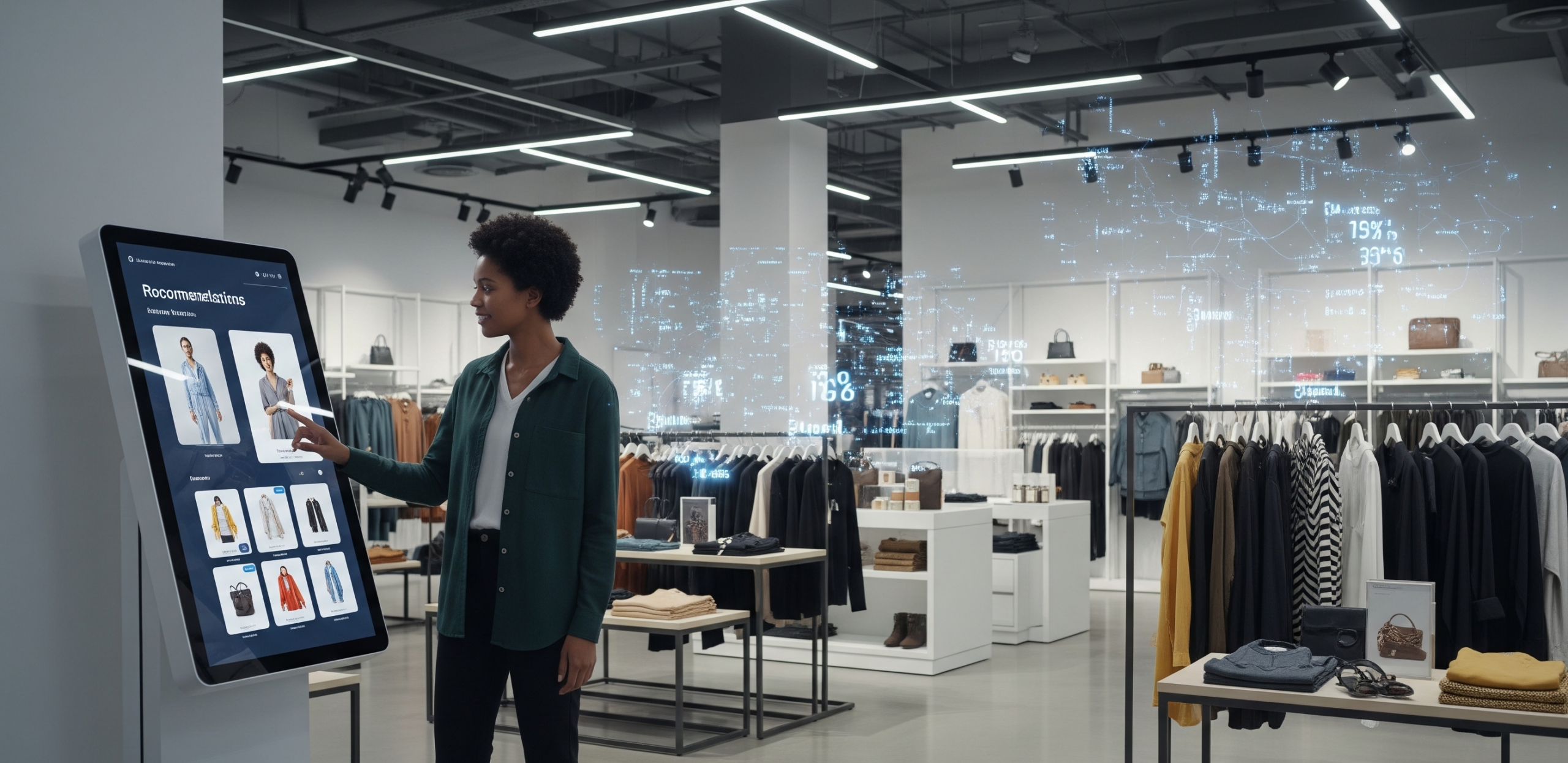
 20 minutes read
Content
Retail has always been a data-rich industry. Every transaction, every footstep through a store, every abandoned cart is a signal. For most of retail history, those signals arrived too late and in too much volume to act on. A weekly sales report told you what happened, but it couldn’t tell you what was about to happen, let alone act on it automatically.
Now, we are entering an era of Cognitive Retail – an intersection of Artificial Intelligence and retail. It’s not only that we have machine learning for retail in a form of various tools; it’s about the convergence of three conditions that make ML genuinely transformative in retail: data at scale (billions of customer interactions across digital and physical touchpoints), compute that is cheap enough to run models continuously, and business processes that are now digital enough to be acted upon by automated systems without a human in the loop.
The term Cognitive Retail describes a retail operation that doesn’t just record what customers do, but also understands why, predicts what they’ll do next, and adjusts prices, inventory, store layouts, and marketing in real time without waiting for a human decision. The store, in fact, thinks.
It’s a structural change in what retail operations look like, who wins, and why. The companies that understood this earliest (Amazon, Alibaba, Zara) built advantages that are now extremely difficult to replicate, not because their algorithms are secret, but because their data flywheels have been running for a decade. Every recommendation accepted, every delivery completed, every return processed makes their models more accurate, which drives more engagement, which generates more data.


Take the one-day assessment
And learn whether your retail operation is running on gut feel or genuine intelligence?
Why retail is becoming a cognitive industry and what that means for your business
Descriptive, predictive, and prescriptive analytics: What’s the difference?
Before discussing AI and retails, and its specific applications, it’s worth establishing the vocabulary of analytics maturity, because most retail organizations are still operating at level one, while the competitive advantage lies at a little higher.
Descriptive analytics answers “What happened?” Last week’s sales by category, return rates by region, and top SKUs by revenue. This is a rearview mirror, but most retail organizations have this and mistake it for insight.
Predictive analytics answers “What will happen?” Demand forecasts, churn probability scores, and which customers are likely to respond to a promotion. This is where ML enters the picture in a meaningful way.
Prescriptive analytics answers “What should we do about it?” Automatically adjusting reorder quantities, triggering a personalized offer at the exact moment a customer is likely to churn, and rerouting a delivery van in real time. This is where ML creates autonomous action, not just insight for a human to act on. The competitive advantage in retail today sits entirely in that third column. The first two are table stakes, the third one is about how AI is changing the retail industry.
Supervised vs. Unsupervised machine learning in retail: Which does what?
Most retail ML applications are supervised. You train a model on labeled historical data (past purchases, known fraudulent transactions, recorded churn events) to predict a labeled outcome on new data. Demand forecasting, price elasticity models, fraud detection, customer lifetime value prediction – all supervised.
Unsupervised learning is less visible but equally important. Customer segmentation (finding natural groupings without predefined labels), anomaly detection in supply chain data, market basket analysis (discovering which products are frequently bought together without being told what to look for) – these are unsupervised. You’re finding structure and patterns in data rather than predicting a known target.
Supervised learning requires labeled training data, which is often the binding constraint. Unsupervised learning requires large volumes of raw behavioral data, which most retailers already have but underuse.
Generative AI vs. Traditional ML: When to use each
This distinction has become commercially important as GenAI has entered retail applications. Discriminative ML learns a decision boundary. It classifies, scores, or predicts. “Is this transaction fraudulent?” “What is this customer’s churn probability?” “How much demand will this SKU see next week?” These are all discriminative tasks.
Generative AI creates new content –product descriptions, marketing copy, synthetic training data, conversational responses in a customer service chatbot, and visual merchandising suggestions. It doesn’t classify existing things; it generates new ones.
The most powerful retail applications combine both: a discriminative model identifies which customer segment a user belongs to, and a generative model creates personalized content specifically for that segment. Neither is useful alone in this context.
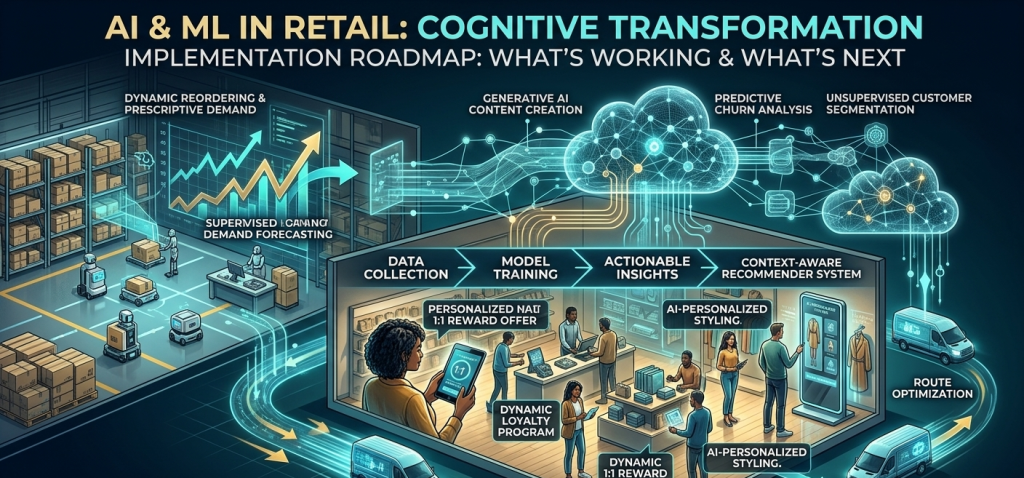
1:1 customer experiences: Focus on hyper-personalization
Beyond “Customers also bought”
The recommender system is where most people first encountered machine learning in retail. Think about the customers-who-bought-this-also-bought-that strip on Amazon or Netflix’s because-you-watched-this-you-will-probably-like-that rail. But the underlying technology has evolved substantially, and understanding the generations helps explain why some retailers’ recommendations feel eerily accurate, and others feel useless.
Collaborative filtering – the original approach – finds customers similar to you and recommends what they liked. It works at scale but has a fundamental cold-start problem: new users and new products have no interaction history, so the model has nothing to work with. It also captures surface correlations without understanding why items are similar.
Content-based filtering recommends items similar to ones you’ve already engaged with, based on item attributes (category, brand, price point, material). It handles cold-start better for new products but tends to create filter bubbles, recommending more of the same rather than surfacing discovery.
Context-aware recommender systems are the current state of the art. They incorporate not just what you’ve bought, but when, where, on what device, after what search, at what point in the purchase funnel, and what else is happening in your life (seasonality, local events, weather). A customer browsing at 11 pm on a Friday on a mobile after searching “gift ideas” is in a fundamentally different buying mode than the same customer browsing at 9 am on Tuesday on a desktop. Context-aware systems treat these as different sessions requiring different recommendations – because they are.
The most sophisticated retail and Artificial Intelligence systems now use transformer-based sequential models (architectures borrowed from NLP) that treat a customer’s purchase and browsing history as a sequence rather than a bag of past events. The order and timing of interactions carry a signal, just as the sequence of words in a sentence carries meaning that the individual words do not.
Your customers expect top personalization
Let’s talk about what’s realistic for your stack and your timeline.
How semantic and visual search are replacing keywords
Keyword search is dying in retail. The gap between what customers type and what they mean has always been a major source of lost revenue. A customer searching “black dress for wedding guest” might get results for “black wedding dresses” (wrong intent) or “cocktail dresses” (right intent, wrong keyword match). Keyword search can’t bridge that gap because it matches strings, not meaning.
Semantic search uses dense vector embeddings (numerical representations of meaning) to find products that are conceptually similar to a query, not just lexically similar. “Something cozy for lounging at home” can match “oversized knit sweater” even if none of those words appear in the product description, because their vector representations are close in embedding space.
Visual search extends this to images. A customer can photograph a product they see in the wild, and the search engine finds visually similar items in the retailer’s catalog. ASOS, Pinterest, and Wayfair have deployed this at scale. The underlying technology uses convolutional neural networks (CNNs) or vision transformers to encode images into the same kind of vector space used for semantic text search, enabling cross-modal retrieval – finding a product with text, an image, or a combination of both.
Loyalty programs that actually change customer behavior
Traditional loyalty programs are blunt instruments: accumulate points, redeem for discounts, repeat. Machine learning for retail makes loyalty programs genuinely dynamic by personalizing the reward structure to the individual.
Rather than offering everyone a 10% discount, an ML-driven loyalty system predicts the minimum incentive required to change a specific customer’s behavior. A customer who buys regularly, regardless of promotions, gets lower-value rewards (they don’t need to be bribed). A customer who is showing early churn signals, such as declining visit frequency, smaller basket sizes, browsing without purchasing, gets a high-value, personalized offer timed to the moment they’re most likely to re-engage. With such an application of artificial intelligence in retail business, you can benefit from intervention optimization, not blanket discounting.
The CLV (Customer Lifetime Value) model sits at the center of this. Accurately predicting CLV allows retailers to segment customers not by who they are today, but by who they are likely to become, and to allocate retention investment proportionally.
Machine learning retail examples: Invisible systems running the field
Demand forecasting with ML: How to reduce forecast error by 30-50%
Demand forecasting is one of the oldest and most commercially important applications of machine learning in retail, and the gap between traditional statistical methods and modern ML approaches is enormous.
Traditional forecasting (ARIMA models, exponential smoothing) works reasonably well when demand follows a stable, predictable pattern. However, such use of Artificial Intelligence in retail market fails badly when multiple causal factors interact: weather events, competitor promotions, viral social media trends, supply disruptions, new product launches, and changes in store layout. These models can’t incorporate external signals, and they can’t learn that a product’s demand correlates with a sporting event 400 miles away.
Modern ML demand forecasting uses gradient-boosted trees (XGBoost, LightGBM) or neural approaches (temporal fusion transformers, N-BEATS) that can ingest hundreds of input features simultaneously – historical sales at multiple granularities, price history, promotions, weather, local events, web traffic, search trends, even social sentiment. Amazon has been running ML-based demand forecasting since the early 2010s. Their documented results show a 30-50% reduction in forecasting error compared to classical methods, which translates directly into lower inventory carrying costs and fewer stockouts.
The prescriptive extension – autonomous replenishment – connects the forecast directly to purchase orders without a human reviewing each one. The model forecasts demand, calculates reorder quantities based on lead times and safety stock parameters, and fires purchase orders automatically. Walmart’s store replenishment system operates largely autonomously for thousands of SKUs.
Dynamic pricing: How retailers optimize margins without losing customer trust
Dynamic pricing – adjusting prices in real time based on demand signals – is one of the most commercially powerful and ethically contested ML applications in retail.
The core mechanics are straightforward: a pricing model monitors demand velocity (how fast an item is selling), inventory levels, competitor prices (via automated web scraping), time of day, and channel (app vs. web vs. in-store), and adjusts prices to maximize a target metric – usually revenue per unit or margin, sometimes conversion rate. Airlines and hotels have done this for decades. Amazon adjusts prices millions of times per day.
Psychological pricing extends this with behavioral economics signals. Artificial Intelligence in retail can detect which customers respond more to percentage discounts (30% off) versus absolute amounts (save $15), which are price-anchored by the was/now pattern, and which are urgency-driven by scarcity signals (only 3 left). These signals can be personalized by customer segment – what moves a bargain-hunter is not what moves a luxury buyer.
It’s important to understand the difference between personalized pricing (showing different prices to different customers based on inferred willingness to pay) and dynamic pricing (changing prices for everyone based on market conditions), since there are legal and ethical nuances. The former is legal in most jurisdictions but deeply corrosive to customer trust if discovered. Most mature retailers apply dynamic pricing at the segment level rather than the individual level for this reason.
ML in logistics: Route optimization, micro-fulfillment, and returns prediction
The last mile – the final delivery leg from distribution center to customer door – accounts for 40-53% of total supply chain costs and is the primary battleground for customer experience in e-commerce. Application of Artificial Intelligence in retail industry attacks this problem at multiple points.
Route optimization uses reinforcement learning and combinatorial optimization to solve the vehicle routing problem in real time, assigning delivery drivers to routes that minimize total distance and time while meeting delivery windows. UPS’s ORION system, one of the most famous applied ML deployments in logistics, saved an estimated 100 million miles per year by shaving an average of one mile off each driver’s daily route.
Micro-fulfillment centers (MFCs) are small, automated warehouses placed close to urban customers – sometimes inside or beneath existing stores. Robots pick orders while human staff handles exceptions. The ML component manages inventory allocation across the MFC network: which SKUs to stock at which location, based on hyperlocal demand forecasts that account for neighborhood demographics, local events, and historical purchase patterns at the postal code level.
Returns prediction is an underappreciated application of AI in retail industry: if a retail machine learning model can predict at the moment of purchase that an item is likely to be returned (based on customer history, item characteristics, sizing information), the retailer can proactively intervene – recommending a different size, offering a virtual try-on, or adding a sizing note – reducing returns before they happen.
Still forecasting demand in Excel?
See 25-40% reduction in forecast error within the first 90 days.
How is the image of the physical store changing?
Smart shelves, planogram compliance, and foot traffic analysis
The physical store has historically been a black box for ML. Unlike e-commerce, where every click and scroll is logged, in-store behavior generates almost no digital data. Computer vision is closing that gap; here are the machine learning use cases in retail.
Camera systems with computer vision can now track customer movement through a store in real time (using anonymous pose estimation rather than facial recognition, which sidesteps most privacy concerns), identifying which displays attract dwell time, which are walked past, and which create traffic jams. This data feeds directly into store layout optimization – the same AB testing methodology used in e-commerce applied to physical merchandising.
Smart shelves are another impressive machine learning retail solutions. They combine weight sensors, RFID readers, and cameras to monitor stock levels in real time. When a product is running low, the system alerts store staff or automatically triggers replenishment. The business impact is significant: out-of-stocks cost US retailers an estimated $82 billion annually in lost sales, and smart shelf technology can reduce that by 30-50% by catching stockouts before they happen rather than after a customer reports them.
Planogram compliance – ensuring shelves are stocked and arranged according to the planned merchandising layout – is another computer vision application. Manual planogram audits are expensive and infrequent; a camera-based system can audit compliance continuously and flag deviations within minutes.
From scan-and-go to just walk out
Checkout is one of the highest-friction points in physical retail, and machine learning retail is attacking it from several directions simultaneously.
Self-checkout has been standard for over a decade, but its loss prevention problem – customers misscanning or not scanning items – has historically been significant. Modern computer vision systems can now monitor self-checkout stations and detect when an item passes through without being scanned, flagging the transaction for review rather than allowing losses to accumulate invisibly.
Amazon Just Walk Out represents the most ambitious version of checkout automation: a store with no checkout at all. Ceiling-mounted cameras, shelf weight sensors, and a fusion of computer vision models track which items each customer takes and automatically charge their account when they leave. The underlying technology is a masterpiece of sensor fusion and multi-object tracking, but it requires enormous infrastructure investment and has been commercially challenging to scale outside Amazon’s own stores.
Scan-and-go mobile apps occupy the middle ground: customers scan items with their phones as they shop, skip the checkout line entirely, and pay through the app at an exit gate. The fraud detection ML model here identifies shopping patterns that suggest customers are scanning fewer items than they’re taking – an anomaly detection problem on transaction data.
In-store robotics
In-store robotics represents the convergence of hardware and ML, and it is moving from proof-of-concept to operational deployment at a significant scale.
Shelf-scanning robots autonomously navigate store aisles, using cameras and computer vision to audit shelf inventory, check price tags, and identify misplaced items. Such a robot can audit an entire store overnight, every night, at a cost per audit far below human labor.
Automated picking systems in distribution centers use ML for robot path planning, collision avoidance, and order batching optimization. These systems are now mature technology, and their economic advantages are compelling enough that greenfield distribution centers are almost universally designed around automation.
Fraud detection and cybersecurity: How ML protects retail operations
Modern retail fraud detection
Retail fraud is a multi-billion-dollar problem spanning payment fraud, return fraud, coupon abuse, account takeover, and inventory theft. ML has become the primary defense across all of these vectors, and the technology has evolved considerably from first-generation rule-based systems.
Traditional fraud detection used hand-coded rules: flag any transaction over $500 from a new card; flag any order shipping to a country different from the billing address. Rules are fast and interpretable but brittle – they are easily gamed once the attacker knows them, and they generate enormous false positive rates that result in legitimate customers having purchases declined.
Modern ML fraud detection uses ensemble models trained on billions of transactions, with features that capture behavioral context: how does this transaction compare to this customer’s normal pattern? Is the typing speed on the checkout form consistent with human input? Does the device fingerprint match previous sessions? Are there network-level signals (IP, geolocation, VPN usage) that are inconsistent with the stated shipping address?
The key advance is graph neural networks (GNNs) for fraud ring detection. Individual fraudulent transactions often look legitimate in isolation; the fraud becomes detectable when you model the relationships between accounts, devices, addresses, and cards as a graph and look for suspicious network patterns — clusters of accounts that share devices, rings of accounts making coordinated return fraud. GNNs can detect these patterns at a scale and sophistication that no rule-based system can match.
Cybersecurity for retailers
Retail is among the most targeted industries for cybersecurity attacks, for obvious reasons: payment card data, personal customer information, and increasingly, the operational technology (OT) systems that run automated warehouses and smart stores.
ML-based anomaly detection monitors network traffic, API call patterns, and user behavior for deviations from baseline that might indicate an intrusion, credential stuffing attack, or data exfiltration. The challenge in retail is the high volume of legitimate traffic variation – promotional periods generate legitimate traffic spikes that look anomalous to naive models, creating false alarms at precisely the moments when security teams are most stretched.
Federated learning has an interesting application here: retailers can train shared threat detection models across industry data without exposing their raw transaction data to each other, getting the benefit of larger training sets while preserving data privacy.
How to implement ML in retail: Practical roadmap from data to ROI
The 4-stage ML implementation roadmap for retail teams
Numerous projects in retail had sound algorithms, and yet they failed. This happened because the data wasn’t ready, the business case wasn’t specific enough, or the model’s outputs weren’t integrated into a workflow that changed any actual decisions.
A practical implementation roadmap follows this sequence:
- Stage 1: Data foundation (months 1-6). Audit existing data sources. Identify gaps between the data you have and the data your target use cases require. Build or consolidate a customer data platform that unifies transaction history, behavioral data, and demographic attributes at the customer level. Without this, every ML project starts with the same expensive data wrangling exercise.
- Stage 2: Quick wins (months 3-9). Identify 2-3 high-impact, relatively low-complexity use cases where you have sufficient data and a clear success metric. Demand forecasting improvement and basic personalization are typical first targets. The goal is to build internal ML capability, demonstrate ROI to stakeholders, and create a production ML pipeline that future models can be deployed into.
- Stage 3: Core capabilities (months 6-18). Build the infrastructure that multiplies future ML value: a feature store (so features computed for one model can be reused by others), a model monitoring system (so you know when models degrade in production), and an experimentation framework (so you can rigorously AB test the business impact of ML improvements).
- Stage 4: Expansion and autonomy (18+ months). With infrastructure in place, deploy increasingly sophisticated models and connect model outputs to automated actions – autonomous replenishment, dynamic pricing, and real-time personalization. This is where prescriptive analytics becomes operational.
Start your ML readiness sprint
We’ll get you from “where do we start” to a production-ready roadmap.
The biggest ML implementation failures in retail – and how to avoid them
When talking about potential challenges, data quality is the first obstacle. Production retail data is messy: inconsistent product categorizations across catalog generations, duplicate customer records, missing transaction history from pre-digital eras, and POS data that doesn’t map cleanly to e-commerce data. Investing in data quality before model building is not glamorous, but it is the highest-leverage work in most retail ML programs.
The algorithm moat problem is the most common strategic concern for mid-sized retailers. How do you compete with Amazon and Walmart, who have a decade’s head start in data and model development? The answer is not to try to replicate their capabilities, but to find the dimensions where their scale advantage is actually a disadvantage. A regional grocer with deep knowledge of local purchasing patterns can build demand forecasts that outperform national models precisely because the national model is averaging across too much variance. Specialization beats scale in specific domains.
Organizational adoption is often the hardest problem. A demand forecast that buyers don’t trust won’t change their ordering behavior. A recommendation system that merchandisers constantly override provides no lift. ML projects succeed when the model’s outputs are integrated into workflows at the point of decision, when the model’s uncertainty is communicated honestly, and when the humans in the loop develop a genuine understanding of when to trust the model and when to override it.
The future of ML in retail: Agentic AI, real-time commerce, and what 2026-2030 looks like
Machine learning has become the operating system of modern retail, visible in every price tag, every recommendation, every delivery route, and every reorder decision in the most competitive operations. The shift from reactive historical analytics to prescriptive autonomy is the defining strategic transition of the current decade in the industry.
The machine learning business use cases who will win are not necessarily those who deploy the most sophisticated algorithms. They are those who combine the right data infrastructure, the right organizational capability, and the right business problem selection – focusing ML on the decisions that are made most frequently, where even small improvements compound into large competitive advantages over time.
Let’s build something that lasts
Because every month you wait, the gap between you and your competitors widens.
FAQ
How is ML shifting retail from reactive analytics to prescriptive autonomy?
How does ML reduce overstock and optimize last-mile sustainability?
Better forecasting prevents overproduction; a 10% accuracy boost can cut safety stock by 15-20%. For delivery, ML route optimization (like UPS’s ORION) drastically reduces CO₂. Additionally, consolidation algorithms that batch urban deliveries can slash emissions by up to 40% compared to on-demand shipping.
How can agentic AI streamline procurement?
Agentic AI monitors forecasts and lead times to negotiate and execute purchase orders autonomously within set parameters. This shifts the human role from making routine orders to “management by exception,” allowing a single buyer to oversee ten times the volume by only reviewing edge cases and high-budget outliers.
What are the ethics of dynamic pricing and how can trust be maintained?
The line is drawn between dynamic pricing (market-based) and personalized pricing (user-based). While market-based changes are accepted, individual pricing can feel predatory. To maintain trust, retailers should use transparent, segment-based rewards, like “App-exclusive discounts,” rather than hidden individual markups.
How can ML predict Customer Lifetime Value (CLV) accurately?
CLV is treated as a survival analysis problem. Rather than simple curve-fitting, modern ML uses probabilistic models (like BG/NBD) and gradient-boosted trees. These incorporate “RFM” data (Recency, Frequency, Monetary) alongside digital signals like category diversity and service interactions to rank customers by future value.
How does computer vision bridge online and physical store experiences?
It creates a “phygital” loop: users can search online via real-world photos (visual search) or preview products in their homes (AR try-on). In-store, vision tech tracks behavioral data like dwell time and traffic, allowing physical retailers to run the same A/B tests and personalization used on websites.
How do context-aware recommenders differ from traditional collaborative filtering?
Traditional systems ask “What do similar people like?” whereas context-aware systems ask “What does this person need right now?” By factoring in real-time data (location, device, weather, session depth), these models transform static profiles into dynamic state predictions, often yielding a 10-20% lift in conversions.
How can mid-sized retailers compete with Amazon and Walmart’s algorithm moats?
By focusing on Сontext Іcale over Вata volume. Smaller retailers should apply ML to specialized categories, local demand, and community discovery – areas where deep category knowledge beats generalist algorithms. Don’t build a full stack; optimize the 2–3 decisions that define your brand.
What is driving the $35B+ AI retail market projection by 2030?
Four forces: plummeting cloud compute costs, the rise of pre-trained foundation models, a flood of new in-store data (sensors/RFID), and defensive necessity. Retailers who don’t adopt AI face a “triple threat”: being undercut on price, burdened by overstock, and losing customers to better recommendation engines.
You may also like
-
 March 23, 2026Read in 23 min.
Why data warehouses fail and how to design one that doesn’t
top building data swamps. Explore the evolution of DWH design, including ELT workflows, Data Vault 2.0, and high-performance cloud modeling strategies -
 March 17, 2026Read in 15 min.
Choosing the Right Computer Vision Development Company for Your Project
From computer vision consulting to full-scale software development, learn how modern vision systems automate defect detection and optimize operations across healthcare, retail, and manufacturing. -
 March 16, 2026Read in 12 min.
AI in data governance: Everything technology leaders need to know
Master Data Governance for AI. Learn how to manage data drift, bias mitigation, and active metadata using NIST standards. Expert guide on MLOps, RAG security, and EU AI Act compliance for 2026. -
 March 16, 2026Read in 16 min.
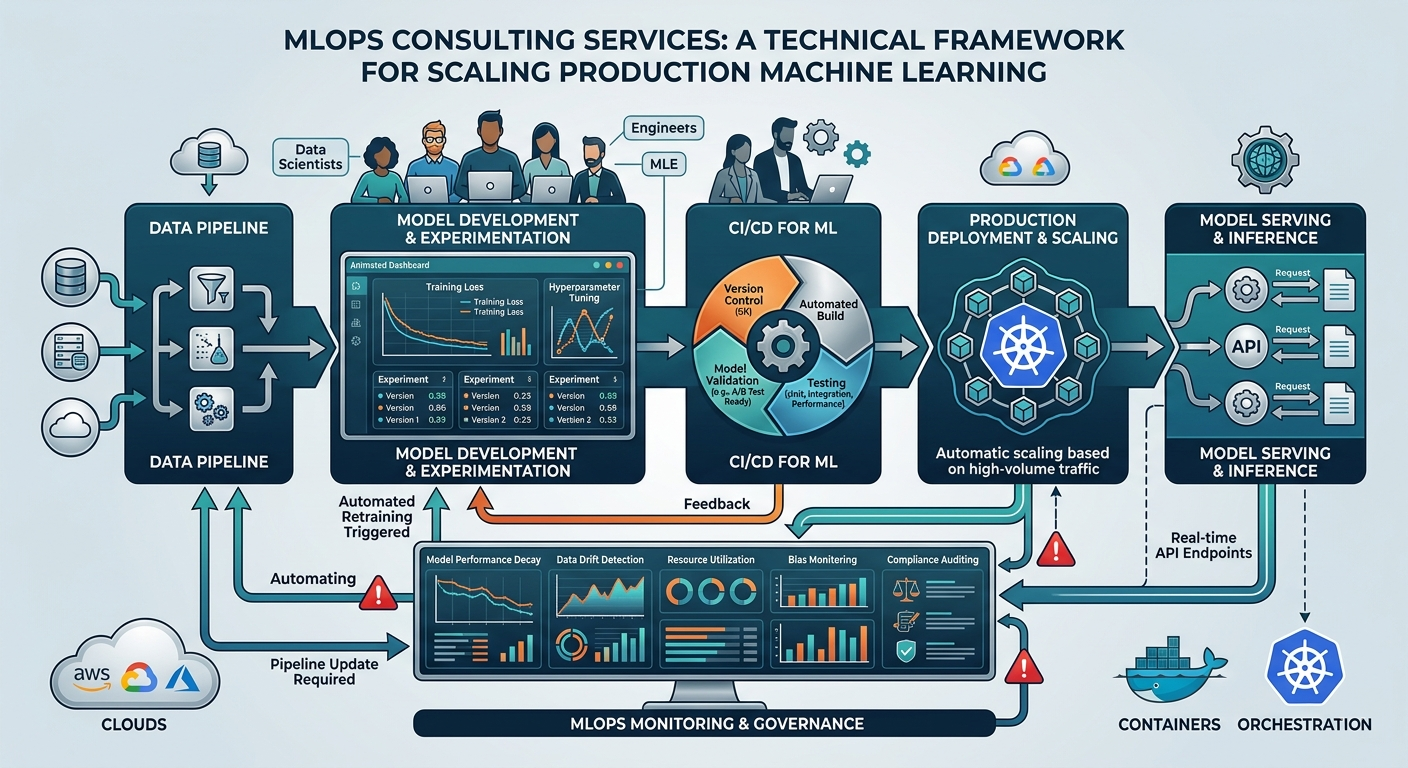
MLOps consulting services: A technical framework for scaling production machine learning
Operationalize ML with expert MLOps consulting. We bridge the gap between Data Science and DevOps using CI/CD/CT pipelines, automated drift detection, and feature stores to reduce Time-to-Value and technical debt. -
 March 12, 2026Read in 12 min.
Choosing your generative AI development company
Compare the best generative AI companies for your enterprise. From custom LLMs to agentic workflows, discover the top partners driving innovation and ROI in the AI-first era. -
 March 6, 2026Read in 15 min.
PyTorch vs TensorFlow: What’s the difference and which one wins
Stop choosing between research and production. Learn how Keras 3 and multi-backend architectures are unifying the AI ecosystem. A professional developer’s deep dive into performance, cost, and scalability. -
 November 4, 2025Read in 12 min.
AI in biotech: Application, specifics, and challenges
How AI and Machine Learning are transforming biotechnology, accelerating drug discovery, genome sequencing, and personalized medicine. Learn the applications, challenges, and future. -
 October 28, 2025Read in 20 min.
The best AI development companies in the US
The definitive guide to hiring the best AI development company. See our ranking by MLOps maturity, GenAI expertise, and verified client ROI. Get transparent costs and a partnership blueprint -
 October 16, 2025Read in 25 min.
Top 10 chatbot development companies
Leading chatbot development companies. Our expert guide helps you choose the best firm for AI chatbot solutions, custom development, and seamless integration -
 April 24, 2025Read in 8 min.
Information technologies revolutionizing oil and gas production
Key technology trends revolutionizing the oil and gas sector. Learn about big data, AI, IoT, and their impact on operations and the environment -
 February 13, 2025Read in 11 min.
Top programming languages for machine learning
Best programming languages for machine learning and how they can help you build powerful models and algorithms -
 February 4, 2025Read in 16 min.
Can Chat GPT be detected?
Whether AI-generated text from ChatGPT can be detected, how detection tools work, and the challenges in distinguishing AI from human writing. -
 August 21, 2024Read in 15 min.
Next big thing: 23 standout tech startup ideas
Tech startup ideas that blend digital expertise with industry knowledge. From VR to AR, discover the next big thing! -
 March 11, 2024Read in 13 min.
AI software development for oil and gas: A comprehensive guide
Explore the transformative power of artificial intelligence software development for oil and gas and the practices of global industry leaders in our blog. -
 March 3, 2024Read in 9 min.
Smart farming: agricultural technology of the future
We have expertise in data analytics, AI, and Machine Learning to build game-changing software tailored for your agricultural business. -
 March 3, 2024Read in 9 min.
What is robotic process automation and how it changes the travel and hospitality industry
How does RPA work and, most importantly, how to utilize it in your travel and hospitality business? Find out in our new article now.